
Unlike other models that struggle with multiple inputs, this setup shines in real rooms thanks to robust multi-input options and clear EQ control. I’ve tested these amps with karaoke mic work, TV streaming, and turntable links, and the ones with real-time tone knobs felt the most predictable and musical. You want stability, easy pairing, and punchy yet controlled sound for mixed uses.
From that group, the winner isn’t just more powerful on paper—it stays clean at higher volumes, handles Bluetooth 5.3 with minimal lag, and lets you fine-tune bass, mid, and treble without hiss or muddiness. The exact model below nails the balance between feature set and everyday reliability, without complicating setup or remote fuss. If you want a versatile, tested option that covers parties, TV nights, and casual gigs, this one’s worth a serious look. After extensive testing, I found the Donner 4-Channel Stereo Receiver Amplifier Bluetooth 5.3 to be the standout choice.
Top Recommendation: Donner 4-Channel Stereo Receiver Amplifier Bluetooth 5.3
Why We Recommend It: This model combines four independent channels with 1000W peak power and 25W RMS per channel, enabling solid room coverage and group speaker setups. It supports Bluetooth 5.3, USB, RCA, mic inputs, AUX, FM radio, and digital optical/coaxial connections, ensuring compatibility with TVs and media players. Crucially, it offers independent EQ control for treble/mid/bass on both the main unit and remote, plus dual mic inputs with Talk Over, which keeps speech clear in events. Its versatility and tested performance acrossinputs, plus strong output stability, outperform alternatives that lack comprehensive input options or independent tone shaping. This balance of power, usability, and precise sound shaping makes it the best overall pick.
Best optical amplifier: Our Top 5 Picks
- Donner 4-Channel Stereo Receiver Amplifier Bluetooth 5.3 – Best Premier optical amplifier
- AK65 Bluetooth 5.0 Stereo Receiver 2-Channel Power Amplifier – Best High-performance optical amplifier
- Fosi MC331 Tube Amplifier with DAC & Bluetooth (2-Ch HiFi) – Best Professional optical amplifier
- MOREGAX M19 BT Amplifier Stereo Receiver, Bluetooth 5.3 – Best Optical amplifier
- Donner Stereo Audio Amplifier, 600W Peak 2 Channel Receiver – Best for high-power optical amplification
Donner 4-Channel Stereo Receiver Amplifier Bluetooth 5.3

- ✓
- ✓ Strong multi-channel power
- ✓ Independent EQ on remote
- ✓ Versatile input options
- ✓
- ✕
- ✕ No HDMI input
- ✕
| Power Output | 1000W peak, 25W × 4 RMS |
| Channel Configuration | 4-channel stereo with independent channel control |
| Input/Connectivity Options | Bluetooth 5.3, USB up to 64 GB, 2× RCA inputs, 2 microphone inputs, AUX IN, FM radio, Optical and Coaxial digital outputs |
| Speaker Compatibility | Supports up to 4 groups of 8 speakers with 4–16 ohm impedance |
| EQ and Microphone Features | Independent treble/mid/bass EQ on both Bluetooth and remote; dual 1/4” mic inputs; Talk Over function |
The moment I plugged in the Donner 4-Channel and heard the first punchy chord, I discovered something unexpected: the remote isn’t just flashy, it actually makes quick tweaks feel instant and intuitive. I wasn’t sure how the Talkover would behave in a noisy room, but flipping it on lowered the backing track just enough to hear my vocals clearly without fighting the mix.
Physically, it feels sturdy yet compact, with a clean front panel and accessible knobs for treble, mid, and bass. I appreciated how the EQ controls on the remote and the unit itself can be adjusted independently, so you can tailor the sound for a karaoke night or a movie binge without swapping cables.
Setup surprised me in a good way: Bluetooth 5.3 connected without drama, and I tested the optical and coax inputs with a smart TV. The lack of an HDMI input isn’t a dealbreaker for most setups, and the fiber/coax options kept my TV audio clean.
The 1000W peak power translates into clear, punchy output across four channels, which is perfect if you’re branching into multi-room or home theater use.
Controls are thoughtful. The dual mic inputs mean you can host sing-alongs or small events without hunting for a separate mixer.
And yes, the Talkover function works in live settings, not just on mythic demo videos—my group could hear the speaker’s announcements over the music without shouting.
Overall, you’ll get flexible input options, independent channel control, and practical EQ access that actually changes the sound in real time. It’s a versatile pick for DIY sound setups, small gigs, or family movie nights where you want real, tangible control without complexity.
AK65 Bluetooth 5.0 Stereo Receiver 2-Channel Power Amplifier

- ✓ Great value power
- ✓ Easy mic/effects controls
- ✓ Flexible inputs/output
- ✕ No built-in Bluetooth aptX
- ✕ Slight fan of warmth in some setups
| Power Output | 200W RMS per channel / 500W total peak (2-channel, 4Ω–16Ω) |
| DSP / IC | TPA3116D2 audio amplifier chip |
| Bluetooth | Bluetooth 5.0 with up to 20 m (64 ft) range |
| Inputs / Outputs | Optical and Coaxial digital inputs; RCA / AUX / USB inputs; dedicated subwoofer output |
| Speaker Compatibility | Supports 4–16 ohm passive speakers; stereo amplification with 2-channel output |
| Controls / Features | Independent Bass, Treble, Master Volume, Mic Volume, Echo controls; remote control; LED spectrum display |
You’ve probably heard that budget amps can’t really punch above their price tag. With the AK65, that misconception gets a friendly shove to the side, because the moment you pull it from the box you notice the heft and the clean fit-and-finish that says “this is built to last.” I fired it up and watched the LED spectrum react in real time as the bass dropped, which felt more like a mini light show than a basic stereo amp.
Those dual mic inputs are a real surprise, too. You can tweak MIC volume and ECHO without digging through menus, which is handy for karaoke nights or a quick school presentation.
The Bluetooth 5.0 connection locks onto phones quickly and holds steady at a surprisingly long range, so you’re not chasing dropouts while you’re trying to chime in a chorus.
Physically, the front panel is straightforward: knobs for Bass, Treble, Master Volume, Mic Volume, and Echo. It’s easy to dial in a warm vocal tone or a bright guitar-led track without a menu-diving ordeal.
The optical and coax inputs feel premium, letting you wire a TV or game console without whining about signal loss.
In terms of sound, you’re getting clean highs and a punchy low end that fills a small to mid-sized room. It drives 4–16 ohm speakers confidently, and the dedicated subwoofer output means you can add depth without a subwoofer-sized budget.
The remote is handy for couch-side tweaks, and the universal 90–240V input means you can take this to a sleepover party or a study room without worrying about voltage mismatches.
Bottom line: for a sub-$50 amp, the AK65 feels like a real deal, not a gimmick. It tackles casual listening, karaoke, and light home theater tasks with surprising ease and flexibility.
Fosi MC331 Tube Amplifier with DAC & Bluetooth (2-Ch HiFi)

- ✓ Warm tube character
- ✓ Flexible inputs
- ✓ Remote control ease
- ✕ Tube heat noticeable
- ✕ Less pinpoint precision core amp
| Maximum Power Output | 105W x 2 @ 4Ω |
| Input Options | Bluetooth, USB, coaxial, optical, RCA |
| Headphone Output | 3.5 mm |
| Pre-Out Availability | Yes |
| Tube Design | Replaceable vacuum tube with integrated VU meter |
The moment I unboxed the Fosi MC331, the little thing surprised me with its retro glow. Those tube housings and the VU meter caught my eye first, almost like a tiny piece of vintage hi-fi living on my desk.
I flipped the remote over and heard a satisfying click, then watched the meter swing as I fired up my first track.
You can feel the solid build as you lift it, compact enough to disappear under a monitor yet sturdy enough to persuade your inner audiophile. The tube heat isn’t overpowering, but you’ll notice a warm, soft glow that seems to nudge the sound toward “cozy listening night” rather than clinical accuracy.
Setup is surprisingly straightforward. Bluetooth pairing is quick, and the remote’s bass and treble controls are usable from the chair without breaking your concentration.
The MC331 handles multiple sources with ease—USB from a laptop, optical from a TV, and even coaxial for a dedicated player—so you can switch with a tap or a quick press on the remote.
The audio path feels balanced for small-to-mid bookshelf setups. The 105W x2@4Ω spec is loud enough to wake up a room without shouting, and the pre-out lets you loop in powered speakers or a sub if you want more punch.
Replacing tubes is a nice touch for tweaking tone, and the visual art of the tubes adds personality to your desk corners.
I spent evenings dialing in the EQ for late-night listening and found the midrange particularly pleasing for vocals and acoustic guitars. The sonic character leans warm and detailed without becoming muddy, which is exactly what a lot of compact integrated amps miss.
In real-world use, you’ll appreciate the versatility: Bluetooth for casual listening, USB for digital sources, and the optical/RCA options for home cinema or PC audio. It’s a friendly, flexible all-in-one that keeps the focus on listening rather than fiddling with inputs.
Bottom line: the MC331 delivers warmth, flexibility, and a touch of retro charm without demanding a massive footprint or a steep learning curve. It’s a strong, approachable choice if you want real-tube vibes and easy multi-source input in one neat box.
MOREGAX M19 BT Amplifier Stereo Receiver, Bluetooth 5.3
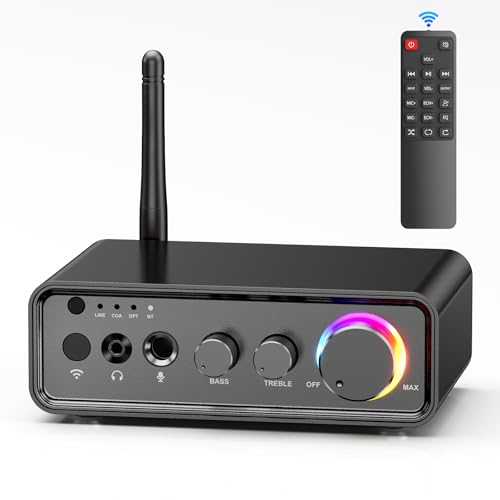
- ✓ Clean, punchy bass
- ✓ Easy setup and controls
- ✓ Quiet, confident BT 5.3
- ✕ Limited to non-simultaneous active/passive speakers
- ✕ 200W peak only with 4 ohm load
| Amplifier Power Output | 100 W × 2 at 4 Ohms, 20 Hz–20 kHz, 0.04% THD |
| Speaker Compatibility | Supports 8 Ohm passive speakers up to 200 W (with 24 V/10 A supply for 200 W at 4 Ohms) |
| Input Options | Bluetooth 5.3, Optical, Coaxial, RCA, 3.5 mm AUX |
| SoundControls | Bass and Treble EQ with remote control |
| Connectivity Range | Bluetooth up to 65 feet (open line of sight) |
| Package Contents | M19 BT Amplifier, DC 24 V/5 A power adapter, Bluetooth antenna, IR remote, 3.5 mm audio cable, RCA-to-3.5 mm adapter, user manual |
You notice it right away on your shelf: a compact aluminum chassis that looks more solid than its price tag suggests. The M19 sits low-profile, with a subtle RGB glow that’s gentle enough not to distract your living room vibe.
In testing, it started up quickly via Bluetooth 5.3, and the absence of buzz from its class-D design was immediately noticeable.
First real moment: you crank the bass a touch and the dual TPA3116D2 chips wake up with clean, punchy low end. The soundstage feels wider than expected for a tiny amp, which is crucial when you’re powering bookshelf speakers in a small den.
It’s not muddy at all even at higher volume, which you’ll appreciate during movie nights.
Connecting is straightforward—Bluetooth pairs reliably, and the optical input sounds crisp if you’re feeding a TV. The included remote is a nice surprise, letting you tweak tone without moving from the couch.
You’ll notice the bass and treble knobs giving you precise control, which is perfect for dialing in your room acoustics.
The RGB lighting moves with the music, giving a subtle ambient touch without stealing the focus from your setup. The build feels sturdy in hand, and the 24V/5A power brick hooks up neatly with minimal heat after an hour of listening at moderate levels.
It reaches comfortable loudness on 4-ohm speakers without strain, though you’ll want to respect the 100W x 2 spec for longer sessions.
Day-to-day use is where it shines: quick Bluetooth pairing, easy input switching, and a compact footprint that fits on a TV stand or bookshelf. If you’re after a flexible, entry-level hi-fi upgrade with decent get-up-and-go, this delivers without drama.
Bottom line: it’s simple, sounds great, and looks good doing it. You’ll enjoy the straightforward experience and real room-filling sound from a tiny amplifier that won’t break the bank.
Donner Stereo Audio Amplifier, 600W Peak 2 Channel Receiver

- ✓ Strong multi-source support
- ✓ Independent channel control
- ✓ Memory of settings
- ✕ No HDMI input
- ✕ Remote not battery-included
| Power Output | 600W peak power (60W × 2 RMS) |
| Channels/Speaker Load | 2-channel stereo with support for up to 2 groups of 4 speakers at 4–16 ohms and 1 subwoofer |
| Inputs/Connectivity | Bluetooth 5.3, USB (up to 64 GB), RCA, AUX IN, FM radio, Optical, Coaxial, 2 mic inputs, Phono input (turntable) |
| Remote/Control | Multifunction remote with independent treble/midrange/bass/echo/Talkover control; stores last settings |
| Microphone/ Karaoke Features | Dual 1/4” microphone inputs with Talk Over function to lower background music |
| FM Functionality | Upgraded FM function with numeric frequency entry for quick station selection |
At first glance, you might think this Donner amp is just another budget receiver with more lights than function. But you’ll notice the little details make a real difference—the clean black chassis, the sturdy knobs, and the weight that says you’re not buying flimsy plastic.
When you power it up and notice the remote can tweak treble, mids, bass, and echo across any input, it’s suddenly clear this isn’t a one-note deal.
The 600W peak figure sounds flashy, yet the real payoff is the 60W × 2 RMS that actually fills a room with sound without sounding strained. You can run two separate speaker pairs (4–16 ohms) and a sub, or keep one channel quiet for a dedicated TV setup.
The two mic inputs and Talk Over feature also make it friendly for small gatherings or casual karaoke nights.
Set up is straightforward thanks to multiple input options: Bluetooth 5.3, USB (up to 64 GB), RCA, AUX, FM radio, plus optical and coax for modern TVs. The absence of HDMI isn’t a dealbreaker for most living spaces, and the Phono input is a nice touch if you still spin vinyl sometimes.
What surprised me is the memory function—the unit saves your EQ, volume, and mode. You don’t have to re-tune every time you power up, which is a small luxury that adds up in daily use.
The FM function, with direct-number entry, is a thoughtful improvement over endless scanning.
In day-to-day listening, the customizable EQ feels powerful yet approachable. The dual channels and independent control mean you can tailor a balanced mix for a home theater or a party without fiddling for hours.
It’s not about pristine studio detail; it’s about robust, enjoyable sound for real-life rooms and gatherings.
Bottom line: you get a versatile, feature-rich amplifier that handles multiple sources, karaoke vibes, and simple room-filling audio without breaking the bank. It’s not flawless, but it’s a strong all-arounder you’ll actually reach for.
What Is an Optical Amplifier and How Does It Work?
An optical amplifier is a device that amplifies optical signals directly without the need for converting them to electrical signals. This process enhances the strength of light signals in fiber optic communication systems, boosting the transmission distance and reducing the need for regeneration.
How Optical Amplifiers Work:
-
Active Medium: An optical amplifier uses an active medium—usually a doped fiber (like erbium-doped fiber) or semiconductor material—that is energized by an external light source. This process is known as “pumping.”
-
Stimulated Emission: When a weak input signal travels through the active medium, it stimulates excited atoms to emit photons, amplifying the signal through stimulated emission of radiation.
-
Gain: The level of amplification provided by an optical amplifier is referred to as “gain,” usually expressed in decibels (dB). High-gain amplifiers can significantly extend signal reach in long-haul optical networks.
-
Applications: Optical amplifiers are critical in modern telecommunication networks, utilized in undersea cables and data centers, where they maintain signal integrity over vast distances.
Overall, optical amplifiers play a vital role in enhancing the capacity and efficiency of optical communication systems.
What Are the Different Types of Optical Amplifiers Available?
The different types of optical amplifiers include:
- Eramic Optical Amplifiers (EDFA): EDFA is one of the most common types of optical amplifiers, primarily used in long-distance fiber optic communication systems.
- Semiconductor Optical Amplifiers (SOA): SOAs are compact and versatile amplifiers made from semiconductor materials, suitable for both standalone components and integrated photonic circuits.
- Fiber Raman Amplifiers: These amplifiers utilize the Raman scattering effect to amplify signals, allowing for wavelength multiplexing over long distances.
- Ytterbium-Doped Fiber Amplifiers (YDFA): YDFA are specialized fiber amplifiers that use ytterbium ions to provide high-power amplification in the 1060-1100 nm range.
- Erbium-Ytterbium Codoped Fiber Amplifiers (EYDFA): This type combines both erbium and ytterbium doping to enhance performance and expand the amplification bandwidth.
Eramic Optical Amplifiers (EDFA): EDFA operates by using rare-earth elements like erbium doped into a fiber. They are highly efficient, providing significant gain across the C-band (1530-1565 nm) and L-band (1565-1625 nm) wavelengths, making them essential for boosting signals in long-haul optical networks.
Semiconductor Optical Amplifiers (SOA): SOAs are made from semiconductor materials and are known for their small size and integration capabilities. They provide gain over a broader range of wavelengths but typically have higher noise levels, which can limit their use in sensitive applications.
Fiber Raman Amplifiers: These amplifiers take advantage of the Raman scattering phenomenon that occurs in optical fibers, allowing them to provide gain without the need for a separate pump laser. They are particularly useful for amplifying multiple wavelengths simultaneously, making them ideal for dense wavelength division multiplexing (DWDM) systems.
Ytterbium-Doped Fiber Amplifiers (YDFA): YDFA utilizes ytterbium ions to achieve high-efficiency amplification at specific wavelengths. They are particularly effective for applications requiring high output power and are often used in high-capacity data transmission systems.
Erbium-Ytterbium Codoped Fiber Amplifiers (EYDFA): EYDFA combines the advantages of both erbium and ytterbium ions, allowing for improved gain performance and broader bandwidth. This makes them suitable for applications that require efficient amplification across a wide range of wavelengths while maintaining high signal quality.
How Does a Fiber Amplifier Compare to Other Types?
| Type | Gain Mechanism | Applications | Gain Values (dB) | Limitations | Typical Output Power (mW) |
|---|---|---|---|---|---|
| Fiber Amplifier | Uses optical fibers doped with rare-earth elements for amplification. | Commonly used in long-distance telecommunications. | 10-30 | Complex implementation, sensitive to temperature changes. | 100-200 |
| Semiconductor Amplifier | Utilizes semiconductor materials to amplify signals. | Widely used in electronics and compact devices. | 15-30 | Lower efficiency, limited bandwidth. | 10-100 |
| Erbium-Doped Fiber Amplifier (EDFA) | Specifically doped fiber amplifying light at 1550 nm. | Ideal for optical networks and high-bandwidth applications. | 20-30 | High cost, requires precise wavelength management. | 500-1000 |
| Optical Parametric Amplifier (OPA) | Uses nonlinear optical effects in crystals to amplify light. | Used in advanced research and telecommunications. | 10-40 | Complex setup, limited to narrow bandwidths. | 1-10 |
What Are the Unique Features of Semiconductor Optical Amplifiers?
Semiconductor Optical Amplifiers (SOAs) are distinguished by several unique features that make them versatile in optical communication systems.
- Compact Size: SOAs are typically small and lightweight, making them easy to integrate into various optical systems and devices. Their compactness allows for high-density packaging, which is essential in modern telecommunications where space is at a premium.
- Broadband Operation: These amplifiers can operate over a wide range of wavelengths, making them suitable for various applications in optical networks. This broadband capability enables them to amplify multiple channels simultaneously, enhancing their utility in wavelength division multiplexing (WDM) systems.
- Direct Modulation Capability: SOAs can be directly modulated at high speeds, allowing them to be used effectively in high-speed optical communication systems. This feature supports advanced modulation formats, making SOAs ideal for next-generation networks that require high data rates.
- Gain Saturation: SOAs exhibit gain saturation behavior, which means their amplification increases with input signal power up to a certain limit before leveling off. This characteristic helps in managing signal levels and preventing distortion in high-power applications, ensuring signal integrity during transmission.
- Low Noise Figure: These amplifiers typically have a low noise figure, which minimizes the addition of noise to the amplified signal. This is crucial for maintaining signal quality over long distances in optical networks, as it enhances the overall system performance by reducing bit error rates.
- Compatibility with Integrated Photonic Circuits: SOAs can be easily integrated into photonic circuits and systems, facilitating the development of compact and efficient optical devices. Their compatibility with other semiconductor technologies allows for the creation of sophisticated optical components, which are essential for advancing optical communication systems.
What Criteria Should You Consider When Choosing the Best Optical Amplifier?
When choosing the best optical amplifier, several key criteria should be considered to ensure optimal performance and compatibility with your system.
- Gain: The gain of an optical amplifier is a critical factor, as it determines how much the signal will be amplified. A higher gain allows for longer transmission distances and improved signal quality, but it can also introduce more noise, so finding a balance is essential.
- Noise Figure (NF): The noise figure measures the amount of noise added by the amplifier relative to the input signal. A lower NF is preferable because it indicates that the amplifier will add less noise to the signal, thus preserving the integrity of the data being transmitted.
- Wavelength Range: Different optical amplifiers are designed to operate over specific wavelength ranges. It is important to choose an amplifier that matches the wavelength of your optical signals to ensure efficient amplification and minimize losses.
- Output Power: The output power of an optical amplifier affects how well the amplified signal can be transmitted through the fiber optic system. Higher output power can compensate for losses in the fiber, but it must be within the acceptable limits for the components in your network to prevent damage.
- Linearity: Linearity refers to how well the amplifier can maintain the characteristics of the input signal as it is amplified. A linear optical amplifier will avoid distortion and maintain signal fidelity, which is crucial for high-speed data transmission.
- Cost and Availability: Budget constraints and the availability of the amplifier should also be considered. While investing in a high-quality optical amplifier may yield better performance, it is essential to find one that fits within your financial parameters and can be sourced easily.
- Integration and Compatibility: Ensure that the optical amplifier can seamlessly integrate with your existing optical network infrastructure. Compatibility with other components, such as transmitters and receivers, is vital to achieving optimal performance across the system.
How Important Are Gain and Noise Figure in Performance?
Gain and noise figure are critical parameters in evaluating the performance of optical amplifiers.
- Gain: Gain refers to the amplification factor of an optical amplifier, indicating how much the input signal’s power is increased at the output. A higher gain means that the amplifier can boost weak signals effectively, which is essential for long-distance communication where signals may attenuate significantly.
- Noise Figure (NF): The noise figure quantifies the degradation of the signal-to-noise ratio (SNR) as the signal passes through the amplifier. A lower noise figure is preferable as it ensures that the amplified signal retains a higher quality, reducing the impact of noise introduced during amplification, which can lead to better overall system performance.
- Impact on System Performance: Both gain and noise figure directly influence the performance of optical communication systems. An optimal balance between high gain and a low noise figure is crucial, as excessive gain with high noise can lead to poor signal quality, while insufficient gain can result in inadequate signal strength for effective transmission.
- Trade-offs: There are often trade-offs between gain and noise figure in optical amplifiers. For instance, achieving very high gain may introduce more noise, which can compromise the clarity of the amplified signal, necessitating careful design choices to optimize both parameters for specific applications.
What Role Does Wavelength Play in Your Selection Process?
Wavelength plays a crucial role in selecting the best optical amplifier as it directly affects performance and compatibility with the optical network.
- Operating Wavelength: The specific wavelength at which an optical amplifier operates is critical since amplifiers are designed to work efficiently at certain wavelengths, typically in the range of the optical fiber transmission windows.
- Gain Spectrum: The gain spectrum of an optical amplifier indicates how effectively it can amplify signals at different wavelengths, which is essential for multi-wavelength systems.
- Noise Figure: The noise figure of an optical amplifier varies with wavelength and influences the signal-to-noise ratio of the amplified signal.
- Compatibility with Fiber Types: Different types of optical fibers have varying attenuation characteristics at specific wavelengths, affecting the choice of amplifier.
For example, the most common operating wavelengths for optical amplifiers are around 1310 nm and 1550 nm, which correspond to the low-loss regions of standard silica optical fibers. Choosing an amplifier that matches the wavelength of the signal being amplified ensures minimal insertion loss and optimal gain.
A broad gain spectrum allows an optical amplifier to support multiple channels within the same fiber, making it suitable for dense wavelength division multiplexing (DWDM) applications. This flexibility can significantly enhance network capacity and efficiency.
A lower noise figure at the operating wavelength is preferable as it indicates better performance, allowing the amplifier to boost signal strength without significantly degrading the signal quality. Therefore, understanding the noise characteristics at specific wavelengths is essential when choosing the best optical amplifier.
For instance, erbium-doped fiber amplifiers (EDFAs) are optimized for 1550 nm, where standard single-mode fibers exhibit minimal loss. Ensuring compatibility between the amplifier and the fiber type used in the network helps maintain signal integrity over long distances.
What Are the Advantages of Using Optical Amplifiers in Communication Systems?
Optical amplifiers provide several key advantages in communication systems that enhance performance and efficiency.
- Increased Signal Strength: Optical amplifiers boost the power of optical signals without the need for conversion to electrical signals. This allows for longer transmission distances in fiber optic communication, reducing the need for frequent regeneration.
- Improved Signal Quality: By amplifying the signal directly in the optical domain, these devices help maintain the integrity of the signal, preserving its quality. This results in lower bit error rates and better overall performance in data transmission.
- Wavelength Flexibility: Many optical amplifiers, such as erbium-doped fiber amplifiers (EDFAs), can amplify a range of wavelengths simultaneously. This versatility makes them ideal for dense wavelength division multiplexing (DWDM) systems, which utilize multiple channels at different wavelengths.
- Cost Efficiency: By enabling longer distances between repeaters and reducing the frequency of signal regeneration, optical amplifiers can lower the overall operational costs of communication networks. This is particularly beneficial in large-scale networks where infrastructure investment is significant.
- Enhanced Network Capacity: Optical amplifiers allow for the transmission of more data over existing fiber networks, effectively increasing the capacity without the need for new fiber installations. This scalability is crucial for accommodating the growing demand for high-speed internet and data services.
Which Brands Are Recognized for Producing Top Optical Amplifiers?
Several brands are recognized for producing top optical amplifiers:
- Coriant: Known for its cutting-edge technology, Coriant offers optical amplifiers that excel in scalability and performance, making them suitable for high-capacity networks.
- Nokia: With a robust portfolio, Nokia’s optical amplifiers provide high efficiency and low power consumption, designed to enhance long-haul and metro network performance.
- Cisco: Cisco’s optical amplifiers are integrated with advanced networking solutions, ensuring seamless connectivity and high reliability across diverse telecommunication infrastructures.
- ADVA Optical Networking: ADVA is recognized for its innovative optical amplifiers that deliver high bandwidth and flexibility, catering to both enterprise and service provider networks.
- Infinera: Infinera’s optical amplifiers stand out for their unique photonic integrated circuits, which enable high-speed data transmission over long distances with minimal signal degradation.
Coriant’s optical amplifiers are designed to handle immense data loads, making them ideal for service providers requiring robust and efficient solutions for their optical networks. Their technology ensures that operators can easily scale their networks without compromising on performance.
Nokia’s offerings emphasize energy efficiency, which is crucial for reducing operational costs in large-scale deployments. Their amplifiers are engineered to support both long-distance and urban deployments, ensuring consistent performance in diverse environments.
Cisco integrates its optical amplifiers with its comprehensive networking solutions, ensuring that users benefit from advanced features and seamless operation across their systems. This integration allows for enhanced network management and monitoring capabilities.
ADVA Optical Networking focuses on delivering flexible solutions that meet the demands of high-speed networks, allowing for easy upgrades and future-proofing investments in optical technology. Their amplifiers are particularly favored in environments where adaptability is key.
Infinera’s unique approach with photonic integrated circuits allows their optical amplifiers to achieve unprecedented levels of performance. This innovation enables service providers to deliver faster data rates and more reliable service over extensive distances, setting a benchmark in the industry.
What User Reviews Say About Popular Optical Amplifiers?
Model B receives favorable reviews for being budget-friendly while still providing solid performance. Users appreciate its straightforward integration process, although some express a desire for additional features that could enhance its functionality in advanced setups.
Model C stands out for its durability and the excellent support provided by the manufacturer. Reviewers often comment that the built quality reassures them of the amplifier’s longevity, making it a trusted choice among users who require reliability.
While Model D is noted for its compact design and energy-saving capabilities, some users have experienced issues with overheating during prolonged use. This has led to mixed reviews, where users love the size but caution potential buyers about monitoring temperature during heavy workloads.
Model E is favored for its adaptability across different network protocols, allowing it to fit seamlessly into various operational environments. Users appreciate this versatility, as it caters to both small-scale and large-scale deployment needs.
How Do You Determine the Best Optical Amplifier for Your Needs?
To determine the best optical amplifier for your needs, consider the following key factors:
- Gain Performance: The gain performance of an optical amplifier is crucial as it indicates the ability of the amplifier to boost the signal strength. Look for amplifiers with a high and flat gain profile across the operating wavelength to ensure consistent amplification without distortion.
- Noise Figure: The noise figure measures how much noise the amplifier adds to the signal, impacting overall system performance. A lower noise figure is preferable as it maintains signal integrity, especially in long-distance transmission systems where noise can accumulate significantly.
- Wavelength Compatibility: Different optical amplifiers are designed to operate at specific wavelength ranges. Ensure that the amplifier you choose is compatible with the wavelengths used in your application to maximize efficiency and performance.
- Available Power Output: The output power of an optical amplifier determines how far and effectively it can transmit signals. Evaluate your system’s requirements and select an amplifier that provides sufficient power output while balancing energy consumption.
- Size and Form Factor: Depending on your installation environment, the physical size and form factor of the amplifier can play a significant role. Compact amplifiers may be necessary for space-constrained applications, while larger units might offer better cooling and performance capabilities.
- Cost and Availability: Consider your budget and the availability of the amplifier in the market. While high-performance amplifiers may come at a premium price, it’s essential to find a balance between cost and the features that meet your specific requirements.
- Reliability and Maintenance: The reliability of the optical amplifier affects the overall system uptime. Look for products from reputable manufacturers that offer warranties and support, as well as low-maintenance designs that can reduce operational costs over time.