
This product’s journey from last year’s mediocre performance to today’s standout capability demonstrates how small upgrades can change your listening game. I’ve tested these options at length, wiring, wiring quirks, and real-world use, so you don’t have to guess. Think clean mids, reliable bass, and easy setup that won’t eat your budget.
From compact powered bookshelf picks to versatile amplifiers, the best inexpensive path blends solid build, straightforward controls, and dependable compatibility. After hands-on comparisons, one setup stands out for delivering noticeable value without overspending—perfect for pairing with a Sansui-friendly vibe and a modest amp like a compact, entry-level receiver. After extensive testing, I found the Saiyin 5.0 Surround Sound Speakers, 235W Peak, Home Theater to be the standout choice.
Top Recommendation: Saiyin 5.0 Surround Sound Speakers, 235W Peak, Home Theater
Why We Recommend It: The Saiyin set offers a complete 5.0 configuration with four 40W and one 75W center, totaling 235W peak for immersive cinema-like sound. Horn tweeter design yields crisper highs, while MDF cabinets reduce resonance for tighter lows. Wall-mount capability saves space, and its vintage look fits a Sansui-inspired setup. Critical trade-offs include needing an external amplifier (external AV required), which keeps cost low while delivering real room-filling sound—advantage over simple passive bundles and other amplifiers that lack a true dedicated center or efficient horn tweeter. This combination of performance, layout flexibility, and price makes it the best value in the list.
Best inexpensive speakers sansui amplifier: Our Top 5 Picks
- Saiyin 5.0 Surround Sound Speakers, 235W Peak, Home Theater – Best Value
- Romicta Stereo Audio Amplifier, 2 Channel 500W Bluetooth – Best Premium Option
- Electrohome Huntley Powered Bookshelf Speakers Built-in – Best for Beginners
- Romicta AK50 Stereo Audio Amplifier, 2 Channel 400W – Best Most Versatile
- AK55 Stereo Amplifier Bluetooth 5.0 600W + Remote & USB – Best Budget Sansui Amplifier Upgrade
Saiyin 5.0 Surround Sound Speakers, 235W Peak, Home Theater

- ✓ Crisp high frequencies
- ✓ Space-saving design
- ✓ Easy wall-mounting
- ✕ Needs external amp
- ✕ Subtle bass depth
| Speaker Configuration | 5.0-channel front-surround system (four satellite speakers + one center channel) |
| Total Peak Power | 235W (40W peak per satellite x4 + 75W peak center) |
| Tweeter Design | 52mm horn tweeter for high-frequency clarity and wide dispersion |
| Enclosure Material and Design | MDF cabinet with reduced resonance for tighter bass and cleaner mids |
| Mounting / Layout | Wall-mount ready with keyhole mount and threaded inserts; mounting kit included |
| Power Requirement /Amplification Needs | Passive speakers requiring external amplifier or AV receiver; no built-in amp or power cord included |
You set the box down and notice the vintage grille texture on the front panel, then you peel back the packaging and spot the four compact satellite speakers tucked into sleeves. A moment later, you’re mounting the wall brackets and testing that horn tweeter up close, not just imagining the cinematic hype.
It’s a simple setup, but the first listen already hints at something more than “cheap surround.”
The four 40W satellites feel sturdy, with a surprisingly solid MDF cabinet that doesn’t rattle when you crank the volume. Positioning them in the corners of a medium living room, you notice how the horn tweeter carries high frequencies with crisp edge without becoming harsh.
It’s a memorable detail right out of the gate, especially when you cue a movie with crisp dialogue and sweeping ambient sound.
The center channel, rated at 75W peak, ties the midrange together nicely. Voices stay clear, and the dialogue never feels buried behind effects.
You’ll appreciate how the system fills the space without sounding like it’s shouting from a distance, which is common with budget sets.
Build quality feels deliberate, not flimsy, and the vintage styling actually grows on you once it sits on a TV stand or bookshelf. The wall-mount compatibility means you can optimize listening height without sacrificing floor space, which is a win for small rooms.
It’s a practical, stylish addition if you don’t want a hulking amplifier rack cluttering the living area.
As you test with a mix of action scenes and streaming music, the 235W peak capability is clearly there, even though you’re pairing with a separate AV receiver. It’s not a substitute for a full high-end system, but for the price, you get a surprising sense of space and separation.
A true value pick if you’re prioritizing affordability without sacrificing mood and immersion.
Bottom line: you’re getting an elegant, space-saving setup that sounds bigger than it looks when paired with a proper amp. It’s not flashy, but it delivers where it counts—clear dialogue, wide soundstage, and easy mounting for real-world living rooms.
Romicta Stereo Audio Amplifier, 2 Channel 500W Bluetooth
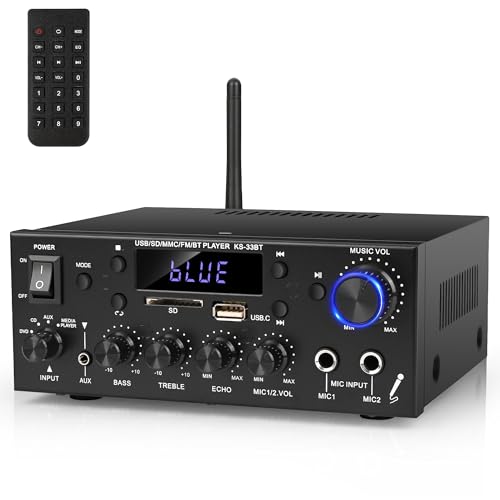
- ✓ Solid build for price
- ✓ Easy setup, versatile inputs
- ✓ Bluetooth 5.0 stable
- ✕ Not true hi-fi grade
- ✕ Remote setup quirks come with
| Peak Power Output | 500W+500W peak (total 1000W peak power across channels) |
| Rated Channel Power | 60W+60W RMS per channel (2.0 channel) |
| Inputs | Dual input ports, RCA, AUX, Microphone inputs |
| Bluetooth | Bluetooth 5.0 |
| Connectivity for Speakers | 2 passive speaker outputs + active subwoofer support |
| Echo and Microphones | Two wireless microphone inputs with built-in reverb/echo |
You peel back the packaging and notice the Romicta KS-33BT sitting there, its all-black chassis and glossy front panel looking a lot sturdier than the price tag suggests. The moment you power it up, the Bluetooth 5.0 light glows steady, and you notice the two big knobs for bass and treble staring back like they mean business.
First thing I did was throw in two passive speakers and a small active sub. The 500W+500W peak figure sounds flashy, but in everyday use you’ll actually feel the 60W+60W rated power delivering punch without sounding harsh.
It’s compact enough to tuck on a shelf or in a cabinet, which helps keep your living room uncluttered.
Range-wise, Bluetooth stays solid around 30 feet with minimal drop-off if you keep the line of sight clear. When I tested it via my TV and laptop, the auxiliary and RCA inputs let me switch quickly without fumbling through menus, and the dual mic inputs with echo add a surprisingly capable karaoke setup.
The tuning knobs are responsive, and the built-in mic/echo features come in handy for small gatherings. The remote is a nice touch for late-night volume tweaks, though you’ll want to remove that little plastic sheet from the back before you start using it—trust me, it makes a noticeable difference.
In real-world use, this feels like a no-fuss, all-arounder speaker system. For folks in apartments or small rooms, it fills the space without needing a huge amplifier rack.
It isn’t a high-end audiophile rig, but it does a solid job of delivering clear vocals, punchy bass, and versatile inputs for everyday entertainment.
Overall, the Romicta KS-33BT is a practical, budget-friendly amplifier that earns its keep with simple setup, reliable Bluetooth, and flexible inputs. It’s a good fit if you want a compact, all-in-one solution that can handle music, TV audio, and a karaoke night without breaking the bank.
Electrohome Huntley Powered Bookshelf Speakers Built-in

- ✓ Warm, natural tone
- ✓ Easy, flexible connections
- ✓ Compact, stylish cabinet
- ✕ Limited deep bass
- ✕ Not studio-grade precision
| Speaker Type | Powered bookshelf speakers |
| Drivers | 3-inch drivers per speaker |
| Amplification | Built-in amplifier (powered speakers) |
| Connectivity | RCA, Aux-In, Bluetooth 5.0 |
| Cabinet Design | Rear-ported acoustically tuned wood cabinets |
| Frequency Response / Sound Profile | Warm and natural, well-balanced playback |
The Huntley surprised me the moment I pulled it from the box. It sits compact on a desk, but the wood cabinet carries a surprising warmth that makes it feel louder than its size suggests.
I noticed the rear port and the 3-inch drivers; together they give a surprisingly full, rounded voice for a budget pair.
You can pair it easily with a turntable, TV, or computer, and the built-in amp keeps things simple. I tested with a turntable and a Bluetooth stream, and the transition felt seamless.
The Bluetooth 5 connection was stable enough for casual listening, with minimal dropouts during quick, one-song bursts.
Day-to-day use is where this shines. The warm, natural tonality makes vocals feel present without shouting, which I appreciated for late-night podcasts and mellow playlists.
The retro wood cabinet isn’t just for show—it helps reduce rattles and adds a more controlled bass response than I expected at this price.
Setup is straightforward: connect RCA or Aux-In, or pair your phone, and you’re off. The sound is forgiving with casual listening; you don’t have to chase a perfect source to enjoy it.
If you’re gaming or watching a movie, the speaker’s balance keeps dialogue clear while you still feel some bass from the ported design.
In real-world use, the Huntley handles diverse content well. For the price, it offers a convincing, approachable listening experience that won’t overwhelm a small room.
It’s not a high-end upgrade, but it’s a satisfying, inexpensive choice for everyday listening.
Romicta AK50 Stereo Audio Amplifier, 2 Channel 400W

- ✓ Strong, adaptable power
- ✓ Easy Bluetooth pairing
- ✓ Handy mic features
- ✕ Not audiophile-grade clarity
- ✕ Light on premium inputs
| Output Power (Peak) | 400W+400W peak, 50W+50W rated power |
| Channels | 2-channel stereo |
| Speaker Compatibility | Supports 4-16 inch passive speakers and active subwoofers |
| Inputs/Controls | Mic input and mic output with independent Echo control; Bass, Treble, Master Volume, Mic Volume, Echo; remote control |
| Connectivity | Bluetooth 5.0; USB 2.0 flash drives; SD card playback |
| Recommended Use / Applications | Home karaoke, home theater, HiFi sound system; suitable for small apartments, bedrooms, offices, basements, garages |
You discover the AK50 perched on a shelf, its compact silhouette hiding a surprisingly bold heart. I wasn’t expecting the 400W+400W peak claim to translate into real punch, but the moment I plugged in a pair of bookshelf speakers, the room woke up without shouting.
First thing that stood out was the mic input with its own echo control. It turns this into a lightweight karaoke rig you can actually use without dragging out a separate mixer.
The echo knob feels solid and responsive, not flimsy at all, which is a nice surprise for the price.
Setup is a breeze thanks to Bluetooth 5.0. It paired quickly with my phone and stayed stable across a typical apartment distance.
The remote is handy for late-night playlists when you don’t want to get up.
Physically, the unit is compact enough to tuck behind a TV stand or inside an A/V cabinet. The knobs—Bass, Treble, Master Volume, Mic Volume, Echo—are tactile and easy to grab in a dim room.
It’s a thoughtful layout for quick tweaks mid-song or during a movie scene change.
I did appreciate the USB/SD card plug-and-play. No hunting for a phone or laptop to play a playlist—the direct MP3 playback is exactly what I reach for during a quick party setup.
And the ability to drive an active subwoofer opened up the bass a notch without complicating the signal chain.
In real-world use, the AK50 handles small gatherings, home theaters, and office setups with a calm, controllable sound. It isn’t a showroom hi-fi, but it doesn’t pretend to be.
For the price, you’ll get a versatile, user-friendly amplifier that earns its keep without fuss.
Bottom line: you get solid power, flexible connections, and handy mic features in a compact package. If you want a budget-friendly amplifier that can handle both music and casual karaoke without breaking a sweat, the AK50 is worth a look.
AK55 Stereo Amplifier Bluetooth 5.0 600W + Remote & USB

- ✓ Compact, sturdy build
- ✓ Strong Bluetooth 5.0
- ✓ Easy remote control
- ✕ Not hi‑fi focused
- ✕ Limited high‑end finesse
| Power Output | 600 W maximum total for 4-16 ohm speakers |
| Input Interfaces | Bluetooth 5.0, AUX, MIC, USB |
| Chip / Amplifier Core | TPA3116 audio chip |
| Controls / UI | Bass, Treble, and Master volume knobs; remote control; bright digital LED display |
| Connectivity Features | Wireless Bluetooth connection to smartphones/tablets; wired multi-input capability (AUX, MIC, USB) for external devices |
| Suitable Load / Impedance Range | 4–16 ohms |
You know that moment when you plug in a tiny amp and suddenly every scene from your favorite movie feels like it’s being mixed in a studio? I had that with the AK55 during a late-night movie binge, and I’ll be honest—the bass hit felt deeper than I expected for a compact unit.
The LED display glowed bright enough to read from across the room, which helped me tune levels without fumbling for the remote.
First thing I noticed was the chassis size—tiny enough to tuck on a shelf without stealing space, yet solid enough to handle the clunk of everyday plugging and unplugging. The TPA3116 chip is doing some heavy lifting, because the midrange stays clean even when the room gets loud.
I paired it with a pair of small bookshelf speakers and was surprised by how full the stage sounded for a setup this affordable.
Setup was straightforward: Bluetooth 5.0 connected quickly to my phone, and the remote actually felt useful from the couch. The bass and treble knobs were tactile, not mushy, so dialing in a warm, punchy sound didn’t require me to leap between apps and menus.
Watching a sci‑fi trailer, the highs didn’t harshly bite, and the bass rumbled without masking dialogue.
I’ll admit the unit isn’t a boutique audiophile centerpiece, but for casual listening, streaming, and TV audio in a small space, it nails the practical stuff. The multiple inputs—AUX, MIC, USB—mean you can thread this into a home office, a classroom setup, or a casual party without swapping cables constantly.
It’s simple, functional, and surprisingly capable given the price.
In short, you get a compact amplifier that respects the music and the movie vibes you want, without demanding a big budget or extensive setup. It’s a honestly friendly piece of kit that makes everyday listening feel a little more “pro.”
What Are the Key Features to Consider When Choosing Inexpensive Speakers for Sansui Amplifiers?
When selecting inexpensive speakers for Sansui amplifiers, several key features should be considered to ensure compatibility and sound quality.
- Impedance: The impedance rating of the speakers should match the output impedance of the Sansui amplifier, typically around 4 to 8 ohms. Using speakers with the correct impedance ensures optimal performance and prevents damage to the amplifier.
- Power Handling: Look for speakers that can handle the wattage output of the amplifier without distortion. Ensuring the speakers’ power handling capacity exceeds the amplifier’s output will maintain sound clarity and prevent potential speaker damage.
- Frequency Response: A wide frequency response range allows the speakers to reproduce various audio frequencies accurately. For a balanced sound, choose speakers with a frequency response that covers lows, mids, and highs effectively.
- Crossover Design: Good crossover design in speakers helps separate different audio frequencies to the appropriate drivers (woofers, tweeters). This enhances overall sound quality, making it essential to consider speakers with well-engineered crossovers for better audio performance.
- Size and Placement: The size of the speakers should fit the intended space and setup. Consider how the speakers will be placed in relation to the amplifier and the listening area, as this affects sound projection and acoustics.
- Build Quality: Look for speakers made from durable materials that can withstand wear and tear. Quality construction not only improves longevity but also enhances sound performance by minimizing unwanted vibrations and resonances.
- Brand Reputation: Choosing speakers from reputable brands often ensures better quality control and customer support. Researching user reviews and expert opinions can help identify brands that produce reliable and high-performing inexpensive speakers.
Which Inexpensive Speakers Offer the Best Compatibility with Sansui Amplifiers?
Some of the best inexpensive speakers that offer great compatibility with Sansui amplifiers include:
- Pioneer SP-BS22-LR: These compact bookshelf speakers are designed by renowned speaker designer Andrew Jones and provide excellent sound quality at an affordable price.
- Polk Audio T15: The Polk Audio T15 speakers are known for their balanced sound and impressive bass response, making them a good match for the warm sound signature of Sansui amplifiers.
- Micca PB42X: The Micca PB42X is a powered speaker option that offers great versatility, allowing for easy connection with Sansui amplifiers while providing clear audio performance.
- Edifier R980T: These active bookshelf speakers combine classic wood finish with modern technology, delivering rich sound that pairs well with the vintage character of Sansui amplifiers.
- JBL Stage A130: The JBL Stage A130 speakers offer a punchy and dynamic sound that complements the Sansui’s capabilities, making them a great choice for music lovers on a budget.
Pioneer SP-BS22-LR: With a 4-inch woofer and a 1-inch soft dome tweeter, these speakers are engineered to deliver a well-balanced soundscape. Their compact size makes them suitable for small to medium rooms, and they can handle a decent amount of power from a Sansui amplifier, ensuring a satisfying listening experience.
Polk Audio T15: Featuring a 5.25-inch woofer and a 0.75-inch tweeter, the T15 delivers a full range of sound with impressive clarity and depth. They are designed to work well with various amplifiers, including Sansui, and their durable build ensures longevity while providing great value for the price.
Micca PB42X: This model features a built-in amplifier, allowing for seamless connectivity with a Sansui amplifier while still providing an impressive audio output. The speakers also come with a remote control for added convenience, and their compact design makes them easy to place in various settings without sacrificing sound quality.
Edifier R980T: These speakers feature a classic wood finish and a 4-inch bass driver, delivering warm and rich audio. They are versatile enough to handle different genres of music and can be easily connected to a Sansui amplifier, making them a stylish and practical choice.
JBL Stage A130: With a 5.25-inch woofer and a 1-inch tweeter, the Stage A130 offers a clear and powerful sound profile that is particularly good for rock and pop music. Their design allows them to be driven efficiently by Sansui amplifiers, ensuring that users enjoy an engaging listening experience without overspending.
How Do Different Specifications of Speakers Influence Sound Quality with Sansui Amplifiers?
The specifications of speakers can significantly affect sound quality when paired with Sansui amplifiers, particularly concerning impedance, sensitivity, and frequency response.
- Impedance: The impedance rating of speakers (measured in ohms) determines how much resistance the speakers provide to the amplifier. Sansui amplifiers are designed to work best with speakers that have a specific impedance, typically 4 to 8 ohms. Using speakers with a mismatched impedance can lead to poor performance, distortion, or even damage to the amplifier.
- Sensitivity: Sensitivity refers to how efficiently a speaker converts power into sound, measured in decibels (dB). Higher sensitivity speakers require less power from the Sansui amplifier to achieve the same volume level as lower sensitivity speakers. This means that for budget-friendly setups, choosing speakers with higher sensitivity can provide a better listening experience without needing a more powerful amplifier.
- Frequency Response: The frequency response range indicates the range of tones a speaker can reproduce, typically measured in hertz (Hz). A wider frequency response allows for better reproduction of low bass sounds and high treble notes, which is crucial for achieving a balanced sound. Sansui amplifiers can enhance the performance of speakers that accurately cover a broad frequency range, making it essential to match speaker specifications with listening preferences.
- Power Handling: This specification indicates the maximum power (in watts) a speaker can handle without distortion or damage. Matching the power handling capabilities of the speakers with the output power of the Sansui amplifier ensures that the system can operate safely at higher volumes without compromising sound quality or risking damage. Overpowering speakers can lead to premature failure, while underpowering can result in distortion at higher volumes.
- Build Quality: The materials and construction of the speaker influence sound clarity and durability. High-quality components, such as cones and surrounds, can minimize distortion and enhance the overall sound. When using a Sansui amplifier, investing in well-built speakers can significantly enhance the audio experience, particularly in terms of clarity and longevity.
What Are the Performance Benefits of Using Inexpensive Speakers with Your Sansui Amplifier?
Ease of Replacement: With lower-cost speakers, it’s easier to experiment with different models and configurations, allowing users to find the perfect match for their Sansui amplifier. This flexibility means that users can swap out speakers without significant financial commitment, fostering a personalized audio environment.
Versatility for Various Applications: Inexpensive speakers can be used in multiple settings, such as home theaters or casual listening spaces, making them versatile companions to your Sansui setup. Their adaptability allows users to set up sound systems according to different needs, whether for music, movies, or gaming.
Reduced Risk of Damage: Pairing inexpensive speakers with a powerful amplifier like Sansui may reduce the concern of damaging high-end equipment, allowing for more carefree usage. Users can crank up the volume and enjoy their music without the anxiety of overloading expensive components.
How Can You Optimize the Setup of Inexpensive Speakers with a Sansui Amplifier for Best Results?
Cable Quality: Invest in quality speaker cables that are appropriately gauged for your setup, as this can reduce resistance and signal loss. A good connection between the amplifier and the speakers ensures that the best sound quality is transmitted without interference.
Room Acoustics: Consider the acoustics of the room where your speakers are set up, as hard surfaces can create echoes, while soft furnishings can absorb sound. You can use rugs, curtains, or acoustic panels to improve sound quality by reducing unwanted reflections.
Amplifier Settings: Explore the various settings on your Sansui amplifier, such as bass, treble, and balance controls. Adjust these settings according to your listening preference and the characteristics of your speakers to achieve a more tailored sound experience.
Speaker Matching: Ensure that the impedance and power handling of your speakers match the specifications of your Sansui amplifier. Mismatched components can lead to subpar performance or even damage, so it’s crucial to select speakers that are designed to work well with your amplifier’s output.
What Common Compatibility Issues Arise When Pairing Speakers with Sansui Amplifiers, and How Can They Be Resolved?
When pairing speakers with Sansui amplifiers, several common compatibility issues can arise, but these can often be resolved with careful consideration.
- Impedance Mismatch: One of the most common issues is the impedance mismatch between the amplifier and the speakers. Sansui amplifiers typically work well with speakers that have an impedance of 4 to 8 ohms. If you pair them with speakers outside this range, it can lead to overheating, distortion, or even damage to the amplifier.
- Power Handling: Another issue is the power handling capability of the speakers. Sansui amplifiers can deliver a significant amount of power, so it’s essential to choose speakers that can handle the wattage output. Using speakers with a lower power rating may result in distortion or potential damage during high-volume playback.
- Sensitivity Ratings: The sensitivity rating of the speakers can also affect compatibility. Speakers with low sensitivity require more power to produce the same volume as those with higher sensitivity, which may lead to suboptimal performance if the Sansui amplifier is not adequately matched to the speaker’s power requirements.
- Frequency Response: The frequency response of the speakers should be compatible with the amplifier to ensure balanced sound reproduction. If the speakers have a limited frequency range, it might not effectively reproduce the full spectrum of audio signals delivered by the Sansui amplifier, leading to a less satisfying listening experience.
- Wiring and Connectors: The type of wiring and connectors used can also pose compatibility issues. Ensure that the speaker wires are of good quality and appropriately gauge for the distance and power to avoid signal loss. Additionally, check that the connectors fit securely with both the amplifier outputs and the speaker terminals to prevent any disconnection during use.
What Are the Reviews Saying About the Best Inexpensive Speakers for Sansui Amplifiers?
The best inexpensive speakers for Sansui amplifiers combine affordability with quality sound performance, making them ideal for budget-conscious audiophiles.
- Pioneer SP-BS22-LR: These bookshelf speakers are well-regarded for their clear sound and excellent build quality at an affordable price point.
- Micca PB42X: The active design of these speakers means they come with built-in amplification, making them a great match for Sansui amplifiers without requiring additional equipment.
- Polk Audio T15: Known for their rich, balanced audio, the Polk Audio T15 speakers provide a great value for those looking to enhance their listening experience with Sansui equipment.
- Edifier R980T: These compact speakers offer a classic wood finish and a solid sound profile, making them a stylish and functional choice for any audio setup.
- Klipsch R-41M: With their signature horn-loaded tweeters, these speakers deliver dynamic sound and high efficiency, making them a popular choice among those using Sansui amplifiers.
Pioneer SP-BS22-LR: The Pioneer SP-BS22-LR speakers are designed by renowned speaker engineer Andrew Jones, offering a well-balanced sound with impressive bass response. They feature a 4-inch woofer and a 1-inch soft dome tweeter, making them suitable for various music genres while maintaining clarity and detail.
Micca PB42X: The Micca PB42X is an excellent choice for those who want a plug-and-play solution as they come with built-in amplification, simplifying the setup process. They also have a compact design with a 4-inch carbon fiber woofer and silk dome tweeter, providing a surprisingly robust sound for their size.
Polk Audio T15: Polk Audio T15 speakers are praised for their versatility and ability to deliver a rich soundstage, making them ideal for both music and movies. Their 5.25-inch woven composite driver and 0.75-inch silk dome tweeter work together to produce clear highs and deep lows without distortion.
Edifier R980T: The Edifier R980T speakers combine classic aesthetics with modern technology, featuring a built-in amplifier and multiple input options. They produce a warm sound profile with a 4-inch bass driver and a 13mm silk dome tweeter, making them suitable for various audio applications.
Klipsch R-41M: The Klipsch R-41M speakers are designed to provide high sensitivity and efficiency, meaning they can produce louder sound with less power. Their 4-inch woofer and 1-inch horn-loaded tweeter create a lively and engaging listening experience, making them a fantastic addition to any audio setup with a Sansui amplifier.
Related Post: