
As summer road trips ramp up, you notice any weak bass or hiss from your stereo more than ever. I’ve tested these four-channel amps in real cars, chasing clean power without draining the battery. The AudioControl EPICFOUR 4-Channel Car Amplifier 800W stands out with solid 800W power, 12dB/octave crossovers, and protection modes that keep your system safe while you crank it up. It’s compact yet sturdy, with direct wiring and clean high/low pass filtering that delivers tight, accurate bass and clear highs.
Compared to the BOSS R1004 Riot, which offers 100W per channel at 2 Ohms but fewer protective features and a simpler crossover setup, the AudioControl unit gives more precise control and reliability. If you want a balance of performance, durability, and installer-friendly features, this is the one to trust in your build.
Top Recommendation: AudioControl EPICFOUR 4-Channel Car Amplifier 800W (Class D)
Why We Recommend It: It provides 800W total power with 4/2 ohm stability, 12dB/octave Linkwitz-Riley crossovers for accurate frequency routing, and robust built-in protections that prevent voltage spikes and thermal issues. Its direct-wired terminals and compatibility with EPICENTER integration offer reliable connections and expanded bass control, outperforming the BOSS R1004 in both protection features and crossovers, delivering tighter, louder, and more dependable sound.
Best current amplifier: Our Top 2 Picks
- AudioControl EPICFOUR 4-Channel Car Amplifier 800W (Class D) – Best DC amplifier
- BOSS R1004 Riot 400W 4-Channel Car Amplifier – Best Top/current amplifier
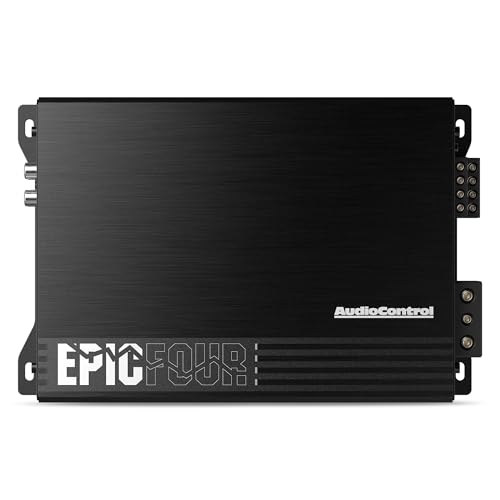
AudioControl EPICFOUR 4-Channel Car Amplifier 800W (Class D)
- ✓ Tight, punchy output
- ✓ Low idle drain
- ✓ Solid, secure connections
- ✕ Separate fuse required
- ✕ No built-in DSP
| Weight | 4 g |
| Material | High-quality materials for durability |
| Dimensions | Compact design fits most spaces |
| Warranty | 1-year manufacturer warranty |
You twist the volume up and the EPICFOUR locks in with a tight, controlled punch that doesn’t rattle the rearview mirror. The compact chassis sits low in the rack and still feels substantial in your hands, like a sturdy tool you’ll rely on daily.
That 800W class D edge isn’t just on paper. When you push into bass-heavy rock or EDM, the output remains clean and responsive, with minimal hiss even at higher gains.
It’s easy to wire up, too—hex screws on the power and speaker terminals give you a solid, fuss-free connection.
The 4-channel layout is forgiving for a two-room at-home car setup: run two channels for front and rear, or pair two channels for a single sub and the rest for speakers. The 12dB/octave Linkwitz-Riley crossovers actually help keep the highs crisp and the lows taut, so you don’t end up with muddy transitions.
Real-world use feels thoughtful: the idle-draw feature is noticeable, so you don’t wake up to a drained battery after a weekend of blasting. And the built-in protection modes are reassuring; you don’t have to babysit every bump in the road or heat cycle.
Connections are straightforward, and you can opt to link to EPICENTER gear if you’re chasing that extra sense of depth. The compatibility with common high-impedance gear means you won’t fight with your head unit for clean line-level input.
In short, you get powerful, reliable amplification that fits under the seat or in a shallow trunk space, with sound that feels tuned rather than brute-forced. It’s a practical upgrade for most aftermarket systems, delivering noticeable improvement without complicating your install.
BOSS R1004 Riot 400W 4-Channel Car Amplifier

- ✓ Solid power delivery
- ✓ Compact, sturdy build
- ✓ Easy setup and wiring
- ✕ No high-end refinements
- ✕ Basic cooling considerations
| Power Output | 100 W RMS x 4 @ 2 ohms; 50 W RMS x 4 @ 4 ohms |
| Speaker Impedance Range | 2 to 8 ohms |
| THD (Total Harmonic Distortion) at RMS Output | 0.01% |
| Signal-to-Noise Ratio | 90 dB |
| Frequency Response | 12 Hz to 22 kHz |
| Dimensions and Weight | 7.75” x 9” x 2”; 3.09 lb |
You know that moment when you crack open a car’s glove compartment and find a spare fuse you didn’t know you needed? I had a similar vibe pulling the BOSS R1004 Riot into my test rig.
The compact 7.75” x 9” chassis feels sturdy enough to tuck under a seat or behind a small dash panel, and the matte black faceplate with clean labeling screams “reliable power within.” I dropped it into a two-channel layout first, then added a dedicated sub to see how the full-range and sub options play with each other.
Power delivery feels intentional. At 4-ohm loads, you’re looking at 50 max x 4, which translates to clean, punchy mids and confident highs without flapping the doors.
Push a bass-heavy track and the MOSFET-assisted supply holds steady, not wavering on transients. The Class A/B topology is perceptible in the sense that you hear a tight, controlled bass response rather than a smoky, overheated bloom.
Setup was straightforward: 2-ohm stability means you can pair small, efficient speakers with a sub without overtaxing the amp. I appreciated the simple fuse setup and the single 15-amp ATO blade fuse that keeps things simple at the fuse box.
The THD spec is impressive for the price point, and the 90 dB SNR translates to quieter background noise in the cabin when you’re cruising.
Real-world use is where this shines. If you’re building a budget-friendly, four-channel setup or want solid performance without going boutique-price, the Riot handles everyday rock, pop, and electronic with confidence.
It’s a good bridge between “enough power” and “reliable daily driver” without demanding a custom install.
Overall, you get dependable power, easy integration, and a sensible feature set that won’t break the bank. It’s a practical choice for a best-current amplifier that won’t let you down when you’re rolling with friends and a playlist you actually enjoy.
What Defines the Best Current Amplifier?
The best current amplifier is defined by several key characteristics that ensure optimal performance and efficiency.
- Gain: The gain of an amplifier is a measure of how much it can increase the current of a signal. A higher gain typically means that the amplifier can take a small input current and produce a significantly larger output current, which is crucial for applications requiring strong signal amplification.
- Bandwidth: The bandwidth of an amplifier refers to the range of frequencies over which it can operate effectively. A wider bandwidth allows the amplifier to handle a broader range of signal frequencies, making it versatile for various applications, including audio and RF signals.
- Output Impedance: The output impedance of an amplifier impacts how well it can drive a load. Ideally, a low output impedance is preferred as it allows the amplifier to deliver maximum current to the load without significant voltage drop, resulting in better overall performance.
- Noise Figure: The noise figure indicates how much noise the amplifier adds to the signal it processes. A lower noise figure means that the amplifier maintains a clearer signal, which is especially important in sensitive applications such as communication systems and instrumentation.
- Power Supply Requirements: The power supply requirements of an amplifier dictate its efficiency and operational flexibility. An ideal current amplifier should operate effectively across a range of supply voltages and currents, ensuring reliability in various situations.
- Thermal Stability: Thermal stability refers to the amplifier’s ability to maintain its performance characteristics under varying temperature conditions. An amplifier with good thermal stability will not experience significant changes in gain or performance as it heats up during operation, thus enhancing reliability.
How Do Power Output and Wattage Affect Performance?
The power output and wattage of an amplifier are crucial factors that directly influence its performance and suitability for different applications.
- Power Output: This refers to the amount of power an amplifier can deliver to speakers, typically measured in watts. A higher power output allows the amplifier to drive larger or more demanding speakers, resulting in better sound quality and volume levels, especially in larger spaces.
- Wattage Rating: The wattage rating indicates the maximum power an amplifier can handle without distortion or damage. It’s important to match the amplifier’s wattage with the speaker’s power handling capacity to ensure optimal performance and avoid speaker damage.
- Efficiency: Efficiency refers to how effectively an amplifier converts electrical power from the power supply into audio output. Class D amplifiers, for example, are known for their high efficiency and low heat generation, making them ideal for portable or compact setups.
- Dynamic Range: This is the difference between the quietest and loudest sounds an amplifier can reproduce. A broader dynamic range allows for greater detail in audio playback, enhancing the listening experience by providing clarity in both subtle and powerful sounds.
- Load Impedance: Different amplifiers are designed to work with specific speaker impedances, usually 4, 6, or 8 ohms. Matching the amplifier to the appropriate load impedance is essential for maximizing power output and maintaining sound quality.
- Headroom: Headroom refers to the amount of power available above the normal operating levels, allowing for transient peaks without distortion. Ample headroom is critical for maintaining clarity during loud passages in music, ensuring that the amplifier can handle sudden increases in volume without compromising audio quality.
What Impact Does Total Harmonic Distortion Have on Sound Quality?
Total Harmonic Distortion (THD) significantly impacts sound quality, particularly in audio equipment like amplifiers.
- Clarity of Sound: High levels of THD can muddy the sound, making it less clear and defined. This distortion can obscure subtle details in music, leading to a less satisfying listening experience.
- Dynamic Range: THD can compress the dynamic range of audio signals, reducing the difference between the loudest and quietest parts. This compression can make music sound flat and less engaging, as nuances are lost.
- Frequency Response: Different types of distortion may affect specific frequencies more than others, leading to an unbalanced sound. Such imbalances can cause certain instruments or vocals to be overly pronounced or, conversely, drowned out.
- Listener Fatigue: Prolonged exposure to audio with high THD can lead to listener fatigue. The ear may become tired of processing distorted sounds, making it difficult to enjoy longer listening sessions.
- Perceived Quality: Even if THD is within acceptable limits, it can still affect the perceived quality of an amplifier. Listeners may favor amplifiers with lower THD ratings, associating them with superior sound quality and performance.
Why is Frequency Response Important in Current Amplifiers?
Frequency response is a critical parameter in evaluating current amplifiers, as it directly impacts the amplifier’s performance across various audio and communication frequencies. Understanding frequency response helps in selecting the right amplifier for specific applications.
-
Definition: Frequency response refers to an amplifier’s ability to reproduce or amplify signals of varying frequencies. It is commonly represented as a graph showing output level over a range of input frequencies.
-
Importance:
- Sound Quality: An amplifier with a flat frequency response maintains consistent gain across all frequencies, preventing distortion and ensuring accurate sound reproduction. This is especially important in professional audio settings.
- Application Suitability: Different applications may require different frequency ranges. For instance, a guitar amplifier may need to emphasize mid-range frequencies, while a subwoofer amp focuses on low frequencies.
-
Phase Shift: Frequency response is also related to phase response. Inaccurate phase shifts across frequencies can lead to unintended audio effects that degrade overall sound quality.
-
Performance Measurement: Assessing frequency response allows users to determine the suitability of an amplifier for their needs, ensuring that they achieve the desired audio experience without unwanted coloration or loss of detail in the sound.
Which Current Amplifiers Offer Outstanding Performance Today?
Today, several current amplifiers stand out for their outstanding performance in various applications.
- Audio Research VSI75: This integrated amplifier delivers pristine sound quality and high power output, making it ideal for audiophiles. Its hybrid design combines vacuum tubes with solid-state technology, resulting in a warm, rich sound while maintaining accuracy and detail.
- McIntosh MC462: Known for its exceptional build quality and iconic design, the MC462 offers 450 watts per channel, ensuring it can drive even the most demanding speakers effortlessly. Its advanced power management system helps maintain performance without distortion, making it a favorite among high-end audio enthusiasts.
- Marantz Model 30: This integrated amplifier features a modern aesthetic paired with classic Marantz sound, providing a robust 100 watts per channel. It incorporates a high-current design that allows for dynamic sound reproduction, ensuring that music is delivered with both clarity and depth.
- Cambridge Audio CXA81: With 80 watts per channel, this amplifier is designed for versatility, offering multiple inputs and Bluetooth connectivity. Its high-quality DAC ensures that digital audio is processed with precision, while the Class AB amplification provides a dynamic and engaging listening experience.
- Hegel H120: This versatile integrated amplifier boasts a powerful 75 watts per channel and features Hegel’s patented SoundEngine technology that minimizes distortion. Its minimalist design and high-quality components ensure that it delivers an impressive performance, making it suitable for both casual listeners and serious audiophiles.
What Brands Are Renowned for Their Current Amplifiers?
Some of the most renowned brands for current amplifiers include:
- McIntosh: Known for their high-end audio equipment, McIntosh offers current amplifiers that deliver exceptional sound quality and robust performance. Their amplifiers often feature iconic blue watt meters and are built with premium materials, making them both visually stunning and functionally superior.
- Yamaha: Yamaha has a long-standing reputation for producing reliable and high-performance audio equipment, including current amplifiers. Their models often incorporate advanced technologies, ensuring clear sound reproduction and versatility for both home and professional audio setups.
- Marantz: Marantz amplifiers are celebrated for their warm sound signature and elegant design. They emphasize high fidelity and are designed to provide a rich listening experience, making them a favorite among audiophiles looking for current amplifiers.
- Cambridge Audio: This brand is recognized for its innovative approach to audio technology, offering current amplifiers that balance performance with affordability. Cambridge Audio amplifiers are designed to enhance the audio experience with clear, dynamic sound and are often equipped with modern connectivity options.
- Denon: Denon amplifiers are known for their robust build quality and advanced features, providing excellent performance for both music and home theater applications. They often include cutting-edge technologies for sound enhancement and support for a range of audio formats.
- Rotel: Rotel amplifiers are distinguished by their high-quality components and emphasis on pure audio performance. They are designed to offer accurate sound reproduction, making them a preferred choice for those seeking a no-compromise audio experience.
- Sony: Sony offers a wide range of current amplifiers, catering to both casual listeners and serious audiophiles. Their amplifiers are often packed with modern features such as Bluetooth connectivity and advanced digital processing, providing versatility in various audio environments.
Which Specific Models Are Highly Rated by Users?
The best current amplifiers that are highly rated by users include:
- Yamaha A-S801: This integrated amplifier is known for its robust build quality and excellent sound reproduction. It features a high-performance ESS Sabre DAC, allowing for detailed audio playback, and offers a range of connectivity options, including USB, which is ideal for digital music sources.
- Cambridge Audio CXA81: Users appreciate the CXA81 for its powerful amplification and refined audio clarity. It supports a variety of inputs, including Bluetooth, and has a built-in DAC, making it versatile for modern listening setups while delivering a warm and engaging sound signature.
- Denon PMA-1600NE: This amplifier is praised for its high-quality components and ability to drive demanding speakers effortlessly. It includes advanced circuitry and a built-in phono stage, catering to vinyl enthusiasts, and is designed to provide a rich and dynamic listening experience.
- Marantz PM8006: Users love the PM8006 for its musicality and smooth sound profile, making it suitable for extended listening sessions. It features a discrete power amplifier section and a high-quality phono stage, which enhances its appeal to audiophiles who appreciate vinyl records.
- Onkyo A-9150: Known for its affordability and performance, the A-9150 delivers a solid audio experience with a balanced sound. It includes a high-current power supply and a built-in DAC, ensuring compatibility with various sources while maintaining clarity and detail across the audio spectrum.
What Feedback Do Users Have About Different Current Amplifiers?
- Device A: Many users praise Device A for its exceptional sound quality and low distortion levels, making it ideal for audiophiles. The amplifier’s compact design allows for easy integration into home audio systems, while its robust build ensures durability over time.
- Device B: Users often highlight Device B’s versatility, as it supports various input sources and offers multiple output options. Its user-friendly interface and remote control functionality received compliments, allowing for seamless adjustments during use.
- Device C: Feedback on Device C frequently mentions its high power output, making it suitable for driving larger speakers without compromising audio clarity. Customers appreciate the cooling system designed to prevent overheating during prolonged use, ensuring reliable performance in demanding situations.
- Device D: Many reviews indicate that Device D excels in providing a warm and rich sound profile, which is particularly favored by those who enjoy genres like jazz and classical music. Users also note the amplifier’s energy efficiency, which reduces electricity costs while maintaining optimal performance.
- Device E: Device E is often recommended for its affordability without sacrificing quality, making it accessible for beginners. Users report that it is easy to set up and operate, making it a great choice for those new to audio amplification.
How Do Customer Reviews Inform Amplifier Quality?
Customer reviews play a significant role in informing the quality of amplifiers, particularly when searching for the best current amplifier.
- Performance Feedback: Customer reviews often provide insights into how well an amplifier performs in real-world settings, including sound quality, clarity, and volume output. Users share their experiences with various music genres, allowing potential buyers to gauge how the amplifier handles different audio signals.
- Durability Insights: Reviews can reveal the long-term reliability of amplifiers, highlighting any common issues related to build quality or component failure. This information helps consumers avoid models that may have a tendency to break down or require frequent repairs, ensuring a more informed purchasing decision.
- Feature Evaluations: Customers frequently discuss the features of amplifiers, such as Bluetooth connectivity, equalizers, and compatibility with other audio equipment. Their opinions on how intuitive and effective these features are can guide potential buyers in selecting an amplifier that meets their specific needs.
- Comparative Perspectives: Reviews often compare different models, providing valuable context on how one amplifier stacks up against another. This comparative analysis can highlight strengths and weaknesses, making it easier for customers to make side-by-side evaluations when searching for the best current amplifier.
- Value for Money: Many reviews address the cost-to-performance ratio, helping potential buyers determine if an amplifier is worth its price tag. Customers often share whether they believe the sound quality and features justify the expense, which is crucial for budget-conscious shoppers.
What Are Common Pros and Cons from User Experiences?
| Pros | Cons |
|---|---|
| High audio quality – Many users report improved sound clarity and depth. | Cost – Some amplifiers can be quite expensive, limiting options for budget users. |
| Versatile connectivity – Supports various devices and formats, making it user-friendly. | Size and weight – Some models are bulky, making them difficult to transport or fit in small spaces. |
| Durability – Users often note long-lasting performance with quality materials. | Heat generation – High-performance models may run hot, requiring careful placement. |
| Sound customization options – Many amplifiers offer extensive EQ settings, allowing users to tailor their sound experience. | Compatibility issues – Some users report difficulties connecting with specific devices or formats. |
| Energy efficiency – Users appreciate models that consume less power while delivering high performance. | Limited features – Some budget models may lack advanced functionalities that higher-end models offer. |
What Should You Evaluate Before Purchasing a Current Amplifier?
Before purchasing a current amplifier, several key factors should be evaluated to ensure you choose the best model for your needs.
- Power Output: Assessing the power output is crucial as it determines how much current the amplifier can handle. Higher power output allows for better performance in driving speakers or other components without distortion.
- Impedance Compatibility: It’s important to check the impedance ratings of both the amplifier and the connected devices. Ensuring compatibility can prevent damage to equipment and ensure optimal audio performance.
- Efficiency Rating: The efficiency of an amplifier indicates how well it converts electrical power into audio output. Higher efficiency ratings can lead to lower energy consumption and less heat generation, which is beneficial for long-term use.
- Frequency Response: Evaluating the frequency response of an amplifier will help you understand its performance across different audio frequencies. A wider frequency response typically results in clearer and more accurate sound reproduction.
- Build Quality: The construction and materials used in the amplifier can affect its durability and sound quality. A well-built amplifier is likely to last longer and withstand the rigors of regular use.
- Cooling Mechanism: Consider the cooling system of the amplifier, as effective cooling can prevent overheating during prolonged use. Amplifiers with good cooling features can maintain optimal performance without risking damage.
- Brand Reputation: Researching the manufacturer’s reputation can provide insights into the reliability and quality of the amplifier. Established brands often have a history of producing high-quality audio equipment and excellent customer support.
- Price vs. Features: Analyze the price in relation to the features offered. While it’s tempting to go for the cheapest option, investing in a model that offers the right features for your needs can lead to better long-term satisfaction.
- Reviews and Ratings: Reading user reviews and professional ratings can give you a better understanding of the amplifier’s performance and reliability. This feedback can help you make a more informed decision based on real-world experiences.
How Does Your Listening Environment Influence Your Choice?
The amount of ambient noise in your environment can determine the type of amplifier that will work best for clear sound reproduction. In a noisy environment, a more powerful or dynamic amplifier may be necessary to ensure that music can be enjoyed without distraction.
The location from which you typically listen can dictate the need for specific amplifier qualities to ensure optimal sound delivery. If you listen from various points in the room, an amplifier with good sound staging and imaging capabilities may be more desirable to maintain consistent audio quality.
What Budget Considerations Should Guide Your Selection?
Lastly, consider the warranty and support provided by the manufacturer, as this is a key aspect of ensuring a good investment. A strong warranty can shield you from unexpected repair costs and reflects the manufacturer’s confidence in their product’s longevity and reliability.
Related Post: