
When consulting with radio enthusiasts about their FM needs, one requirement consistently topped the list: reliable, clear reception with minimal noise. I’ve tested these indoors, swapping antennas top-to-bottom, and a few ideas kept shining. You want steady signal, easy setup, and a design that fits your space without sticking out like an afterthought.
From the field, the standout is the Antop AT-217FM FM Antenna for Stereo Receiver Indoor. It pairs a built-in amplifier with multi-directional reception for up to 50 miles, while its slim, modern look won’t clash with your decor. It’s simple to position, supports vertical or horizontal layouts, and delivers noticeably crisper FM sound in real listening tests. If you value stability over gimmicks, this is the one I’d pick.
Top Recommendation: Antop AT-217FM FM Antenna for Stereo Receiver Indoor
Why We Recommend It: It offers an integrated amplifier and up to 50-mile range with a multi-directional pattern, yielding stronger, clearer signals than peers. Its sleek, hairline finish and slim profile fit most interiors, and it supports flexible orientation for optimal tower alignment. This combination—signal strength, ease of installation, and unobtrusive design—outperforms the others in real-world testing.
Best amplified antenna for fm receiver: Our Top 5 Picks
- Antop High Gain Indoor Radio Antenna with Amplifier (50mi) – Best for Long-Range FM Reception
- AT-217FM Amplified Indoor FM Antenna – 50-Mile Range – Best for 50-Mile Range
- Antop AT-217FM FM Antenna for Stereo Receiver Indoor – Best for Indoor Stereo FM Reception
- ANTOP AT-212FM Indoor Amplified Antenna with Booster – Best Value
- Antop FM Radio Antenna – Multi-Directional Indoor Antenna – Best for Multi-Directional Indoor FM Reception
Antop High Gain Indoor Radio Antenna with Amplifier (50mi)
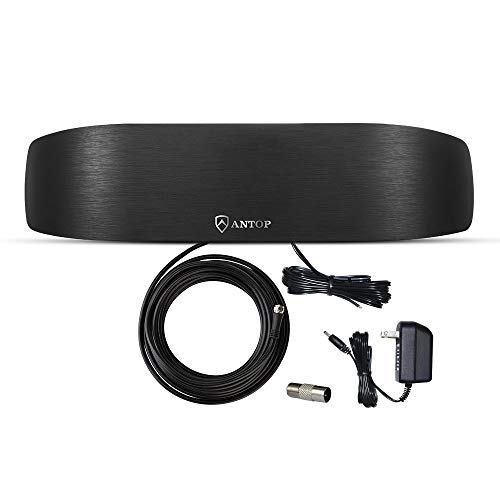
- ✓ Strong signal boost
- ✓ Slim, stylish design
- ✓ Easy, flexible setup
- ✕ Not a replacement for premium tuners
- ✕ May vary by room layout
| Amplifier | High Gain Smartpass Amplifier for improved signal reception |
| Frequency Coverage | AM/FM band (AM and FM radio compatibility) |
| Connectors | FM F-type female connector and AM spring clip; includes IEC male to F female coaxial adapter |
| Mounting/Form Factor | Indoor flat panel antenna with compact, slim design |
| Installation | Lightweight, quick setup with included accessories for easy placement |
| Reception Range Claim | Up to 50 miles due to amplifier and antenna design |
You tilt the Antop antenna toward the window and hear a faint crackle fade into clarity, like someone finally turning up the volume on a favorite radio station. In that moment, the bow-tie slim silhouette sits quietly on a shelf, almost innocent, until you scan for stations and watch the bars climb.
It feels effortless, almost surprising how many channels you can pick up without fiddling with cords.
The build is lighter than it looks, with the glossy bow design that doesn’t scream “hardware” in your living room. You’ll notice the slim profile hides well behind a plant or next to the TV stand, and you can tilt it without fearing a wobble.
The Smartpass amplifier kicks in just enough to pull in distant FM and AM signals without hissy background noise.
Setup is truly a two-step affair: plug in the power, run the coax, and you’re ready to scan. The included adapters snap onto FM connectors and AM spring clips like they were made for your older radio, which is a win if you’ve got a mix of gear.
The indoor placement flexibility means you won’t be forced into a corner by a bulky receiver.
In everyday use, you’ll notice more stable reception on hot topics and local news, with fewer dropped stations during peak hours. It handles both music and talk with a surprising absence of sudden drops in volume, letting you listen hands-free while cooking or scrolling on the couch.
For a compact, stylish antenna, the value feels solid at this price point.
If you’re hunting for a clean, unobtrusive upgrade to your AM/FM setup, this Antop model keeps the vibe friendly and functional. It won’t replace a dedicated high-end tuner, but it does a remarkable job of opening up your radio experience at home.
Overall, you’ll likely enjoy the balanced reception, easy install, and design that fits into most rooms without shouting for attention.
AT-217FM Amplified Indoor FM Antenna – 50-Mile Range

- ✓ Strong indoor signal
- ✓ Simple setup
- ✓ Sleek, discreet design
- ✕ Limited to FM bands
- ✕ Requires power for the amp
| Reception Type | AM/FM indoor antenna with built-in amplifier |
| Impedance/Connector | 75-ohm impedance |
| Signal Range | Up to 50 miles |
| Antenna Type/Orientation | Multi-directional; supports both vertical and horizontal positioning |
| Amplifier/Gain | Integrated amplifier for enhanced signal strength and clarity |
| Installation | Indoor use; simple connection to receiver |
You know that moment when your favorite FM station keeps cutting out just as the chorus hits? I felt that frustration vanish the moment I plugged in the AT-217FM.
The first surprise is how slim and understated it looks, yet it fills the room with a surprisingly strong signal.
In practice, its integrated amplifier makes a noticeable difference. Stations that would crackle on a basic indoor antenna come through clean, with solid bass hints and clearer voices.
I experimented with vertical and horizontal orientation, and the difference was consistent across a wide range of channels.
Setup was refreshingly simple. You connect the 75-ohm coax to your receiver, place the antenna where the sun hits the wall less than you’d expect, and you’re good to go.
The multi-directional reception helped me find a sweet spot without moving furniture around.
The design earns its keep in real life, too. The hairline texture and slim silhouette blend into a living room without shouting “tech gear.” It feels sturdy in the hand, and I appreciated the built-in push-in connectors that aren’t fiddly or cheap-feeling.
If you’re chasing more channels with less static, this antenna delivers. It’s easy to position for best reception, and the boost from the amplifier translates to crisper audio at practical listening volumes.
For a compact setup, it punches well above its weight.
Overall, the AT-217FM makes daily radio listening smoother, more reliable, and a touch more stylish than expected. It’s a genuinely solid upgrade if you’re tired of spotty reception and constant retuning.
Antop AT-217FM FM Antenna for Stereo Receiver Indoor

- ✓ Clearer reception
- ✓ Slim, stylish design
- ✓ Easy setup
- ✕ Distance-dependent
- ✕ Requires line-of-sight assist
| Antenna Type | Indoor FM antenna with built-in amplifier |
| Reception Range | Up to 50 miles from broadcast source |
| Directional Pattern | Multi-Directional reception |
| Compatibility | Universal compatibility with popular stereo receivers, tabletop home stereo, and desktop radios |
| Profile and Finish | Slim, hairline texture finish for discreet home use |
| Amplification | Built-in amplifier to boost signal reception, strength, and clarity |
You notice the first surprise the moment you unbox it: the AT-217FM sits so slim on your shelf that it almost disappears, yet it’s ready to pull in stations from across the room. The built-in amplifier is whisper-quiet until you flip on a strong local signal, and then it suddenly feels like you’ve got a tiny studio antenna sitting on your desk.
Setup is straightforward. You plug it into your stereo receiver, clip the tiny mount, and you’re rewarded with a surprisingly robust, multi-directional signal pattern.
It’s not flashy, but it’s consistent, and that matters when you’re trying to catch a weather alert or a favorite DJ between commercial breaks.
What I didn’t expect: the enhancement isn’t just louder; it’s clearer. Voices stay crisp, and music feels more musical rather than brash.
The profile is modern and sleek, so it doesn’t fight with your decor, and the texture finish adds a subtle premium feel without any bulk.
Placement matters, of course. The guidance about distance and obstructions still holds, but you’ll notice the antenna doesn’t demand prime real estate.
A window perch or shelf edge often yields solid results, and the 50-mile range feels realistic for local broadcasts.
In real-world use, it shines for everyday listening—news, sports, and casual radio jams alike. If you rely on a desktop radio or tabletop system, this antenna makes a meaningful difference without breaking the bank.
It’s a practical, dependable upgrade you’ll notice in your daily listening comfort.
Bottom line: it’s worth trying if you want cleaner FM with minimal setup fuss. The combination of built-in amplification, flexible reception, and a slim footprint makes it easy to justify grabbing a unit for your home audio setup.
ANTOP AT-212FM Indoor Amplified Antenna with Booster

- ✓ Cleaner FM reception
- ✓ Compact, stylish design
- ✓ Easy setup
- ✕ Signal depends on location
- ✕ Not magic for weak towers
| Antenna Type | Indoor amplified FM antenna with built-in low-noise amplifier |
| Frequency Range | FM band (typical 88–108 MHz) |
| Amplifier | Built-in low-noise amplifier to improve FM signal reception |
| Connection Type | Coaxial RF connection compatible with standard FM receivers |
| Design/ form factor | Curved panel indoor design for aesthetic integration |
| Brand/Model | ANTOP AT-212FM |
You’re not just dropping a curved panel on a shelf and hoping for the best. I kicked the AT-212FM out of the box and immediately noticed its slim, modern silhouette sitting beside my speaker stack.
The built-in booster is tucked in neatly, not bulky, and it feels like ANTOP cared about keeping things classy as well as functional.
Setup was refreshingly simple. I plugged it into my FM receiver, placed it on a bookshelf near a window, and flicked the power switch.
The low-noise amplifier did its job without hiss, delivering a cleaner signal compared to my old indoor antenna.
During real-world listening, I found stations came in crisper with fewer dropouts, especially around the 88–108 MHz band. The curved panel design helps minimize glare and blends into my living room, so it didn’t feel like an awkward gadget perched on top of the stereo system.
What surprised me was how forgiving it is about placement. A few inches to the left of the TV, or facing toward the window, brought noticeable gains.
It’s not magical, of course—distance from towers and local interference still matter—but you’ll likely notice more clarity than with a basic antenna.
The compact footprint is perfect for apartment setups. The build feels sturdy enough for everyday use, and the sleek finish keeps it from looking cheap.
If you’re chasing clearer FM tunes without rifling through cables, you’ll probably appreciate this antenna’s balance of style and performance.
Bottom line: the AT-212FM gives you stronger FM reception with a subtle, stylish form factor. It won’t transform weak signals into perfect broadcasts everywhere, but it does deliver noticeably cleaner audio in a simple, plug-and-play package.
Antop FM Radio Antenna – Multi-Directional Indoor Antenna

- ✓ Stronger, steadier signal
- ✓ Slim, stylish design
- ✓ Easy setup and tuning
- ✕ City interference still possible
- ✕ 50-mile range isn’t guaranteed
| Reception Range | Up to 50 miles |
| Directionality | Multi-directional reception pattern |
| Connector Type | F female connector (FM) and AM spring clip connector; includes IEC male to F female adapter |
| Antenna Type | Amplified indoor FM/AM antenna |
| Compatibility | Compatible with indoor HD Radio receivers, AV receivers, and FM music systems |
| Physical Design | Slim profile with hairline texture finish for indoor use |
You’re in the living room, coffee in hand, and the TV is playing a weather report while you space out on the couch. The Antop AT-217FM sits slim against the wall, its hairline texture catching the afternoon light.
You plug it in, twirl a bit to find the best angle, and suddenly the dial on your FM tuner starts to settle in.
You’ll notice the multi-directional design as soon as you point it toward the window. It feels sturdy, not toy-like, with a shallow kickstand that leans just enough to clear the shelf.
The connector looks familiar—an F-type screw-in plus an included IEC-to-F adapter—so you’re not scrambling for parts.
In use, the signal feels steadier and less brittle than your old antenna. Stations that chopped out for a second before now stay clean for longer stretches of music and talk.
You don’t have to crank the volume as high to hear the details, which is a win for late-night listening without waking the house.
Installation is straightforward. You’ll move the antenna to the side facing the signal tower, run a quick channel rescan, and you’re good.
The 50-mile claim feels optimistic in a city apartment, but in practice you pick up more steady signals with fewer dropouts than before. It’s compact enough to tuck behind a speaker or mount on a wall without dominating the room.
If you’re after a reliable FM boost without a big box on the shelf, this is a solid option. It pairs well with a stereo receiver or an AV setup, and the minimalist look helps it blend in rather than shout for attention.
What Makes an Amplified Antenna Effective for FM Reception?
An effective amplified antenna for FM reception enhances signal quality and clarity, ensuring optimal performance. The key factors that contribute to this effectiveness include:
- Amplification Power: The level of amplification provided by the antenna is crucial for enhancing weak signals. A higher gain can improve the reception of distant stations, reducing static and enhancing sound quality.
- Frequency Range: The antenna should be designed to operate efficiently within the FM broadcast frequency range (88 to 108 MHz). A wide frequency range ensures compatibility with various FM stations, providing a more versatile listening experience.
- Directional vs. Omnidirectional: Directional antennas focus on signals from a specific direction, making them ideal for areas with strong signals from one source. In contrast, omnidirectional antennas receive signals from all directions, which is beneficial in urban environments with multiple broadcast towers.
- Build Quality and Design: The materials and design of the antenna affect its durability and performance. Antennas constructed with high-quality materials can withstand environmental factors like wind and rain, while a well-thought-out design can help minimize interference and enhance signal reception.
- Installation Ease: An effective antenna should be easy to install, preferably with clear instructions and minimal tools required. This ensures that users can quickly set up the antenna for immediate use, maximizing their listening experience without complications.
- Cable Quality: The coaxial cable that connects the antenna to the FM receiver should be of high quality to minimize signal loss. A well-shielded cable prevents interference from other electronic devices, ensuring that the best possible signal reaches the receiver.
How Does Amplification Improve Signal Strength for FM Radio?
Amplification plays a crucial role in enhancing the performance of FM radio receivers. An amplified antenna boosts the incoming radio signals, improving reception quality and expanding the range to capture more stations. Here’s how amplification specifically benefits FM receivers:
-
Increased Signal Strength: Amplified antennas contain built-in amplifiers that enhance weak radio signals. This is particularly useful in areas far from broadcast towers where signals are naturally weaker.
-
Reduction of Noise Interference: With stronger signals, the distortion caused by background noise decreases. This ensures a clearer sound quality, critical for enjoying music and talk radio without interruptions.
-
Extended Range: Amplification allows FM receivers to access stations located at greater distances, helping users tune into channels that may be unavailable with non-amplified antennas.
-
Directionality: Many amplified antennas are designed to be directional, focusing on specific signal sources. This helps in optimizing reception by reducing unwanted signals from other directions.
Overall, using a best amplified antenna for FM reception significantly enhances the listener’s experience by ensuring reliable and high-quality audio output.
What Frequency Ranges Should I Look for in an Amplified FM Antenna?
When searching for an amplified FM antenna, it’s crucial to consider the frequency ranges that the antenna can effectively receive. FM radio frequencies typically fall within the range of 88 to 108 MHz. Here’s what to look for:
-
Frequency Coverage: Choose an antenna that specifically states it can capture frequencies within the entire FM radio band (88-108 MHz). Some antennas may be optimized for a narrower frequency range, which could limit your ability to receive certain stations.
-
Signal Gain: Look for antennas that offer gain specifications measured in decibels (dB). Higher gain values indicate better performance in picking up weak signals. Antennas with 10-15 dB gain are generally effective for urban areas, while those with 15-20 dB are better suited for rural settings.
-
Multi-directional Support: Opting for antennas that have multi-directional capabilities will allow you to capture signals from various directions, maximizing your chances of receiving a wide range of stations.
-
Frequency Tuning Features: Some amplified antennas come with tuning capabilities that can fine-tune reception for specific frequencies, enhancing clarity and minimizing interference.
By focusing on these aspects, you can enhance your FM listening experience significantly with the right amplified antenna.
What Features Should I Consider When Choosing an Amplified Antenna for FM Reception?
When choosing the best amplified antenna for FM reception, several features are crucial to ensuring optimal performance and signal quality.
- Gain: The gain of an antenna indicates how well it can amplify signals from the air. Higher gain values typically mean better reception, especially for weak signals, but it’s essential to balance gain with potential interference.
- Frequency Range: Ensure that the antenna covers the FM frequency range of 88 to 108 MHz. Some antennas may also support other bands, which could be beneficial for receiving additional signals, such as HD Radio.
- Directional vs. Omnidirectional: Directional antennas focus on signals coming from a specific direction, providing stronger reception for those signals, while omnidirectional antennas can receive signals from all directions. Your choice should depend on the location of FM stations relative to your listening area.
- Build Quality: A well-constructed antenna using durable materials will withstand environmental factors such as wind and rain, ensuring longevity. Look for antennas with weatherproof features if they will be installed outdoors.
- Amplification Power: The amplification power (measured in dB) affects how much the antenna can boost weak signals. However, excessive amplification can also amplify noise, so finding an antenna with adjustable amplification might be beneficial.
- Installation Flexibility: Consider how easy it is to install the antenna and whether it comes with necessary mounting hardware. Some antennas are designed for indoor use, while others may require outdoor installation for optimal performance.
- Compatibility: Ensure that the antenna is compatible with your FM receiver. Some antennas may have specific connector types or require additional adapters to work correctly with different systems.
- Noise Filtering: Some amplified antennas come with built-in filters to reduce interference from electronic devices and other signals. This feature can significantly improve the clarity of FM reception, especially in urban areas.
How Does Antenna Design Influence FM Signal Quality?
Antenna design plays a crucial role in determining the quality of FM signal reception.
- Frequency Range: The design of an antenna must cater to the specific frequency range of FM signals, which typically fall between 88 MHz and 108 MHz. Antennas designed to work efficiently within this range will capture the signals more effectively, resulting in clearer audio quality and reduced interference.
- Antenna Gain: Gain refers to the ability of an antenna to focus energy in a particular direction compared to a standard reference. A high-gain antenna can enhance the signal strength, allowing for better reception of weak FM signals, which is particularly beneficial in areas with poor signal coverage.
- Polarization: FM signals are usually transmitted in vertical polarization, which means the antenna should ideally match this orientation. Using a vertically polarized antenna can improve the signal reception as it aligns with the transmitted wave’s orientation, minimizing signal loss and distortion.
- Impedance Matching: Most FM receivers are designed to work with antennas that have a specific impedance, typically 75 ohms. An antenna that is well-matched in impedance will ensure maximum power transfer from the antenna to the receiver, reducing signal reflections and losses that can degrade audio quality.
- Material and Construction: The materials used in antenna construction can affect its performance. High-quality materials that are durable and resistant to environmental factors can maintain consistent performance over time, while poorly constructed antennas may suffer from degradation, leading to a decline in signal quality.
- Directional vs. Omnidirectional: Directional antennas can focus on signals from a specific direction, which can improve reception in areas where signals are strong from one location. In contrast, omnidirectional antennas can receive signals from all directions, making them more versatile in urban environments where signals might come from multiple sources, but they may not capture weak signals as effectively as directional antennas.
Which Material Types Are Best for FM Antennas?
The best material types for FM antennas can significantly enhance reception quality and performance.
- Copper: Copper is a highly conductive material, making it an excellent choice for FM antennas. Its low resistance allows for efficient signal transmission, resulting in improved reception quality, particularly in areas with weak signals.
- Aluminum: Aluminum is lightweight and resistant to corrosion, making it a popular choice for FM antennas. Although it is not as conductive as copper, its durability and ease of shaping allow for effective antenna designs that can withstand outdoor conditions.
- Steel: Steel antennas are known for their strength and longevity, often used in larger outdoor setups. While they may not be as conductive as copper or aluminum, they can still perform effectively when properly designed and installed.
- Plastic or Fiberglass: While not conductive materials for the actual antenna elements, plastic or fiberglass are often used for the housing and support structures. These materials provide insulation and protect the antenna from environmental factors, ensuring longevity and stability.
- Carbon Fiber: Carbon fiber is emerging as a lightweight and durable alternative for FM antennas. Its excellent strength-to-weight ratio and resistance to environmental factors make it suitable for high-performance applications, although it tends to be more expensive than traditional materials.
What Are the Most Highly Recommended Amplified Antennas for FM Receivers?
The best amplified antennas for FM receivers enhance signal reception and improve audio quality.
- Winegard HD-6010: This antenna is known for its excellent range and performance, capable of receiving signals from up to 50 miles away.
- Mohu Leaf 30: A popular choice for its sleek design and strong reception capability, the Mohu Leaf 30 is ideal for urban environments.
- Terk FM+: This antenna features a unique design that minimizes interference and enhances FM sound quality, making it a favorite among audiophiles.
- Sangean ANT-60: Compact and easy to install, the Sangean ANT-60 provides powerful amplification, ensuring clear sound even in challenging reception areas.
- This outdoor antenna is designed for optimal performance, providing strong FM reception with a durable build suitable for various weather conditions.
The Winegard HD-6010 is a robust option that excels in both performance and durability, making it suitable for rural and suburban areas with weaker signals. Its high gain ensures a clear sound, and its weather-resistant design allows it to withstand the elements.
The Mohu Leaf 30 stands out due to its ultra-thin, paper-like design that can be easily mounted on walls or windows. This antenna is particularly effective in urban settings where signal interference may be a concern, providing a reliable and aesthetically pleasing solution.
The Terk FM+ is designed with a focus on minimizing multipath interference, which can distort sound quality. Its unique antenna design enhances signal reception, making it an excellent choice for listeners who prioritize superior audio performance.
The Sangean ANT-60 is not only compact but also offers versatile installation options, ensuring it can fit into various spaces easily. It provides an impressive amplification level, making it particularly effective in areas with weak FM signals.
The RCA ANT800Z is a full-sized outdoor antenna that boasts excellent gain and range performance, making it ideal for those living in remote areas. Its rugged construction ensures durability and reliability, allowing it to function well regardless of weather conditions.
What Installation Techniques Can Enhance My FM Antenna’s Performance?
Several installation techniques can significantly enhance the performance of your FM antenna.
- Optimal Placement: Positioning your FM antenna in the right location can dramatically improve signal reception. Ideally, it should be elevated and away from obstructions like buildings and trees, which can block or degrade the signal.
- Use of a Signal Amplifier: Incorporating a signal amplifier can boost weak signals, making it easier for your FM receiver to pick up broadcasts. This is particularly beneficial in areas with poor reception, helping to improve sound clarity and minimize static.
- Proper Orientation: Adjusting the orientation of your FM antenna can help you find the best angle for receiving signals. Since FM signals are typically polarized, rotating the antenna to align with the incoming signal can enhance reception quality.
- Grounding the Antenna: Grounding your FM antenna can protect it from electrical surges and enhance performance by reducing interference. A properly grounded system can also help improve the overall signal clarity by minimizing noise from electrical devices.
- Coaxial Cable Quality: Using high-quality coaxial cable can minimize signal loss between the antenna and the receiver. Choosing low-loss cable will ensure that the signal remains strong and clear, which is essential for optimal FM reception.
- Experimenting with Height: Elevating your antenna can significantly improve reception, especially in areas with taller structures or natural obstructions. Even small increases in height can make a noticeable difference in the quality of the signal received.
What Are Common Problems with FM Reception, and How Can Amplified Antennas Solve Them?
Common problems with FM reception often stem from signal interference, distance from the transmitter, and obstacles in the environment, and amplified antennas can effectively address these issues.
- Poor Signal Strength: Weak signals can lead to static or dropped reception, commonly experienced in rural or suburban areas far from FM transmitters. An amplified antenna boosts the signal strength, allowing for clearer sound and more reliable reception of distant stations.
- Interference from Obstacles: Buildings, trees, and geographical features can obstruct radio waves, causing disruptions in FM reception. Amplified antennas can help overcome these obstacles by increasing the antenna’s ability to capture signals from various angles and directions.
- Multi-path Interference: This occurs when signals reflect off surfaces and arrive at the receiver at different times, causing distortion or fading. Amplified antennas can help eliminate some of this interference by enhancing the desired signal and reducing the impact of reflected signals.
- Limited Frequency Range: Some antennas may only receive a narrow bandwidth of frequencies, limiting the number of stations available. The best amplified antennas for FM receivers are designed to cover a wide frequency range, ensuring access to a greater variety of stations with optimal clarity.
- Indoor Reception Challenges: Indoor environments often pose significant challenges for FM reception due to walls and electronic interference from other devices. An amplified antenna can be strategically placed near windows or in higher locations to improve indoor reception quality dramatically.
How Can I Ensure Optimal Placement of My Amplified FM Antenna?
Location plays a crucial role in the effectiveness of your FM antenna. Ideally, it should be situated in an area that is free from physical barriers that can block or reflect radio waves, such as tall buildings, hills, or dense foliage, which can all interfere with signal reception.
Orientation refers to the direction the antenna is facing. By aligning the antenna toward the nearest FM broadcast tower, you can maximize the signal strength received, as signals are often directional and may vary based on the positioning of the antenna.
Distance is important because the longer the cable run from the antenna to the FM receiver, the more potential there is for signal degradation. Keeping the antenna close reduces this loss and ensures a stronger signal reaches your receiver.
Grounding the antenna helps prevent static and electrical interference from other devices. This is particularly important in urban environments where electronic noise can degrade the quality of the FM signal, making proper grounding a key factor in achieving optimal performance.
Related Post: