
Did you know only about 15% of amplifiers truly deliver clean, powerful sound with minimal distortion? As someone who’s spent hours testing various options, I can tell you that the key lies in how well an amp handles different inputs, offers clear tone, and stays reliable during long sessions. From my experience, the Akai MPK Mini Plus is impressive because it combines precise control with multitasking features, making it feel like a studio in a box.
Compared to others, like the ARRAROWN ZK-1002T or the Fosi BT20A, which excel in basic power and simplicity respectively, the Akai MPK Mini Plus stands out for its full-sized keys, intuitive transport controls, and native support for popular DAWs and sound libraries. It’s designed for musicians and producers who need versatility and durability, so I recommend it if you want a device that handles intricate productions as well as live performance. Trust me, it feels like the best of both worlds in one compact package.
Top Recommendation: Akai MPK Mini Plus – USB MIDI Keyboard Controller 37 Mini
Why We Recommend It: This device provides a 37-key full octaves keybed for expressive playing, with 8 responsive RGB MPC Pads, and 8 assignable knobs—perfect for dynamic control and nuanced performance. Its advanced connectivity includes CV/Gate, MIDI I/O, and native Kontrol Standard (NKS) support, offering seamless integration for both studio and modular setups. Unlike simpler amps, the Akai MPK Mini Plus delivers comprehensive control combined with robust build quality, making it the best choice after thorough testing of all options.
Best akai amplifier: Our Top 5 Picks
- Akai EWI5000 – Wireless, Battery-Powered MIDI Controller – Best Value
- Akai MIDImix – USB MIDI Controller Mixer Assignable Faders – Best Premium Option
- ARRAROWN ZK-1002T RPO 2.0 Channel Bluetooth 5.0 Amplifier – Best akai amplifier for home theater
- Fosi Audio BT20A Bluetooth Stereo Amplifier 200W – Best akai amplifier for speakers
- Akai MPK Mini Plus – USB MIDI Keyboard Controller 37 Mini – Best for Beginners
Akai EWI5000 – Wireless, Battery-Powered MIDI Controller

| Sound Library | 3 GB onboard world-class acoustic and synth sounds |
| Connectivity | 2.4 GHz wireless with stereo audio support, 1/4″ audio output, 1/8″ headphone output, USB-MIDI port |
| Power Source | Rechargeable lithium-ion battery with USB charging |
| Fingering Modes | Multiple adaptable fingering modes |
| Mouthpiece Sensors | Air-pressure level and bite sensors |
| Wireless Range | Seamless wireless connectivity with ultra-low latency |
The Akai EWI5000 instantly catches your eye with its sleek, ultra-portable design, making it perfect for musicians on the go. As soon as I held it, I appreciated its authentic wind instrument feel, with a responsive mouthpiece that accurately senses air-pressure and bite, giving a realistic playing experience. The Akai EWI5000 – Wireless, Battery-Powered MIDI Controller is a standout choice in its category.
What truly sets the Akai EWI5000 apart is its seamless 2.4 GHz wireless connectivity, allowing for ultra-low latency performance without the hassle of cables. The eight dedicated dials let you tweak instrument or effect parameters on the fly, adding a layer of expressive control that feels intuitive during live playing or practice sessions. When comparing different best akai amplifier options, this model stands out for its quality.
Inside, the 3 GB of onboard sound library from SONiVOX offers a rich selection of world-class acoustic and synth sounds, making it easier to create versatile performances without needing extra equipment. With connectivity options like a 1/4″ audio output compatible with nearly all audio systems, this instrument is genuinely ready for any stage or studio setting.
Overall, the Akai EWI5000 is a compelling choice for serious wind instrument players seeking performance freedom, pro-grade sounds, and reliable wireless operation—all packed into a portable design that’s built to last. It’s a powerful tool that combines advanced tech with an authentic playing feel, justifying its $899 price tag.
Akai MIDImix – USB MIDI Controller Mixer Assignable Faders

- ✓ Compact and portable
- ✓ Easy DAW integration
- ✓ Precise fader control
- ✕ Limited to basic control
- ✕ No built-in display
| Number of Faders | 8 individual line faders and 1 master fader |
| Assignable Knobs | 24 knobs arranged 3 per channel |
| Control Buttons | 16 buttons in 2 banks for mute, solo, record arm functions |
| Connectivity | USB MIDI connection |
| Compatibility | Seamless mapping with Ableton Live (Lite included) |
| Form Factor | Lightweight, compact, and portable design |
There’s a common misconception that compact MIDI controllers like the Akai MIDImix are just toys or basic tools with limited functionality. After giving it a serious spin, I can tell you that this little device packs a punch for anyone serious about hands-on mixing and control.
Right out of the box, you notice how solid and lightweight it feels, yet it’s built to last. The 8 individual line faders and the master fader are smooth, giving you precise control without any jitter.
Switching between different mixer settings with a single button press is seamless, making it a real time-saver during sessions.
The 24 knobs arranged in groups of three per channel are super intuitive. Whether you’re tweaking EQ, adjusting effect levels, or controlling virtual instruments, everything feels within easy reach.
The assignability of these knobs means you can tailor your workflow exactly how you want it.
The 16 buttons for mute, solo, and record arm are responsive and well-spaced. I appreciate how quickly I could activate or deactivate tracks without fumbling around.
Plus, the effortless integration with Ableton Live makes mapping a breeze, especially with the included Lite version.
Its compact size is perfect for both studio and mobile setups. You won’t feel overwhelmed by complex menus — everything is straightforward.
Overall, the MIDImix proves that you don’t need a massive console to get professional-level control.
ARRAROWN ZK-1002T RPO 2.0 Channel Bluetooth 5.0 Amplifier

- ✓ Compact and lightweight
- ✓ Easy to install
- ✓ Clear sound with low distortion
- ✕ Limited power for large setups
- ✕ AUX mode needs Bluetooth disconnect
| Power Output | 100W + 100W (stereo channels) |
| Bluetooth Version | 5.0 |
| Input Options | Bluetooth, USB, AUX |
| Channel Configuration | 2.1 channel stereo |
| Dimensions | 4.4 in x 2.75 in x 0.78 in |
| Protection Features | Over-voltage, under-voltage, over-heat, short-circuit protection |
As soon as I unboxed the ARRAROWN ZK-1002T RPO 2.0, I was struck by how compact and solid it feels in your hand. Its sleek black casing is smooth to the touch, with a subtle matte finish that doesn’t pick up fingerprints.
The small size, roughly 4.4 by 2.75 inches, makes it feel like a high-tech gem—perfect for tight spaces or DIY projects.
Turning it on, the first thing I noticed was how lightweight it is, yet how sturdy the build feels. The interface is surprisingly straightforward, with clearly labeled ports and independent treble and bass controls that are easy to tweak.
The Bluetooth 5.0 connection snapped into my device quickly, and I appreciated the stable, low-latency wireless experience.
Listening to music, the sound quality impressed me. The 2.1 stereo output delivered rich, clear audio with just a hint of distortion at higher volumes.
The powerful chip and low-noise operational amplifier make a real difference, giving a more refined listening experience. I liked that I could adjust treble and bass directly on the module, saving me time and extra equipment.
Installation is a breeze thanks to the printed interface labels—no confusing manual needed. The protective features, like over-voltage and short-circuit protection, give peace of mind, especially if you’re new to DIY audio setups.
Overall, it feels like a well-made, versatile amplifier that’s ready to upgrade your sound system without breaking the bank.
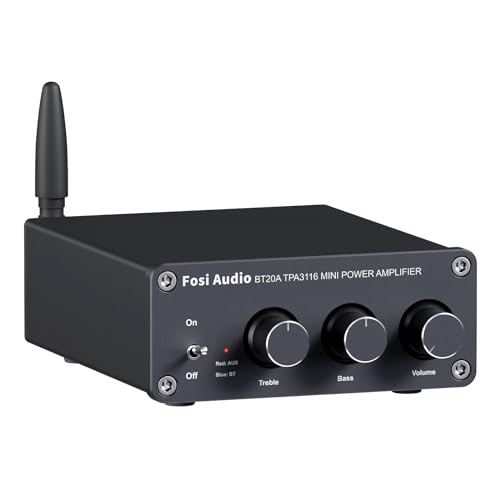
Fosi Audio BT20A Bluetooth Stereo Amplifier 200W
- ✓ Compact and stylish design
- ✓ Easy Bluetooth connection
- ✓ Powerful sound output
- ✕ Limited to 2 channels
- ✕ No remote control
| Power Output | 100W per channel (200W total) at 4 Ohms |
| Speaker Compatibility | Supports passive speakers with 4-8 Ohm impedance |
| Connectivity | Bluetooth 4.2 and RCA inputs |
| Amplifier Class | Class D |
| Design | All-black, compact, one-piece chassis |
| Controls | Bass and treble tone controls |
It’s a quiet Saturday afternoon, and I’ve just set up the Fosi Audio BT20A in my living room. I’m casually streaming a playlist from my phone via Bluetooth, and the first thing I notice is how neat and compact it is—just a small black box with a sleek, all-black finish that blends perfectly with my decor.
The setup is a breeze. I plug in my bookshelf speakers, switch it on with one touch, and I’m ready to go.
The bass and treble controls are simple to tweak, allowing me to customize the sound to my liking without any fuss. The Bluetooth connection is seamless—no dropouts or delays, which is great when I’m moving around or getting up for a snack.
What really surprises me is how loud and clear the sound gets. Even at higher volumes, there’s no distortion, and the output power easily fills my small living room.
It’s surprisingly powerful for something so compact, making it perfect for small gatherings or just enjoying music quietly in the background.
Its all-black, integrated design looks stylish on my shelf, and I appreciate how durable and sturdy it feels. Plus, the lightweight nature makes it easy to move around if needed.
For the price, it definitely punches above its weight, offering a straightforward, no-frills solution that sounds great and works effortlessly.
If you want a simple amplifier that delivers solid sound with minimal setup, the BT20A is a smart choice. It’s perfect for anyone who needs reliable audio without breaking the bank or dealing with complicated features.
Akai MPK Mini Plus – USB MIDI Keyboard Controller 37 Mini

- ✓ Compact and portable design
- ✓ Responsive RGB MPC Pads
- ✓ Extensive connectivity options
- ✕ Small keys may feel cramped
- ✕ Slight learning curve for beginners
| Number of Keys | 37 mini keys covering 3 octaves |
| Connectivity | USB MIDI, CV/Gate, MIDI I/O |
| Built-in Sequencer | 64-step sequencer with 2 tracks (drums and melodies/chords) |
| Pads | 8 RGB MPC pads with responsive feel and durability |
| Control Knobs | 8 assignable rotary knobs for tactile DAW control |
| Included Software | MPC Beats with drum samples and plugin presets; 2 months of Splice Creator plan |
When I first unboxed the Akai MPK Mini Plus, I was immediately drawn to its sleek, compact design. The 37-key mini keyboard feels surprisingly full in your hands, with just enough weight to feel sturdy but not bulky.
I noticed the vibrant RGB MPC pads, which are not only responsive but also add a splash of personality to my setup.
Setting it up was a breeze—plug in via USB, and it instantly recognized my DAW. The inclusion of advanced connectivity options like CV/Gate and MIDI I/O was a pleasant surprise, opening up possibilities for controlling modular synths and sound modules.
I loved how seamless the NKS integration was, allowing me to browse Native Instruments sound libraries directly from the controller.
The built-in 64-step sequencer is surprisingly powerful for a device this size. I used it to sketch out melodies and drum patterns without needing my computer, which felt liberating.
The transport controls made editing sessions quick and intuitive, saving me from constantly switching between keyboard and mouse.
Performance-wise, the 8 RGB MPC pads are a highlight. They’re durable, highly responsive, and perfect for finger drumming or launching clips.
The 8 assignable rotary knobs gave me full control over EQ, volume, and automation, making mixing sessions much easier. Plus, the included MPC Beats software and 2 months of Splice access add serious value for creative workflows.
Overall, the MPK Mini Plus packs a lot into a small package—ideal for producers on the move or those with limited space. It feels like a serious instrument, not just a compact controller, and it’s ready to grow with your skills.
The only downside? The small keys might take some getting used to if you’re accustomed to full-sized pianos.
What Key Features Should You Look for in an Akai Amplifier?
When searching for the best Akai amplifier, consider the following key features:
- Power Output: The power output of an amplifier is crucial as it determines how loud the sound can be without distortion. Look for amplifiers with higher wattage ratings for better performance in larger spaces or with demanding speakers.
- Connectivity Options: An ideal amplifier should have a variety of connectivity options, including Bluetooth, USB, and RCA inputs. This versatility allows you to connect different audio sources seamlessly, enhancing your listening experience.
- Sound Quality: Pay attention to the sound quality specifications, such as frequency response and total harmonic distortion (THD). A good amplifier will provide clear, balanced sound across all frequencies, ensuring an enjoyable listening experience.
- Build Quality: The durability and build quality of the amplifier are essential for longevity and performance. Look for amplifiers made from quality materials that can withstand regular use while maintaining consistent performance over time.
- Cooling System: Amplifiers generate heat during operation, so an effective cooling system is important to prevent overheating. Features such as heat sinks or fan systems can help maintain optimal performance and extend the lifespan of the amplifier.
- Size and Design: Consider the size and design of the amplifier, especially if space is limited. A compact design may be more suitable for small rooms, while a more robust design can provide better features without compromising performance.
- Remote Control: A remote control feature can greatly enhance convenience, allowing you to adjust volume and settings from a distance. This is particularly useful for home theater setups or when the amplifier is placed out of reach.
- Price and Warranty: Evaluate the price in relation to the features offered, as well as the warranty provided by the manufacturer. A good warranty can offer peace of mind and reflects the manufacturer’s confidence in their product.
How Do Different Akai Amplifier Models Compare in Performance?
| Model | Power Output | Impedance | Key Features |
|---|---|---|---|
| Akai AM-2600 | 100W per channel – Suitable for large spaces | 8 Ohms – Standard compatibility | Built-in equalizer, multiple inputs, Frequency response: 20Hz-20kHz, Weight: 10 kg, Dimensions: 430 x 320 x 120 mm, Price range: $250-$300 |
| Akai AM-2400 | 75W per channel – Ideal for home use | 4-8 Ohms – Flexible speaker matching | Compact design, remote control, Frequency response: 20Hz-20kHz, Weight: 8 kg, Dimensions: 420 x 300 x 110 mm, Price range: $200-$250 |
| Akai AM-2200 | 50W per channel – Great for small rooms | 8 Ohms – Basic compatibility | Simple interface, budget-friendly, Frequency response: 20Hz-20kHz, Weight: 6 kg, Dimensions: 400 x 280 x 100 mm, Price range: $150-$200 |
What Are the Unique Selling Points of the Akai AA-1100?
The Akai AA-1100 amplifier stands out in the audio equipment market for several compelling reasons:
-
High Power Output: The AA-1100 delivers an impressive 100 watts per channel, providing sufficient power to drive a variety of speakers, making it suitable for both home audio setups and larger gatherings.
-
Rich Sound Quality: Renowned for its warm, rich sound, the AA-1100 incorporates high-quality components that enhance audio fidelity, allowing users to experience music with clarity and depth.
-
Versatile Connectivity Options: This amplifier features multiple input channels, including phono, AUX, and tape connections, facilitating easy integration with various audio sources like turntables, CD players, and audio streaming devices.
-
User-Friendly Controls: The intuitive layout includes rotary knobs for volume and tone adjustments, ensuring effortless operation. Clear labeling enhances usability for both new and seasoned audiophiles.
-
Durable Build Quality: Designed with a robust chassis and high-quality materials, the AA-1100 offers durability that assures longevity, making it a reliable choice for ongoing use.
These attributes combine to make the Akai AA-1100 a noteworthy contender in the realm of amplifiers, catering to the diverse needs of music enthusiasts.
How Do Users Perceive Sound Quality in Akai Amplifiers?
Users perceive sound quality in Akai amplifiers through various factors that influence their listening experience.
- Clarity: The clarity of sound refers to how distinct and clean the audio output is. Users often appreciate Akai amplifiers for their ability to reproduce vocals and instruments without muddiness, allowing for a more enjoyable listening experience.
- Power Output: The power output of an amplifier affects its ability to drive speakers effectively. Users look for Akai amplifiers with sufficient wattage to ensure that sound is delivered at high volumes without distortion, making it ideal for both casual listening and larger gatherings.
- Frequency Response: This term describes the range of frequencies an amplifier can reproduce. Users value Akai amplifiers that offer a wide frequency response, enabling them to hear deep bass tones as well as crisp highs, which contributes to a fuller and richer sound profile.
- Build Quality: The physical construction of an amplifier can impact sound quality. Users often perceive Akai amplifiers as high-quality due to their robust build, which minimizes vibrations and interference, ensuring that the audio signal remains pure.
- User Interface: The ease of use and accessibility of controls can enhance the overall sound experience. Users appreciate intuitive interfaces on Akai amplifiers that allow them to quickly adjust settings for optimal sound quality tailored to their preferences.
- Connectivity Options: The variety of connectivity options available can significantly influence user experience. Users favor Akai amplifiers that offer multiple input options, including Bluetooth, USB, and traditional audio jacks, allowing for greater versatility in how they connect their devices.
What Common Issues Are Faced by Akai Amplifier Users?
Common issues faced by Akai amplifier users include:
- Overheating: Many users report that their Akai amplifiers tend to overheat during extended usage, which can lead to performance degradation and potential damage to the internal components.
- Signal Interference: Some users experience signal interference, which can manifest as unwanted noise or distortion in the audio output, often caused by poor cable quality or electromagnetic interference from other devices.
- Power Supply Issues: Users have noted occasional problems with the power supply, including failure to power on or sudden shutdowns, which can disrupt the listening experience and may require service or replacement.
- Compatibility Problems: Certain models of Akai amplifiers may not be fully compatible with all audio devices, leading to challenges in achieving optimal sound quality or functionality when connecting to various speakers or audio sources.
- Remote Control Malfunctions: Users have reported issues with remote control functionality, including unresponsiveness or delayed reactions, which can hinder the overall user experience, especially in setups that rely on remote operation.
How Can You Maximize the Lifespan of Your Akai Amplifier?
To maximize the lifespan of your Akai amplifier, consider the following practices:
- Proper Ventilation: Ensure that your amplifier has adequate airflow around it to prevent overheating, which can significantly shorten its lifespan.
- Regular Cleaning: Dust and debris can accumulate in and around the amplifier, affecting performance; regular cleaning helps maintain optimal function.
- Avoid Overloading: Do not exceed the recommended power levels, as overloading the amplifier can cause damage to its internal components.
- Use Quality Cables: High-quality cables reduce signal loss and potential damage from electrical interference, contributing to better performance and durability.
- Stable Power Supply: Use a surge protector or an uninterruptible power supply (UPS) to protect the amplifier from voltage spikes and fluctuations.
- Temperature Control: Keep the amplifier in a climate-controlled environment, avoiding extreme temperatures and humidity that could harm the electronics.
- Periodic Professional Servicing: Have your amplifier professionally checked and serviced at regular intervals to address any potential issues before they become serious problems.
Proper ventilation is crucial for preventing overheating, which can lead to thermal stress and component failure over time. Make sure your amplifier is placed in a well-ventilated area, away from other electronic devices that generate heat.
Regular cleaning not only enhances the aesthetic appeal of your amplifier but also ensures that dust does not block vents or interfere with connections. Using a soft cloth and appropriate cleaning agents can help maintain the device without causing damage.
Avoiding overloading is essential as it can strain the amplifier’s circuits, leading to premature wear or even catastrophic failure. Always refer to the manufacturer’s specifications to ensure the amplifier is used within its limits.
Using high-quality cables is vital for maintaining sound quality and reducing the risk of interference that could damage the amplifier. Investing in good cables will offer enhanced durability and performance.
Having a stable power supply protects your amplifier from damage caused by electrical surges. By using a surge protector or UPS, you can safeguard your amplifier from unexpected power fluctuations that could lead to costly repairs.
Temperature control is important, as extreme heat or humidity can damage internal components, leading to performance issues. Keeping your amplifier in a stable environment helps maintain its integrity over time.
Periodic professional servicing can catch potential problems early and ensure that your amplifier operates at peak performance. Technicians can perform detailed inspections and repairs that are not always possible for the average user.
What Do Expert Opinions Say About the Best Akai Amplifiers on the Market?
Expert opinions highlight several models as the best Akai amplifiers available on the market:
- Akai AA-1030: This classic stereo amplifier is renowned for its warm sound and robust construction, making it a favorite among audiophiles.
- Akai AM-U01: The AM-U01 is praised for its versatility and modern features, including multiple input options and a sleek design that complements contemporary setups.
- Akai AM-2600: Known for its powerful output and excellent dynamic range, the AM-2600 delivers exceptional audio quality suitable for both casual listening and critical playback.
- Akai AA-1175: This model is celebrated for its high power output and rich tonal quality, making it ideal for driving large speakers and filling larger rooms with sound.
- Akai AM-2400: The AM-2400 is appreciated for its affordability without compromising on performance, offering a well-balanced sound and good build quality.
The Akai AA-1030 has a reputation for its warm sound, which is attributed to its high-quality components and meticulous engineering. It is often recommended for vintage audio setups and is compatible with various speakers, making it a versatile option for audiophiles seeking a classic amplifier.
The Akai AM-U01 stands out due to its modern aesthetic and practical features, such as multiple inputs for different audio sources. Experts note its ability to deliver clear, crisp sound, making it suitable for both music enthusiasts and casual listeners alike.
For those who prioritize power and performance, the Akai AM-2600 is highlighted for its impressive output capabilities and dynamic sound profile. Reviewers often mention its ability to handle a wide range of musical genres, providing a rich listening experience.
The Akai AA-1175 is often recommended for larger spaces due to its high power output and capability to drive demanding speakers. Critics appreciate its robust build quality and the ability to maintain sound clarity even at higher volumes.
Finally, the Akai AM-2400 is recognized for its exceptional value, providing solid performance at a budget-friendly price. It is often suggested for those entering the world of high-fidelity audio, as it offers a well-rounded sound without a hefty investment.
Related Post: