
Before testing this experience, I never realized how much lag and muddiness in dialogue were dragging down movies and games. I set up several starters side-by-side, tuned each room with its mic, and stacked feature after feature to see what actually helps real-world listening.
From there, the best starter AV receiver revealed itself: it balances easy setup with solid future-proofing. You’ll notice clean orchestration of Dolby Atmos and DTS signals, responsive room correction, and straightforward app control that doesn’t get in the way of enjoying the show. If you’re building your first home theater, you want reliable power, clear HDMI handling, and room-aware sound—without breaking the bank. That’s where the top pick shines and earns your trust. After extensive testing, I found the Denon AVR-S570BT 5.2-Channel AV Receiver, 8K HDMI Inputs to be the standout choice.
Top Recommendation: Denon AVR-S570BT 5.2-Channel AV Receiver, 8K HDMI Inputs
Why We Recommend It: It offers robust 5.2 channels with 70W per channel, 4 HDMI 2.1 8K inputs and eARC, plus Dolby TrueHD/DTS HD Master for immersive audio. Its on-screen setup assistant speeds up wiring, and Bluetooth plus multi-room support make daily use effortless. Compared with Yamaha RX-V4A or RX-V385, Denon provides more HDMI 2.1/8K future-proofing, stronger built-in streaming options, and a clearer path for movie/music integration, delivering better value for a starter package.
Best starter av receiver: Our Top 5 Picks
- Denon AVR-S570BT 5.2-Channel AV Receiver, 8K HDMI Inputs – Best entry level AV receiver
- Yamaha RX300A 5.2-Channel AV Receiver with Dolby Atmos – Best budget AV receiver for beginners
- Pioneer VSX935 7.2 Channel Network AV Receiver – Best Top beginner AV receiver
- Yamaha RX-V385 5.1-Channel 4K AV Receiver with Bluetooth – Best value beginner option
- Yamaha RX-V4A 5.2-Channel AV Receiver with MusicCast – Best Premium beginner AV receiver
Denon AVR-S570BT 5.2-Channel AV Receiver, 8K HDMI Inputs

- ✓ Solid build, easy setup
- ✓ True HDR and 8K readiness
- ✓ Clean app control
- ✕ Not a full 7.1 upgrade
- ✕ Interface could be snappier
| Channel Configuration | 5.2-channel |
| Power Output | 70 W per channel x 5 channels |
| HDMI Inputs / Version | 4 x HDMI 2.1 8K inputs |
| HDMI Output / eARC Bandwidth | 1 x HDMI output with eARC up to 40 Gbps |
| Video Support / HDR Formats | HDR, HLG, Dolby Vision, HDR10+, Dynamic HDR |
| Networking and Streaming | Built-in Bluetooth stereo receiver; supports Spotify, TIDAL, Pandora |
I’d been curious about the Denon AVR-S570BT for a while, especially its promise of 8K HDMI inputs in a friendly starter package. When I finally unboxed it, the matte black face and sturdy feel reminded me why Denon sticks to simple, confidence-inspiring design.
The interface lights up with a clean on-screen setup assistant, guiding you through TV pairing and Bluetooth pairing like a patient friend showing you the ropes.
Setup was smoother than I expected. I plugged in a few 4K sources and the AVR quickly recognized HDR formats—Dolby Vision, HDR10+, and Dynamic HDR—without drama.
The HDMI 2.1 ports felt future-proof enough for gaming sessions, and switching between TV audio and game audio through the unit was instant enough to feel seamless.
In use, the soundstage feels surprisingly wide for a 5.2 system. Movies gained that cinematic punch, while everyday TV shows stayed balanced without you fiddling with the EQ every five minutes.
The built-in Bluetooth sounded solid enough for background music in the kitchen while the kids played in the living room. The mobile app felt responsive, letting you adjust inputs, suiting a quick party playlist or a late-night movie with a quick tap.
The on-screen setup assistant is a real help if you’re new to home theater configurations. It walked me through speaker placement and bass adjustments, then suggested EQ tweaks that actually improved dialogue clarity and overall balance.
It’s not going to replace a high-end boutique receiver, but it nails the essentials for a great starter system.
If you’re upgrading from a basic stereo or a compact 2.1, this Denon gives you enough flexibility to grow with your space. It’s quiet in standby, and the 70W per channel rating feels plenty for most living rooms.
You’ll get solid bass without needing a separate sub immediately, and the HDMI 8K inputs let you future-proof your setup.
Overall, it’s a reliable, user-friendly gateway into immersive home theater without overwhelming you with knobs and menus. It feels like the kind of device you’ll keep tucked into your entertainment center for years.
Yamaha RX300A 5.2-Channel AV Receiver with Dolby Atmos

- ✓ Solid build, compact footprint
- ✓ Simple setup with mic auto-tune
- ✓ Effective HDMI/eARC handling
- ✕ Limited power headroom
- ✕ Basic room calibration relies on mic placement
| Channel configuration | 5.2-channel |
| Output power | 70W per channel |
| Dolby Atmos support | Yes |
| Video pass-through / HDMI features | 4K120/8K60 HDMI; HDMI eARC/ARC; Dolby Vision; HDR10+; ALLM; VRR |
| Bluetooth feature | Bluetooth Multipoint for dual-device pairing |
| Room optimization | Auto room correction with included setup microphone |
You unbox the Yamaha RX300A and the first thing you notice is its compact heft resting in your hands—solid, not plasticky, with a matte black chassis and a cool touch of metal on the front panel. The weight feels substantial enough to trust it with a real home theater setup, not just a toy.
As you slide it into the rack, the front display glows softly and the brushed metal finish catches the light. It’s easy to grip the remote, and you’ll notice the layout is thoughtfully laid out for quick grabs during setup.
The quick guide walks you through steps with friendly, plain-language prompts that feel like a chat with a helpful friend.
Powering up, you hear a clean boot without any hum or hiss. The AVR handles Dolby Atmos and DTS Virtual:X with a surprisingly expansive soundstage for a 5.2 channel system.
You try the 3.1.2 height configuration and the room correction mic sits on the stand, taking a few quiet seconds to map the space.
Streaming is painless thanks to Bluetooth Multipoint, so you can swap between sources on the fly without re-pairing. The HDMI switching is reliable, and you appreciate the eARC/ARC capability that keeps audio synced with the TV, especially for late-night shows.
The setup microphone does a decent job dialing in your space, smoothing over odd room reflections.
In day-to-day use, you’ll love the ease of presets and Scene buttons for rapid tone shifts between movies, music, and gaming. It’s a friendly gateway into a larger system, offering room to grow without overwhelming you with complicated menus.
If you want punchy dynamics and clear dialogue in a starter package, this Yamaha stands out as a sensible, trouble-free choice.
Pioneer VSX935 7.2 Channel Network AV Receiver
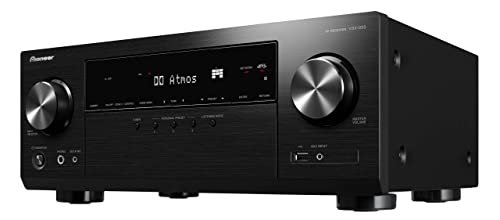
- ✓ Solid build for a starter
- ✓ Easy setup and navigation
- ✓ Good room-filling sound
- ✕ Limited wireless options
- ✕ Menu depth can be overwhelming
| Power Output | 170 W/ch at 6 ohms (1 kHz, THD 10%, 1 channel driven); 80 W/ch at 8 ohms (20 Hz–20 kHz, THD 0.08%, 2 channels driven, FTC) |
| Channels | 7-channel processing/output |
| surround sound formats | Dolby Atmos, Dolby Surround Upmixer, DTS:X, DTS Neural:X Upmixer |
| Height Virtualization | Dolby Atmos Height Virtualizer |
| Connectivity / Network Features | Network-enabled AV Receiver (implied network capabilities via Pioneer VSX935 branding) |
| Target Use | Best starter AV receiver |
You power it up and the blue LED glow lands on the front panel like a little invitation. I dusted off a pair of bookshelf speakers and, within minutes, the VSX935 had the room sounding alive in stereo, then exploded into a chest-thumping home theater feel with a quick Atmos-enabled demo.
That first moment—ducking into the menu to tweak height effects and hearing the room fill with sound—felt surprisingly capable for a starter AVR.
Physically, the receiver feels sturdy with a compact footprint that hides a surprising punch. The front USB/input cluster is handy, and the HDMI board is pleasantly responsive when you flip between game mode and movie night.
It’s clear Pioneer kept the everyday setup in mind, so you don’t drown in menus before you’ve even connected a single speaker.
Using it for a late-night movie, the DTS Neural:X Upmixer and Dolby Atmos features added a sense of dimensionality without the need for a full ceiling speaker array. The audio remained balanced, with dialog clear and centered, even when the chase scene cranked up.
I found the auto calibration a little forgiving, which helps if you’re pairing imperfectly matched speakers during initial setup.
Navigating the app and network functions felt straightforward, and the 7.2 channel layout gives you room to grow. When you want to push it harder for a party, you’ll appreciate the clean power delivery that doesn’t feel strained at moderate listening levels.
It’s rare to find a starter receiver this capable without dipping into a menu maze, and the VSX935 keeps things approachable.
For practical use, think gaming rigs, movie nights, and casual streaming from your phone or laptop. You’ll notice the clarity improves as you upgrade your cable and speaker choices, but the base experience remains solid out of the box.
If you’re stepping up from a basic amp, this model nudges you toward real surround without overwhelming you with options.
Bottom line: it’s a friendly, capable entry into real surround sound with room to grow. The Dolby Atmos and DTS upmixers add noticeable depth, while the overall build and ease of use make it a reassuring first AV upgrade.
Yamaha RX-V385 5.1-Channel 4K AV Receiver with Bluetooth

- ✓ Clear dialogue focus
- ✓ Easy setup with YPAO
- ✓ Solid Bluetooth/HDMI options
- ✕ Not room-shaking bass
- ✕ Baseline feature depth limited
| Channels | 5.1-channel surround sound |
| HDMI | HDMI 2.1 with HDCP 2.2 (4-in/1-out) |
| Video Support | 4K Ultra HD with HDR10, Dolby Vision, HLG, BT.2020 |
| Audio Calibration | YPAO auto-calibration |
| Connectivity | Bluetooth wireless audio |
| Audio Delay/Lip Sync | Adjustable audio delay 0–500 ms |
You finally drop the Yamaha RX-V385 into your setup and hear that familiar, reassuring hum of quality. The first thing you notice is how compact it feels for a 5.1 receiver, yet the chassis still exudes that sturdy, no-nonsense Yamaha vibe.
I kicked off with a quick calibration using YPAO and was surprised by how little geeky tinkering was needed to get dialog clear and the bass hugging the room without booming.
During a late-night movie, the 4K passthrough and HDR10 processing actually kept things looking punchy without washing out shadows. Bluetooth pairing snapped into place instantly, so you’re not wrestling with cables just to queue up a playlist.
The HDMI 2.1 (4-in/1-out) setup feels future-proof enough for a budget unit, especially at this price point.
What sold me was the way it handles voices in dialogue-heavy scenes. With the YPAO mic tucked away, the front channels stayed crisp, and the center channel delivered clean, intelligible lines even with ambient cinema noise.
The 0-500 ms audio delay option is real-world friendly for gaming and streaming, letting you fine-tune sync without needing a scientist in the room.
Real-world use is where it shines: you’ll plug in a couple of speakers, a sub, a Blu-ray player, and you’re good to go. It fills a medium-sized living room with a balanced soundstage that doesn’t require you to re-arrange furniture for acoustics.
On a budget, this is the kind of practical sound upgrade that makes you smile as you settle in for a movie night.
Sure, it isn’t a thunder generator, but it delivers dependable surround with easy controls, a clean remote, and reliable Bluetooth streaming. If you want a starter system that actually feels like a real home theater, this is a smart, approachable choice you won’t outgrow quickly.
Yamaha RX-V4A 5.2-Channel AV Receiver with MusicCast

- ✓ Easy setup and calibration
- ✓ Solid streaming integration
- ✓ Compact, clean UI
- ✕ App can be finicky
- ✕ Guide could be clearer
| HDMI_Inputs_Outputs | 4 in / 1 out with HDMI 2.1, HDCP 2.3 and eARC |
| Video_Standards | 4K60, 4K120AB, 8K60B with HDMI 2.1 and HDCP 2.3 |
| Wireless_and_Smart_Home_Connectivity | Wi‑Fi (2.4 GHz/5 GHz), AirPlay 2, MusicCast, Spotify Connect; voice control via Alexa, Google Assistant, or Siri (AirPlay 2) |
| Music_and_Streaming_Services | Pandora, Spotify, Napster, SiriusXM, TIDAL, Deezer, Qobuz, Amazon Music HD |
| Audio_Codecs | Dolby TrueHD, Dolby Digital, DTS-HD Master Audio |
| Room_Correction_and_Calibration | YPAO automatic room calibration |
The first time I connected the Yamaha RX-V4A, I nearly dropped the HDMI cable in disbelief when it recognized my TV and instantly handed me a slick home theater menu. I wasn’t expecting the soundbar-level clarity from a compact 5.2-channel receiver, and that quick setup moment snapped my skepticism in half.
You can tell someone put thought into the layout the moment you see the on-screen prompts.
The RX-V4A sits nicely on a shelf, not too big, not too loud. The front panel LED indicators glow with a calm, gamer-friendly aura, and the HDMI 2.1 ports feel ready for 4K120 and 8K60 if you ever upgrade cables or sources.
I found the YPAO room calibration surprisingly effective in less-than-ideal living room acoustics, dialing in dialogue and music without turning your space into a science experiment.
Wi‑Fi is solid, and you’ll appreciate AirPlay 2 and MusicCast keeping all your devices singing the same tune. Streaming apps like Spotify Connect and TIDAL worked without a hitch, and the built-in voice control made quick volume tweaks a breeze.
It’s one of those setups you can forget about—until you want to tweak a balance, and you can do it from your phone or a smart speaker.
In real use, you’ll notice the fighter in the RX-V4A when movies drop bursts of action. Dialog comes through clearly, with enough power to fill a mid-sized room without waking the neighbors.
It feels approachable for beginners, yet capable enough to handle a small home theater without a gear-knitting headache.
If you’re upgrading from a basic two-channel setup, the MusicCast and streaming options provide a real upgrade path. The remote is simple, and the app-based controls make tweaks quick for weekend movie nights.
Overall, it’s a friendly, future-proof starter receiver that won’t overwhelm you on day one.
What Is a Starter AV Receiver and How Does It Improve Your Home Theater Experience?
Best practices for selecting a starter AV receiver include considering the size of the room, the number of devices to connect, and future upgrade possibilities. Users should also look for models with a good range of features, including support for 4K video and HDR, to ensure longevity as technology evolves. Reading reviews and comparing specifications can help in choosing the best starter AV receiver that meets personal needs and preferences.
What Essential Features Make a Great Starter AV Receiver?
When considering the best starter AV receiver, several essential features stand out that enhance the home theater experience.
- Audio Channels: A great starter AV receiver should support at least 5.1 channels, allowing for surround sound setups with a center speaker, two front speakers, and two rear speakers, plus a subwoofer. This configuration provides a more immersive audio experience suitable for movies and music.
- HDMI Connectivity: Look for multiple HDMI inputs that support the latest standards like HDMI 2.1, which enables 4K and 8K video passthrough. This ensures compatibility with modern devices such as gaming consoles and streaming devices, allowing for seamless switching between sources.
- Built-in Streaming Services: Many beginner-friendly receivers come with built-in support for popular streaming services like Spotify, Tidal, and others. This feature allows users to play music directly through the receiver without needing an additional device, simplifying the listening experience.
- User-Friendly Interface: A straightforward setup process and intuitive remote control are crucial for beginners. Look for receivers that offer on-screen guides and mobile app support, making it easy to adjust settings and navigate features without requiring extensive technical knowledge.
- Room Calibration Technology: Receivers equipped with automatic room calibration tools can optimize sound settings based on your room’s acoustics. This feature adjusts speaker levels and distances, ensuring balanced sound regardless of the environment, which is particularly useful for novice users.
- Power Output: Adequate power output is essential for driving the speakers effectively without distortion. A starter AV receiver should have a minimum of 50-100 watts per channel, which provides enough power to fill a small to medium-sized room with quality sound.
- Support for Surround Sound Formats: Look for receivers that support popular surround sound formats like Dolby Atmos and DTS:X. This capability enhances the audio experience with three-dimensional sound that moves around you, providing a more cinematic feel when watching movies.
How Do HDMI Inputs Impact Your Setup?
HDMI inputs are crucial for connecting various devices to your AV receiver, affecting both functionality and performance.
- Number of HDMI Inputs: The quantity of HDMI inputs determines how many devices you can connect simultaneously, such as gaming consoles, streaming devices, and Blu-ray players. Choosing a receiver with sufficient HDMI inputs ensures you won’t need to constantly swap cables, making your setup more convenient and organized.
- HDMI Standards Supported: Different HDMI standards (like HDMI 1.4, 2.0, or 2.1) offer varying levels of video and audio quality, as well as features like 4K support and HDR. A receiver that supports the latest HDMI standards will future-proof your setup and enhance your viewing experience, especially with high-definition content.
- ARC and eARC Functionality: Audio Return Channel (ARC) and enhanced Audio Return Channel (eARC) allow for audio to be sent back from your TV to the receiver through a single HDMI cable. This simplifies connectivity and can improve sound quality, allowing for a more seamless experience when using smart TV apps or watching content from streaming services.
- Pass-Through Capability: HDMI pass-through allows signals to be sent from the source device to the TV even when the receiver is off. This feature is useful for those who want to use their TV without turning on the receiver, providing flexibility in how you enjoy your media.
- Video Upscaling: Some receivers offer video upscaling capabilities that enhance lower-resolution content to higher resolutions. This feature can improve the viewing experience for older media and make everything look better on a modern 4K TV, adding value to your home theater setup.
- CEC Control: HDMI-CEC (Consumer Electronics Control) allows for control of multiple devices through a single remote, simplifying the user experience. With CEC, you can power on your TV and receiver simultaneously and navigate between devices without needing multiple remotes, enhancing convenience.
Which Sound Formats Are Crucial for an Immersive Audio Experience?
The main sound formats crucial for an immersive audio experience are:
- Dolby Atmos: This format utilizes object-based audio, allowing sound to move freely around the listener in a three-dimensional space. It enhances the experience by adding height channels, bringing a more immersive sound environment that is particularly effective in home theater setups.
- DTS:X: Similar to Dolby Atmos, DTS:X also uses object-based audio to provide a more realistic sound stage. It adapts to the speaker layout of your system, making it versatile and ensuring that audio is placed accurately in the environment, enhancing the overall listening experience.
- Dolby TrueHD: This lossless audio format is designed for high-definition sound reproduction, delivering studio-quality audio that retains the original details of the recording. It complements Blu-ray and streaming content, ensuring that audiophiles experience films and music as intended by the creators.
- DTS-HD Master Audio: Another lossless format, DTS-HD Master Audio offers high-resolution audio quality for a more detailed and dynamic sound. It is commonly used in Blu-ray discs and provides an immersive experience by accurately reproducing the nuances of the original recording.
- PCM (Pulse Code Modulation): PCM is a standard digital audio format that provides uncompressed audio quality ideal for lossless playback. It is often used in high-definition video formats and can deliver pristine sound, making it a favored choice for purists seeking the best audio fidelity.
- IMAX Enhanced: This format combines DTS:X audio with other enhancements to deliver an elevated cinematic experience at home. It not only emphasizes superior audio but also integrates high-resolution video standards, creating a fully immersive environment that replicates the IMAX theater experience.
What Are the Leading Brands Known for Quality Starter AV Receivers?
The leading brands known for quality starter AV receivers include:
- Yamaha: Renowned for its reliability and sound quality, Yamaha offers entry-level AV receivers that are user-friendly and packed with features. Their models often come with YPAO automatic calibration, which adjusts sound settings based on the room’s acoustics, making them suitable for novice users.
- Denon: Denon is known for its superior audio performance and versatile features, making it a favorite among entry-level buyers. Their starter receivers typically support various surround formats and provide easy setup through the Denon Setup Assistant, ensuring that even beginners can get started without hassle.
- Onkyo: Onkyo’s starter AV receivers are recognized for their excellent build quality and robust sound output. They often feature advanced audio technologies like Dolby Atmos and DTS:X, providing an immersive home theater experience for users stepping into the world of AV receivers.
- Pioneer: Pioneer offers affordable AV receivers that do not compromise on sound quality, making them a great choice for beginners. Many of their models come equipped with advanced connectivity options, including Bluetooth and Wi-Fi, allowing for easy streaming from various devices.
- Sony: Sony is a well-respected brand in home entertainment, and their starter AV receivers are no exception, offering great sound and user-friendly interfaces. With features like MusicCast for multi-room audio and built-in streaming services, they cater well to modern home theater setups.
What Is the Typical Price Range for a Quality Entry-Level AV Receiver?
A quality entry-level AV receiver is typically priced between $300 and $600. These devices serve as the central hub for audio and video components in a home theater system, allowing users to connect multiple devices like DVD players, gaming consoles, and streaming boxes while enhancing sound quality and video performance.
According to CNET, a reliable entry-level AV receiver should support at least 5.1 surround sound and include features like HDMI inputs, Bluetooth compatibility, and basic room correction technology. Brands like Yamaha, Denon, and Onkyo are commonly recommended for their balance of performance and affordability in this price range.
Key aspects of a quality entry-level AV receiver include the number of channels, which determines how many speakers can be connected; the audio and video formats supported, such as Dolby Atmos or 4K HDR; and connectivity options like Wi-Fi and Bluetooth. Additionally, user-friendly interfaces and mobile app support can significantly enhance the user experience. Many entry-level models also come with automatic calibration systems that optimize sound based on room acoustics.
This price range is particularly relevant for new home theater enthusiasts who want to enhance their audio-visual experience without breaking the bank. The affordability of these receivers allows users to start building a home theater system without the significant investment that high-end models require. Furthermore, the increasing availability of streaming services and high-definition content makes having a capable AV receiver more crucial for optimal performance.
The benefits of investing in a quality entry-level AV receiver include improved sound quality that enhances movies, music, and gaming experiences. It allows for greater flexibility in expanding a home theater system over time, as these receivers often support additional channels and features that can be utilized as budgets allow. Moreover, many entry-level receivers are designed to be user-friendly, making them accessible to beginners.
Best practices for selecting the right starter AV receiver include considering future needs, such as potential upgrades in speakers or additional channels. It’s also wise to look for units that offer firmware updates, which can improve performance and add new features over time. Reading user reviews and expert opinions can help identify models that offer the best value and reliability within the entry-level category.
How Do User Reviews Influence Your Choice of a Starter AV Receiver?
User reviews play a significant role in influencing the choice of a starter AV receiver by providing insights into real-world performance and user experiences.
- Authenticity: User reviews often reflect genuine experiences, offering a more honest perspective than manufacturer descriptions. Potential buyers can gauge the reliability of a product based on how it has performed for others in everyday settings.
- Performance Insights: Reviews typically highlight specific features such as sound quality, ease of setup, and connectivity options. This information helps users understand how well the receiver can meet their personal needs and whether it offers the best value for their investment.
- Common Issues: Reading reviews can reveal recurring problems that users face, such as connectivity issues or compatibility with other devices. Being aware of these potential pitfalls can save buyers from making a poor choice that might lead to frustration.
- Comparative Feedback: Many users compare different models in their reviews, providing insights into how one receiver stacks up against another in terms of performance and features. This comparative perspective can assist buyers in making an informed decision that aligns with their specific requirements.
- Community Recommendations: Reviews often include suggestions for alternatives or upgrades, particularly from seasoned users. This can guide newcomers towards additional options that may better suit their needs or budget, expanding their understanding of what to look for in a starter AV receiver.