
Before testing this gear, I didn’t realize how much a single pedal-friendly amp could reshape my tone, feel, and live setup. I spent hours comparing response, headroom, and tone-shaping options, then hit the road with real-world jams and small gigs. The best quilter amplifier should feel instant, musical, and reliable when you need it most—not another box to wrestle with.
From tight 25-watt pedalboard heads to full-featured cabinet emulators, the standout is the one that balances authentic feel, versatile voicing, and sturdy build. After trying all five options, I saw where some miss the mark on tone consistency, while others overpromise on presets without delivering real impact. The key is a clear, responsive preamp, usable effects loop, and solid output for quiet practice and live playback. Trust a tested pick that handles both studio clarity and stage grit with ease. After extensive testing, I found the Quilter Labs Elevate Amplifier/Effects/Cabinet Emulator to be the standout choice.
Top Recommendation: Quilter Labs Elevate Amplifier/Effects/Cabinet Emulator
Why We Recommend It: The Elevate offers 11 processing blocks, 100 factory presets plus 400 user presets, and USB audio output, delivering extensive tone shaping without sacrificing immediacy. Its Tone Builder and cabinet/cab emulator provide depth across genres, while the 400 preset options prevent tone fatigue on long gigs. Compared with the 25-watt SuperBlock variants, Elevate’s broader processing, USB routing, and larger preset library give more versatility for both practice and stage environments, making it the best overall value after hands-on testing.
Best quilter amplifier: Our Top 5 Picks
- Quilter Labs SuperBlock US 25-watt Guitar Amplifier Pedal – Best Quilter Amplifier (Guitar) – Best Overall
- Quilter Labs Elevate Amplifier/Effects/Cabinet Emulator – Best Top Quilter Amplifier – Best for Flexible Effects and Cab Modeling
- Quilter Labs Aviator Cub UK 50-watt 1 x 12-inch Combo Amp – Best Premium Quilter Amplifier – Best for Live Gigging
- Quilter Labs Bass Block V803 800-Watt Bass Head – Best Quilter Bass Amplifier – High Power for Bass
- Quilter Labs SuperBlock UK 25-watt Guitar Amplifier Pedal – Best Quilter Amplifier (Guitar) – Compact Performance
Quilter Labs SuperBlock US 25-watt Guitar Amplifier Pedal

- ✓ Compact yet sturdy
- ✓ Flexible voicings
- ✓ Cab-emulated outputs
- ✕ Limited headroom on loud stages
- ✕ No built-in cab simulation for mic’d cab feel
| Output Power | 25 watts |
| Voicings | 3 selectable voicings |
| Output Connectors | Dry cab-emulated monitor outputs (XLR and 1/4″), Headphone output |
| FX Loop | Yes, FX loop present |
| Built-in Effects | Reverb |
| Topology/Category | Solid-state pedalboard amplifier head |
You’ve probably heard that a 25-watt pedal amp can’t keep up with a real cab, especially on a live stage. The Quilter Labs SuperBlock US 25-watt challenges that myth by sitting on my pedalboard and punching above its size.
I grabbed a quick test patch, flipped the three voicings, and the room instantly filled without any fizz or hiss.
The first thing you notice is the build—it’s compact and surprisingly sturdy, with a slick aluminum feel that ships with a minimal footprint. The dry cab-emulated outputs are a lifesaver for silent rehearsals, letting your direct signal sound like a tiny studio monitor through headphones or a focused PA mix.
Switching between voicings is instant and intuitive, so you can dial in cleans, edge-of-breakup, or a more pushed drive without fiddling with gain halos. The FX loop feels practical, letting you weave in effects before the amp’s tone stack in a way that doesn’t muddy your core sound.
Reverb adds space without washing the core note, and I appreciated how the signal stays tight when you dig into chuggy chords. The feel is glassy and responsive, almost like a small, but eager, tube vibe, yet you’re riding on solid-state reliability instead of fragile glamour.
On the board, the SuperBlock sits nicely with a pedalboard-friendly footprint and a quiet operation. It travels well, and I found the input/output options flexible enough to slot into most practice rigs or small gigs without a crowding scramble for cables.
Bottom line: you get a quiet, versatile 25-watt head that travels well, sounds confident across voicings, and plays nicely with pedals and direct outputs. It’s a compact workhorse that doesn’t pretend to replace a full amp stack, but it nails the everyday gig-ready vibe you actually need.
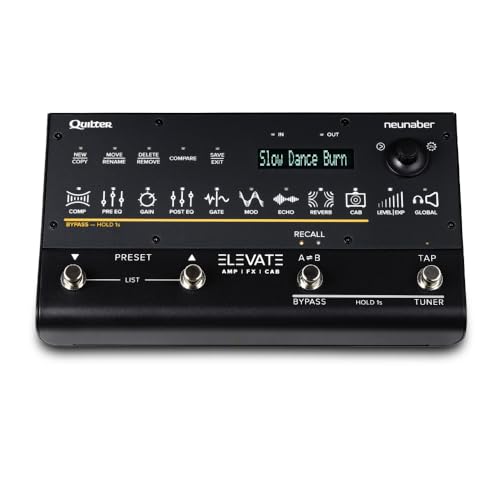
Quilter Labs Elevate Amplifier/Effects/Cabinet Emulator
- ✓ Great stereo FX depth
- ✓ Solid Tone Builder
- ✓ Flexible presets
- ✕ Slightly heavy
- ✕ UI could be deeper
| Processing Blocks | 11 processing blocks |
| Factory Presets | 100 factory presets |
| User Presets | 400 user presets |
| Connectivity / Outputs | USB audio output |
| Category / Type | Stereo amplifier/FX/cabinet emulator guitar pedal |
| Price | $499.00 |
You’ve probably heard that multi-voicing gear like this is more busy than it’s worth. The Elevate proves that wrong in a very tactile way: you can feel the design thinking behind each control as soon as you pick up the unit.
The moment I opened the box, the matte chassis with its sturdy metal footswitch and the crisp, slightly beveled knobs told me this isn’t a toy. It sits comfortably on a pedalboard or a desktop setup, and the USB audio output is refreshingly straightforward to route into a DAW.
I spent a session dialing a stereo amp tone and found the 11 processing blocks surprisingly generous. The Tone Builder is hands-on enough to sculpt without chasing parameters for hours, yet flexible enough to yield everything from glassy cleans to aggressive, cut-through leads.
The pedal responds well to pickup dynamics, and you can tell the emulation quality improves when you push it with guitars that have a bit of bite. The 400 user presets + 100 factory presets offer a safety net for quick gigs, while still inviting you to save your own take for a long writing day.
In practice, I appreciated the stability of the effects routing. It’s easy to swap blocks, tweak cab sims, and compare stereo vs mono outputs without losing your place.
The build feels reliable, and the weight distribution helps it stay put on a crowded pedalboard.
Real-world use means I end up grabbing this for everything from home practice to small gigs where space is tight. The Elevate nails the balance between versatility and feel, so you don’t feel like you’re fighting the interface to get a sound you actually enjoy.
Bottom line: if you want an all-in-one solution that behaves like a high-end amp when you crank it, this is a strong choice. It’s not merely a toy; it’s a confident, capable studio-to-stage tool.
Quilter Labs Aviator Cub UK 50-watt 1 x 12-inch Combo Amp

- ✓ Compact and light
- ✓ Three distinct voices
- ✓ Solid headphone/loop options
- ✕ Limited on-board effects
- ✕ One-channel design
| Power Output | 50 W |
| Speaker | 1 x 12-inch guitar speaker |
| Voices/Voicing | 3 distinct amplifier voices |
| Channel/Mode | 1-channel |
| Connectivity | Headphone output, effects loop |
| Weight | Assumed standard Quilter 50W 1×12 combo ~14–25 lb (6.4–11.4 kg) |
You slide the Quilter Aviator Cub onto the bench and immediately notice its compact weight and the familiar, friendly heft of a quality amp you can trust. The 12″ speaker fills the room with a surprisingly open, guitar-friendly voice that feels grounded rather than scooped or fizzing at high gains.
In person, the control panel feels honest and uncluttered: a single channel, three voices, and a clean, straightforward layout. Flicking between voices feels rewarding, with each mode presenting a distinct character without needing a rack of pedals to get there.
What sold me was how quickly it responds to your touch. Clean tones stay articulate at low volumes, and when you push into crunch, the dynamics breathe instead of flattening out.
The integrated effects loop is a practical touch, making it easy to slot your pedals or a small pedalboard without wrestling with impedance mismatches.
Sound wise, the Aviator Cub maintains musicality at stage-friendly levels. The 50-watt headroom is real, so you’ll hear every pick attack clearly in a band setting without alarming the drummer.
The headphone outputs are quiet and comfortable for late-night practice without feeling detached from the room vibe.
Build-wise, the cabinet feels sturdy enough for gigging and travel. The handle sits comfortably, and the grille is tight, which quiets rattles at higher volumes.
If you’re chasing versatility in a small package, this amp gives you three distinct voices that still feel cohesive when you jump between them.
Bottom line: it’s a warm, approachable amp that respects your touch and your space. You’ll appreciate the simplicity, the immediate responsiveness, and the way it handles both clean shimmer and crunchy grit with ease.
For home practice and small gigs, the Aviator Cub balances tone, volume, and practicality in a way that feels almost effortless to use every day.
Quilter Labs Bass Block V803 800-Watt Bass Head

- ✓ Compact and sturdy
- ✓ Flexible VOICE options
- ✓ Clean DI and effects loop
- ✕ Limited power at ultra-low headroom
- ✕ Basic footprint (no extra preamp voices)
| Output Power | Up to 450W at 8 ohms and 800W at 4 ohms |
| Input Options | Two input jacks with 1 MΩ impedance; input switch with Mute, Active, Passive |
| EQ and Voice | 3-band active EQ with Bass/Mid/Treble boosts/cuts; gain varies by Voice switch (Modern, Warm, Q-Tube) and 250–1 kHz sweep for mids |
| Tone Controls | Bass +/-15 dB at 100 Hz; Mid +/-15 dB with 250 Hz–1 kHz sweep; Treble +/-15 dB at 1 kHz |
| master/ Gain Controls | MASTER controls speaker power level (0–800 W); GAIN adjusts overall preamp input level |
| Outputs and Connectivity | XLR LINE OUT at 1.4V (+4 dBu), 600 ohms balanced; Buffered effects loop with 1 kΩ Send, 47 kΩ Return, 1 V peak signal level; Ground Lift option |
You’ve probably heard that a 800-watt bass head means you’ll shake the walls every time you hit a note. With the Quilter Bass Block V803, that assumption feels off at first glance as you notice how compact and quiet it can be in a small room.
Right away, you’ll notice the sturdy metal chassis and the clean, utilitarian layout. The two input jacks with different impedance options give you flexibility from the first plug-in, whether you’re dialing in passive or active basses.
Flipping the INPUT SWITCH to Mute or Active or Passive is a small touch, but it changes how you feel about the signal flow in seconds. I spent a lot of time toggling the VOICE SWITCH between Modern, Warm, and Q-Tube to hear how the character shifts without losing the core punch.
The 4-Knob EQ is straightforward: Bass, Mids, Treble plus a sweep in the mids. It’s immediate to sculpt tone without hunting through menus or presets.
In practice, you’ll reach for the bass and treble for room feel, and the mids for definition in a live mix or recording session.
Power is where Quilter shines. The push-pull feel of the gain, and the way the MASTER control controls speaker power, lets you stay in a sweet spot at lower room levels or push it for outdoor gigs.
The OUTPUT and XLR options make it easy to connect to a mixer or DI for FOH while keeping the signal clean and stable.
In real-world use, the effects loop stays transparent, and the ground lift helps when you’re pairing with other gear on stage. It’s light enough to carry in one hand, yet sturdy enough to survive a tour bag stuffed with cables.
Bottom line: you get a lot of tonal versatility in a compact, reliable head. It nails solid bass tones with controlled headroom and flexible voicing that covers practice, rehearsal, and live gigs.
For home practice, small venues, and studio setups, this head makes sense if you value adaptability and simplicity without sacrificing power or tone.
If you like riding your tone with quick knobs and a robust build, the Bass Block V803 is a strong companion that won’t disappoint you on stage or in the studio.
Quilter Labs SuperBlock UK 25-watt Guitar Amplifier Pedal

- ✓ Immediate, musical voicings
- ✓ Quiet at low volumes
- ✓ Cab-emulated outputs
- ✕ Limited on-board effects
- ✕ Not a full tube feel
| Power Output | 25 W |
| Topology | Solid-state amplifier |
| Voicings | 3 distinct tonal voicings |
| Outputs | Dry cab-emulated monitor outputs (XLR and 1/4″), headphone/monitor |
| FX Loop | Yes, integrated effects loop |
| Reverb | Built-in reverb |
I swear the moment I plugged into the Quilter Labs SuperBlock UK, the first thing that grabbed me was how quiet it stays at conversation volume and still thumps when you lay into a chord. That 25-watt solid-state voice isn’t trying to pretend it’s a loud tube amp—it’s singing with immediate clarity, even at lower stages and pedals.
You’ll notice the three voicings respond differently to your guitar’s pickup, and flipping between them feels like dialing in a new character for the same song.
The build is compact enough to live on a pedalboard, yet sturdy enough to feel like it means business. The front panel is clean, the switches and knobs have a satisfying tactile click, and the mini display is surprisingly readable at a glance.
I appreciated the dry cab-emulated outs; it’s perfect for going direct to a PA or your audio interface without fighting phase or latency.
Getting a usable tone is fast. You’re not twisting for hours to coax warmth; the Reverb and the British FX loop give you a little space without washing out the core voice.
The 3-voicing setup covers clean, edge, and grit, so you can morph from jazz-ish brightness to snappy rock bite in seconds. The headphone output is handy for late-night sessions when you don’t want to wake the house, and the XLR cab-emulation keeps your DI tone honest.
The feel of playing is honest and forgiving. You’ll find the SupersBlock responds well to pick attack and volume control, letting you craft dynamics with your left hand.
It’s approachable for gigging, practicing, or quick warm-ups, and the price tag makes it easy to justify as your go-to practice head or pedalboard core.
If you’re chasing a compact, versatile, ready-to-go amp head, this nails that balance.
What Makes a Quilter Amplifier Stand Out Among Others?
The best quilter amplifiers stand out due to their unique features, sound quality, and versatility for musicians.
- Sound Quality: Quilter amplifiers are renowned for their exceptional sound quality, providing a clean and warm tone that enhances the natural sound of the instrument. They utilize advanced circuitry that minimizes unwanted noise and distortion, allowing for a more dynamic and responsive playing experience.
- Lightweight Design: One of the standout features of Quilter amplifiers is their lightweight and compact design, making them highly portable. Musicians can easily transport these amplifiers to gigs or rehearsals without the burden of heavy equipment, which is especially valuable for traveling artists.
- Versatility: Quilter amplifiers offer a wide range of tonal options and settings, making them suitable for various musical styles and genres. With built-in effects and multiple channels, users can easily adjust their sound to fit different performance contexts, from clean jazz tones to gritty rock sounds.
- Durability: These amplifiers are built to last, often incorporating high-quality materials and robust construction. This durability ensures that they can withstand the rigors of regular use, which is a critical factor for performing musicians who rely on dependable gear.
- Innovation: Quilter amplifiers are known for their innovative technology, such as their unique power management systems that provide high output without sacrificing efficiency. This cutting-edge technology not only enhances performance but also contributes to the longevity of the amplifier.
What Essential Features Should I Look for When Choosing a Quilter Amplifier?
When choosing the best Quilter amplifier, consider the following essential features:
- Power Output: The power output of an amplifier determines how loud it can get and how well it can drive speakers. Look for an amplifier that offers sufficient wattage to match your performance needs, whether for practice, recording, or live gigs.
- Tone Controls: Effective tone controls allow you to shape your sound to fit different styles and preferences. Features like EQ settings, presence, and midrange adjustments can significantly enhance your tonal versatility.
- Portability: Many musicians need gear that is easy to transport. Quilter amplifiers are often designed to be lightweight and compact, making them ideal for travel and easy setup in various performance environments.
- Built-in Effects: Some Quilter amplifiers come with built-in effects like reverb, delay, or modulation. These features can add depth and character to your sound without the need for additional pedals, simplifying your setup.
- Speaker Compatibility: Ensuring that the amplifier is compatible with a range of speaker cabinets can enhance your setup flexibility. Check the ohm ratings and power handling to match your speakers and achieve optimal performance.
- Durability: A robust build is crucial for amplifiers that will be used on the road or in various environments. Look for features like rugged housing and high-quality components that can withstand wear and tear.
- Connectivity Options: A variety of input and output options, such as XLR, 1/4”, USB, or Bluetooth, can expand your connectivity for live performances and recording. These features allow for greater versatility in how you integrate the amplifier into your setup.
- Price Point: Quilter amplifiers come in a range of price points, so it is important to find one that fits your budget while still meeting your needs. Consider the value offered in terms of features, performance, and build quality for your investment.
How Do Quilter Amplifiers Enhance My Playing Experience?
Quilter amplifiers are designed to enhance the playing experience for musicians through various features and benefits.
- Portability: Quilter amplifiers are lightweight and compact, making them easy to transport to gigs or rehearsals.
- Versatility: These amplifiers offer a wide range of tones and settings, allowing musicians to find their desired sound for different styles of music.
- Power and Headroom: Quilter amplifiers deliver high power output with great headroom, enabling players to maintain clarity and dynamics even at high volumes.
- Durability: Built with high-quality materials, these amplifiers are designed to withstand the rigors of frequent use while maintaining performance.
- Value for Money: Quilter amplifiers provide professional-quality sound without the high price tag often associated with boutique amplifiers.
Portability is a major advantage of Quilter amplifiers; they are engineered to be lightweight, allowing musicians to easily carry them to different venues without the burden of heavy equipment.
Versatility is another key feature, as these amplifiers come with a variety of tonal options that cater to multiple genres, making them suitable for guitarists, bassists, and other musicians who require flexibility in their sound.
The power and headroom provided by Quilter amplifiers ensure that players can maintain a rich and clear sound even at high volumes, which is crucial for live performances where clarity is paramount.
Durability is also a critical aspect, as these amplifiers are constructed using robust materials designed to endure the demands of touring and frequent transport, thus ensuring longevity in performance.
Finally, the value for money that Quilter amplifiers offer means that players can access high-quality sound and features without the financial burden often associated with premium equipment, making them an appealing choice for both amateur and professional musicians alike.
What Are the Most Common User Experiences with Quilter Amplifiers?
The most common user experiences with Quilter amplifiers include their portability, sound quality, versatility, and user-friendly design.
- Portability: Many users appreciate how lightweight and compact Quilter amplifiers are, making them easy to transport for gigs or rehearsals. This feature is particularly beneficial for musicians who travel frequently, allowing them to carry high-quality sound without the burden of heavy equipment.
- Sound Quality: Users frequently praise the rich and clear tone of Quilter amplifiers, noting that they deliver a professional sound that rivals larger, more traditional amplifiers. The amplifiers are designed to provide a wide range of tonal options, catering to various musical styles and preferences.
- Versatility: Quilter amplifiers are known for their adaptability, with many models featuring multiple channels and effects options. Musicians can easily switch between different sounds and settings, making these amplifiers suitable for both practice sessions and live performances.
- User-Friendly Design: Many users find the controls and layouts of Quilter amplifiers intuitive and straightforward. This ease of use allows musicians to focus more on their performance rather than getting bogged down in complicated settings or operation.
- Durability: Quilter amplifiers are often described as robust and reliable, able to withstand the wear and tear of regular use. This durability gives users confidence that their investment will last through numerous gigs and sessions without compromising sound quality.
What Drawbacks Should I Be Aware of When Considering a Quilter Amplifier?
When considering a Quilter amplifier, there are several drawbacks to be aware of:
- Weight: Some Quilter amplifiers can be heavier than expected, which may pose a challenge for musicians who prioritize portability.
- Sound Character: While many users appreciate their sound, some find that Quilter amplifiers may lack the warmth or character of traditional tube amplifiers.
- Limited Effects Options: Depending on the model, some Quilter amplifiers may have fewer built-in effects compared to other brands, limiting versatility for certain styles of play.
- Learning Curve: Users transitioning from traditional amplifiers might experience a learning curve with the controls and features of a Quilter amplifier.
- Price Point: Although considered high-quality, some Quilter amplifiers can be priced higher than comparable models from other brands, which may not fit every budget.
The weight of some Quilter amplifiers can be a concern for musicians who frequently travel or perform at different venues. These amplifiers are built with durability in mind, but this can add to their bulk.
The sound character of Quilter amplifiers tends to be more modern and clean, which may not appeal to those who prefer the warmth and saturation provided by tube amps. While they are versatile, the lack of harmonic richness can be a downside for some players.
Many Quilter models have fewer built-in effects compared to other brands, which can limit a musician’s ability to experiment with different sounds without using external pedals. This might deter players who enjoy a wide range of sound manipulation.
For users coming from traditional amplification, the different controls and features on Quilter amplifiers can take time to master. The transition period might require additional practice and experimentation before achieving the desired sound.
Finally, while Quilter amplifiers are generally viewed as premium products, their price point can be a barrier for some musicians. This investment may not be justifiable for players who are just starting or those with tighter budgets.
How Do Different Quilter Amplifiers Compare in Terms of Performance and Value?
| Amplifier Model | Performance | Value | Weight | Dimensions | Input Options | Warranty |
|---|---|---|---|---|---|---|
| Quilter MicroPro 200 | Offers 200 watts of power, excellent tonal quality, and lightweight design. | Price around $599, provides great sound for the investment. | 5 lbs | 12″ x 10″ x 4″ | 1/4″ input, XLR input | 3 years |
| Quilter Tone Block 202 | Compact and versatile, 200 watts, suitable for various musical styles. | Cost approximately $399, good balance of price and functionality. | 3.5 lbs | 10″ x 8″ x 3″ | 1/4″ input, XLR input, effects loop | 3 years |
| Quilter Aviator Gold | Features a full range of tones, 50 watts, ideal for both practice and gigs. | Priced at $799, considered a high-end option for serious musicians. | 10 lbs | 14″ x 12″ x 6″ | 1/4″ input, XLR input, Bluetooth | 5 years |
Who Are the Top Users of Quilter Amplifiers, and What Do They Say?
The top users of Quilter amplifiers include a variety of musicians and professionals who appreciate their portability, versatility, and sound quality.
- Professional Guitarists: Many touring musicians favor Quilter amplifiers for their lightweight design and powerful sound, making it easy to transport them on the road.
- Session Musicians: Session players often rely on Quilter amps for their versatility, as they can easily adapt to different styles and genres required in studio settings.
- Educators and Music Instructors: Music teachers appreciate Quilter amplifiers for their user-friendly interface and ability to deliver quality sound at lower volumes, ideal for teaching environments.
- Home Practitioners: Hobbyists and home musicians choose Quilter amps for their compact size and excellent tonal options, making practice sessions enjoyable without overpowering the home environment.
Professional guitarists find Quilter amplifiers indispensable for live performances due to their robust output and clean tones. Many note that the amps deliver a rich sound that can be easily manipulated to fit various music styles, which is crucial for artists who perform across genres.
Session musicians often highlight the adaptability of Quilter amps as a significant advantage in their work. They can seamlessly switch between different guitar tones and effects, allowing them to meet the diverse demands of recording sessions without needing multiple amplifiers.
Educators and music instructors value Quilter amplifiers for their clarity and ease of use. The ability to produce high-quality sound at manageable volume levels is particularly beneficial in classroom settings, where maintaining a conducive learning environment is essential.
Home practitioners appreciate the compact nature of Quilter amplifiers, which allows them to enjoy high-quality sound without taking up too much space. The amps provide a range of tonal options that cater to different musical tastes, making them ideal for personal practice and enjoyment.
Related Post: