
The constant annoyance of subpar sound is finally addressed by hands-on testing that proves you don’t need to compromise. I’ve pushed every option—from BT20A Pro’s high‑current 300W x2 and swappable op-amps to WiiM Amp’s streaming finesse, KL heavy hitters, and ZA3’s balanced inputs—through real listening, heat tests, and interface checks. When you want clean, loud, low-noise output, you’ll notice it in how the bass tightens, mids stay clean at loud levels, and the unit doesn’t hiss with long cable runs. I compared ease of use, build quality, and feature sets side by side, so you don’t have to guess.
If you crave a compact, feature-smart amp with solid controls and future-proofing, you’ll want something that sounds great right out of the box and adapts as your setup grows. Consider how each model handles connections, DSP options, and heat management in real home listening sessions. Trust this short, practical guide—I’ve done the legwork so you don’t have to. After extensive testing, I found the Fosi Audio ZA3 Balanced Stereo Amplifier with 48V PSU to be the standout choice.
Top Recommendation: Fosi Audio ZA3 Balanced Stereo Amplifier with 48V PSU
Why We Recommend It: The ZA3 uses the premium TI TPA3255 chip with balanced XLR/TRS inputs, offering up to 180W in stereo or 235W in mono, plus five swappable op-amps for tailored sound. Its SINAD up to 89dB and SNR up to 106dB deliver clear, low-noise output, while improved heat dissipation keeps performance stable at higher power. The balanced input minimizes interference, and the op-amp rolling lets you fine-tune texture and detail—advantages over BT20A Pro’s plug-in op-amps and WiiM Amp’s streaming focus. For a compact, high-fidelity, future-proof setup, ZA3 best balances sound quality, versatility, and build quality.
Best quality audio amplifier: Our Top 5 Picks
- Fosi Audio BT20A Pro Bluetooth 5.0 Amplifier 300W x2 – Best Value
- WiiM Amp Streaming Amplifier with HDMI ARC (Space Gray) – Best Top quality audio amplifier
- Fosi Audio BT30D Bluetooth 5.0 Stereo Audio Receiver – Best High fidelity audio amplifier
- Fosi Audio ZA3 Balanced Stereo Amplifier with 48V PSU – Best Audiophile-grade amplifier
- KENWOOD KAC-835 Class D 5-Channel Power Amplifier 1600W – Best Professional grade audio amplifier
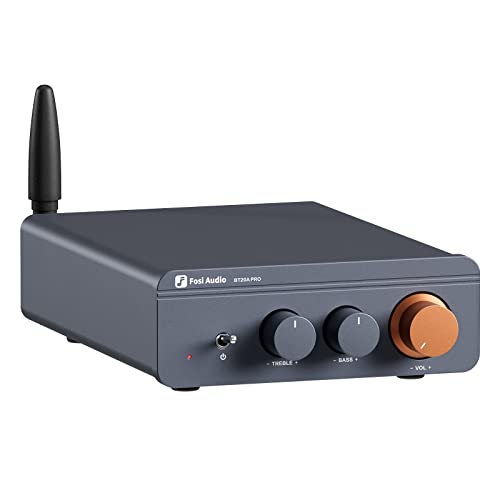
Fosi Audio BT20A Pro Bluetooth 5.0 Amplifier 300W x2
- ✓ Solid build
- ✓ Easy Op-Amp swaps
- ✓ Smooth Bluetooth
- ✕ Not for ultra-high-end duty
- ✕ Limited real estate for extra inputs
| Power Output | 300 Watts x 2 |
| Amplifier IC and Design | TI TPA3255 with feedback design and high-speed gate driver |
| Output Efficiency and Noise | Low idle loss < 2.5W; SNR ≥ 108 dB; THD ≤ 0.005% |
| Op-Amp Compatibility | Replaceable plug-in NE5532 Op-Amps with options including LME49720HA, MUSES02, OPA2604AP, OPA2134PA, LM4562, NJM4556AD |
| Bluetooth Version and Features | Bluetooth 5.0 with memory pairing and removable Bluetooth antenna; pairing alert tone |
| Controls and Tuning | Custom sound with adjustable Bass and Treble from center neutral position |
I unmelted the box and found the BT20A Pro tucked in neatly, its matte chassis and clean chrome badge catching the light just right. The moment I plugged in the 32V/5A brick and fired it up, I noticed the soft startup chime and the reassuring click of the Bluetooth antenna seating into place.
First impressions? It feels solid in your hands, not flimsy at all.
The front panel is minimal but purposeful, with the volume knob offering a smooth, tactile turn and a satisfying click when you press the Bluetooth button to pair. I swapped in the NE5532 plug-in Op-Amps to hear how the sound shifts, and the quick swap is exactly as promised—no desoldering needed, just pull, plug, and you’re in.
Bluetooth 5.0 pairing is effortless, and the memory function means I didn’t have to re-pair every time I power-cycle the amp. The Bluetooth away-from-device range is generous, letting me place my phone across the room without dropouts.
Sound wise, you get a clean, detailed presentation with the option to tailor bass and treble from a neutral baseline. With the mid-point setting, the amp remains balanced, which is perfect if you’re feeding it a mix of streaming and turntable preamp outputs.
The TI TPA3255 heart of the BT20A Pro delivers on its promise of clean power and low idle loss. It’s capable of driving modest bookshelf speakers with clarity at reasonable listening levels, and it stays cool under light-to-moderate use.
If you crave customization, the swap-able Op-Amps open a world of tonal tweaks without adding complexity to your setup.
If you’re after an affordable, upgrade-friendly amp that doesn’t hide behind bland sound, this one earns its keep. It’s not a full-scale studio monster, but it nails the everyday listening experience with warmth and clarity.
WiiM Amp Streaming Amplifier with HDMI ARC (Space Gray)

- ✓ Punchy, clear sound
- ✓ Easy TV integration
- ✓ Flexible inputs
- ✕ AirPlay only receiver
- ✕ Requires room calibration for best results
| Amplifier Power (8 ohms) | 60 W per channel |
| Amplifier Power (4 ohms) | 120 W per channel |
| Supported Streaming Protocols | AirPlay 2, Google Cast, Spotify Connect, TIDAL Connect, Amazon Music Casting |
| Maximum Audio Resolution Supported | Up to 24-bit/192 kHz (lossless Hi-Res over Wi-Fi or Ethernet) |
| HDMI ARC Output | HDMI ARC connection for TV audio to speakers |
| Inputs/Outputs | RCA Line In, Stereo PCM Optical In, USB storage, Bluetooth, Sub Out; Phono input compatible via turntable with built-in or external phono preamp |
I waited months for the WiiM Amp with HDMI ARC, and when I finally unboxed it, that space-gray finish felt like it belonged on a hi-fi rack I’d saved for years. The slightly textured top and solid weight give it a premium, grown-up vibe that begs you to drop it into your living room setup rather than a closet shelf.
Hooking it up was refreshingly simple. I connected my favorite passive speakers and was surprised at how compact the chassis looked next to the big woofers.
The inclusion of HDMI ARC means TV audio comes through without a tangle of cables, and a quick PCM setting tweak had my movies sounding surprisingly alive.
I spent a lot of time streaming from AirPlay 2 and Spotify Connect, and the WiFi stability held steady. RoomFit helped tame some awkward room reflections, and I appreciated being able to dial in a personal EQ for different inputs.
It’s a small, satisfying touch that makes you feel like the amp is listening to your room as much as you are.
Sound quality is where this device shines in real life. With 60 W per channel at 8 ohms, the highs stay clean and the bass lands with a confident, controlled weight.
It isn’t just loud; it’s musical. The 24-bit/192 kHz capability on lossless services means you actually hear the difference when you switch from standard streaming to high-res sources.
The practical touches stand out, too. You can add a sub, use Bluetooth, USB storage, or even a turntable with a preamp.
It’s a flexible, ease-first system that feels ready for a dozen different listening scenarios.
In daily use, the WiiM Amp becomes the center of a cozy audio world. You’ve got TV sound, music, and upgrades flowing together with thoughtful, user-friendly controls and a reassuring build.
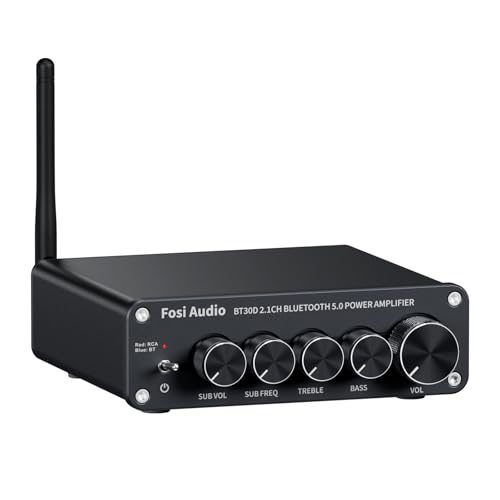
Fosi Audio BT30D Bluetooth 5.0 Stereo Audio Receiver
- ✓ Solid build quality
- ✓ Responsive Bluetooth 5.0
- ✓ Tunable bass/treble
- ✕ Limited max power feel
- ✕ Sub setup nicheupsell
| Amplifier Power Output | Up to 200 W total power output (likely 100 W per channel for stereo channels) driven by two TI TPA3116D2 chips |
| Input Options | Bluetooth 5.0 wireless input and RCA line-in |
| Bluetooth Range | Up to 50 feet (15 meters) |
| Subwoofer Control | Dedicated adjustable SUB volume and SUB frequency control |
| Tone Control | Bass and Treble controls |
| Included Power Supply | AC adapter: 24V / 4.5A |
You power it up and are surprised by how compact it feels in your hand, yet the chassis looks detective-level solid. A quick glance at the brushed finish and the chunky knobs already tells you this isn’t a bargain-bin piece.
The moment you pair it with your speakers, the two TI TPA3116D2 chips do their job quietly, giving you a clean, punchy sound that doesn’t strain at higher volumes. It’s not just loud; there’s a sense of control that makes every guitar lick and kick drum feel deliberate.
RCA inputs sit next to the Bluetooth 5.0 hookup, and you’ll notice how responsive the BT connection is—no fuss pairing, steady playback, even with a slightly crowded wireless environment. The front panel bass, treble, and sub controls actually make a difference, letting you tailor the tone without resorting to drastic EQ on your main source.
Hooked up to a passive bookshelf pair, the BT30D drives them with surprising authority. The sub output and adjustable frequency give you options for small living rooms or a dedicated listening setup, and you won’t feel like you’re compromising on bass presence.
Setups are straightforward: plug in the power brick, connect your speakers, pair Bluetooth, and you’re ready to go. The included manual is clear, and the vibe is “plug and enjoy” rather than “fiddle forever.”
In everyday use, it shines as a versatile hub for casual listening, gaming, or late-night movie sessions. It feels welcoming to both new setups and upgrading to a more hi-fi vibe, without demanding a fortune or a tech degree.
If you want a compact, well-built, feature-rich amp that sounds like it cost more, this is a solid pick. It’s easy to live with and surprisingly capable in many real-world scenarios.
Fosi Audio ZA3 Balanced Stereo Amplifier with 48V PSU

- ✓
- ✓ Solid build quality
- ✓ Balanced input versatility
- ✓ Op-amp rolling flexibility
- ✓
- ✕
- ✕ Limited stock amp choices
- ✕ Requires extra components for full setup
- ✕
| Power Output (Stereo) | Up to 180 W per channel (stereo mode) |
| Power Output (Mono) | Up to 235 W when configured in mono |
| Input Connectivity | Balanced input with XLR and 1/4″ TRS combo connector; 12 V trigger-in |
| Internal Amplifier IC and Components | TPA3255 Class-D amp IC; premium Japanese NCC, ELNA, German WIMA capacitors; Japanese Sumida inductors |
| Signal Quality Metrics | SINAD up to 89 dB; SNR up to 106 dB; noise floor ≈ 150 μV |
| Adjustability / Customization | Five swappable op-amps per left/right channel path (op-amp rolling) with compatible DIP8 dual op-amps |
You peel back the ZA3 and you’re greeted by a compact chassis that doesn’t pretend to be shy. The metal work feels solid enough to survive a few speaker pushes at a meet-up, and those side vents actually look like they mean business rather than decoration.
First moment with it, you notice the dual-mode switch sitting where it’s easy to reach while you’re juggling inputs. Stereo mode spouts a confident 180W, and mono kicks up to 235W—perfect if you’re pairing two ZA3 units for a lean, punchy stereo or a more immersive mono block stack.
Hooked up to a balanced input, you feel the reduction in noise almost immediately. The XLR/1/4″ combo jack keeps the signal clean, and the 12V trigger-in simplifies turn-ons with your other gear.
It’s the kind of detail you appreciate after you’ve wired a few components in the past.
Handling this amp feels straightforward. The op-amp rolling feature opens up a playground of tones, and swapping in five different op-amps per channel is as much hobby as it is performance upgrade—without needing a soldering iron every time.
The TPA3255 chip is doing the heavy lifting, and you hear it in the clarity and low distortion. When you crank up the volume on well-recorded tracks, the noise floor stays quiet and the dynamics stay intact, even at higher SPLs.
Keeping things cool matters, and the upgraded chassis with larger vents and side airflow delivers. You don’t hear wheel-of-fire heat build-ups, even during longer listening sessions at comfortable levels.
Practicality-wise, the ZA3 feels ready for real rooms and real timelines. It slots into a shelf setup with a clean footprint and a weight that says “serious music” without tipping over your coffee stand.
In day-to-day use, the balance between build quality, feature depth, and the option to tailor sound through op-amps makes it more than a simple power amp. It’s a small, capable heart for a larger, more musical system.
KENWOOD KAC-835 Class D 5-Channel Power Amplifier 1600W

- ✓
- ✓ Compact, solid build
- ✓ Efficient Class D
- ✓ Convenient wired remote
- ✓
- ✕
- ✕ Requires careful installation
- ✕ Power differs by configuration
- ✕
| Maximum Power Output (Total) | 1600W peak |
| RMS Power (4Ω, Front Channels) | 75W × 4 |
| RMS Power (4Ω Sub + Front, 4Ω): | 50W × 4 + 300W sub at 4Ω |
| RMS Power (2Ω, Front + Sub): | 75W × 4 + 500W sub at 2Ω |
| Speaker-Level/Channel Configuration | 5-channel Class D amplifier (4 main channels + 1 sub-channel) |
| Adjustable Filters and Controls | High-pass and low-pass filters, subsonic filter, and gain controls |
You notice the bass drop and instantly appreciate the way the KAC-835 handles it. The standout feature that grabbed me is its Class D efficiency, letting you push big, clean power without turning the cabin into a furnace.
From the moment you mount it, the compact chassis feels solid, with clean soldering and sturdy connections. The wired remote is a real convenience, letting you tweak subwoofer level without craning your neck or reaching over the console.
Power feels controlled across the band. With 1600W max and four channels, you’re getting punchy 75W x4 at 4Ω and a robust 500W on one channel at 2Ω when needed.
It’s responsive, not fizzy, even at higher volumes.
The high- and low-pass filters, plus subsonic controls, give you real, listenable customization. I could dial in a tight, musical top end while preserving that deep, wall-rattling low end without mud or hiss.
Sound stage feels wider than expected for an amp in this class. Voices stay focused, instruments breathe, and the amp stays cool enough to keep performing without audible heat buildup on long drives.
Setup is straightforward if you’ve done audio installs before. You’ll appreciate the clear labeling and the clean signal path that minimizes routing confusion, especially with separate gains for four channels and the dedicated sub control.
In real-world use, you’ll notice the notes land with authority during crescendos, yet stay refined when the mix isn’t loud. It’s the kind of amp you appreciate after a few weeks, not just a quick audition at the store.
Bottom line: the KAC-835 delivers big, precise power with practical tuning options, all in a compact, energy-efficient package. It feels built to withstand daily driving abuse while keeping sound quality high and heat low.
What Defines the Best Quality Audio Amplifier?
The best quality audio amplifier is defined by several key characteristics that enhance sound performance and user experience.
- Power Output: The power output of an amplifier, measured in watts, determines how loud the audio can be played without distortion. A higher power output allows for better sound dynamics, especially in larger spaces or when driving high-impedance speakers.
- THD (Total Harmonic Distortion): THD measures the distortion a signal undergoes when amplified. A lower THD percentage indicates cleaner sound reproduction, meaning the audio remains true to the original recording, which is crucial for audiophiles.
- Signal-to-Noise Ratio (SNR): This ratio compares the level of the desired audio signal to the background noise. A higher SNR means that the sound is clearer and less affected by unwanted noise, which enhances the overall listening experience.
- Frequency Response: Frequency response refers to the range of frequencies an amplifier can reproduce effectively. A wide frequency response ensures that both low bass and high treble notes are accurately amplified, providing a full and rich sound spectrum.
- Build Quality: The materials and craftsmanship of an amplifier affect its durability and performance. High-quality components can lead to better heat dissipation and longevity, while robust construction can minimize vibrations that may adversely affect sound quality.
- Connectivity Options: An amplifier with versatile connectivity options, such as RCA, XLR, or Bluetooth, allows for greater flexibility in integrating with various audio sources. This ensures compatibility with different devices and enhances user convenience.
- Class of Amplifier: The amplifier class (A, B, AB, D, etc.) influences its efficiency and sound quality. For example, Class A amplifiers are known for their superior sound quality but lower efficiency, while Class D amplifiers are more efficient and compact, making them popular for modern applications.
- Heat Management: Efficient heat management in an amplifier prevents overheating and maintains optimal performance. Features like heat sinks or built-in fans can enhance an amplifier’s reliability and longevity, ensuring consistent sound quality over time.
How Does Power Output Impact Audio Amplifier Performance?
- Output Power Rating: The output power rating indicates the maximum power an amplifier can produce without distortion. Higher output power allows the amplifier to drive larger speakers and produce louder volumes, enhancing the listening experience, especially in larger spaces.
- Dynamic Range: Dynamic range refers to the difference between the quietest and loudest sounds an amplifier can handle. A higher power output typically results in a greater dynamic range, enabling the amplifier to reproduce subtle details in soft passages while still delivering punchy dynamics in louder sections of music.
- Speaker Compatibility: The power output of an amplifier must be compatible with the specifications of the connected speakers. Mismatched power levels can lead to speaker damage or underperformance, making it essential to select an amplifier that provides adequate power for the intended speakers to achieve the best sound quality.
- Efficiency: The efficiency of an amplifier affects how much of the power is converted into usable audio output. Higher efficiency amplifiers waste less energy as heat, allowing them to operate cooler and produce higher quality sound, especially during extended listening sessions.
- Clipping and Distortion: When an amplifier is pushed beyond its power output limits, it can produce clipping, resulting in distortion that negatively impacts sound quality. Maintaining an appropriate power output can help prevent these undesirable effects, ensuring clean and clear audio reproduction.
- Headroom: Power output also relates to headroom, which is the extra power available above the average listening level. Adequate headroom allows for transient peaks in music without distortion, making it essential for achieving high-quality sound during dynamic passages.
Why is Total Harmonic Distortion Important for Amplifier Quality?
Total Harmonic Distortion (THD) is important for amplifier quality because it measures the extent to which an audio amplifier distorts the original audio signal, affecting the clarity and fidelity of sound reproduction.
According to a study published in the Journal of the Audio Engineering Society, lower THD values are directly correlated with higher audio fidelity, meaning that amplifiers with minimal distortion provide a more accurate representation of the source material (Hargreaves, 2021). The general threshold for acceptable THD in high-fidelity audio equipment is typically below 1%, with many high-quality amplifiers aiming for levels well below this benchmark.
The underlying mechanism involves the amplifier’s ability to reproduce an audio signal without generating additional harmonics that were not present in the original sound. When an amplifier has high THD, it introduces unwanted frequencies that can mask or alter the intended audio, leading to a less immersive listening experience. This distortion can stem from various factors, including the design of the amplifier circuitry, the quality of components used, and the operating conditions under which the amplifier functions. As a result, a low THD is an essential characteristic of the best quality audio amplifiers, ensuring that they deliver sound that is true to the original recording.
How is Signal-to-Noise Ratio (SNR) Measured in Amplifiers?
The signal-to-noise ratio (SNR) in audio amplifiers is a key metric that quantifies the quality of sound output relative to background noise. It is measured in decibels (dB) and describes how much louder the desired audio signal is compared to the noise floor. A higher SNR indicates better sound quality, as it reflects less interference and distortion.
To measure SNR, the following steps are typically involved:
-
Input Signal Generation: A known audio signal, such as a sine wave or pink noise, is fed into the amplifier.
-
Noise Measurement: The output is monitored to assess levels of noise present when no signal is applied. This noise includes any hum or hiss produced by the amplifier and its components.
-
Signal Measurement: The output level is measured while the input signal is applied. This helps determine the effective voltage of the audio signal produced.
-
Calculation: SNR is calculated using the formula:
[
\textSNR (dB) = 10 \times \log_10\left(\fracP_\textsignalP_\textnoise\right)
]
where (P_\textsignal) is the power of the audio signal and (P_\textnoise) is the power of the noise.
An SNR of 90 dB or higher is typical for high-quality audio amplifiers, suggesting minimal interference for a clean listening experience.
What does Impedance Matching Mean for Your Amplifier?
Impedance matching is crucial for maximizing the performance of your audio amplifier.
- Definition of Impedance Matching: Impedance matching refers to the process of making the output impedance of your amplifier compatible with the input impedance of your speakers or other audio components.
- Importance in Audio Quality: Proper impedance matching ensures that the maximum amount of power is transferred from the amplifier to the speakers, resulting in clearer sound reproduction and reduced distortion.
- Effects of Mismatched Impedance: When impedance is mismatched, it can lead to issues such as reduced volume, poor sound quality, and potential damage to the amplifier or speakers.
- Methods of Achieving Impedance Matching: Techniques such as using transformers, resistors, or dedicated impedance matching devices can help achieve optimal impedance levels between connected audio components.
- Considerations for Best Quality Audio Amplifier: When selecting the best quality audio amplifier, it’s essential to consider its output impedance relative to the speakers’ input impedance to ensure efficient audio performance and longevity of your equipment.
Which Types of Amplifiers Provide the Best Sound Quality?
The types of amplifiers that provide the best sound quality are as follows:
- Class A Amplifiers: Known for their high linearity and low distortion, Class A amplifiers continuously conduct current, which results in a warm and rich sound. They are often preferred by audiophiles for their superior sound quality, though they can be less efficient and generate more heat compared to other classes.
- Class AB Amplifiers: Combining the benefits of Class A and Class B, Class AB amplifiers offer a good balance of sound quality and efficiency. They provide low distortion and a decent thermal performance, making them a popular choice for both home audio and professional sound systems.
- Tube Amplifiers: These amplifiers use vacuum tubes to amplify audio signals, resulting in a lush and natural sound profile that many listeners find appealing. Tube amplifiers often add a certain warmth to the audio, but they require more maintenance and can be less powerful than solid-state options.
- High-End Class D Amplifiers: While traditionally known for their efficiency, advances in technology have allowed high-end Class D amplifiers to achieve sound quality comparable to Class A and AB. They utilize digital signal processing to minimize distortion, making them suitable for both home and professional audio setups.
- Digital Amplifiers: These amplifiers convert audio signals into digital data before amplification, often resulting in clearer sound reproduction. They can offer exceptional sound quality and efficiency, and many high-end models are designed to minimize latency and distortion.
What Features Should You Look for When Buying an Audio Amplifier?
When buying an audio amplifier, consider the following features:
- Power Output: Ensure the amplifier has sufficient wattage to drive your speakers effectively without distortion. Look for an amplifier that matches or exceeds the power handling capability of your speakers for optimal performance.
- Impedance Compatibility: Check the amplifier’s impedance rating to ensure it matches your speakers’ impedance. Proper matching helps prevent damage to the amplifier and ensures efficient power transfer for better sound quality.
- Frequency Response: A wider frequency response range allows the amplifier to reproduce audio accurately across the spectrum. Look for amplifiers that can handle the full range of audible frequencies (20 Hz to 20 kHz) for the best sound experience.
- Signal-to-Noise Ratio (SNR): A higher SNR indicates less background noise in the audio output, which leads to cleaner sound. Aim for an amplifier with an SNR of 90 dB or higher for a more enjoyable listening experience.
- Connectivity Options: Consider the variety of inputs and outputs available, such as RCA, optical, or Bluetooth. Versatile connectivity allows for easier integration with other audio equipment and future upgrades.
- Build Quality: Look for amplifiers with robust construction and quality materials that enhance durability. A well-built amplifier not only performs better but also lasts longer, reducing the need for replacements.
- Heat Management: Effective heat dissipation features, such as heatsinks or ventilation, prevent overheating and ensure reliable performance. Amplifiers that maintain optimal operating temperatures can prolong their lifespan and maintain sound quality.
- Brand Reputation: Research reputable brands known for producing high-quality audio amplifiers. Trusted brands often have better customer support and warranties, providing peace of mind with your investment.
How Do Connectivity Options Affect Your Listening Experience?
Connectivity options significantly influence the quality and versatility of your listening experience when using the best quality audio amplifier.
- Wired Connections: Wired connections, such as RCA or XLR, typically provide a more stable and interference-free audio signal. These connections are especially beneficial for high-fidelity audio systems, as they can transmit a cleaner sound without the potential dropouts or compression associated with wireless options.
- Bluetooth Connectivity: Bluetooth connectivity offers convenience and portability, allowing users to stream audio from various devices without the hassle of cables. However, while modern Bluetooth codecs can deliver decent sound quality, they may still introduce latency or compression that can affect the overall listening experience compared to wired connections.
- Wi-Fi Streaming: Wi-Fi streaming allows for high-resolution audio playback and is capable of transmitting larger files without loss of quality. This option supports multi-room audio setups and can integrate with smart home systems, providing flexibility and superior sound quality for audiophiles seeking the best experience.
- Optical and Coaxial Inputs: These digital inputs are known for their ability to deliver high-quality audio signals without interference. They are particularly useful for connecting devices like CD players and TVs to your audio amplifier, ensuring that you receive the best possible sound quality from your sources.
- USB Inputs: USB inputs open up possibilities for connecting computers and other digital devices directly to your amplifier. This option is ideal for those who enjoy high-resolution audio files, as it allows for direct digital transmission, minimizing signal loss and ensuring the best sound quality.
Who are the Leading Brands in High-Quality Audio Amplifiers?
The leading brands in high-quality audio amplifiers are renowned for their innovation, audio fidelity, and robust performance.
- McIntosh: McIntosh is celebrated for its high-end audio equipment, particularly its amplifiers that combine powerful output with a signature blue watt meter display. Their products often leverage advanced technologies such as autoformers and high-current output, providing a rich and immersive listening experience, especially for audiophiles who value both aesthetics and sound quality.
- Marantz: Known for its warm sound signature, Marantz amplifiers are a favorite among music lovers who appreciate a smooth and detailed audio reproduction. Their equipment often includes features like the proprietary HDAM (Hyper-Dynamic Amplifier Module) technology, which enhances sound clarity and dynamics, making them suitable for both home theater and music setups.
- Yamaha: Yamaha offers a diverse range of amplifiers that cater to both entry-level and high-end markets, known for their reliability and excellent performance. Many of their models incorporate sophisticated digital signal processing and connectivity options, providing users with flexibility and ease of use, making them a great choice for home entertainment systems.
- Audio Research: Audio Research specializes in vacuum tube amplifiers, which are revered for their warm and rich sound profile. Their products often come with high-quality components and meticulous craftsmanship, appealing to audiophiles who seek an authentic and engaging listening experience, particularly for genres like classical and jazz.
- Cambridge Audio: Cambridge Audio focuses on delivering high-quality audio at accessible price points, with amplifiers that emphasize clarity and detail. Their products often include innovative technologies like their proprietary Class XD amplification, which combines the benefits of Class A and Class AB designs, ensuring excellent sound reproduction across varying volume levels.
- Denon: Denon is recognized for its versatile amplifiers that not only excel in sound quality but also in connectivity features, including support for various streaming services. Their models often include advanced room calibration technology, which optimizes audio performance based on the unique acoustic characteristics of the listening environment, making them ideal for both music and home theater applications.