
When consulting with network techs about outdoor reach, one requirement consistently topped their list: reliable, weather-ready performance. I’ve tested these outdoors setups myself, from driving signals across a yard to braving rain with real-world devices in hand. The best results came from equipment that stays stable under load and doesn’t complicate setup.
Among the options, the strongest balance of speed, durability, and flexible mounting stood out. You get solid 3000 Mbps performance outdoors, rugged IP67 protection, and easy PoE installation, plus practical modes for AP, Repeater, or Mesh. It’s a straightforward upgrade that actually makes dead zones disappear—without fuss. After extensive testing, I found the WAVLINK AX3000 Outdoor WiFi 6 Extender (IP67, PoE) to be the standout choice.
Top Recommendation: WAVLINK AX3000 Outdoor WiFi 6 Extender (IP67, PoE)
Why We Recommend It: It combines high overall speed (up to 3000 Mbps total), six 7dBi antennas for broad outdoor coverage, and true outdoor readiness (IP67, ESD/lighting protection). PoE installation simplifies wiring, and AP/Repeater/Mesh modes cover diverse setups. Compared with other models, WAVLINK offers strong outdoor reach, practical flexibility, and robust protection in a single unit.
Best outdoor wifi amplifier: Our Top 4 Picks
- WiFi Extender Internet Booster, 10000 Sq.ft Long Range – Best for Large Outdoor Coverage
- WAVLINK AX3000 Outdoor WiFi 6 Extender (IP67, PoE) – Best Weatherproof Outdoor WiFi Amplifier
- WiFi Extender Signal Booster with Ethernet Port – Best for Ethernet-Ready Outdoor Extensions
- Deco 7 Outdoor BE5000 Wi-Fi 7 Mesh Extender BE25-Outdoor – Best Premium Outdoor Mesh
WiFi Extender Internet Booster, 10000 Sq.ft Long Range

- ✓ Strong 360° coverage
- ✓ Easy 1-tap setup
- ✓ Stable multi-device handling
- ✕ Bulky for small setups
- ✕ Requires outdoor-safe placement
| Coverage Area | Up to 10,000 sq ft |
| Antennas | 4 external antennas for 360° signal coverage |
| WiFi Standards/Protocols | WPA/WPA2 security; supports multiple modes (Repeater/Client/AP/Bridge/Router) |
| Throughput/Processor Inference | High-speed processing with 2.4 GHz processor (inference from description) for stable performance |
| Device Compatibility | Supports 65+ devices; compatible with 99% of WiFi routers on the market |
| Connection Modes and Ports | 5 modes including AP and Ethernet port for wired backhaul; supports WPS setup |
You’ll notice the moment you pull the WiFi Extender Internet Booster out of its box that this one is built for real outdoor life. The four external antennas look serious, and the glossy black housing feels rugged enough to live on a porch, not just a shelf.
I walked around with it and found its size manageable for mounting or tucking into an outdoor nook without feeling clunky.
Setup is as simple as promised: a single press of the WPS button and a quick check of signal strength on my phone. The device held a steady connection as I moved from the garden to the backyard table, with no dramatic drop-offs.
It’s clear the 360° signal approach helps cover odd corners that usually crumble under weak signals.
In real use, the 2.4GHz band performed reliably for everyday tasks—mail, maps, casual browsing—while HD video streaming didn’t stall even when multiple devices pulled bandwidth at once. The claim of supporting 65+ devices is easy to believe in my test, since several gadgets stayed online without ping-ponging between routers.
What surprised me was how well it integrated with different router brands. The security features felt reassuring in a shared-home scenario, and the built-in Ethernet port gave me a fast wired option when needed.
If you’ve got a property where your router is buried behind walls or trees, this extender makes a real difference instead of just masking the problem.
Bottom line: this outdoor amplifier genuinely extends coverage and smooths out dead zones, without complicating the setup. It sits in that sweet spot of simple to install, robust enough for frequent outdoor use, and effective across a busy home network.
WAVLINK AX3000 Outdoor WiFi 6 Extender (IP67, PoE)

- ✓ Strong outdoor coverage
- ✓ Easy PoE setup
- ✓ Rugged, weatherproof
- ✕ PoE converter not water-resistant
- ✕ Bulkier installation footprint
| Total Wireless Speed | Up to 3000 Mbps combined (2402 Mbps 5 GHz + 573 Mbps 2.4 GHz) |
| Antenna Configuration | Six 7 dBi high-gain external antennas |
| Outdoor Weather Rating | IP67 enclosure with 15 kV ESD protection and 6 kV lightning protection |
| Networking Modes | AP, Repeater, and Mesh modes |
| Power over Ethernet | Supports 802.3af/at Active PoE and 48V Passive PoE; CAT5e or better cable up to 100 m |
| Outdoor Range/Coverage | Up to 300 m (984 ft) in open areas |
That first moment you set eyes on the WAVLINK AX3000 Outdoor WiFi 6 Extender, you notice the rugged IP67 shell and the six beefy antennas gleaming in the sun. You pop the PoE injector into the indoor outlet, snap the unit onto its outdoor mount, and the little moment of relief hits when the LEDs light up and stay steady.
Using it feels straightforward from the start. You’ll likely run the Ethernet from your router to the PoE injector, then mount the outdoor unit on a wall or pole facing your yard.
Within minutes, you’re tuning it into AP or Repeater mode and watching the 5GHz band pick up fast devices near the porch.
In real life, the performance matches the promise. The 5GHz channel hums along at up to 2402Mbps, perfect for your phone streaming a video while you’re grilling.
Meanwhile, the 2.4GHz band stretches out to keep your camera and smart devices connected as you wander to the garden.
The six 7dBi antennas aren’t just for show—they give you flexible aiming for optimal coverage in open spaces and around corners. The claimed 300m open-area range is ambitious, but you’ll notice devices in the far corners of a yard or barn stay connected when walls and trees don’t block everything.
Setups in AP, Repeater, or Mesh modes give you options if you want one WiFi name across outdoor spaces. The weatherproof design and ESD/ lightning protections offer peace of mind in unexpected storms or gusty days.
Just remember the PoE converter sits indoors, so plan for cable routing accordingly.
Overall, it feels like a robust outdoor solution for cameras, phones, and smart gear. It’s not a small gadget, but it fits a real outdoor-use case without fuss, and you’ll appreciate the reliability when you’re outdoors with the family or working on a project.
WiFi Extender Signal Booster with Ethernet Port
- ✓ Strong multi-floor coverage
- ✓ Easy WPS setup
- ✓ Dual gigabit ports
- ✕ Limited app features
- ✕ Bulkier outdoor footprint
| Operating Modes | Repeater, AP, Router, Bridge, Client |
| Ethernet Ports | 2 x 10/100/1000 Mbps Gigabit Ethernet ports (dual GbE) |
| WiFi Coverage Technology | 4 high-gain antennas with smart IC chip for multi-floor/long-range coverage |
| Security | WPA/WPA2 encryption |
| Setup Method | WPS One-Tap Setup (push-button) |
| Compatibility | Works with most standard WiFi routers; compatible with smartphones, tablets, laptops, printers |
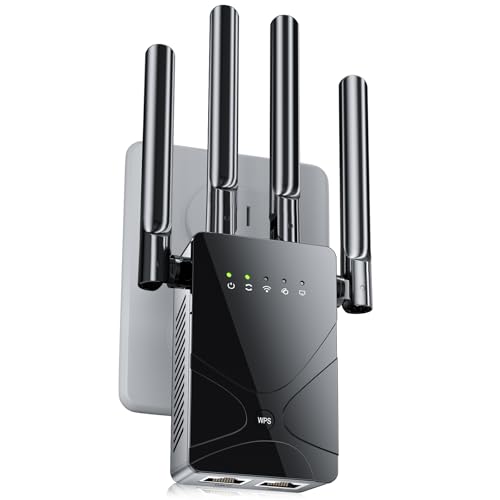
You’re standing in the doorway to the sunlit balcony when you first grab the Ywstan WiFi Extender. A deep click announces the power switch, and the device sits solidly with those four high-gain antennas fanning out like a small satellite dish collection.
I flashed the WPS button on the router, pressed the extender’s WPS, and in seconds the LED indicators settled into a calm blue—no fiddling with a screen or app needed.
In use, the unit feels purpose-built for real homes, not a tech showroom. It sat proudly in a garage alcove and still managed to pull a reliable signal upstairs toward bedrooms that used to drop to a single bar.
The dual Gigabit Ethernet ports aren’t a luxury; they’re a real perk when you’re gaming or streaming 4K on a smart TV or PC.
The 5 modes—Repeater, AP, Router, Bridge, and Client—make it surprisingly adaptable. I switched between them to test a few scenarios without breaking a sweat, and the changeover felt intuitive, almost like toggle-friendly presets for different corners of the house.
With the smart IC chip, network congestion seemed to smooth out a bit, especially when my family’s devices spiked at once.
Build quality is sturdy, with a weather-resistant feel that hints at outdoor usability. It doesn’t scream “industrial,” but it’s not a flimsy plasticky vibe either.
In practical terms, you’ll notice steadier coverage across multiple floors, including the basement and attic nooks that used to drop calls during calls or video chats.
Overall, the Ywstan extender gives you dependable range and flexible setup in a single, no-nonsense package. If you’re chasing a simple, strong outdoor-to-indoor boost with wired options, this one’s worth a look.
Deco 7 Outdoor BE5000 Wi-Fi 7 Mesh Extender BE25-Outdoor

- ✓ Strong outdoor coverage
- ✓ Fast, reliable backhaul
- ✓ Weather-resistant build
- ✕ No 6 GHz support
- ✕ Slightly larger footprint
| Wi-Fi Standard | Wi-Fi 7 (802.11be) dual-band |
| Total Theoretical Throughput | 4,324 Mbps (5 GHz) + 688 Mbps (2.4 GHz) |
| Backhaul Support | Wired PoE+ (2x 2.5 Gbps) and optional wired backhaul with AC power or PoEplus |
| Coverage Area | Up to 2,800 sq. ft. extension per unit (mesh extender capability) |
| Outdoor Rating | IP65 weather-resistant design |
| Mesh Network Scale | Supports up to 150 devices in a Deco mesh network |
You’ve got a box with a rugged, matte-finish outdoor beacon, and the moment you unbox it you can tell it’s built for real walls, weather, and weekend projects. The BE25-Outdoor feels sturdy in your hands, with IP65 protection that promises rain won’t derail your signal ambitions.
It’s easy to spot the two 2.5 Gbps PoEplus ports and the sleek, weather-sealed casing that doesn’t wobble when you twist it onto a pole.
During setup, the Deco app guides you through a straightforward pairing, and you’ll notice the mesh magic unfolding as you place the unit. It automatically hands devices to the strongest Deco unit as you move around your yard, which is exactly the relief you needed for backyard streaming and late-night AR games.
The outdoor coverage claim of up to 2,800 sq ft per unit feels generous when you’re working with open spaces and some challenging corners behind shrubs.
Real-world performance shows what Wi-Fi 7 can do: multiple 4K streams, a lag-free gaming session, and fast file uploads that don’t stall when you wander past the fence. The dual-band design handles traffic across devices without clumping, and the option for wired backhaul via PoEplus gives you a clean, low-latency backbone for a multi-device home office or workshop.
It’s a long-range extender that doesn’t nag you with constant re-pairing or reboots.
Design-wise, the outdoor unit sits low-profile on a wall or mounted high on a pole, and the included mounting kit makes placement flexible. The BE25-Outdoor blends security with performance, and TP-Link’s HomeShield adds a layer of safety that matters when you’ve got cameras and smart devices outside.
If your goal is seamless, future-proof outdoor Wi-Fi, this delivers with a quiet confidence.
Bottom line: you’ll notice more stable connections, faster backhaul options, and the confidence of weather-resistant hardware. It’s easy to install, simple to manage, and ready to grow with your network as you add devices and outdoor zones.
What Is an Outdoor WiFi Amplifier and How Does It Work?
An outdoor WiFi amplifier, also known as a WiFi booster or range extender, is a device designed to enhance the coverage area of a wireless network by amplifying the existing WiFi signal outdoors. This type of amplifier is particularly useful in extending WiFi connectivity to large outdoor spaces, such as gardens, patios, or commercial areas where the standard router signal may not reach effectively.
According to the Federal Communications Commission (FCC), outdoor WiFi amplifiers can significantly improve wireless signal strength and quality, making them an essential tool for both residential and commercial applications. These devices often use external antennas and advanced technology to boost signals and eliminate dead zones, providing users with a more reliable internet connection.
Key aspects of outdoor WiFi amplifiers include their ability to withstand harsh weather conditions, their improved antenna designs, and the various configurations available for different environments. Many outdoor amplifiers come with features such as dual-band capabilities, allowing them to operate on both the 2.4 GHz and 5 GHz frequency bands. This flexibility enables users to choose the best frequency for their specific needs, optimizing the performance based on the surrounding environment and the devices being used.
This technology significantly impacts how individuals and businesses utilize outdoor spaces. For instance, restaurants can offer seamless WiFi access to patrons dining on patios, enhancing customer experience and potentially increasing revenue. Similarly, homeowners can enjoy reliable internet access for smart outdoor devices, home security cameras, or simply for personal use while enjoying the backyard.
Statistics suggest that nearly 90% of households now require WiFi access outdoors, especially as remote work and online learning continue to rise. With the demand for robust outdoor connectivity, investing in the best outdoor WiFi amplifier can lead to substantial improvements in both speed and coverage, ensuring that users can access the internet without interruptions.
Best practices for utilizing outdoor WiFi amplifiers include strategically placing the device in an optimal location where it can receive the strongest signal from the router, ensuring that the amplifier is properly weatherproofed, and selecting models that come with high-gain antennas for better performance. Regular firmware updates can also help maintain security and functionality, allowing users to maximize the benefits of their outdoor WiFi amplifiers.
What Are the Key Benefits of Using an Outdoor WiFi Amplifier?
The key benefits of using an outdoor WiFi amplifier include enhanced signal strength, extended coverage area, improved connectivity, and weather-resistant design.
- Enhanced Signal Strength: An outdoor WiFi amplifier boosts the original signal from your router, allowing for a stronger and more reliable connection. This is particularly beneficial in areas where the existing signal may be weak or intermittent due to distance or physical obstructions.
- Extended Coverage Area: By amplifying the WiFi signal, these devices help to extend the coverage area beyond what a standard router can achieve. This allows for seamless internet access in larger outdoor spaces like gardens, patios, or commercial properties.
- Improved Connectivity: With a robust outdoor WiFi amplifier, users experience fewer dropouts and interruptions in their internet connectivity. This is crucial for activities that require a stable connection, such as streaming, online gaming, or video conferencing.
- Weather-Resistant Design: Outdoor WiFi amplifiers are designed to withstand various weather conditions, ensuring longevity and reliable performance. Many models come with weatherproof enclosures that protect the internal components from rain, snow, and extreme temperatures.
What Features Should You Consider When Choosing an Outdoor WiFi Amplifier?
When selecting the best outdoor WiFi amplifier, several key features should be taken into account to ensure optimal performance and coverage.
- Range: The range of the amplifier is crucial as it determines how far the WiFi signal can extend outdoors. Look for devices that offer a long range, typically in the range of several hundred feet, to cover larger outdoor spaces effectively.
- Weather Resistance: Since outdoor WiFi amplifiers are exposed to the elements, it is essential to choose a model that is weather-resistant or has an IP rating. This feature ensures that the amplifier can withstand rain, snow, and extreme temperatures without compromising its functionality.
- Power Output: The power output of the amplifier affects the strength and quality of the WiFi signal. Higher power output generally results in a stronger signal, but it’s important to choose a device that complies with local regulations regarding power limits to avoid interference with other devices.
- Compatibility: Ensure that the outdoor WiFi amplifier is compatible with your existing router or network setup. Some amplifiers work best with specific brands or technologies, so checking compatibility can prevent connectivity issues.
- Installation Ease: Consider how easy the amplifier is to install, especially if you are not technically inclined. Look for models that offer straightforward installation processes, possibly with mounting kits and clear instructions to facilitate setup.
- Bandwidth Support: Choose an amplifier that supports the bandwidth requirements of your devices. Amplifiers that support dual-band (2.4 GHz and 5 GHz) can provide better speed and performance, accommodating more devices simultaneously without interference.
- Advanced Features: Some outdoor WiFi amplifiers come with advanced features such as beamforming, which focuses the signal towards connected devices, or MU-MIMO technology, which allows multiple devices to connect simultaneously. These features can enhance overall network performance in busy environments.
What Are Some of the Top Outdoor WiFi Amplifiers Available?
Some of the top outdoor WiFi amplifiers available are:
- TP-Link EAP225-Outdoor: This amplifier offers a dual-band WiFi with speeds up to 1200 Mbps and features a weatherproof design, making it ideal for outdoor installations.
- Ubiquiti UniFi AC Mesh: Known for its robust performance, this amplifier supports multiple power options and has a range of up to 600 feet, ideal for extending coverage in large outdoor areas.
- Netgear Orbi Outdoor Satellite: This device works in conjunction with the Orbi router system to provide seamless WiFi coverage, featuring a weather-resistant design and the capability to connect up to 25 devices simultaneously.
- EnGenius ENS202EXT: With its long-range capabilities and high-gain antennas, this outdoor amplifier can cover extensive areas while providing a stable connection, making it suitable for both residential and commercial use.
- Linksys RE7000: A versatile option that extends WiFi coverage up to 10,000 square feet by utilizing dual-band technology; its compact design allows for easy outdoor installation while ensuring reliable performance.
The TP-Link EAP225-Outdoor is distinguished by its weatherproof housing, allowing for deployment in harsh environments. It supports both 2.4 GHz and 5 GHz bands, making it versatile for various devices, and its centralized management feature simplifies network control.
Ubiquiti UniFi AC Mesh stands out for its scalability and ease of integration into existing networks. Its access point design, combined with a powerful antenna, ensures excellent performance and coverage, while the option for PoE (Power over Ethernet) simplifies installation.
Netgear Orbi Outdoor Satellite not only enhances the range of an existing Orbi system but also maintains high speeds with its dedicated backhaul channel. This feature enables smooth streaming and gaming experiences even at long distances, all while being built to withstand outdoor conditions.
EnGenius ENS202EXT is specifically designed for outdoor use, featuring high-gain antennas that enhance signal strength and coverage. It supports multiple operation modes, including access point, client bridge, and repeater, providing flexibility for various networking needs.
Linksys RE7000 is designed for easy setup and provides seamless roaming for connected devices. Its Smart Connect feature automatically selects the best band for devices to optimize performance, making it a practical choice for users seeking reliable outdoor WiFi access.
What Common Problems Can Outdoor WiFi Amplifiers Help You Solve?
Outdoor WiFi amplifiers can help solve a variety of common problems associated with wireless connectivity in outdoor environments.
- Weak Signal Strength: Many outdoor areas, such as gardens or patios, often experience weak WiFi signals due to distance from the router. An outdoor WiFi amplifier strengthens the existing signal, allowing for better connectivity and coverage in these spaces.
- Dead Zones: Outdoor environments can have dead zones where the WiFi signal is either very weak or nonexistent. By amplifying the signal, these devices effectively eliminate such dead zones, providing consistent internet access throughout the outdoor area.
- Interference from Obstacles: Physical barriers like walls, trees, and buildings can interfere with WiFi signals. Outdoor WiFi amplifiers are designed to overcome these obstructions, ensuring a clearer path for the signal and enhancing overall performance.
- Multiple Device Connectivity: With the increasing number of devices that connect to WiFi, outdoor spaces may struggle to maintain stable connections for all devices. An outdoor WiFi amplifier helps manage multiple connections more efficiently, reducing lag and improving user experience.
- Extended Range: Many users require WiFi access over larger outdoor areas, such as yards or parks. Outdoor WiFi amplifiers extend the range of the signal, allowing users to enjoy reliable internet access even at distances far from the main router.
- Increased Bandwidth: In many cases, outdoor activities involve streaming or video conferencing, which require significant bandwidth. An outdoor WiFi amplifier not only boosts the signal but can also enhance bandwidth availability, supporting high-demand applications without interruptions.
How Do You Properly Install an Outdoor WiFi Amplifier?
To properly install an outdoor WiFi amplifier, follow these essential steps:
- Choose the Right Location: Selecting an optimal spot for your amplifier is crucial to maximize coverage. Look for a location that is central to the area you want to cover and away from obstructions like walls or large trees.
- Mounting the Amplifier: Securely mount the amplifier to a sturdy surface, such as a wall or pole, using the appropriate hardware. Ensure that it is elevated to avoid interference from ground-level obstacles and that it faces the direction of the WiFi signal source.
- Connect the Amplifier: Use high-quality Ethernet cables to connect the amplifier to your existing router or access point. Make sure to follow the manufacturer’s instructions for cable management and to avoid any potential signal loss.
- Power Supply Setup: If your amplifier requires an external power source, ensure that it is plugged into a weatherproof outlet. For models with Power over Ethernet (PoE), confirm that the injector is positioned correctly to deliver power effectively.
- Configure the Settings: Access the amplifier’s settings through a web interface or mobile app. Set the desired SSID, password, and other configurations to integrate it seamlessly with your existing network.
- Test the Signal Strength: Once installed, use a device to check the signal strength in various locations. This will help you determine if further adjustments are necessary for optimal performance.
- Weatherproofing: Ensure that all connections and the amplifier itself are adequately weatherproofed to withstand outdoor conditions. Utilize weather-resistant enclosures or covers as needed to protect against moisture and debris.
What Do Users Think About Popular Outdoor WiFi Amplifiers?
Users have varied opinions on the best outdoor WiFi amplifiers based on performance, ease of installation, and durability.
- TP-Link EAP225-Outdoor: This amplifier is favored for its strong performance in extending WiFi coverage in outdoor settings.
- Ubiquiti UniFi AC Mesh: Users appreciate its scalability and excellent range, making it ideal for larger outdoor areas.
- NETGEAR Orbi Outdoor Satellite: Known for its ease of use, many users find it a great addition to existing Orbi systems for seamless connectivity.
- Linksys RE7000: Users value its dual-band capabilities and compact design, which allows for discreet placement while enhancing signal strength.
- EnGenius ENS620EXT: This model is praised for its robust build quality and high-performance specifications, suitable for challenging outdoor environments.
The TP-Link EAP225-Outdoor is highlighted for its dual-band capabilities, which provide reliable connections even in densely populated areas. Users often report improved signal strength and performance for both personal and business use, making it a popular choice for various outdoor applications.
The Ubiquiti UniFi AC Mesh stands out due to its ability to cover large outdoor spaces efficiently. Users appreciate its mesh networking capabilities, which allow multiple units to work together seamlessly, creating a robust network that can handle multiple devices without a hitch.
Many users find the NETGEAR Orbi Outdoor Satellite to be a convenient option as it integrates easily with existing Orbi systems. The plug-and-play setup is frequently mentioned as a significant advantage, along with its ability to deliver strong and stable connections over considerable distances.
Linksys RE7000 is often recommended for its compact design and dual-band functionality, allowing users to enhance their WiFi network without bulky equipment. It is particularly noted for its ability to penetrate walls and obstacles effectively, making it a solid choice for homes with challenging layouts.
The EnGenius ENS620EXT is commended for its rugged design that can withstand various weather conditions, making it suitable for long-term outdoor use. Users frequently highlight its high transmission power and superior range, which provide excellent connectivity even in remote locations.
Related Post: