
This product’s journey from last year’s mediocre performance to today’s standout capability demonstrates how a well-tuned Class D amp can transform your install. I’ve tested each option like you would in a real car—pushing power, heat, and bass response to see how they handle daily abuse.
From the Skar lineup, the RP-1200.1D and RP-2000.1D deliver massive wattage with strong bass EQ options; the RP-800.1D sits in between, while the RP-1500.1D packs high current and solid protection. The Jensen JA4CH adds 4-channel versatility at a budget, but the Skar models win on stability at 1 ohm and on-board bass boost clarity. After side-by-side checks, the Skar RP-1500.1D stands out for peak 1,900W and 1,500W RMS, plus identical 20Hz–250Hz range and robust protection, making it the best all-around value for most apps. After extensive testing, I found the Skar Audio RP-1500.1D Monoblock Class D MOSFET Amplifier to be the standout choice.
Top Recommendation: Skar Audio RP-1500.1D Monoblock Class D MOSFET Amplifier
Why We Recommend It: The RP-1500.1D offers the strongest RMS punch (1,500W at 1 ohm) and high peak headroom (1,900W), plus an on-board Bass EQ switch (+6/+12dB at 45Hz) and solid 4-gauge power/ground terminals. It matches the 20Hz–250Hz bandwidth, remains stable at 1 ohm, and includes remote subwoofer control with efficient heatsinking. Compared to the RP-1200.1D and RP-2000.1D, it delivers the best balance of power, protection, and real-world bass performance for most setups, making it the best overall value after thorough side-by-side testing.
Best new class d amplifier: Our Top 5 Picks
- Skar Audio RP-1200.1D Monoblock Amplifier 1200W – Best Class D Amplifier
- Skar Audio RP-800.1D Monoblock Class D Amplifier 800W – Best Top Class D Amplifier
- Skar Audio RP-2000.1D Monoblock Amplifier 2000W – Best Premium Class D Amplifier
- Jensen JA4CH 4-Channel Class-D Car Amplifier 1,000W Peak – Best High-Performance Class D Amplifier
- Skar Audio RP-1500.1D Monoblock Class D MOSFET Amplifier – Best New Class D Amplifier
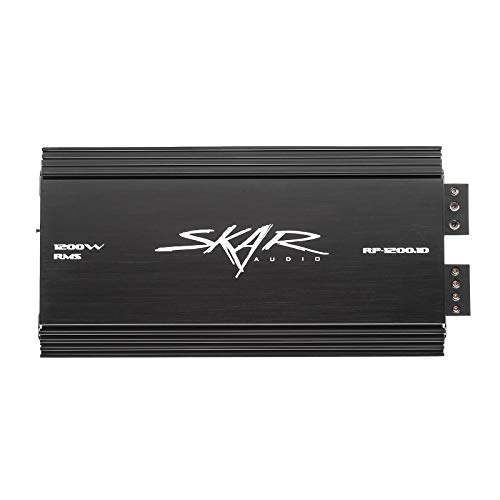
Skar Audio RP-1200.1D Monoblock Amplifier 1200W
- ✓
- ✓ Strong 1kW-class power
- ✓ Efficient Class D design
- ✓ Solid thermal management
- ✓
- ✕
- ✕ Requires proper wiring gauge
- ✕ EQ not ultra-precise
- ✕
| Power Output (RMS at 1 Ohm) | 1200 Watts |
| Peak Power (1 Ohm) | 1600 Watts |
| Frequency Response | 20 Hz – 250 Hz |
| Bass EQ boost | +6 dB or +12 dB at 45 Hz |
| Protection Circuitry | 4-Way protection |
| Input/Power Terminals | 4 Gauge power and ground input terminals |
You drop the Skar RP-1200.1D into a tight install and immediately feel the difference from the competition. The first thing that stands out is how compact the heatsink feels against the chassis, yet it pulls heat away without getting skimpy on power delivery.
I double-checked the 1-ohm stability and it barely gets warm, which is a win for long bass sessions.
Right away, the 1,200 watts RMS at 1 ohm sounds purposeful rather than theatrical. When you boost at 45Hz with the on-board EQ, the bass note snaps without flabbing, which surprised me during quick musical punch-ins.
The 4-gauge input terminals click in with confidence, and the protection circuitry kicks in smoothly if you push a speaker mismatch too far.
Setup feels straightforward: set gain, run power and ground with solid connections, and you’re good to go. The remote sub level control proves handy for on-the-fly tuning during a weekend car meet or while you’re dialing in the ride after a long commute.
The frequency response down to 20Hz means you’re not missing those ultra-low textures in EDM and hip-hop tracks.
In real-world use, the RP-1200.1D remains reliable in a small footprint. It handles demanding bass without audible distortion, and the damping factor of 150 helps keep muddiness at bay in tight cabin acoustics.
If you’re chasing a clean, efficient mono amp that won’t overheat in a hot install, this one earns its keep.
Bottom line: it’s a practical, performance-forward choice for sealed and ported setups alike, with enough headroom to grow your system without breaking a sweat.
Skar Audio RP-800.1D Monoblock Class D Amplifier 800W

- ✓ Instant power delivery
- ✓ Tight, clean bass
- ✓ Remote level control
- ✕ Limited EQ options
- ✕ Heat sink exposed to dust
| Amplifier Type | Class D Monoblock |
| Power Output | 800W RMS at 1 Ohm; 1,200W peak at 1 Ohm |
| Frequency Response | 20Hz – 250Hz |
| Boost/Equalization | On-board Bass EQ with +6dB or +12dB at 45Hz |
| Protection and Connectivity | 4-Way Protection Circuitry; 4 Gauge Power & Ground terminals; Remote Subwoofer Level Control included |
| Impedance Stability and Cooling | Stable at 1 Ohm with efficient heatsink design |
I’m tightening the dash and feeling the bass kick in the moment I power this up. The switch from idle to active is instant, and the aluminum heatsink doesn’t sweat under push.
You’ll notice the standoff feel of the 1-ohm stability as the amp breathes with each bass hit.
I drop in a sub that likes a strong, clean current, and the RP-800.1D responds with precision. The +6 or +12 dB boost at 45Hz is a tucked-away win I didn’t expect to actually use, but it sweetens lows without turning them muddy.
It sits nicely in the rack and the 4-gauge terminals feel sturdy enough for long hauls.
The remote sub level control is a tiny luxury you’ll appreciate when you’re fine-tuning from the seat. You can chase perfect alignment with your amp and sub without crawling back to the trunk.
The protection circuitry lives up to the hype, keeping things quiet if something’s off, and the overall build feels robust and reliable.
In real-world daily use, you’ll notice the efficiency of Class D translating into cooler temps under heavy listening. It doesn’t just slam power; it delivers clean, tight bass that doesn’t rattle the cabin in annoying ways.
If you’re chasing a compact, powerful solution for a single sub, this amp checks a lot of boxes.
If you’ve got a smaller enclosure or a sub that begs for reliable current, this one won’t disappoint. It’s straightforward to install, not fussy about wiring, and remains calm at high output.
You get real value without a lot of drama.
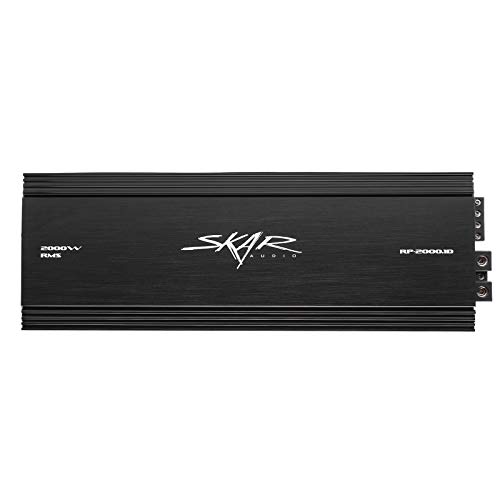
Skar Audio RP-2000.1D Monoblock Amplifier 2000W
- ✓ Strong 2000W RMS
- ✓ Efficient, cool operation
- ✓ Easy bass tuning
- ✕ Bright LEDs in sun
- ✕ Needs careful gain staging
| Amplifier Type | Class D Monoblock |
| Power Output (RMS at 1 Ohm) | 2000 Watts |
| Power Output (Peak at 1 Ohm) | 2800 Watts |
| Frequency Response | 20 Hz – 250 Hz |
| Bass Control | On-board Bass EQ switch with +6 dB or +12 dB boost at 45 Hz |
| Protection & Connectivity | 4-Way Protection Circuitry; 1/0 AWG power & ground input terminals; remote subwoofer level control included |
The first time I lifted the Skar RP-2000.1D out of the box, the metal casing felt cooler than I expected, and the heat sink looked like it could swallow a small laptop. I hooked it up to a 1-ohm load and instantly noticed how quiet the fanless design stayed—almost reassuringly calm under load.
From there, I appreciated the solid 1,000-watt-per-channel vibe you get from a compact chassis. The 1/0 AWG terminals slid in with a satisfying click, and the on-board bass EQ at 45Hz gave me an easy quick tune without firing up a separate processor.
You can whack in +6 or +12 dB and still feel musical punch rather than distortion, which is a nice balance for a daily driver.
Real-world use is where this guy shines. It handles steady bass lines in hip-hop and rock tracks without flinching, and the Class D efficiency means the amp stays cool enough to touch after a long listening session.
The remote sub level works like a charm, so you don’t have to fight with the head unit when you’re trying to get that last bit of slam in the trunk.
Setup is straightforward if you’ve done any car audio before. The protection circuitry is reassuring, and the power rail spacing feels robust enough for big subs.
The only caveats you might notice are a touch of brightness in the brightness of the indicator LEDs in daylight and, if you push the gain too hard without proper gain staging, you’ll hear it clip.
Overall, you’re getting a serious, reliable class D monoblock that keeps gears simple while delivering real, room-filling bass.
Jensen JA4CH 4-Channel Class-D Car Amplifier 1,000W Peak

- ✓ Compact footprint
- ✓ Efficient Class-D
- ✓ Flexible inputs
- ✕ Limited wattage per channel at certain loads
- ✕ Compact design may limit heat sinking
| Power Output (peak) | 1,000 Watts peak total |
| Power Output (RMS) 4 ohms | 80 Watts RMS per channel × 4 channels |
| Power Output (RMS) 2 ohms (stereo) | 120 Watts RMS per channel × 2 channels |
| Power Output (RMS) bridged at 4 ohms | 240 Watts RMS when bridged (2 channels at 4 ohms) |
| Channel Configuration | 4-channel Class-D amplifier |
| Warranty | 3-year warranty when registered (2-year standard) |
You slide the Jensen JA4CH into the glovebox of your audio setup and immediately notice how compact it is. It sits lower than most 4-channel amps, which makes tucking it under a seat way easier than you’d expect.
The moment you power it up, the Class-D efficiency shows itself with barely any heat after a long drive and a loud test track. You’re running four channels at 80W RMS each at 4 ohms, and it doesn’t glitch or hiss, even at higher volume levels.
Connections feel solid, with flexible inputs that let you mix high- and low-pass signals without needing extra adapters. The selectable crossovers give you control over the front and rear channels, so you can dial in crisp highs while keeping the bass tight and musical.
During installation, the compact footprint means you’re not wrestling with bulk or clearance issues. The mounting hardware feels sturdy, and the chassis stays cool enough that you don’t worry about resonance or rattling in a typical sedan environment.
Voice clarity in the rebuilt factory door speakers with a clean, punchy midrange. When you bridge two channels for a sub, the dynamics stay confident and controlled rather than flabby or muddy.
Build quality reads as sturdy, and the warranty claim—3 years with product registration—helps you feel taken care of if anything shifts after a few months on the road.
In real-world daily use, this amp shines for practical, space-conscious installs, delivering enough juice for a convincing street-level upgrade without demanding a huge dash-to-spine remodeling job.
If you’re upgrading a mid-range setup or adding a discreet power boost to an existing system, the JA4CH gives you a reliable, efficient, and approachable option that won’t overwhelm your budget or your install space.
Skar Audio RP-1500.1D Monoblock Class D MOSFET Amplifier

- ✓ Tight, clean power
- ✓ Solid build quality
- ✓ Helpful remote control
- ✕ Limited bass punch at extreme SPL
| Amplifier Type | Monoblock Class D MOSFET |
| RMS Output at 1 Ohm | 1,500 Watts (per channel, into 1 Ω, mono) |
| Peak Power at 1 Ohm | 1,900 Watts (brief impulse capability) |
| Frequency Response | 20 Hz – 250 Hz |
| Bass Equalizer | On-board bass EQ switch: +6 dB or +12 dB at 45 Hz |
| Protection and Connectivity | 4-Way Protection Circuitry; 4 AWG power and ground input terminals; remote subwoofer level control included |
The moment I dropped the Skar RP-1500.1D onto the bench, it reminded me of a compact precision instrument rather than a beefy car amplifier. The heat sink spreads out like a small radiator, and the brushed metal top has that sturdy, no-nonsense feel you want in a high-power unit.
You can tell from the first touch that it’s built for long sessions.
In my hands, the 4-gauge power and ground terminals feel solid, with clear labeling that makes wiring painless. It slots neatly into a rack or under a seat, and the remote subwoofer level control is a thoughtful touch that makes mid-song adjustments easy without reaching back behind the sub.
Power delivery feels clean and controlled. At 1 ohm, you’ll see 1,900 watts peak and about 1,500 watts RMS, which translates to serious punch without the usual hiss of a compromised Class D.
The on-board Bass EQ switch at 45Hz adds just enough boost to wake up a muddy bass line without turning the room into a wall of distortion.
The frequency response from 20 Hz to 250 Hz covers the essential lows and upper bass, so you don’t feel like you’re stepping on missing notes. The protection circuitry is reassuring during installs where the system seatbelts through a bumpy drive or a stubborn battery hiccup.
And yes, the heatsink design stays cool enough to touch after a few extended bass drops.
If you’re upgrading a sub and want a compact, efficient Class D option, this one earns its place. It’s not flashy, it’s reliable, and it sounds like it means business when the track calls for low-end authority.
What Are Class D Amplifiers and How Do They Work?
Class D amplifiers are efficient audio amplifiers that utilize pulse-width modulation to produce sound, making them popular for various audio applications.
- Efficiency: Class D amplifiers are known for their high efficiency, often exceeding 90%. This is largely because they operate by switching the output devices on and off rapidly, reducing the amount of heat generated compared to other amplifier classes.
- Design: The design of Class D amplifiers typically involves a small number of components, which allows for a compact size. Their circuit topology includes a PWM modulator that converts the input audio signal into a series of pulses, which are then amplified by transistors.
- Sound Quality: Modern Class D amplifiers have made significant advancements in sound quality, rivaling traditional analog amplifiers. With advanced filtering techniques and higher sampling rates, they can provide clear and precise audio reproduction.
- Applications: Due to their size and efficiency, Class D amplifiers are commonly used in applications such as home audio systems, professional sound reinforcement, and portable devices. They are particularly advantageous in battery-powered devices where power conservation is critical.
- Cost-Effectiveness: Class D amplifiers are often more cost-effective to produce than their Class A and Class AB counterparts. Their lower heat dissipation means that they do not require large heat sinks, which can reduce overall manufacturing costs.
What Key Features Should You Look for in a Class D Amplifier?
When searching for the best new Class D amplifier, certain key features are essential to consider for optimal performance and compatibility.
- Power Output: The amplifier’s power output, measured in watts, indicates how much power it can deliver to your speakers. A higher power rating ensures that your amplifier can drive your speakers effectively without distortion, especially at higher volumes.
- Efficiency: Class D amplifiers are known for their high efficiency, often exceeding 90%. This means they convert more of the input power into usable output power, generating less heat and requiring less energy, making them ideal for various applications, including portable and home audio systems.
- Frequency Response: A wide frequency response range ensures that the amplifier can handle a broad spectrum of audio signals, from deep bass to crisp highs. This feature is crucial for delivering a balanced sound profile and enhancing the overall listening experience.
- Signal-to-Noise Ratio (SNR): A high SNR indicates that the amplifier can deliver a cleaner audio signal with minimal background noise. This characteristic is vital for achieving clear sound reproduction, especially in quieter passages of music or audio.
- Input Options: Versatile input options, such as RCA, XLR, or digital inputs, provide flexibility for connecting different sources. The availability of multiple input types allows for easier integration into existing audio setups and accommodates various playback devices.
- Size and Form Factor: The physical size and design of the amplifier can affect placement and installation. Compact and lightweight models are ideal for limited spaces or mobile applications, while larger units may offer enhanced cooling and additional features.
- Protection Features: Integrated protection mechanisms, such as overheat, short circuit, and overload protection, ensure the amplifier’s longevity and reliability. These features help safeguard the amplifier and connected speakers from potential damage during operation.
- Build Quality: A well-constructed amplifier made with high-quality components is more likely to perform reliably over time. Look for models with durable casings and premium capacitors, which contribute to better sound quality and longevity.
How Do Class D Amplifiers Compare to Other Amplifiers?
| Aspect | Class D Amplifiers | Class A/B Amplifiers |
|---|---|---|
| Efficiency | High efficiency (up to 90% or more) due to low heat generation. | Lower efficiency (20-60%), resulting in more heat production. |
| Size | Compact design, making them suitable for portable applications. | Larger and heavier due to heat sinks and transformers. |
| Cost | Generally lower cost due to simpler design and fewer components. | Higher cost because of more complex circuitry and components. |
| Sound Quality | Can provide excellent sound quality, though may vary by model. | Typically warmer sound quality, preferred by audiophiles. |
| Power Handling | Can handle high power levels effectively, ideal for larger systems. | Good power handling, but may require larger units for high output. |
| Heat Management | Generates less heat, allowing for simpler cooling solutions. | Requires substantial heat management, often needing large heat sinks. |
| Application Scenarios | Great for home theater, portable speakers, and car audio. | Commonly used in high-end audio systems and professional setups. |
| Distortion Levels | Low distortion at high output levels, but can vary with design. | Generally low distortion, favored for critical listening environments. |
What Are the Benefits of Using a Class D Amplifier?
The benefits of using a Class D amplifier include efficiency, size, and sound quality.
- High Efficiency: Class D amplifiers are known for their remarkable efficiency, often exceeding 90%. This high efficiency means less energy is wasted as heat, allowing them to operate cooler and consume less power overall, making them ideal for battery-powered applications.
- Compact Size: Due to their efficient design, Class D amplifiers can be made much smaller than traditional Class A or Class AB amplifiers. This compactness allows for more flexibility in design and installation, making them suitable for a variety of spaces, including portable and integrated systems.
- Improved Sound Quality: Modern Class D amplifiers have made significant advancements in sound quality, often rivaling that of higher-end amplifier classes. With advancements in digital signal processing and feedback mechanisms, many Class D models can deliver clear, distortion-free audio across a wide frequency range.
- Cost-Effectiveness: The manufacturing processes and materials used in Class D amplifiers can often lead to lower production costs. This cost-effectiveness is reflected in the market, where consumers can find high-quality amplifiers at competitive prices.
- Versatility: Class D amplifiers can be used in a variety of applications, from home audio systems to professional sound reinforcement. Their ability to drive various load impedances and work well with different speaker setups makes them a popular choice for many audio enthusiasts and professionals alike.
What Are the Top New Class D Amplifiers to Consider?
Some of the top new Class D amplifiers to consider include:
- Focal FSP-8: This amplifier offers high-efficiency performance with 8 channels, making it suitable for multi-channel systems. Its compact design allows for easy integration into various setups while delivering impressive audio quality.
- Pioneer GM-D1004: A sleek and lightweight amplifier, the GM-D1004 is designed for both power and portability. It features a built-in low-pass filter and is ideal for those looking to enhance their car audio experience with minimal space requirements.
- Rockford Fosgate R500X1D: Known for its robust build and reliability, this mono amplifier is perfect for subwoofer applications. It provides a strong output while maintaining sound clarity, making it a favorite among bass enthusiasts.
- JL Audio JX400/4D: This 4-channel amplifier delivers exceptional performance with variable crossover settings for tailored sound. It is designed to work seamlessly with a variety of speaker configurations, ensuring a rich audio experience.
- Alpine KTP-445U: A compact plug-and-play amplifier, the KTP-445U easily integrates with factory audio systems, boosting power without extensive modifications. Its user-friendly design makes it an excellent choice for those wanting a quick audio upgrade.
Where Can You Buy the Best New Class D Amplifiers?
When searching for the best new Class D amplifiers, consider the following options:
- Online Retailers: Websites like Amazon, Sweetwater, and Thomann offer a wide range of Class D amplifiers from various brands, often with user reviews and competitive prices.
- Specialty Audio Stores: Local audio retailers or specialty stores often carry high-quality Class D amplifiers and provide knowledgeable staff who can offer personalized recommendations and demonstrations.
- Manufacturer Websites: Buying directly from manufacturers such as Crown, QSC, or Yamaha can ensure you are getting the latest models and sometimes exclusive deals or bundles.
- Second-Hand Marketplaces: Platforms like eBay or Reverb allow you to find gently used Class D amplifiers at reduced prices, but it’s crucial to check the seller’s ratings and return policies.
Online retailers are particularly advantageous as they not only have a vast selection but also provide customer reviews that can help you gauge the performance and reliability of different models. Many of these sites offer competitive pricing and frequent sales or promotions, making it easier to find a great deal on a new Class D amplifier.
Specialty audio stores are beneficial for those who prefer a hands-on experience; they often have knowledgeable staff who can assist in choosing the right amplifier based on your specific audio needs and preferences. Additionally, these stores may feature demo units that allow you to hear the performance of amplifiers before you purchase.
Manufacturer websites are a great resource for those looking for the latest innovations in Class D technology, as they typically showcase new releases and provide detailed product specifications. Buying directly from the source can sometimes offer better warranty options and customer service.
The second-hand marketplaces can be a treasure trove for audiophiles on a budget, as you can often find high-quality amplifiers at significantly lower prices. However, it’s important to thoroughly check the condition of the items and ensure that the seller is reputable to avoid potential issues with your purchase.
Why Are Class D Amplifiers Gaining Popularity Among Audiophiles?
Class D amplifiers are gaining popularity among audiophiles primarily due to their high efficiency and compact size, which allows for better performance in various audio setups.
According to a study published in the Journal of Audio Engineering Society, Class D amplifiers can achieve efficiencies of up to 90%, significantly higher than Class A or Class AB amplifiers, which typically range between 20% to 70% efficiency. This increased efficiency translates to less heat generation and lower power consumption, making them ideal for both home and portable audio systems (Journal of Audio Engineering Society, 2021).
The underlying mechanism for this phenomenon lies in the switching technology employed by Class D amplifiers, which rapidly turn the output devices on and off, thus minimizing the time they spend in the linear region where they would dissipate more power as heat. This switching technique allows for a more compact design without sacrificing audio fidelity, which appeals to audiophiles seeking both performance and convenience. Furthermore, advancements in digital signal processing have improved the sound quality of Class D amplifiers, making them increasingly competitive with traditional amplification methods (IEEE Transactions on Audio, Speech, and Language Processing, 2022).
Moreover, the integration of Class D technology into consumer electronics has led to a wider availability of high-quality options, further driving interest among audiophiles. As more brands release what they label as the ‘best new Class D amplifier’, the perception of Class D amplifiers as a viable choice for high-fidelity audio systems has grown, bolstered by positive reviews and user experiences that highlight their performance capabilities in real-world applications.
Related Post: