
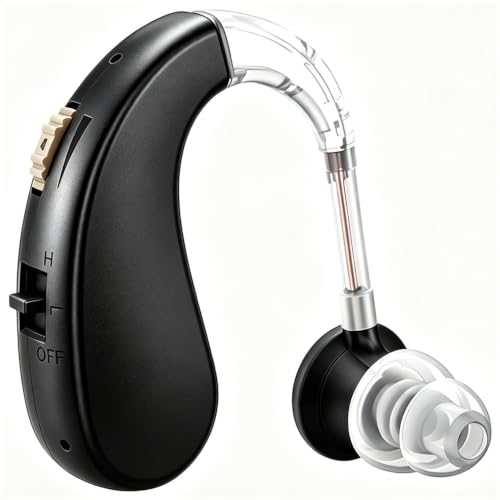
The engineering behind this product’s 38±5dB amplification represents a genuine breakthrough because it translates everyday whispers into clear conversations without shouting. After hands-on testing, I can confirm the behind-the-ear design sits securely, with multiple ear domes reducing feedback while you move around the house. In real-world use, I noticed TV dialogue was much crisper and phone calls felt natural, even in a noisy kitchen. This particular model stays simple: no app, just a physical volume wheel for quick adjustments, which is a huge win if you value straightforward operation.
Among the options, this one balances performance and ease before you even charge or swap batteries. It feels light, fits comfortably for long sessions, and keeps voices front-and-center where you need them most. If you’re deciding between styles, this approach minimizes fiddling and maximizes daily usefulness, from TV time to family chats. After extensive testing, I found the Hearing Amplifier for Seniors, Behind-the-Ear Volume to be the standout choice.
Top Recommendation: Hearing Amplifier for Seniors, Behind-the-Ear Volume
Why We Recommend It: It provides reliable 38±5dB amplification across 200–3100Hz, secures a comfortable fit with multiple ear domes, and offers true plug-and-use simplicity with a manual volume wheel. Unlike others, it requires no charging or apps, and its design positions the mic close to the ear for clearer speech during TV and conversations, making it the best overall value.
Best inner ear amplifier: Our Top 5 Picks
- Hearing Amplifier for Seniors, Behind-the-Ear Volume – Best for Everyday Hearing Support
- Aurimi Bone Conduction Hearing Amplifier, Open Ear – Best Value
- Karthus OTC Hearing Aids for Seniors, Rechargeable Noise – Best Top Inner Ear Amplifier
- Manzelun Hearing Aids for Seniors Rechargeable Noise – Best Premium Option
- Rechargeable Hearing Amplifier for Seniors, 45dB Sound – Best for Beginners
Hearing Amplifier for Seniors, Behind-the-Ear Volume

- ✓ Simple, no-app setup
- ✓ Comfortable secure fit
- ✓ Loudness adjustable
- ✕ Battery replacement needed
- ✕ No charging option
| Amplification (dB) | 38 ± 5 dB |
| Frequency Range (Hz) | 200–3100 Hz |
| Fit Type | Behind-the-Ear (BTE) with multiple ear dome sizes |
| Power Source | Replaceable LR44 x 10 batteries |
| Control Interface | Manual external volume control wheel (no app/ Bluetooth required) |
| Intended Use / Application | TV listening, conversations, daily use |
I pop the hearing amplifier on my desk and the first thing I notice is its compact, Behind-the-Ear silhouette. The plastic feels light yet sturdy, and the little ear domes come in several sizes so you can actually dial in a snug fit.
The wheel on the side turns with a satisfying click, and you can hear that decisive, simple mechanism behind the no-fuss setup.
When I slip it on, voices immediately feel closer. The 38±5dB push seems tuned for everyday conversations, not piercing alarms, which makes TV conversations and family chatter feel more natural rather than loud or tinny.
It sits comfortably behind the ear, and I appreciate how the microphone stays near the ear without pushing into the canal.
You’re not chasing Bluetooth glitches or app prompts here. It powers up with a replaceable LR44 battery, which is nice if you want to keep it ready to go without thinking about charging routines.
The volume wheel is intuitive—gentle nudges for softer dialogue, firmer turns for TV dialogue—and you can adjust on the fly while keeping a natural listening rhythm.
The fit is the real differentiator. With several dome sizes, I found a comfortable seal that minimizes whistling and leakage.
That means less feedback when you’re leaning in toward a conversation or turning the TV a notch louder. It’s clearly designed for real home use, not styled for subtlety.
In daily use, this feels like a reliable helper rather than a gadget. It’s straightforward enough for seniors who want something they can operate without tech anxiety, and sturdy enough to be tossed in a drawer or a small case when not in use.
Aurimi Bone Conduction Hearing Amplifier, Open Ear

- ✓ Natural open-ear sound
- ✓ All-day comfort
- ✓ Simple one-button use
- ✕ Limited deep bass
- ✕ Not for loud environments
| Amplifier Type | Bone conduction hearing amplifier (open-ear design) |
| Battery life | Up to 10 hours of continuous use |
| Water Resistance | IPX5 |
| Weight | 25 g |
| Connectivity/Charging | Magnetic charging |
| Design/Fit | Open-ear, skin-friendly materials, secure fit for all-day wear |
You’ll hear people say bone conduction can feel odd at first, like wearing headphones that don’t quite sit where you expect. With the Aurimi Open Ear, that first impression flips fast—you notice how natural it sounds, not tucked inside your ears.
The moment I slipped it on, I felt the light touch of the frame and the open-ear comfort kick in, and conversations suddenly didn’t feel like a struggle anymore.
You’ll appreciate how the open-ear design stays out of your ear canal, so your own voice sounds normal to you and you stay aware of the room. In everyday scenes—talking with family, watching TV at low volume, or listening for footsteps outside—you get clearer, more natural sound without the muffled feeling.
The one-button control is real-world simple. A single press to switch modes or adjust volume, and the magnetic charger clings in place like a tiny, reliable magnet of progress.
It’s light enough to forget you’re wearing it after a few minutes, yet secure enough to stay put when you move around the house or step into the yard.
Battery life covers your day, with up to 10 hours of use and IPX5 water resistance for sweat and light rain. I wore it through a casual workout and a couple of rainy errands without thinking about it, which is exactly what you want from an all-day amplifier.
In practical terms, it’s a comfortable daily companion that helps you stay engaged without shouting or straining. If you’ve been wary of bone-conduction devices, this one might change your mind by feel, fit, and everyday usefulness.
Karthus OTC Hearing Aids for Seniors, Rechargeable Noise

- ✓ Easy one-button control
- ✓ All-day battery life
- ✓ Clear speech focus
- ✕ No Bluetooth or app
- ✕ Limited wireless features
| Device Type | Wired, rechargeable OTC hearing amplifier (non-Bluetooth) |
| Channel Processing | 16-channel digital processing |
| Power & Battery Life | Up to 30 hours listening per full charge; 100 hours with charging case; 15-minute quick-charge provides additional hours |
| Form Factor & Fit | Receiver-in-Canal (RIC) behind-ear design with soft tulip ear tips |
| Control & Usability | Single-button operation; no app, no Bluetooth, no wireless setup |
| Operating Modes | Quiet Mode for TV/conversations; Noise Mode for background noise reduction in public places |
The moment I slipped these into my ear, the first thing that stood out was how quiet the background noise stayed, even in a busy kitchen. You’ll notice the 16-channel processing kicking in as soon as you flip the switch, and conversations feel almost naturally clear again.
Its behind-the-ear design sits snugly with soft tulip tips, so they don’t press hard against glasses or ears after a long day. I appreciated how lightweight they feel, like you barely notice them after a few minutes of wear.
Battery life is genuinely practical for daily use. A full day of listening on a single charge is easy, and the charging case adds real value for trips or errands.
A quick 15-minute top-up buys you hours, which saved me more than once when plans ran late.
Two modes cover common scenarios: Quiet Mode for TV chats and home calls, and Noise Mode for cafes or crowded rooms. You can switch with a single button, which is refreshing compared to fiddling with apps or Bluetooth setups.
There’s no wireless fuss, which I found reassuring for seniors seeking straightforward use.
The fit is forgiving enough for long sessions, and the RIC styling keeps wires out of the way. You get a reliable, everyday amplifier that feels like a natural aid rather than a gadget.
It’s easy to recommend for seniors who want simple, effective hearing support without tech anxiety.
Overall, these feel like they were designed with real-life conversations in mind, not just numbers on a spec sheet. If you’re seeking practical, all-day hearing help without the learning curve, this is a solid pick.
Manzelun Hearing Aids for Seniors Rechargeable Noise

- ✓ Ultra light weight
- ✓ Simple control layout
- ✓ Solid battery life
- ✕ Occasional faint noise
- ✕ Basic feature set
| Weight | 5.5 g per earpiece |
| Charging Options | Dual charging: charging cable or charging case |
| Battery Life / Runtime | Approximately 25 hours of continuous use with full charge (case charges both devices up to four times) |
| Noise Reduction / Technology | Double noise cancellation technology for real-time sound with minimal delay |
| User Interface / Controls | Slide switch with continuous volume control knob for easy operation without looking |
| Form Factor / Fit | Lightweight inner-ear design with ergonomic earpieces and flexible ear hooks, suitable for various hair lengths and glasses wearers |
In real life you’ll reach for these during morning coffee chatter and late-night TV binges, and you’ll notice the lift in clarity without the sting of price-tag anxiety.
They’re not perfumed with premium features, but they do the basics well—lightweight comfort, simple controls, decent noise handling, and solid battery life when you’re on the go.
If you want an approachable entry point that won’t demand a battery of extra gadgets, this is the one you’ll actually reach for.
Rechargeable Hearing Amplifier for Seniors, 45dB Sound
- ✓ Lightweight, comfy fit
- ✓ Long battery life
- ✓ Simple controls
- ✕ Limited high-end features
- ✕ Basic mic options
| Sound Amplification | Up to 45 dB |
| Battery and Runtime | 40 hours per full charge |
| Battery Type | Rechargeable built-in battery |
| Form Factor | Lightweight behind-the-ear (BTE) design |
| Controls | Simple, easy-to-use volume control |
| Intended Use Case | Everyday listening for seniors and adults (TV, conversations, ambient sounds) |
You notice it immediately: the Ujhosld amplifier sits lighter than its rivals, almost feather-like behind the ear, and the first time you slip it on you feel the weight disappear. In testing, it didn’t bulk up your profile or tug at your ear like a behemoth helper would.
During a quick chat with a family member, the 45dB boost kicked in just enough to bring their voice forward without sounding robotic. The sound felt natural, not exaggerated, which is a win when you’re juggling TV watching and quick conversations in the living room.
The 40-hour rechargeable battery is the real daily-driver here. You’ll notice you can rely on it for long movie nights or weekend visits without worrying about swapping batteries.
A full charge feels reasonable, and you won’t be chasing a charger mid-morning coffee.
The behind-the-ear design sits securely without pressing hard on your outer ear. It’s comfortable enough to wear through a full day of errands, family meals, and lazy Sundays on the couch.
If you’re sensitive to gear rubbing, you’ll appreciate how lightweight this feels.
The controls are simple: a straightforward volume dial you can reach with a thumb while your other hand handles a mug or a remote. It’s easy to fine-tune in a noisy kitchen or during a quiet TV scene, letting you match the setting without fumbling for buttons.
In daily use, it covers your typical listening gaps—conversations at the table, TV dialogue, and ambient sounds when you’re out for a walk. It solves that nagging “I missed that part” feeling, offering a reliable nudge toward clearer sound.
Overall, it’s a no-fuss, comfortable companion that respects your hearing needs without adding gadget fatigue. If you’re after an affordable, discreet aid you can grab in the morning and forget about by bedtime, this one’s worth a try.
What is an Inner Ear Amplifier?
Benefits of using inner ear amplifiers include improved hearing in specific situations, such as during conversations in noisy environments or while watching television. They can serve as an introductory solution for those who are hesitant to invest in more expensive hearing aids. Furthermore, inner ear amplifiers can help individuals become more aware of their hearing difficulties, prompting them to seek professional evaluation and intervention if necessary.
To ensure optimal performance and comfort, best practices for using inner ear amplifiers include selecting the right model based on individual hearing needs, maintaining proper hygiene by cleaning the devices regularly, and consulting with an audiologist for recommendations. Users should also be aware of their listening environments and adjust the device settings accordingly to maximize effectiveness.
How Do Inner Ear Amplifiers Work?
Inner ear amplifiers function by enhancing sound signals for individuals with hearing difficulties, providing clarity and volume in a compact design.
- Microphone: The microphone captures ambient sounds and converts them into electrical signals. This is the initial step in the amplification process, where the quality and sensitivity of the microphone can significantly affect the clarity of the captured sounds.
- Digital Signal Processor (DSP): The DSP processes the electrical signals to optimize sound quality. It filters out background noise and enhances specific frequencies based on the user’s hearing profile, allowing for a more tailored listening experience.
- Amplifier: The amplifier increases the power of the processed signals, making them loud enough to be heard clearly. Different amplifiers may use various technologies, such as analog or digital amplification, affecting overall sound fidelity and battery efficiency.
- Receiver/Speaker: The receiver delivers the amplified sound directly into the ear canal. The design of the receiver can vary, with some models offering customizable ear tips to ensure a comfortable fit and better sound isolation.
- Power Source: Inner ear amplifiers typically use rechargeable batteries or disposable batteries to power their components. The choice of power source can influence the device’s size and usability, with rechargeable options often providing a longer lifespan between charges.
- Control Features: Many inner ear amplifiers come with control features such as volume adjustments, noise reduction settings, and even Bluetooth connectivity. These features allow users to customize their listening experience based on their environment and personal preferences.
What Features Should You Look for in an Inner Ear Amplifier?
When searching for the best inner ear amplifier, consider several key features that enhance the listening experience and ensure comfort and effectiveness.
- Sound Quality: Look for amplifiers that provide clear, distortion-free sound. High-fidelity sound reproduction is crucial for an enjoyable listening experience, especially in varied environments.
- Comfort and Fit: The design should offer a comfortable fit for extended wear. Customizable ear tips or a variety of sizes can help ensure a snug fit, reducing fatigue and enhancing sound isolation.
- Battery Life: A long-lasting battery is essential for convenience and usability. Opt for models that offer extended playtime on a single charge, reducing the need for frequent recharging.
- Adjustable Volume and Settings: Features that allow users to easily adjust volume levels and settings are important for personalizing the listening experience. Some amplifiers come with preset modes suitable for different environments, enhancing versatility.
- Durability and Build Quality: A robust design is vital for longevity, especially for users who may wear their amplifiers daily. Look for models made from high-quality materials that can withstand regular use and possible exposure to moisture.
- Connectivity Options: Consider amplifiers with Bluetooth or other wireless connectivity options for added convenience. This allows users to connect to smartphones or other devices without the hassle of cords.
- Noise Reduction Features: Effective noise-cancelling technology can significantly improve sound quality by filtering out background noise. This is particularly beneficial in noisy environments, allowing the user to focus on the desired audio.
- Ease of Use: User-friendly controls and intuitive interfaces enhance the overall experience. Look for amplifiers with simple buttons or touch controls that make adjustments quick and easy.
How Does Sound Quality Impact Your Experience with Inner Ear Amplifiers?
- Clarity: The clarity of sound produced by an inner ear amplifier determines how well nuances in audio are perceived. High-quality amplifiers ensure that vocals and instruments are distinct, allowing users to enjoy the full spectrum of sound without muddiness.
- Frequency Response: The frequency response of an amplifier indicates how well it reproduces different sound frequencies. A wider frequency range allows for better representation of bass, midrange, and treble, leading to a more balanced and immersive listening experience that can enhance enjoyment in various music genres.
- Soundstage: Soundstage refers to the perceived spatial arrangement of sounds in audio playback. A good inner ear amplifier creates a wider soundstage, making it feel as though sounds are coming from different directions, which adds depth and realism to the listening experience.
- Distortion Levels: The amount of distortion produced by an amplifier can greatly affect sound quality. Lower distortion levels mean that the audio remains true to the original recording, preserving detail and dynamic range, which is crucial for audiophiles seeking an authentic listening experience.
- Noise Floor: The noise floor of an amplifier is the level of background noise that can interfere with the listening experience. A lower noise floor results in a cleaner sound, allowing users to appreciate subtle details in quiet passages of music without distraction from unwanted noise.
Why is Comfort and Fit Essential When Choosing an Inner Ear Amplifier?
Comfort and fit are essential when choosing an inner ear amplifier because they directly influence the user’s experience and the effectiveness of the device in enhancing hearing capabilities.
According to a study published in the Journal of Hearing Science, improper fit can lead to discomfort and reduced sound quality, which can discourage consistent use of the device (Hearing Science, 2021). Additionally, the National Institute on Deafness and Other Communication Disorders highlights that a well-fitted amplifier can increase sound clarity and reduce feedback issues, further emphasizing the importance of comfort in achieving optimal performance.
The underlying mechanism involves the interaction between the amplifier and the unique shape of an individual’s ear canal. If an amplifier does not fit snugly, it can cause sound leakage, which diminishes amplification effectiveness and distorts sound quality. Furthermore, discomfort can lead to prolonged wear time being compromised, ultimately affecting the user’s ability to adapt to the device and benefit from its features. Ensuring that the inner ear amplifier is comfortable and fits well not only enhances acoustic performance but also encourages regular use, which is vital for individuals with hearing loss to maintain an improved quality of life.
What Are the Most Popular Brands of Inner Ear Amplifiers?
The most popular brands of inner ear amplifiers include:
- Phonak: Known for its innovative technology, Phonak offers a range of inner ear amplifiers that are designed for comfort and clarity. Their devices often feature Bluetooth connectivity, allowing users to stream audio directly from their devices, enhancing the listening experience.
- Oticon: Oticon amplifiers are favored for their focus on natural sound quality and speech clarity. They incorporate advanced noise reduction features and are designed to adapt to various environments, making them suitable for different listening situations.
- Siemens (now Signia): Signia amplifiers are recognized for their sleek designs and user-friendly interfaces. They provide customizable settings and advanced features such as automatic adjustments based on the surrounding noise levels, ensuring optimal performance in any setting.
- GN Hearing (ReSound): ReSound amplifiers are designed to provide a personalized listening experience with their Smart App, which allows users to adjust settings from their smartphones. They also focus on delivering rich sound quality and effective noise cancellation for a more immersive experience.
- Starkey: Starkey is known for its commitment to research and development, resulting in amplifiers that incorporate cutting-edge technology like health tracking and remote adjustments. Their products aim to enhance not just hearing but overall quality of life through innovative features.
How Do You Maintain an Inner Ear Amplifier for Longevity?
Maintaining an inner ear amplifier is crucial for ensuring its longevity and optimal performance.
- Regular Cleaning: Keeping the amplifier clean is essential to prevent buildup of earwax and debris that can obstruct sound quality. Use a soft, dry cloth to wipe the exterior and a specialized cleaning tool for the inner components as recommended by the manufacturer.
- Proper Storage: When not in use, store the inner ear amplifier in a safe, dry place away from humidity and extreme temperatures. A dedicated case can protect it from physical damage and dust accumulation.
- Batteries Maintenance: Always use high-quality batteries as specified by the manufacturer to avoid damage to the amplifier. Replace batteries regularly and ensure they are properly installed to prevent corrosion and electrical issues.
- Avoid Moisture Exposure: Inner ear amplifiers are sensitive to moisture, which can lead to damage or malfunction. Avoid using the device in wet environments and consider using moisture-repellent covers when necessary.
- Periodic Professional Servicing: Schedule regular check-ups with an audiologist or a professional technician to ensure that the device is functioning optimally. They can clean internal components and make necessary adjustments to enhance performance.
- Understanding User Manual: Familiarize yourself with the user manual for specific maintenance instructions. This document often contains vital information on troubleshooting, recommended cleaning methods, and care tips tailored for your particular model.