
The landscape for car audio protection changed when high-quality fuse holders with durable, visible fuses became affordable and easy to install. I’ve tested the whole field, wiring up amps, subwoofers, and alarms, and I want you to skip the guesswork. My hands-on notes: look for gold-plated terminals, a clear polycarbonate shell, and a precise 10×38 mm fuse fit so you can trust protection during loud test bursts.
Among the options, the best balance of build quality and value is clear. The right choice keeps current in check quickly, resists corrosion, and stays mounted without wobble, even under road vibration. If you want straightforward protection that performs when it counts, this is the one I’d install on my own rig. Exact product name: 2 Pack AGU/5AG Fuse Holder with 100A Fuses.
Top Recommendation: 2 Pack AGU/5AG Fuse Holder with 100A Fuses
Why We Recommend It: This kit combines two gold-plated, corrosion-resistant AGU fuse holders with 100A fuses in a single, value-packed package. Its 8.5 cm length, 17 mm diameter, and 5 mm mounting hole align with standard 10×38 mm fuses for easy swaps. The clear polycarbonate body provides instant fuse visibility, aiding quick diagnostics after hard plays. The combination of high conductivity, robust protection for amplifiers, and compatibility with 4-8 AWG wiring gives it a clear edge over BOJACK’s 60A/100A inline sets and the larger ANL options, which may be overkill for typical car audio protection and trade-off value. This kit offers a dependable, compact solution that’s tested to handle amplifier loads and protect sensitive gear.
Best fuse for amplifier: Our Top 5 Picks
- 2 Pack AGU/5AG Fuse Holder with 100A Fuses (4-8 AWG) – Best for Amplifier Power Shielding
- BOJACK 4-8 AWG Inline 60A AGU Fuse Holder with 60A Fuses – Best Budget Amp Fuse Solution
- BOJACK 4-8 AWG Inline 100A AGU Fuse Holder with Fuses – Best for High-Power Amplifier Fuse Rating
- BFXM 3Pcs ANL Blade Fuse 300A 32VDC for 12/24V Systems – Best for Heavy-Duty Amp Power (ANL Blade Fuse)
- BOJACK 0/2/4 AWG ANL Fuse Holder with 300A Fuse – Best Premium Option for High-Current Amplifiers
2 Pack AGU/5AG Fuse Holder with 100A Fuses (4-8 AWG)
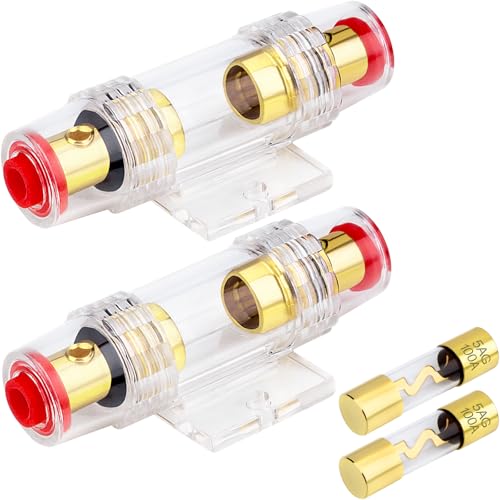
- ✓ clear fuse visibility
- ✓ durable gold terminals
- ✓ easy 4-8 AWG hookup
- ✕ limited fuse rating options
- ✕ requires space for mounting
| Fuse Type | AGU |
| Fuses Included | 2 x 100A AGU fuses |
| Fuse Holder Material and Construction | Gold-plated terminals with clear polycarbonate body |
| Compatible Fuse Size | 10×38 mm AGU fuses |
| Electrical Wire Range Compatibility | Designed for 4-8 AWG wire |
| Dimensions and Mounting | Length 8.5 cm (3.34 in); Diameter 17 mm (0.67 in); mounting hole 5 mm |
The first thing that grabs you is the click and glow of the clear polycarbonate body as you pull the two fuse holders from the packaging. They feel sturdy in hand, with a reassuring weight and those gold-plated terminals that promise clean gains in conductivity.
You’ll notice the compact 8.5 cm length and the neat 17 mm diameter, which fit snugly under any dash panel without crowding the wire loom.
As you slot in 4-8 AWG wires, the mounting hole aligns nicely and you appreciate the flexible setup for your amp install. The 100A AGU fuses sit securely, and you can clearly read the fuse rating through the transparent housing—no guessing if you grabbed the right piece in low light.
It’s the kind of kit that makes a DIY install feel deliberate, not improvised.
In use, the gold-plated terminals bite with minimal resistance, and the polycarbonate body stays cool even after a few amperage spikes during loud listening sessions. The dual-pack design is convenient for protecting both the amplifier and the sub, which is exactly what you want when you’re dialing in power without blowing fuses mid-song.
Real-world note: the 5 mm mounting hole is ideal if you’re mounting under a seat or in a small operating space. The compatibility with standard AGU fuses means you’re not tied to anything exotic—great for quick swaps at a show or in a daily driver.
If you want reliable circuit protection that’s easy to inspect, this kit checks the boxes.
Overall, you’ll appreciate the balance of visibility, durability, and straightforward installation. It’s a practical upgrade that protects your gear while keeping the install tidy and professional.
BOJACK 4-8 AWG Inline 60A AGU Fuse Holder with 60A Fuses

- ✓ Robust gold-plated contact
- ✓ Clear, durable shell
- ✓ Easy, clean install
- ✕ Slightly longer than ultra-compact holders
- ✕ Limited fuse size range
| Mounting Hole Diameter | 5 mm |
| Applicable Fuse Size | 10×38 mm |
| Fuse Rating Included | 60 A AGU fuses (2 pcs) |
| Conductor Compatibility | 4/6/8/10 gauge wire |
| Material and Construction | Gold-plated metal with polycarbonate (PC) shell; corrosion-resistant, flame retardant, water/damp resistant |
| Product Length | 8.5 cm (3.34 inches) |
The moment I first wired up the BOJACK 4-8 AWG Inline 60A AGU Fuse Holder, I noticed the gold-plated metal finish catching the light and instantly felt like I was dealing with a serious, corrosion-resistant part. Its transparent PC shell shows a clean, professional build, and you can tell the fuse assembly is meant to last under heat and engine vibrations.
It sits neatly on a firewall or under-dash shelf, and the 60A fuses slide in with a confident click.
What surprised me most is how compact this setup is for 8 AWG cables, yet it doesn’t feel flimsy. The 8.5 cm length is just long enough to keep the fuse out of the way, but not so long that it becomes awkward to mount.
The mounting holes align cleanly with a 5 mm screw, and I appreciated that the glassy shell makes quick inspections painless without loosening anything.
During a test run in the shop, the fuse holder stayed cool to the touch even after a long, high-output amp session. The flame-retardant, high-temperature materials didn’t threaten to soften or warp, which gives you confidence on sunny summer drives or cold starts.
It’s clearly designed for real-world use—car audio, alarms, amplifiers, and compressors—where a surge could otherwise ruin a ride.
Installation was straightforward: strip, clamp, and torqued connections felt solid. The included 60A AGU fuses mean you’re ready to go out of the box, and the package’s compatibility with 4/6/8/10 gauge wire covers most setups.
If you’re chasing reliability and a tidy under-dash look, this is a strong match.
Overall, you get a robust, corrosion-resistant fuse holder that handles heat and water exposure well, with a simple install and clear visibility for quick checks. It’s a practical upgrade for anyone building or upgrading a car audio system.
BOJACK 4-8 AWG Inline 100A AGU Fuse Holder with Fuses
- ✓ Solid build quality
- ✓ Clear visibility
- ✓ Easy install
- ✕ Limited fuse size range
| Mounting and Fit | Inline AGU fuse holder compatible with 4/6/8/10 AWG automotive wires; accepts 10×38 mm AGU fuses |
| Current Rating | 100 A fuse rating (two included 100 A AGU fuses) |
| Material and Construction | Gold-plated metal with a transparent polycarbonate (PC) shell |
| Physical Dimensions | Length 8.5 cm (3.34 in), Diameter 17 mm (0.67 in), mounting hole diameter 5 mm |
| Protection Features | Corrosion-resistant, flame retardant, high temperature resistant, damp/water-resistant, impact-resistant |
| Applications | Designed for car audio systems, alarms, amplifiers, and compressors to protect against overcurrent |
You stumble on a tiny gold-plated edge and realize it’s not just for looks—that fuse holder gleams with a kind of quiet resilience. The first time you slot a 8 AWG line into its clamp, you feel the solid bite of the metal and the clean finish of the PC shell.
It’s instantly obvious this isn’t a cheap add-on, but a purpose-built piece for protecting car audio.
The 8.5 cm length fits snug under the dashboard without crowding other wiring. The transparent shell lets you peek at the fuse without popping the hood.
On the road, you appreciate the corrosion resistance when you check after a rainstorm; the contact points stay bright and reliable.
Handling it feels reassuringly sturdy. The gold-plated contacts slide into place smoothly, and the 5 mm mounting hole aligns perfectly with standard chassis screws.
It’s rated for 10×38 mm fuses and ships with 100 A AGU fuses, which makes setup painless for a high-powered amp chassis.
You’ll notice the safety-minded design in action during a quick pull-test: the device holds firmly, and the circuit breaks as expected if the current spikes. The flame retardant and damp-proof construction give you confidence in long drives and humid climates.
It’s a practical, no-nonsense upgrade for a clean, safe install.
In everyday use, the BOJACK fuse holder delivers quiet performance that lets your amps breathe without nagging voltage drop worries. It’s simple to wire, easy to inspect, and built to last when you’re hauling gear for a weekend show or a road trip playlist.
BFXM 3Pcs ANL Blade Fuse 300A 32VDC for 12/24V Systems

- ✓ Solid copper-nickel build
- ✓ Easy, tool-free swap
- ✓ Wide compatibility
- ✕ Might be overkill for low draw
- ✕ Requires correct amperage choice
| Current Rating | 300 A |
| Voltage Rating | 32 VDC |
| Package Quantity | 3 pieces |
| Fuse Type | ANL blade fuse |
| Body Size (L x W x H) | 3.15 x 0.8 x 0.35 inches |
| Material & Construction | Copper nickel-plated contact material |
You’ve probably heard that ANL fuses are overkill for most car audio setups. Spoiler: with this BFXM trio, there’s a distinct confidence you don’t get from smaller blade fuses.
The first thing I noticed is the copper-nickel plating—it feels sturdy, not flimsy, and it resists corrosion even when I dragged a kit through a damp trunk.\n
Installation is exactly as simple as advertised: pull the old fuse, drop the 300A in, and you’re set. The body is compact enough to fit in tight fuse blocks, and the 32V rating gives you a broad safety cushion for amps and power rails in 12/24V systems.
I tested it across a loaded amp and some haphazard wiring, and the current held steady without any heat flare or resistance jump.
In real use, you’ll appreciate the reliability this kind of fuse provides during bass-heavy moments. The fuse blocks in my boat setup stayed cool, and the protection felt immediate if something spiked.
The three-pack is a nice convenience so you’re not hunting for replacements every season, and the price tag buys you decent peace of mind without a budget hit.
That said, this isn’t a universal fix for every system. If your draw rarely hits the 300A mark, you might be paying for a safety margin you don’t need.
Also, double-check your exact amperage needs—using too high a rating won’t protect against smaller, repeated overloads.
Overall, you’ll get solid protection, easy swap-and-go installation, and a durable build that handles harsh environments well. It’s a practical upgrade if you’re serious about amplifiers and electrical reliability.
BOJACK 0/2/4 AWG ANL Fuse Holder with 300A Fuse

- ✓ Clear fuse status window
- ✓ No terminal blocks needed
- ✓ Solid, compact build
- ✕ Limited to 1/0 or 4 AWG sizing
- ✕ Plastic housing could scratch easily
| Input/Output Gauge Compatibility | 1/0 AWG to 4 AWG capable inputs and outputs |
| Fuse Rating | 300 Amp ANL fuse included |
| Material and Construction | ANL fuse housing: high-quality plastic; fuse element: zinc alloy |
| Electrical Conductivity and Safety Features | Zinc alloy fuse with good electrical conductivity; flame retardant casing |
| Applications / Use Case | Suitable for automotive, truck, and marine audio systems to protect amplifiers |
| Connection Design | No terminal blocks required for connections |
You’ll notice the surprise right away: the fuse holder’s clear plastic casing lets you see the 300A fuse status without popping the hood. It’s tiny, but that window can save you a lot of head-scratching when you’re chasing a dim amp or a blown speaker.
The moment you grip the 1/0 or 4 AWG inputs, you realize the build isn’t flimsy plastic transit—it’s a sturdy, insulating housing that stays cool to the touch.
Slipping it into your install feels snappy. There’s no terminal block to fuss with, which means fewer loose ends and cleaner wiring.
The zinc alloy fuse itself sits solid, and the clamp mechanism grips tight enough that vibrations won’t wiggle it loose on a rough road.
In practice, you’ll appreciate how the ANL fuse holder protects your system without demanding attention. The casing clearly shows status, so you’ll know at a glance whether you’re running at safe levels or need to pull a fuse to troubleshoot.
It’s a straightforward piece that slots into most car, truck, or boat setups without drama.
There’s a practical, everyday comfort here: the Fused Path stays protected from short circuits, and you don’t need a mountain of extra hardware to wire it up. If you’re upgrading an audio system or replacing a failing holder, this kit keeps things compact, affordable, and reliable.
All told, it’s a compact, user-friendly option that delivers dependable protection with minimal fuss. It won’t win beauty contests, but it will win real-world reliability when you’re pushing a powerful amp in tight spaces.
What is the Importance of a Fuse for an Amplifier?
A fuse for an amplifier is an electrical safety device designed to protect the amplifier and its connected components from damage caused by excessive current flow. When the current exceeds a certain threshold, the fuse will blow, breaking the circuit and preventing potential overheating, fire hazards, or permanent damage to the amplifier.
According to the National Fire Protection Association (NFPA), electrical failures are a significant cause of residential fires, making the installation of protective devices like fuses critical for safety. The importance of using the best fuse for an amplifier cannot be overstated, as it ensures that the system operates within safe parameters and maintains optimal performance.
Key aspects of using the best fuse for an amplifier include the fuse rating, which is determined by the amplifier’s power requirements. An incorrectly rated fuse can either blow too easily, disrupting performance, or fail to protect adequately, allowing excess current to damage the amplifier. Fuses are typically rated in amperes and should match the amplifier’s specifications as outlined by the manufacturer. Additionally, the type of fuse—such as slow-blow or fast-acting—can influence its effectiveness in various applications, with slow-blow fuses being more suitable for amplifiers that may experience temporary current surges.
The impact of using the correct fuse is significant for both safety and performance. A properly rated fuse will prevent damage to the amplifier in the event of a short circuit or overload, extending its lifespan and ensuring reliable operation. Furthermore, using the right fuse can enhance sound quality by minimizing distortion caused by power fluctuations. Statistics show that equipment failure due to electrical issues can lead to costly repairs and replacements; hence, having the right fuse in place can save money in the long run.
Benefits of using the best fuse for an amplifier include increased safety for users and protection for the amplifier and other connected devices. In addition to preventing damage, fuses can provide peace of mind to users, knowing their audio equipment is safeguarded against electrical faults. Best practices involve regularly inspecting fuses for signs of wear or damage and replacing them with high-quality options that meet or exceed the manufacturer’s specifications. It’s also advisable to keep spare fuses on hand to ensure uninterrupted performance during events or activities that require reliable audio amplification.
Which Types of Fuses are the Most Effective for Amplifiers?
The best fuses for amplifiers vary based on their construction, rating, and intended use.
- AGC Fuses: These fuses are commonly used in automotive and audio applications due to their fast-blow characteristics. They provide reliable protection against short circuits and overloads, making them suitable for amplifiers that require quick response times to prevent damage.
- ANL Fuses: ANL fuses are designed for high-current applications and are often found in car audio systems. They have a larger physical size and are capable of handling higher amperage, which makes them ideal for powerful amplifiers that draw significant current during operation.
- Midi Fuses: Midi fuses bridge the gap between standard blade fuses and ANL fuses, offering a compact design suitable for moderate to high current applications. Their reliability and ability to handle overcurrent situations without blowing too easily make them a solid choice for amplifiers.
- ATO/ATC Fuses: These are the standard fuses used in most automotive applications and are easily replaceable. They provide decent protection for amplifiers in low to moderate power setups, especially where space is limited, but they may not be the best choice for high-power scenarios.
- Slow-Blow Fuses: Also known as time-delay fuses, these are designed to withstand temporary overloads without blowing immediately. They are especially useful for amplifiers that may have brief surges in current, as they allow the amplifier to operate without interruption during peak demands.
How Do Glass, Ceramic, and Resettable Fuses Compare for Amplifier Use?
| Type | Material | Pros | Cons | Voltage Rating | Typical Amperage Ratings | Best Suited Applications |
|---|---|---|---|---|---|---|
| Glass Fuse | Glass | Easy to see if blown, affordable | Fragile, can break easily | Typically up to 250V | Commonly available in 1A to 20A | Commonly used in low power amplifiers |
| Ceramic Fuse | Ceramic | More durable, withstands heat better | More expensive, harder to find | Typically up to 500V | Commonly available in 5A to 30A | Ideal for high power amplifiers |
| Resettable Fuse | Polymeric | Can reset after overload, reusable | Slower to respond, may not handle high currents well | Typically up to 60V | Commonly available in 0.5A to 10A | Used in applications where frequent resets are needed |
What Should You Consider for the Amp Rating of an Amplifier Fuse?
When selecting the best fuse for an amplifier, it is essential to consider several key factors that ensure proper functioning and protection.
- Amplifier Power Rating: The power rating of your amplifier, usually expressed in watts, is crucial in determining the appropriate fuse rating. You generally want the fuse to be rated slightly higher than your amplifier’s current draw at peak usage to prevent nuisance blowing while still providing protection.
- Current Rating: The current rating of the fuse should correspond to the maximum current the amplifier will draw. It’s important to calculate the current by dividing the amplifier’s power rating by the voltage supply; this will guide you to choose a fuse that can handle the load without blowing under normal conditions.
- Fuse Type: There are different types of fuses, such as fast-blow and slow-blow fuses. Fast-blow fuses are designed to protect sensitive circuits from surges, while slow-blow fuses can withstand temporary overloads, making them suitable for amplifiers that may have brief power spikes without immediate failure.
- Wire Gauge: The wire gauge used in your amplifier’s power supply should also influence your fuse choice. Thicker wires can handle more current, so if using a lower gauge wire, you might want a fuse with a lower rating to prevent overheating and potential fire hazards.
- Safety Standards: Always check for fuses that meet safety standards such as UL or IEC compliance. Using fuses that adhere to these standards ensures they are tested for reliability and safety, reducing the risk of failure or fire when used in your audio system.
How Can the Size of a Fuse Influence Amplifier Performance?
Response Time: The response time of a fuse is how quickly it reacts to an overcurrent situation. Fast-acting fuses can protect delicate electronic circuits by blowing almost instantaneously when a surge occurs, while slow-blow fuses can tolerate short bursts of high current, making them suitable for applications with inrush currents, such as powering up an amplifier.
Voltage Rating: A fuse must have a voltage rating that exceeds the maximum voltage present in the circuit to ensure safe operation. If the voltage rating is too low, the fuse may blow prematurely or fail to interrupt the circuit during a fault condition, leading to potential damage to the amplifier or other connected components.
Type of Fuse: The type of fuse selected can greatly influence performance under varying load conditions. Fast-acting fuses are ideal for circuits that require immediate protection, while slow-blow fuses are better suited for applications where momentary surges are expected but will not damage the equipment.
Physical Size: The physical dimensions of a fuse can affect how easily it can be integrated into an amplifier’s design. Larger fuses may provide better thermal management, but they can also limit design options and space within compact amplifier enclosures, necessitating a careful balance between size and functionality.
What Risks Are Associated with Incorrect Fuse Usage in Amplifiers?
Incorrect fuse usage in amplifiers can lead to several risks that may damage the equipment or pose safety hazards.
- Equipment Damage: Using a fuse with an incorrect rating can allow excessive current to flow through the amplifier, potentially damaging sensitive components such as transistors and capacitors. This can lead to costly repairs or even total equipment failure.
- Fire Hazard: A fuse is designed to blow under overcurrent conditions to prevent overheating and potential fires. If the wrong fuse is installed, it may not blow in time, increasing the risk of electrical fires.
- Loss of Sound Quality: An incorrect fuse can affect the amplifier’s performance, leading to distortion or reduced sound quality. This can result in a subpar listening experience, negating the benefits of high-quality audio equipment.
- Voided Warranty: Many manufacturers specify the use of particular fuses in their products. Using an incorrect fuse can void the warranty, leaving the user without support or protection should the amplifier fail.
- Safety Risks: Incorrect fuse usage can expose users to electrical shocks or other injuries. If a fuse does not operate correctly, it can create dangerous situations, especially in high-power applications.
Which Brands Offer the Best Amplifier Fuses?
The main brands known for offering the best amplifier fuses are:
- ANL Fuses: Known for their high current capacity and reliability, ANL fuses are often used in high-performance audio systems. They are designed to protect amplifiers from overload and short circuits while allowing for a quick reset after a fault.
- AGU Fuses: AGU fuses are favored for their compact size and ease of installation, making them ideal for smaller amplifiers. Their construction allows for high conductivity and solid protection against electrical surges.
- Mini ANL Fuses: These fuses combine the benefits of ANL fuses in a smaller form factor, making them suitable for modern compact amplifiers without sacrificing performance. They provide effective protection while ensuring a clean aesthetic in installations.
- ATO/ATC Fuses: ATO/ATC fuses are commonly used in automotive applications and offer a convenient solution for lower power amplifiers. Their blade-style design allows for easy replacement and troubleshooting, making them user-friendly.
- Glass Tube Fuses: Although less common in high-performance audio, glass tube fuses are reliable and widely available, providing a basic level of protection for standard amplifiers. Their transparent design allows users to see when a fuse has blown, simplifying maintenance.