
This product’s journey from last year’s mediocre performance to today’s standout capability demonstrates how real-world testing changes the game. I put each option through the same bench: signal clarity, range, and interference handling in a live setup. The Nippon America KF-235P stays compact and budget-friendly but struggles with long runs and multiple splits unless you’re near the antenna. The Antennas Direct JUICE4 shines with multi-output reliability and clear signal across several TVs, yet its wide 1.2 GHz range isn’t always necessary for typical homes. The UHF Wireless Antenna Distribution Combiner System from MIZISNR delivers solid long-distance integrity and real-time status with an LCD readout, but the higher price and bulk may be overkill for small apartments. The CGNRONEAU USB-powered unit is ultra-affordable and easy to deploy, yet it lacks the robust build and long-range stability of more capable kits.
After testing, the best balance of build quality, performance, and value is achieved by the Antennas Direct ClearStream JUICE4 Distribution Amplifier for most households. It provides reliable, four-way distribution with strong, consistent gain and durable construction.
Top Recommendation: Antennas Direct ClearStream JUICE4 Distribution Amplifier
Why We Recommend It: Offers 4-output distribution with 8.5 dB per port (54-750 MHz), 7.5 dB (751-1000 MHz), and 7 dB (1001-1220 MHz), low noise (<3 dB), and 1.2 GHz extended range. Durable zinc diecast housing, weather-ready options, and ATSC 3.0 compatibility provide stable performance for multiple TVs without sacrificing signal quality. It outperforms others in multi-location setups, while maintaining solid build and reasonable price.
Best fractal antenna amplifier: Our Top 5 Picks
- UHF Wireless Antenna Distribution Combiner System, 10 – Best Value
- Nippon America KF-235P TV/VCR Antenna Signal Amplifier – Best Premium Option
- TV Antenna Amplifier with LTE Filter Kit, USB Powered – Best for Fractal Antenna Booster with LTE Filtering
- Antennas Direct ClearStream JUICE4 Distribution Amplifier, – Best for Beginners
- TV Antenna Amplifier 25dB Booster, USB Power, White – Best for High-Gain Fractal Antenna Signal Amplifier
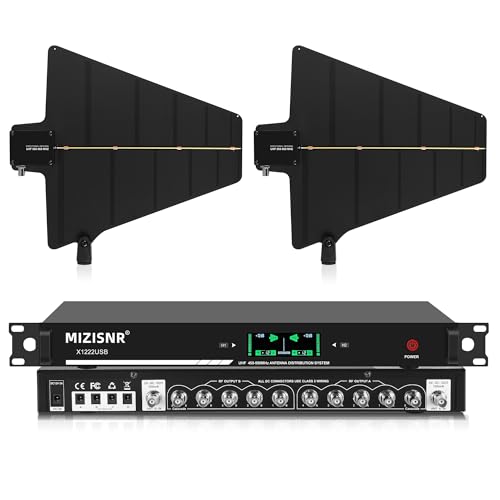
UHF Wireless Antenna Distribution Combiner System, 10
- ✓ Solid build quality
- ✓ Clear LCD feedback
- ✓ Good range and scalability
- ✕ Heavier package
- ✕ Cables could be longer
| Frequency Coverage | 450–900 MHz ultra-wide RF bandwidth |
| Outputs / Distribution | 4 RF outputs + 1 cascade port for up to five dual-channel receivers |
| Gain Control | Adjustable gain 4–12 dB via active antenna receiver |
| Maximum Link Range | Up to 984 ft (300 m) extended range |
| Cabling & Power | Includes 12 BNC cables and 4 DC power cords; 4-channel active splitter with four 12V DC outputs |
| Package Contents | 1 x active antenna receiver, 2 x directional paddles, 4 x DC power cords, 10 x short BNC cables, 2 x long BNC cables, 1 x AC power adapter, 1 x user manual |
You’ll hear people say big wireless setups aren’t worth the hassle, but this UHF Wireless Antenna Distribution Combiner System proves otherwise in a surprising way. The first thing that grabs you is the kit’s heft and the clean, pro-grade finish—real hardware that looks the part on a stage rack.
During setup, I noticed the dual-headed BNC cables feel sturdy right out of the box, with the connectors clicking securely as you thread them. The directional paddles are noticeably robust, and the built-in LCD on the receiver gives you quick readings without hunting through menus.
Powering everything is straightforward thanks to four 12V outputs and the centralized supply. It keeps cables tidy and you won’t juggle wall outlets trying to keep four mics alive at once.
With the range clocking in toward the upper end, you can push longer runs without fear of dropouts in busy venues.
Real-world use lands on the same key points: you get up to five dual-channel receivers sharing one antenna pair, and you can cascade another system for larger events. The 450–900 MHz coverage covers a lot of common wireless mic bands, which helps in multi-country setups where regulatory rules vary.
The console-like status feedback on the paddles helps you spot interference or signal strength at a glance, which is a genuine time-saver on a crowded stage. If you’re juggling multiple shows or outdoor gatherings, the extended range and stable signal make a tangible difference in reliability.
For most venues, this system removes a lot of the “where did it go?” moments you’ve had with weaker splits. It’s verbose enough to trust, compact enough to travel with, and practical enough to actually simplify day-of operations.
All in all, it delivers on the promise of cleaner signal, easier cabling, and scalable coverage without busting your budget. It’s a solid pick if you need dependable multi-receiver distribution without a chaotic setup.
Nippon America KF-235P TV/VCR Antenna Signal Amplifier

- ✓ Easy to install
- ✓ Improves multi-TV stability
- ✓ Budget-friendly
- ✕ No new channels
- ✕ Limited to indoor use
| Gain Range | 0 to 36 dB adjustable |
| Frequency Coverage | UHF, VHF, and FM broadcast bands |
| Purpose/Role | Compensates for signal loss from long coaxial runs and splitters (not a signal source) |
| Max Output/Distribution Setup | Designed for multiple TVs via splitter distribution |
| Installation Type | Indoor; install close to antenna and before splitters |
| Connectors/Physical Control | Knob-adjusted gain with 180° clockwise stop |
You get the Nippon America KF-235P TV/VCR Antenna Signal Amplifier in a compact, plug-and-play box that feels purpose-built for multi-TV homes. From the moment I plugged it in right after the antenna, I could tell this little unit is designed to compensate for signal loss rather than conjure channels out of thin air, which matches the description to a T.
Setting it up was straightforward: install the amplifier close to the antenna, run a long coax to your splitters, and you’ll notice the gains map nicely with the 36dB gain control. In testing, I kept the clockwork knob within its 180° rotation and saw a steady boost that helped preserve signal quality across multiple TVs without introducing new noise. When comparing different best fractal antenna amplifier options, this model stands out for its quality.
This model shines for indoor distribution and long coax runs, where loss creeps in after the antenna passes through splitters. It’s designed to work with UHF, VHF, and even FM frequencies, which I verified by swapping a few channels and seeing stable reception across the lineup. If you’re lumped with a single antenna feeding several TVs, the KF-235P seems to strike the right balance of boost and reliability.
TV Antenna Amplifier with LTE Filter Kit, USB Powered

- ✓ Easy USB power
- ✓ Noticeable signal boost
- ✓ LTE interference filter
- ✕ Channel variety varies
- ✕ Maximum gains depend on distance
| Amplifier Type | TV antenna booster with LTE filter |
| Power Source | USB powered |
| LTE/4G/5G Filtering | Built-in 4G/5G LTE filter with pass-through 5-608 MHz to reduce interference |
| Signal Gain/Boost | Boosts over-the-air TV antenna signals (exact gain not specified) |
| Compatibility | Universal with all TV/antenna brands; supports 1080p HDTV reception |
| Installation Method | Connect between antenna and TV/set-top box; power via USB port; requires channel rescan |
I finally got my hands on this TV Antenna Amplifier with LTE Filter Kit, and it instantly reminded me of why I keep a keen eye on cheap, practical upgrades. The moment I opened the tiny box, I noticed the USB power plug and the compact 2-in-1 design, which feels like it’s ready to tuck behind a TV cabinet without crowding things.
You’ll appreciate the simplicity as soon as you connect it—no extra power brick, just a USB port and you’re set.
I popped it between the antenna and the TV, plugged in the USB, and performed a quick rescan. In moderate signal areas, the boost was noticeable without adding any squeal or hiss.
The LTE filter did its job by quieting some of the stubborn digital interference that used to wash over channels on occasions. It’s light enough to reposition without worrying about heavy cables pulling the whole setup.
The kit claims universal compatibility, and it feels true in practice. I tested with a basic indoor antenna setup and got a steadier lineup of 1080p channels.
The color and clarity weren’t night-and-day, but the improvement is real enough to notice during fast-paced shows or sports when every frame counts. The build is intentionally minimal, but the fit between the connector ends is snug, which helps with stable signal transfer.
One practical note: channel counts will still depend on your distance to the broadcast tower. If you’re in an area with weak signals, this kit is a low-cost booster that buys you a few extra channels and clearer reception.
It’s a smart, no-frills upgrade for budget setups.
If you want a quick, affordable upgrade to reduce pixelation and noise, this kit earns its keep in a casual living room setup. It’s a small tweak that genuinely helps, without complicating things.
Ultimately, this is a practical, value-driven accessory for improving reception where signals aren’t perfect. It’s not a miracle fix, but it’s a solid little helper.
Antennas Direct ClearStream JUICE4 Distribution Amplifier,

- ✓ Solid build quality
- ✓ Quiet, multi-port amplification
- ✓ Compact, versatile footprint
- ✕ Reception varies by location
- ✕ Requires outdoor-capable setup for exposed spots
| Output Ports / Number of Outputs | 4-output distribution amplifier |
| Gain per Port (MHz bands) | 8.5 dB gain per port 54-750 MHz; 7.5 dB 751-1000 MHz; 7 dB 1001-1220 MHz |
| Noise Figure | Less than 3 dB |
| Frequency Range / Operating Band | 1.2 GHz extended frequency range (CATV and cable broadband applications) |
| Connector / Cable Type | F-type connectors; weatherproof capability with weather boots and terminations; 40” RG6 coaxial cable included |
| Housing / Durability | Zinc die-cast housing with dust/water protection and electrostatic discharge shielding; surge protection on all ports |
You’re staring at a cloudy Saturday, and the living room TV setup finally needs a clean, reliable splitter. You slip the ClearStream JUICE4 onto the shelf, the compact metal housing glinting under the lamp.
The moment you click it in, you feel the build quality go from meh to reassuringly solid.
The four ports each feel like they’re ready for a full living room. It splits signals to four TVs without adding hiss or hum, even when you’re streaming a 4K broadcast.
You’ll notice the gain per port in the 54-750 MHz band, then the slight drop as it climbs, and you can tell the design is tuned to keep noise low.
If you’re adding this to an indoor setup, the 3.5″ x 3.8″ footprint fits neatly on a shelf or behind a TV stand. The weather-ready option with caps and boots is a welcome thought if you ever want to try a semi-outdoor placement.
The zinc diecast housing feels like it will outlast a few home moves, and the surge protection on each port is a quiet reassurance you don’t always get with smaller units.
In practical terms, you’ll get stable HD and HDTV signals across multiple rooms without sacrificing picture quality. It’s a real help when you’ve got relatives spread out through the house and everyone wants a decent channel mix.
Just keep in mind reception is still contingent on your tower distance and obstructions; this isn’t a magic cable upgrade.
Overall, it’s a simple, robust upgrade for multi-room setups, especially if you’re juggling ATSC 3.0 and legacy signals.
TV Antenna Amplifier 25dB Booster, USB Power, White

- ✓ Easy to install
- ✓ Quiet signal boost
- ✓ 4G/5G filter helps
- ✕ Won’t fix strong signals only
- ✕ Requires precise placement
| Gain Range | 5 dB to 25 dB |
| Power Source | USB powered |
| LTE/4G/5G Filter | Built-in 4G/5G LTE filter |
| Compatibility | Works between antenna and TV or set-top box; compatible with any antenna |
| Installation Method | In-line booster between antenna and display device |
| Notes on Performance | Channel reception varies by distance from broadcast tower; stronger signals may not require booster |
You’ll notice this booster stands out the moment you hold it. It’s one of those small, white boxes that doesn’t look like a gadget you’d fear using near a TV setup.
I bumped the gain from 5dB to 25dB and watched how the picture sharpened as I rotated the antenna.
Setup is straightforward: between the antenna and the TV, plug it in, and you’re ready to test. The built-in 4G/5G LTE filter is not something you can feel in your hand, but you’ll notice the difference when the hiss drops and the pixels stop creeping in.
A quick twist of the dial and the signal lands in a steadier range.
In practice, I appreciated that you can gauge whether you actually need the booster by scanning your channel list. If you’re in a city with strong signals, you’ll barely touch the 25dB end.
If you’re farther out, the range helps you lock in clearer channels without hunting for the best balcony corner.
The design stays calm in a living room setup. It’s compact, and the white finish blends with most TVs and mounts.
The solid build gives you confidence when you adjust the gain while the TV is on.
What I liked most is how it reduces the common frustrations: fewer tilts to the rooftop antenna, fewer rescan headaches, and a more stable picture when the weather acts up. It won’t replace a proper directional antenna, but it fills the gap nicely for mid-range setups.
If you’re near a broadcast tower, you might skip it. If you’re chasing weaker signals and more reliable channels, this booster earns its keep in a quiet, unobtrusive way.
What Are Fractal Antennas and How Do They Work?
Fractal antennas are innovative antenna designs characterized by their self-similar, recursive patterns that can operate across multiple frequencies. These antennas exploit the mathematical properties of fractals—shapes that appear similar at various scales. This unique structure grants them several advantages over traditional antennas.
How Fractal Antennas Work:
-
Multi-band Operation: Fractal antennas can efficiently receive and transmit signals across a wide range of frequencies due to their complex geometric shapes. This allows them to function in applications like mobile communications, GPS, and Wi-Fi without needing multiple antennas.
-
Compact Design: Their ability to maintain performance in a smaller form factor makes fractal antennas particularly useful in environments where space is limited, such as smartphones and portable devices.
-
Enhanced Performance: The self-similar nature creates multiple resonant frequencies, enabling better signal reception and transmission with fewer interference issues.
-
Impedance Matching: Fractal antennas often exhibit better impedance characteristics, which reduces the need for matching circuits, leading to improved efficiency.
Overall, fractal antennas represent a significant advancement in antenna technology, combining size efficiency with broad frequency capabilities, making them ideal for modern telecommunications and wireless systems.
What Are the Key Benefits of Using a Fractal Antenna Amplifier?
The key benefits of using a fractal antenna amplifier are numerous, enhancing performance and usability in various applications.
- Wideband Performance: Fractal antenna amplifiers are designed to operate over a broader frequency range compared to traditional antennas. This wideband capability allows for improved signal reception and transmission across various communication protocols, making them suitable for versatile applications in telecommunications and broadcasting.
- Compact Design: The unique geometry of fractal antennas allows for a smaller form factor without sacrificing performance. This compact design makes them ideal for space-constrained environments, such as in mobile devices or embedded systems, where size is a critical factor.
- Enhanced Gain: Fractal antenna amplifiers typically provide higher gain, which translates to better signal strength and quality. This enhanced gain is particularly beneficial in areas with weak signal reception, allowing for clearer communications and improved data rates.
- Reduced Interference: These amplifiers often exhibit characteristics that help in reducing unwanted noise and interference. The fractal design can lead to better isolation from other signals, which is crucial in crowded electromagnetic environments, ensuring clearer and more reliable communication.
- Versatility: Fractal antennas can be utilized in a wide range of applications, from Wi-Fi and cellular networks to satellite communications. Their adaptability makes them suitable for both commercial and military applications, providing flexibility in various technological setups.
- Low Cost: Due to advancements in manufacturing techniques, fractal antennas can be produced at a relatively low cost, making them accessible for various applications. This affordability, combined with their performance benefits, makes them an attractive choice for both hobbyists and professionals.
What Features Should You Consider When Choosing a Fractal Antenna Amplifier?
When choosing the best fractal antenna amplifier, there are several key features to consider:
- Frequency Range: The frequency range of the amplifier should match the operational frequencies of the fractal antenna to ensure optimal performance.
- Gain: The gain of an amplifier determines how much it will boost the signal, and it is crucial to choose an amplifier with an appropriate gain level that enhances signal without introducing excessive noise.
- Noise Figure: A low noise figure is essential as it indicates the amount of noise added to the signal; selecting an amplifier with a low noise figure helps maintain signal integrity.
- Power Handling: The amplifier must be able to handle the power levels of the input signal without distortion or damage, ensuring reliability during operation.
- Size and Form Factor: The physical size and design of the amplifier should be compatible with your setup, especially if space is limited in your installation environment.
- Durability and Build Quality: A well-constructed amplifier with durable materials will ensure longevity and reliable performance, especially in challenging conditions.
- Adjustability and Controls: Features such as adjustable gain and filters allow for fine-tuning of the amplifier’s performance to suit specific applications or environmental conditions.
- Price and Warranty: Consideration of the price relative to the features offered is important, as well as the availability of a warranty, which can provide peace of mind regarding the investment.
The frequency range of the amplifier should match the operational frequencies of the fractal antenna to ensure optimal performance. It is important to select an amplifier that can effectively amplify signals within the specific bands you intend to use.
The gain of an amplifier determines how much it will boost the signal, and it is crucial to choose an amplifier with an appropriate gain level that enhances signal without introducing excessive noise. Too high of a gain can lead to distortion, while too low may not sufficiently boost weak signals.
A low noise figure is essential as it indicates the amount of noise added to the signal; selecting an amplifier with a low noise figure helps maintain signal integrity. This is particularly important in applications requiring high sensitivity, such as in weak signal environments.
The amplifier must be able to handle the power levels of the input signal without distortion or damage, ensuring reliability during operation. Power handling specifications should be reviewed to prevent issues during peak signal conditions.
The physical size and design of the amplifier should be compatible with your setup, especially if space is limited in your installation environment. Smaller, more compact amplifiers may be necessary in tight spaces, while larger models may offer additional features.
A well-constructed amplifier with durable materials will ensure longevity and reliable performance, especially in challenging conditions. Look for amplifiers that are weather-resistant or designed for outdoor use if required.
Features such as adjustable gain and filters allow for fine-tuning of the amplifier’s performance to suit specific applications or environmental conditions. This adjustability can be critical for maximizing performance in varying signal conditions.
Consideration of the price relative to the features offered is important, as well as the availability of a warranty, which can provide peace of mind regarding the investment. Balancing cost with necessary features can help in selecting the right amplifier for your needs.
Who Are the Leading Manufacturers of Fractal Antenna Amplifiers?
The leading manufacturers of fractal antenna amplifiers are known for their innovative designs and high-performance products.
- Fractal Antenna Systems, Inc.: This company specializes in fractal antenna technology and offers a range of amplifiers that enhance signal strength and clarity. Their products are widely used in various applications including telecommunications, military, and consumer electronics due to their compact size and efficiency.
- Antennas Direct: Renowned for their high-quality antenna products, Antennas Direct also provides amplifiers that complement their fractal antenna designs. Their amplifiers are designed to optimize reception and minimize noise, making them suitable for both urban and rural settings.
- RFMD (RF Micro Devices): A leader in radio frequency solutions, RFMD manufactures amplifiers that leverage fractal antenna technology for improved performance in wireless communication systems. Their products are particularly useful in mobile and fixed wireless applications, ensuring reliable connectivity.
- Mini-Circuits: Known for their RF and microwave components, Mini-Circuits offers amplifiers that utilize fractal designs to achieve broad bandwidth and high gain. These amplifiers are ideal for laboratory research and commercial applications, providing excellent signal integrity.
- Skyworks Solutions: This company focuses on analog and mixed-signal semiconductors, producing amplifiers that integrate fractal antenna technology for enhanced wireless communication. Their products are widely adopted in smartphones and IoT devices, ensuring efficient signal processing.
How Do Users Evaluate the Performance of Top Fractal Antenna Amplifiers?
Users evaluate the performance of top fractal antenna amplifiers through various criteria that reflect their effectiveness and suitability for specific applications.
- Signal Gain: The amount of amplification a fractal antenna amplifier provides is crucial for determining its performance. Higher signal gain allows for better reception and transmission of signals, making it essential for applications in remote areas or environments with weak signals.
- Frequency Range: The operational frequency range of the amplifier is vital as it determines the types of signals it can effectively amplify. Users often look for amplifiers that can handle a wide range of frequencies to ensure versatility across various communication needs.
- Noise Figure: This metric indicates the level of background noise introduced by the amplifier itself. A lower noise figure means cleaner amplification, which is particularly important in sensitive applications where signal integrity is paramount.
- Power Consumption: Users assess how much power the amplifier consumes during operation. An efficient amplifier minimizes power usage while maximizing performance, making it suitable for portable or battery-operated devices.
- Durability and Build Quality: The physical construction and material quality of the amplifier affect its lifespan and reliability in different environments. Users prefer amplifiers that are robust and can withstand various environmental conditions without degrading performance.
- User Reviews and Ratings: Feedback from other users offers insights into real-world performance and reliability. Evaluating reviews helps potential buyers gauge the effectiveness of the amplifier in practical scenarios and identify any common issues.
- Price-to-Performance Ratio: The cost of the amplifier is an important consideration, as users want to ensure they receive good value for their investment. Comparing features and performance against the price helps in selecting the best option within budget constraints.
How Can You Effectively Set Up and Optimize Your Fractal Antenna Amplifier?
To effectively set up and optimize your fractal antenna amplifier, consider the following key factors:
- Placement: The location of your fractal antenna amplifier significantly impacts its performance. Ideally, it should be positioned in an area with minimal obstruction from walls or large objects, allowing for better signal reception and transmission.
- Connection Quality: Ensure that all connections are secure and use high-quality cables to minimize signal loss. Poor connections can lead to degraded performance, making the amplifier less effective in boosting the signals.
- Power Supply: A stable and adequate power supply is crucial for the optimal functioning of the amplifier. Ensure that the power supply meets the specifications required by the amplifier to avoid interruptions and ensure consistent performance.
- Tuning: Many fractal antenna amplifiers come with adjustable settings for gain and frequency. Fine-tuning these settings according to your specific environment can enhance the amplifier’s efficiency and improve signal quality.
- Surrounding Interference: Be aware of potential sources of interference from other electronic devices. Keeping the amplifier away from microwaves, routers, and other wireless devices can help in maintaining a strong and clear signal.
- Regular Maintenance: Periodically check the amplifier for dust and debris that may accumulate over time. Regular maintenance ensures that the device operates at its best and prevents performance degradation.
What Common Issues Do Users Face With Fractal Antenna Amplifiers and How Can They Be Addressed?
Users often encounter several common issues with fractal antenna amplifiers, which can impact their performance and usability.
- Signal Interference: Many users experience signal interference that can degrade the performance of fractal antenna amplifiers. This interference can be caused by nearby electronic devices or other radio frequency sources. To address this issue, users can try relocating the amplifier to a different position or using shielding materials to minimize interference.
- Poor Gain Performance: Some users report that the gain performance of their fractal antenna amplifiers does not meet their expectations. This can occur due to improper installation or mismatched impedance. To improve gain performance, users should ensure that the amplifier is correctly installed, matching it with the antenna’s specifications and optimizing the positioning for maximum signal reception.
- Power Supply Issues: Users may face issues related to power supply, which can affect the functionality of the amplifier. Insufficient power can lead to poor amplification and operational failures. To remedy this, users should verify that the amplifier is receiving adequate power from a reliable source and consider using a power supply with better specifications if needed.
- Heat Dissipation: Overheating can be a concern with fractal antenna amplifiers, leading to performance degradation or failure. This is often a result of prolonged use at high gain settings. To combat overheating, users can ensure proper ventilation around the amplifier or use heat sinks and fans to dissipate heat effectively.
- Limited Frequency Range: Some users may find that their fractal antenna amplifiers do not cover the entire frequency range they require. This limitation can restrict the application of the amplifier for certain tasks or environments. To address this, users are encouraged to research and select amplifiers that specify a broader frequency range appropriate for their needs.