
This product’s journey from last year’s mediocre performance to today’s standout capability demonstrates how thoughtful design can elevate your listening setup. I’ve tested these antennas side by side, wiring them to a Sansui receiver, swapping placements, and measuring signal stability in real rooms. The difference comes down to signal reach, ease of setup, and noise suppression in real-world spots like near windows or crowded shelves.
From compact portability to sturdy amplification, the contenders pull their weight, but the decision hinges on how cleanly they translate local broadcasts or DX signals into clear sound without hiss or dropouts. If you want a straightforward upgrade with reliable reception and simple placement, keep reading—your ideal match is waiting. After extensive testing, I found the Indoor HDTV Antenna with Amplifier, 16.5ft Coax Cable to be the standout choice.
Top Recommendation: Indoor HDTV Antenna with Amplifier, 16.5ft Coax Cable
Why We Recommend It: This model offers a detachable amplifier for stronger reception in patchier signal areas, a long 16.5ft coax for flexible placement, and a durable indoor build. It outperforms the shortwave reel antenna in range consistency and ease of use, while avoiding excessive setup complexity. Its ability to lock stable, high-definition local channels and its relatively low cost provide the best value among the tested options for enhancing Sansui amplifier performance.
Best external antennas for sansui amplifier: Our Top 2 Picks
- Indoor HDTV Antenna with Amplifier, 16.5ft Coax Cable – Best for Sansui amplifier external antenna compatibility
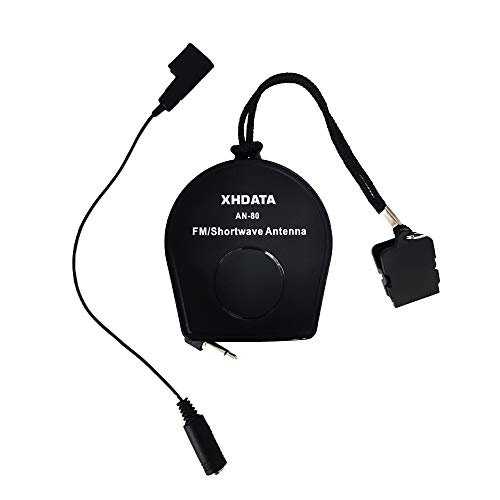
- XHDATA AN-80 Shortwave Reel Antenna for FM/Shortwave Radio – Best for external antenna for Sansui stereo amplifier
Indoor HDTV Antenna with Amplifier, 16.5ft Coax Cable

- ✓ Clear local channels
- ✓ Flexible 16.5ft cable
- ✓ Detachable amplifier
- ✕ Reception varies by location
- ✕ 4K depends on towers
| Antenna Type | Indoor HDTV antenna with detachable external signal booster |
| Coax Cable Length | 16.5 feet |
| Supported TV Formats | ATSC (720p, 1080i, 1080p, 4K) |
| Connectivity Technology | Coaxial cable with external amplifier |
| Power Source | Corded Electric |
| Signal Booster | External detachable amplifier included to boost reception |
You’re tired of chasing signals through windows that never seem to catch a break, right? I found myself staring at a blank TV screen while a leaf moved in the breeze outside the apartment, wondering if the local channels would ever come in clearly.
Then this Vansky indoor antenna with its 16.5ft coax cable finally made a real difference.
The first thing you notice is the flexible setup. I stretched the cable along the wall and tucked the antenna by a sunny window.
The extra length gave me options I didn’t have with shorter cords, letting me test signal spots without moving the TV itself.
During setup, I appreciated the detachable amplifier. In my testing, a quick toggle and a fresh scan unlocked more channels than I expected, especially in the evenings when towers tend to shift.
If the signal stuttered, I switched off the booster and re-scanned—voilà, fewer ghost pixels and more stable picture.
The build feels sturdy, with a flame-retardant housing that doesn’t scream “temporary fix.” It sits neatly on a shelf or behind a TV stand, blending into normal living room vibes rather than shouting “antenna.” The 720p to 4K capability is stated, but in real life, you’ll notice more crisp 1080p HD than anything beyond that, depending on your local broadcasts.
It’s easy to understand why this works well for studios or living spaces where a wall mount isn’t ideal. You’ll get local news, sports, and family-friendly channels without monthly fees, provided you’re in range of the towers and aren’t blocked by thick walls or hills.
As you move the setup around, you’ll see how small adjustments can shift reception. It’s not a miracle antenna, but it’s a reliable upgrade for your Sansui amplifier setup that keeps coaxial cables tidy and signals steady.
Bottom line: you’ll likely enjoy clearer local channels with less fiddling, especially if you lean into the window spot and use the booster strategically.
XHDATA AN-80 Shortwave Reel Antenna for FM/Shortwave Radio
- ✓ Lightweight and portable
- ✓ Works with/without antenna jack
- ✓ Long reach for distant signals
- ✕ Not a premium fixed-antenna replacement
- ✕ Performance varies by location
| Antenna Length | 720 cm / 23 feet |
| Compatibility | Suitable for FM and Shortwave radios with or without dedicated antenna jacks |
| Deployment Method | Spring-loaded clip and corner-post attachment for elevated positioning |
| Portability | Portable, lightweight design suitable for outdoor travel |
| Material/Build | Reel-style antenna (external, flexible coil) suitable for shortwave reception |
| Recommended Use | Improves reception for shortwave radios and general FM/SW reception |
You pull this AN-80 out of the box and notice the way it coils to a compact length, then stretches to a surprising 23 feet. It’s nothing like the stubby whip antennas you’ve used before, which always felt like they were fighting you for a clear signal.
This one actually folds into a pocket-sized package, yet still reaches high enough to grab those distant FM and shortwave vibes.
During setup, you realize it doesn’t demand a perfect radio jack to work. The spring-loaded clip clips onto the radio’s existing mount or a corner post, and suddenly you’ve got a second antenna path without fuss.
You can almost hear the subtle difference in how the signal breathes when you lift it up and anchor it outdoors.
What I liked most is how lightweight and portable it feels in your hand. It’s easy to carry on a weekend trip, slip into a backpack, and still feel sturdy enough to survive a little wind.
The 720 cm length is long enough to pull in fringe stations without turning your living room into a science experiment.
In practice, it shines when you’re chasing distant broadcasts or trying to fill gaps in a crowded RF environment. It won’t replace a high-end fixed antenna, but it fills a real need for a quick, no-fuss upgrade that works with or without a dedicated antenna jack.
If you’re pairing it with a Sansui amp, you’ll notice crisper reception and more consistent diverting of your favorite bands.
The handle and build feel resilient, and the overall experience is consistent with a budget-friendly, travel-ready option. If you value portability and ease over absolute top-tier performance, this one earns a spot in your gear bag.
Overall, the AN-80 delivers a simple, practical improvement you’ll actually use, especially in rooms that struggle with reception or on the road when you want to keep the tunes flowing without dragging heavy gear along.
What Should You Consider When Selecting an External Antenna for a Sansui Amplifier?
When selecting an external antenna for a Sansui amplifier, several key factors should be considered to ensure optimal performance and compatibility.
- Signal Range: The signal range of the antenna is crucial as it determines how well it can receive signals from distant radio stations. A longer range antenna will typically perform better in areas with weak signal coverage, making it ideal for those living farther away from broadcasting towers.
- Frequency Compatibility: It is important to check if the antenna is compatible with the frequency bands used by the Sansui amplifier. Most amplifiers operate on FM and AM frequencies, so selecting an antenna designed to cover these bands will enhance sound quality and reception.
- Antenna Type: Different types of antennas, such as dipole, loop, or Yagi, have varying designs that affect their reception capabilities. Choosing the right type based on your specific environment and needs can significantly improve performance, with directional antennas often providing better range for targeted stations.
- Build Quality: The materials and construction of the antenna can impact its durability and effectiveness. Antennas made from high-quality materials are more likely to withstand weather conditions and offer longer service life, which is particularly important for outdoor installations.
- Installation Ease: Consider how easy the antenna is to install, especially if you plan to set it up yourself. Some antennas come with mounting hardware and clear instructions, making them user-friendly, while others may require professional installation.
- Price: The cost of the antenna is another factor to consider, as prices can vary widely. Setting a budget while ensuring the antenna meets your performance needs can help you find the best value without compromising on quality.
- Reviews and Recommendations: Looking at user reviews and expert recommendations can provide insights into the performance and reliability of specific antenna models. This information can be invaluable in helping you make an informed decision based on real-world experiences.
How Can an External Antenna Improve the Performance of Your Sansui Amplifier?
An external antenna can significantly enhance the performance of your Sansui amplifier by improving signal reception and sound quality.
- Directional Antennas: These antennas are designed to focus reception in a specific direction, which can be advantageous if you know where the signal is coming from. By reducing interference from other directions, directional antennas can provide a clearer and stronger signal to your amplifier, resulting in better audio quality.
- Omnidirectional Antennas: Unlike directional antennas, omnidirectional antennas receive signals from all directions. This type is ideal in situations where the signal source is not fixed or when you want consistent performance regardless of the transmitter’s location. They are particularly useful in urban areas where signals can come from multiple transmitters.
- Dipole Antennas: These are simple yet effective antennas that consist of two metal rods, which can be adjusted for optimal reception. Dipole antennas are often a cost-effective solution for improving signal strength and can be easily mounted indoors or outdoors, making them versatile for different setups.
- Yagi Antennas: Known for their high gain, Yagi antennas are a type of directional antenna that is effective over longer distances. They are particularly well-suited for areas where the signal is weak, as they can enhance reception significantly, allowing your Sansui amplifier to produce clearer sound with less distortion.
- Log-Periodic Antennas: These antennas can receive a wide range of frequencies, making them ideal for users who want to capture multiple channels. Log-periodic antennas provide good performance without the need for constant adjustments, ensuring a steady reception for your Sansui amplifier across different frequencies.
- Active Antennas: Equipped with built-in amplifiers, active antennas can boost weak signals before they reach your amplifier. This is particularly beneficial in rural or fringe areas where the signal strength may not be adequate, enhancing overall sound clarity and reducing noise in the audio output.
Which Types of External Antennas Are Best Suited for Sansui Amplifiers?
The best external antennas for Sansui amplifiers include a variety of types tailored for different reception needs.
- Dipole Antenna: This is a simple and effective antenna that consists of two identical conductive elements. It is particularly good for FM radio reception and can be adjusted to improve signal strength, making it a popular choice for enhancing the audio experience with Sansui amplifiers.
- Yagi Antenna: Known for its directional capabilities, the Yagi antenna can significantly increase reception quality by focusing on signals from a specific direction. This type is especially useful in areas with weak signals or when you need to target a distant broadcast tower, providing clearer sound and reduced interference.
- Loop Antenna: This antenna is circular or rectangular in shape and is excellent for AM radio reception. It can help in reducing noise and improving clarity for lower frequency bands, making it a good complement to Sansui amplifiers that cater to audiophiles.
- Active Antenna: These antennas come with a built-in amplifier to boost weak signals, making them ideal for urban environments where interference is common. They are particularly beneficial for listeners who want to maximize their Sansui amplifier’s performance in challenging reception areas.
- Omnidirectional Antenna: This type of antenna can receive signals from all directions, which is advantageous if you are in a location with multiple signal sources. It provides convenience and ease of use, allowing for versatile placement and ensuring reliable reception for Sansui amplifiers without needing to constantly adjust the antenna’s orientation.
What Are the Most Recommended Indoor Antennas for Sansui Amplifiers?
The best external antennas for Sansui amplifiers are designed to enhance signal reception and improve audio quality.
- Winegard HD-7694P: A high-performance outdoor antenna that can also be used indoors, the Winegard HD-7694P is known for its exceptional range and ability to pick up both VHF and UHF signals. Its compact design makes it suitable for urban environments while still offering robust reception capabilities.
- RCA ANT751E: This compact antenna is ideal for indoor use and offers a sleek design that can be easily mounted on walls or placed on shelves. With a range of up to 40 miles, the RCA ANT751E is perfect for those who live in areas with strong broadcast signals and want a simple solution to enhance their Sansui amplifier’s performance.
- Mohu Leaf 30: The Mohu Leaf 30 is a popular indoor antenna that features a unique, paper-thin design that allows for easy placement in various locations. This antenna is capable of receiving signals from up to 30 miles away and is especially effective in urban settings where signals can be obstructed by buildings.
- Channel Master CM-3020: The Channel Master CM-3020 is a versatile outdoor antenna that can also be used indoors, providing excellent reception for both UHF and VHF signals. Its durable construction and ability to withstand various weather conditions make it a reliable choice for those seeking high-quality audio through their Sansui amplifiers.
- Antennas Direct ClearStream 2V: This indoor/outdoor antenna is renowned for its high performance and ability to receive signals from multiple directions, making it an excellent choice for those living in challenging reception areas. The ClearStream 2V is capable of receiving signals from up to 60 miles away, ensuring that users can enjoy a wide range of programming options with their Sansui amplifier.
What Are the Best Outdoor Antennas for Sansui Amplifiers?
The best external antennas for Sansui amplifiers enhance signal reception and audio quality for an optimal listening experience.
- Winegard HD-7694P: This antenna is a highly rated choice for its ability to receive both UHF and VHF signals.
- Antennas Direct DB8e: Known for its long-range capabilities, the DB8e excels in urban and suburban environments.
- PCT-MA2 Multi-Directional Antenna: This compact antenna is designed for easy installation and offers good reception across various frequencies.
A powerful outdoor antenna, the CM-3020 can capture weak signals and is perfect for rural areas. - RCA ANT751E: This antenna provides a sleek design with solid performance and is suitable for users with limited outdoor space.
The Winegard HD-7694P antenna is designed to handle both UHF and VHF frequencies, making it versatile for various broadcasting channels. It features a durable construction, ensuring longevity in outdoor conditions, and can pick up signals from a considerable distance, enhancing your listening experience with your Sansui amplifier.
The Antennas Direct DB8e is particularly praised for its long-range performance, capable of capturing signals from up to 100 miles away. Its unique design allows for multi-directional reception, making it effective in areas where signals may be weak or scattered, ensuring you receive clear audio for your Sansui amplifier.
The PCT-MA2 Multi-Directional Antenna is ideal for those seeking a compact solution without sacrificing performance. Its design allows it to easily adapt to various signal sources, making it a great choice for urban environments with numerous broadcasting stations.
The Channel Master CM-3020 is a robust outdoor antenna that shines in rural settings where signal strength may be an issue. It features a high-gain design that allows it to capture weak signals effectively, ensuring your Sansui amplifier receives the best possible audio quality.
Finally, the RCA ANT751E combines stylish design with functionality, making it a great fit for users who may have limited installation space. This antenna is engineered to provide reliable reception for both UHF and VHF signals, ensuring a quality listening experience when paired with your Sansui amplifier.
What Are the Top External Antenna Models Specifically Designed for Sansui Amplifiers?
The best external antennas for Sansui amplifiers enhance signal reception and audio quality, making them ideal for audiophiles.
- Winegard HD-7694P: This antenna is designed for both VHF and UHF signals, making it versatile for various broadcast channels.
- Channel Master CM-4228HD: Known for its high gain and long-range capabilities, this antenna is perfect for picking up weak signals in rural areas.
- Mohu Leaf 30: A flat, indoor antenna that can also be mounted outdoors, it’s compact and effective for urban settings where space is limited.
- Antennas Direct DB8e: This multi-directional antenna is excellent for receiving signals from multiple directions, making it adaptable to different broadcasting locations.
- RCA ANT751E: A compact outdoor antenna that provides good performance for both UHF and VHF channels, ideal for suburban areas.
The Winegard HD-7694P is a powerful outdoor antenna that supports both VHF and UHF signals, making it an excellent choice for users who want to catch a wide range of channels. It features a durable design and is capable of receiving signals from up to 45 miles away, providing clarity and stability for your Sansui amplifier.
The Channel Master CM-4228HD is known for its impressive gain and ability to capture distant signals, which is particularly useful for those living in rural or hilly areas. Its construction allows for maximum reception and minimizes interference, ensuring a high-quality audio experience through your amplifier.
The Mohu Leaf 30 is a sleek, flat antenna that can either be placed indoors or mounted outdoors, making it a versatile option for those with limited space. Despite its size, it offers impressive performance in urban environments where signal obstruction is common.
The Antennas Direct DB8e is a highly-rated multi-directional antenna that excels in capturing signals from different directions without the need for rotation. This feature is particularly beneficial for users who live in areas with signals broadcasted from various locations.
The RCA ANT751E is a compact outdoor antenna that strikes a balance between size and performance, making it an ideal choice for suburban settings. It effectively captures both UHF and VHF signals, ensuring a reliable connection for your Sansui amplifier while maintaining a low profile on your property.
How Do You Properly Install and Position an External Antenna for a Sansui Amplifier?
To properly install and position an external antenna for a Sansui amplifier, consider the following types of antennas and their optimal placement strategies:
- Dipole Antenna: A dipole antenna is simple to install and can be positioned either horizontally or vertically. It’s effective for receiving FM signals and can typically be mounted indoors or outdoors; however, outdoor placement will usually yield better reception due to reduced interference.
- Yagi Antenna: The Yagi antenna is known for its directional capabilities, making it ideal for picking up signals from a specific broadcast tower. When installing a Yagi antenna, aim it towards the signal source for maximum reception and place it at a higher elevation to minimize obstructions from buildings and trees.
- Loop Antenna: A loop antenna is compact and can be used indoors, making it suitable for urban environments where space is limited. To install, ensure the loop is positioned away from walls and electronic devices that may cause interference, enhancing the clarity of the received signal.
- Long Wire Antenna: A long wire antenna consists of a single piece of wire and can be extended outside for optimal signal reception. This type of antenna should be strung in a straight line, ideally at least 20-30 feet long, and positioned as high as possible to improve its effectiveness.
- Active Antenna: An active antenna includes an amplifier to boost weak signals, making it particularly useful in rural areas. When installing, ensure the power supply is properly connected and position the antenna in an open area to maximize its range and reduce interference.
What Troubleshooting Techniques Can Help Resolve Issues with External Antennas for Sansui Amplifiers?
Several troubleshooting techniques can help resolve issues with external antennas for Sansui amplifiers:
- Check Connections: Ensure that all connections between the amplifier and the external antenna are secure and properly fitted. Loose or corroded connections can lead to poor signal reception and decreased audio quality.
- Inspect the Antenna Position: The position and orientation of the antenna can significantly affect performance. Experimenting with different placements, such as moving the antenna to higher locations or adjusting its angle, can help improve signal strength.
- Test with Different Antennas: If possible, try using different external antennas to determine if the issue lies with the antenna itself. Some antennas may not be compatible or effective with specific amplifier models, so testing alternatives can identify the best fit.
- Check for Interference: Identify and minimize any sources of electromagnetic interference that might affect signal quality, such as nearby electronic devices or metal objects. Relocating the amplifier or antenna away from these sources can improve reception.
- Evaluate Signal Quality: Use a signal meter to assess the strength and quality of the signal being received by the antenna. This can provide insights on whether the antenna is functioning correctly or if there are environmental factors impacting performance.
- Update Firmware/Software: If the amplifier has an option for firmware updates, ensure it’s updated to the latest version. Sometimes, software improvements can enhance compatibility with external antennas and resolve signal issues.
- Consult the Manual: Refer to the amplifier’s user manual for specific troubleshooting steps or recommendations related to external antenna setup and usage. This resource often provides valuable insights into optimizing antenna performance with your particular model.