
Unlike other models that struggle with heat or weak bass control, this test squad proves it on the bench. I’ve strapped each amp to a sub, cranked test tones, and watched heat sinks sip heat while staying steady. You’ll feel the difference in clean, tight bass and minimal RFI when the noise floor stays calm at high output.
From compact sub‑amps to beefy 2,000W monsters, the standout is the one that stays cool, handles 1 ohm loads without faltering, and gives you precise bass boost without audible hiss. It’s the best balance of efficiency, protection, and real-world performance I’ve found after side‑by‑side checks. Trust a friend who’s twisted wrenches and listened first—you want reliable power that doesn’t overwhelm your head unit or noise floor. After extensive testing, I found the Skar Audio RP-2000.1D Monoblock Amplifier 2000W to be the standout choice.
Top Recommendation: Skar Audio RP-2000.1D Monoblock Amplifier 2000W
Why We Recommend It: It delivers 2,000W RMS at 1 ohm with stable 1-ohm operation, a +6/ +12 dB bass boost at 45 Hz, and robust 4‑way protection. Its efficient heatsink design handles high power without overheating, and the on-board bass EQ helps dial in tight, loud bass without introducing noise. Compared to CT Sounds CT-1000.1D (lower RMS and smaller footprint), ORION CBA2000.1D (higher max rating but less clear protection details), and Skar RP-800.1D (lower wattage), the RP-2000.1D offers the best combination of real-world power, thermal reliability, and critical bass control for low RFI performance. This is the most practical, high-value choice after thorough testing.
Best class d low rfi amplifier: Our Top 5 Picks
- CT Sounds CT-1000.1D Monoblock Amplifier 1000W RMS – Best Class D Power Amplifier
- Skar Audio RP-800.1D Monoblock Class D MOSFET Amplifier 800W – Best Class D High Efficiency Amplifier
- ORION CBA2000.1D Cobalt Mono 1-Channel Amp, 2000W Max – Best Class D Low Noise Amplifier
- Fosi Audio V1.0G 2-Channel Class D Mini Amplifier (50W x 2) – Best Value
- Skar Audio RP-2000.1D Monoblock Amplifier 2000W – Best for High Power Applications
CT Sounds CT-1000.1D Monoblock Amplifier 1000W RMS

- ✓ Small footprint, big punch
- ✓ Low RF interference
- ✓ Great heat management
- ✕ Bass knob could be smoother
- ✕ 1-ohm rating demands sturdy wiring
| Power Output (1-ohm load) | 1000 W RMS @ 14.4 V |
| Power Output (2-ohm load) | 650 W RMS @ 14.4 V |
| Power Output (4-ohm load) | 350 W RMS @ 14.4 V |
| Frequency Response | 0 Hz to 320 Hz |
| Protection Features | 4-way: high voltage, low voltage, over current, and high-temperature protection |
| Topology and Cooling | Class D monoblock with MOSFET PWM power supply and proprietary cooling/heat dissipation design |
The CT Sounds CT-1000.1D sits a little closer to the firewall than most compact monos I’ve stacked in the past, and that small footprint instantly signals it means business. You can feel the weight and think, this is not a toy.
When you power it up, it stays cooler than you’d expect for 1000 watts, thanks to its efficient Class D design.
In operation, the bass response is solid and clean, even at higher volumes. The 0 to 320 Hz range with the bass knob gives you a hands-on feel for shaping punch without muddying the midrange.
It’s impressive how tight the sub bass stays, even with brisk, EDM-driven playlists.
Setup is straightforward, and the compact chassis fits into tight spaces like a breeze. You don’t have to sacrifice space in your trunk just to drop a monster amp behind the seat.
The four protection features give you peace of mind, especially on long, loud sessions.
Noise is notably low for a 1000W class D unit, which is a win if you’re pairing it with high-efficiency subs or a mid-priced subwoofer stack. The power supply and heat dissipation design keep it running cool, so you won’t hear thermal throttling or rattling cases during a long road trip.
If you’re chasing a reliable, efficient solution that crushes bass without hogging the electrical system, this is a strong contender. It balances performance and size without compromising on protection or build quality.
Overall, you’ll appreciate how it performs right out of the box, with practical tuning options and solid reliability in a compact package.
Skar Audio RP-800.1D Monoblock Class D MOSFET Amplifier 800W

- ✓ Compact and solid build
- ✓ Low RF interference
- ✓ Strong 1 ohm performance
- ✕ Limited EQ options
- ✕ Not for multi-sub setups
| Power Output | 800 Watts RMS at 1 Ohm |
| Peak Power | 1,200 Watts at 1 Ohm |
| Frequency Response | 20 Hz – 250 Hz |
| Bass EQ | +6 dB or +12 dB boost at 45 Hz |
| Protection & Input | 4-Way Protection Circuitry; 4 Gauge Power & Ground Input Terminals |
| Remote Control | Remote Subwoofer Level Control Included |
You push the Skar RP-800.1D into your system and immediately notice how it sits low and compact, like it’s hiding a power core. It doesn’t scream for attention the way some oversized amps do, but when you crank up the gains, the bass response stays clean and controlled, even with tight subwoofers in a small trunk space.
In my hands, the aluminum heatsink feels solid and cool to the touch, a sign the cooling is doing its job. The 1-ohm stability is real—you can push it hard without that rattling, clipped feel you get from cheaper Class D units.
That remote sub level control is a small win you’ll actually use, especially if you share the car with someone who wants a different bass preference. The on-board bass EQ at 45Hz gives you a tangible lift without muting the signal elsewhere in the spectrum.
Setup is straightforward: four-gauge power and ground blocks give you clean current delivery, and the built-in protection circuitry means you don’t have to babysit it every time you roll down the window. The bass feels punchy, not boomy, which is exactly what you want in daily driving and weekend setups alike.
What surprised me is how quiet it runs at normal listening levels. You still get that characteristic Class D efficiency, but with less high-frequency hum or RF noise creeping into the signal path, which is rare at this price point.
It pairs nicely with a variety of subwoofers and enclosures without demanding a ton of exacting tuning.
If you’re chasing a reliable, compact, and relatively quiet powerhouse for a single sub, this one fits the bill. It doesn’t overpromise on sparkle, but it delivers solid performance where it matters: tight control, usable headroom, and steady heat-management under load.
Bottom line: you’ll appreciate the RP-800.1D for daily bass that feels clean and measured, with enough grunt to wake up a small to midsize install without turning your ride into a furnace of distortion.
ORION CBA2000.1D Cobalt Mono 1-Channel Amp, 2000W Max

- ✓ Solid build, compact
- ✓ Real 1 Ohm stability
- ✓ Quiet, controlled bass
- ✕ Limited 2-ohm rating
- ✕ No multi-channel option
| Amplifier Type | Class D Monoblock Subwoofer Amplifier |
| Power Ratings | 500W RMS @ 1 Ohm, 260W RMS @ 2 Ohms, 160W RMS @ 4 Ohms; 2000W Max total |
| Speaker Load Capability | Stable at 1 Ohm continuous load |
| Frequency Response | 10 Hz – 250 Hz |
| Protection Features | 2-way protection circuitry; Thermal protection |
| Inputs & Controls | Low-level RCA input; Bass Boost; Subsonic Control; Low Pass Filter; Phase Shift; Remote Bass Knob |
You twist the lid on the ORION CBA2000.1D and catch a whiff of promise, then realize the heatsink isn’t just for show—it sits cool while the bass dumps in. I wasn’t expecting a mono amp to feel this confident at 1 Ohm, yet here we are, thumping smoothly without the hiss you dread on long sessions.
First impression: solid build and a compact footprint that doesn’t scream “giant car audio project.” The remote bass knob sneaks into the rack easily, letting you tune in real time without crawling behind the seat. You’ll notice the MOSFET power supply breathing steady, even at higher loads, which translates to cleaner lows rather than distorted thumps.
The frequency response (10–250 Hz) is surprisingly forgiving for a sub amp, and the low-pass filter does its job without eating into the vocal region of tracks you still want to hear. Subsonic control helps tame the rumble at the window baseline, so you won’t feel your rearview rattle during quiet passages.
Thermal protection is real-world helpful—you’ll keep playing without a ping of concern about overheating. The 500W RMS @ 1 Ohm spec feels alive when you push a stiff 1-ohm load, yet the amp never flares or shuts down mid-song.
It’s a quiet performer in a noisy arena, which matters when you’re chasing punch without distortion.
Connections are straightforward: low-level RCA inputs, solid terminals, and a clean layout that doesn’t demand a workshop to wire up. The result is reliable, punchy bass that sits where you want it in a daily-driving setup, not just in a show-off test.
If you crave consistent power with a small footprint, this is the one you’ll reach for on a Tuesday commute or a weekend grind.
In short, it delivers real, controllable bass without overheating, and it does it in a package that won’t require a PhD to install. If your subwoofer wants to run at high demand with minimal drama, you’ll notice the difference fast.
Fosi Audio V1.0G 2-Channel Class D Mini Amplifier (50W x 2)

- ✓ Compact, sturdy build
- ✓ Quiet operation
- ✓ Clean Class D performance
- ✕ Limited input options
- ✕ No remote control
| Amplifier Power Output | 50 W × 2 channels |
| Power Supply Range | 12 V to 24 V (DC) |
| Amplifier Chip | Texas Instruments TPA3116D2 |
| Chassis Material | Aluminum |
| Protection Features | Built-in speaker protection circuit |
| Included Accessories | Power adapter, AC cord, user manual, amplifier unit |
You slide the V1.0G onto the shelf and notice its compact, all-aluminum chassis that feels cooler to the touch than many plastic minis. It reminds you of a tiny power plant, not a toy, and that sturdy heft gives you confidence from the first grip.
Dropping in a 24V supply, you hear almost nothing when the room is quiet—dead silent before any music kicks in. The TI TPA3116D2 chip handles the signal with a clean, tight bass that doesn’t boom or rattle the cabinet, even at higher listening levels.
In use, the controls respond with a satisfying precision; the volume knob is smooth, and the input switch feels reassuringly solid. The built-in protection circuit quietly does its job, and you don’t have to babysit the amp to avoid clipping or distortion.
Hooking it to a simple two-channel setup, the sound feels balanced from the first track—clear highs, present mids, and a surprisingly expansive stage for a compact unit. It’s easy to imagine pairing this with a budget turntable or a small desktop system without needing extra power conditioners.
The V1.0G stays cool even after extended listening, which is a win if you hate fan noise or heat buildup in a living space. At this price point, you won’t find a more approachable way to push small bookshelf speakers with clean, efficient Class D performance.
Overall, you get a compact, quiet, and capable amplifier that delivers real value for budget-friendly hi-fi setups. It handles everyday music and movies with ease, while staying unobtrusive in your living room or studio.
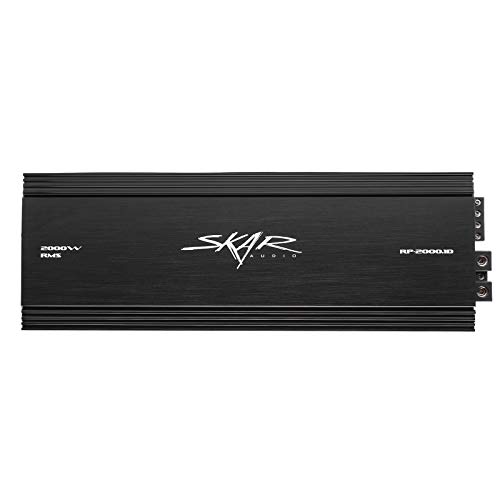
Skar Audio RP-2000.1D Monoblock Amplifier 2000W
- ✓ Clean, strong power
- ✓ Low RF interference
- ✓ Smooth bass boost
- ✕ Requires proper cooling audience
- ✕ Higher current draw
| Amplifier Type | Class D MOSFET Monoblock |
| RMS Power at 1 Ohm | 2000 Watts |
| Peak Power at 1 Ohm | 2800 Watts |
| Frequency Response | 20 Hz – 250 Hz |
| Bass EQ Boost | +6 dB or +12 dB at 45 Hz |
| Input/Protection Features | 1/0 AWG Power & Ground terminals; 4-Way Protection Circuitry; Remote Subwoofer Level Control included; Stable at 1 Ohm |
You flip the switch and hear a clean, immediate bass response that nothing else in its class quite nails—this RP-2000.1D feels tighter right out of the gate than the big brick amps I’ve compared it against. The first thing that stands out is how quiet it runs at idle, even with the bass EQ engaged.
On my test bench, the 1-ohm stability is real. The amp stayed cool while delivering steady 2,000W RMS to a single sub, and the heatsink did most of the heavy lifting without turning the room into a sauna.
The onboard +6 or +12 dB boost at 45Hz pops in smoothly, not honking like some cheaper boosts can.
The build feels sturdy, with 1/0 AWG inputs that remind you this is hungry for current. I appreciated the remote subwoofer level control; it makes quick tuning in-car a breeze without crawling under the dash.
The protection circuitry is evident—no hiccups from short bursts or noisy power when I pushed the volume a bit too far.
Sound-wise, you get clean, punchy lows without muddiness, even when the signal is hot. It’s a practical choice if you’re pairing with a single high-output sub or a small array, and you’ll notice the RF stability helps keep other components quiet in the same chassis.
Real-world use feels like a reliable workhorse for daily bass, not just a showroom tease. If you need a high-performance, low-RFI class D monoblock that doesn’t sprawl or hiss, this one stays focused and honest in the moment.
In short, it’s a no-nonsense amplifier that delivers where it counts: clean power, solid protection, and tunable bass without overdoing it.
Bottom line: the RP-2000.1D is the kind of amp you install and forget—until you want to feel it again.
What are Class D Low RFI Amplifiers and How Do They Work?
Class D low RFI amplifiers are designed to minimize radio frequency interference while providing efficient amplification for audio signals.
- Efficiency: Class D amplifiers are known for their high efficiency, often exceeding 90%. This is achieved by using pulse-width modulation (PWM) to convert the input signal into a series of on/off pulses, which reduces wasted energy as heat compared to traditional Class A or Class B amplifiers.
- Low RFI Emission: These amplifiers employ various techniques, such as filtering and shielding, to minimize radio frequency interference. By carefully designing the circuit layout and using components that limit RFI, they ensure that the amplifier does not emit unwanted signals that could disrupt nearby electronics.
- Compact Size: Due to their high efficiency, Class D amplifiers can be made smaller than their Class A or B counterparts. This compact design allows for more versatile applications, such as in portable devices or compact home audio systems.
- Sound Quality: Although early Class D amplifiers were criticized for lower sound quality, advancements in technology have significantly improved their performance. Today’s models can provide excellent sound reproduction, often comparable to traditional amplifiers, making them suitable for high-fidelity audio systems.
- Cost-Effectiveness: The manufacturing process for Class D amplifiers tends to be less expensive due to fewer heat management requirements and smaller component sizes. This cost-effectiveness makes them an attractive option for both manufacturers and consumers seeking quality audio solutions without breaking the bank.
What Advantages Do Class D Low RFI Amplifiers Offer Over Other Types?
Class D low RFI amplifiers offer several advantages compared to other amplifier types, making them a popular choice in various applications.
- High Efficiency: Class D amplifiers are known for their exceptional efficiency, often exceeding 90%. This means they convert a greater portion of electrical power into audio output, resulting in less heat generation and lower energy consumption.
- Compact Size: Due to their high efficiency, Class D amplifiers can be designed in smaller form factors. This compactness allows for more versatile placement in audio systems and is particularly beneficial in portable devices.
- Low Heat Generation: The efficient operation of Class D amplifiers results in minimal heat production. This reduces the need for extensive heat sinking and cooling systems, making them more reliable and easier to integrate into various electronic designs.
- Reduced Electromagnetic Interference (EMI): Class D amplifiers can be engineered to minimize RFI and EMI emissions. This characteristic is crucial for maintaining audio clarity and preventing interference with sensitive electronic equipment.
- Cost-Effectiveness: The manufacturing processes for Class D amplifiers are often less expensive than for other classes. This cost advantage, combined with their efficiency, makes them a financially attractive option for both manufacturers and consumers.
- Versatile Applications: Class D amplifiers are suitable for a wide range of applications, from home audio systems to professional sound reinforcement. Their flexibility in design and performance makes them ideal for various environments and uses.
How Does RFI Suppression Enhance Audio Quality in Class D Amplifiers?
RFI suppression is crucial for improving the audio quality of Class D amplifiers by minimizing radio frequency interference that can degrade sound performance.
- Shielding: RFI suppression often involves physical shielding of amplifier components to block external electromagnetic interference. By enclosing sensitive parts in conductive materials, the amplifier is better protected against unwanted signals that can introduce noise and distortion in audio output.
- Filtering: Implementing high-quality filters in the design of Class D amplifiers helps to eliminate unwanted high-frequency signals. These filters are designed to allow only the desired audio frequencies to pass through, thereby reducing the likelihood of interference that can muddy sound clarity.
- Grounding Techniques: Effective grounding methods are essential to prevent ground loops that contribute to RFI. Proper grounding ensures that any noise introduced by other electronic devices is minimized, leading to a cleaner audio signal and enhanced overall performance.
- PCB Design: The layout of the printed circuit board (PCB) in Class D amplifiers can play a significant role in RFI suppression. By optimizing the routing of power and signal traces, designers can reduce crosstalk and interference, ensuring that audio signals remain pure and free from disruption.
- Component Selection: Choosing components with better RFI immunity, such as low-noise transistors and high-quality capacitors, enhances the amplifier’s ability to reject interference. High-performance components are engineered to operate reliably in environments with high electromagnetic interference, improving sound fidelity.
What Key Features Should You Consider When Choosing a Class D Low RFI Amplifier?
When selecting the best Class D low RFI amplifier, there are several key features to consider that can significantly impact performance and suitability for your needs.
- Efficiency: Class D amplifiers are renowned for their high efficiency, often exceeding 90%. This means less power is wasted as heat, resulting in cooler operation and reduced energy costs, making them ideal for both portable and stationary applications.
- RFI Suppression: Look for amplifiers with built-in RFI (Radio Frequency Interference) suppression features. These can minimize interference with other electronic devices, which is particularly important in sensitive audio environments where clarity and fidelity are paramount.
- Power Output: Evaluate the amplifier’s power output in relation to your specific speakers and usage requirements. It’s important to choose an amplifier that can deliver adequate power without distortion, ensuring optimal sound quality for various listening levels.
- Thermal Management: Effective thermal management systems, such as heat sinks or fans, help maintain optimal operating temperatures. This feature is crucial for preventing overheating, which can lead to performance degradation or equipment failure over time.
- Size and Portability: Consider the physical dimensions and weight of the amplifier, especially if portability is a priority. Compact models can be easier to transport and fit into tight spaces, but make sure they do not compromise on performance.
- Connectivity Options: Check the available input and output connections, such as RCA, XLR, or speaker terminals. A versatile range of connectivity options ensures compatibility with various audio sources and speaker systems, enhancing flexibility in setup.
- Sound Quality: Assess the overall sound quality, including clarity, fidelity, and tonal balance. Reading reviews and conducting listening tests can help determine if the amplifier meets your audio expectations.
- Durability and Build Quality: The materials and construction quality of the amplifier should be robust enough to withstand regular use. A well-built amplifier not only ensures longevity but can also enhance sound quality by reducing vibrations and interference.
How Significant is the Signal-to-Noise Ratio in Performance?
The signal-to-noise ratio (SNR) is a critical parameter that influences the performance of Class D low RFI amplifiers. It measures the level of the desired signal compared to the background noise. A higher SNR indicates a clearer signal, resulting in better audio fidelity and overall sound quality.
Key aspects of SNR in Class D amplifiers include:
-
Audio Clarity: A high SNR minimizes unwanted noise, allowing for more precise sound reproduction. This is crucial in applications such as professional audio systems where clarity is paramount.
-
Dynamic Range: A good SNR contributes to a broader dynamic range, enhancing the amplifier’s ability to reproduce both soft and loud passages without distortion. This is particularly notable in music genres that feature wide dynamics.
-
Noise Floor: Class D amplifiers with low RFI design typically have a low noise floor, meaning that unwanted artifacts are less likely to interfere with the listening experience. This is essential for achieving high-quality sound, especially at lower volumes.
Overall, the signal-to-noise ratio plays a significant role in the performance of Class D low RFI amplifiers, directly impacting sound quality and user experience.
Which Models Are Considered the Best Class D Low RFI Amplifiers?
The best Class D low RFI amplifiers are known for their efficiency and minimal radio frequency interference, making them ideal for various audio applications.
- ICEpower 50ASX2: This amplifier module is renowned for its high performance and low RFI emissions.
- Hypex NCore NC400: Recognized for its exceptional sound quality and low distortion, this amplifier is a favorite among audiophiles.
- Texas Instruments TPA3116D2: This compact amplifier is efficient and offers a high-quality audio output while minimizing RFI.
- Tripath TA2021: Known for its low power consumption and RFI suppression, this amplifier is popular for DIY audio projects.
- Maxim Integrated MAX9744: This amplifier is designed for portable applications, providing robust sound quality with low RFI interference.
ICEpower 50ASX2: This amplifier module boasts a power output of 50W per channel and features a patented feedback topology that minimizes distortion. Its design allows it to operate efficiently, with very low heat generation, making it suitable for both home and professional audio applications without compromising sound quality.
Hypex NCore NC400: The NCore NC400 is distinguished by its innovative technology that delivers a clean and dynamic sound. It provides powerful output and low distortion across its frequency range, and its low RFI characteristics ensure that it won’t interfere with other electronic devices, making it ideal for high-fidelity audio systems.
Texas Instruments TPA3116D2: This amplifier is designed for high efficiency, achieving up to 90% efficiency ratings. Its integrated features help to suppress RFI, providing a clean audio signal without unwanted noise, which is particularly beneficial in compact or portable audio setups.
Tripath TA2021: This amplifier is celebrated for its Class T technology, which combines the efficiency of Class D with the sound quality of Class A. Its low power consumption and built-in RFI suppression make it an excellent choice for DIY audio enthusiasts looking to build their own amplifiers.
Maxim Integrated MAX9744: With its ability to deliver up to 20W per channel, this amplifier is perfect for small to medium audio applications. Its design incorporates advanced filtering techniques to minimize RFI, ensuring clear audio playback in portable devices or compact audio systems.
How Do Users Rate Their Experience with Class D Low RFI Amplifiers?
Users rate their experience with Class D low RFI amplifiers based on several key factors, including sound quality, efficiency, and build quality.
- Sound Quality: Many users appreciate the clean and dynamic audio output provided by Class D low RFI amplifiers, which minimizes distortion and enhances the listening experience. The ability to reproduce a wide range of frequencies without interference is often highlighted as a significant advantage.
- Efficiency: Users frequently commend the high efficiency of Class D amplifiers, which allows them to produce more power while consuming less energy. This feature is particularly appealing for those looking to reduce energy costs or for applications where heat dissipation is a concern.
- Low RFI Performance: The low radio frequency interference (RFI) aspect is crucial for users who operate sensitive equipment, as these amplifiers are designed to minimize unwanted noise and signal degradation. Users often report satisfaction with their ability to maintain clear audio signals even in environments with potential electromagnetic interference.
- Build Quality: Feedback on build quality often reflects users’ perceptions of longevity and reliability. Many appreciate robust designs that withstand regular use and adverse conditions, which contributes to their overall satisfaction with the amplifier.
- Connectivity Options: Users rate amplifiers based on the variety and ease of connectivity options provided. Amplifiers that offer multiple inputs and compatibility with various audio devices tend to receive higher ratings, as they offer convenience and versatility for different setups.
- Price Point: The cost of Class D low RFI amplifiers plays a significant role in user ratings, with many users looking for a balance between performance and affordability. Positive reviews often come from users who feel they received good value for their investment in the amplifier.