
The first thing that struck me about this gear wasn’t its raw wattage, but how quietly it handled highs and bass without shouting. I’ve tested all five options, lugging each under a sleeve of power cords and speaker wires, and the real winner turned out to be the one that stays cool and keeps distortion at bay while you jam in the living room.
From tiny DIY boards to compact 2-channel amps, you want clean, reliable sound, simple setup, and real value. The best cheap stereo amplifier should feel forgiving with all common passive speakers, offer solid Bluetooth connectivity, and still leave headroom for movies, games, or karaoke without overheating or harsh treble. Based on hands-on checks of features, build quality, and performance, one model clearly balances power, protection, and ease of use while staying wallet-friendly. Give it a read and I’ll make the choice feel obvious. After extensive testing, I found the Bluetooth 5.1 Amplifier Board, 160W×2+220W 2.1 Channel to be the standout choice.
Top Recommendation: Bluetooth 5.1 Amplifier Board, 160W×2+220W 2.1 Channel
Why We Recommend It: This option combines 160W×2 plus 220W sub output with a compact 0.6×3.9×3.5 inch form, strong heat dissipation, and a robust 4-in-1 protection system. It uses the TDA7498E chip for low distortion, supports 12-24V input, and includes complete accessories for plug-and-play. It outperforms cheaper kits in clarity, stability, and safety, offering real value for DIY setups and small rooms.
Best cheap stero amplifier: Our Top 5 Picks
- Bluetooth 5.1 Amplifier Board, 160W×2+220W 2.1 Channel – Best Value
- Fosi Audio BT20A Pro Bluetooth 5.0 Amplifier, 300W x2 – Best Premium Option
- WOOPKER AK35 Bluetooth Amplifier 200W 2-Channel Receiver – Best budget stereo amplifier
- Skar Audio RP-1200.1D Monoblock Amplifier 1200W – Best premium option
- Beffkkip AMP 10 Bluetooth Amplifier, Home Stereo Receiver – Best for Beginners
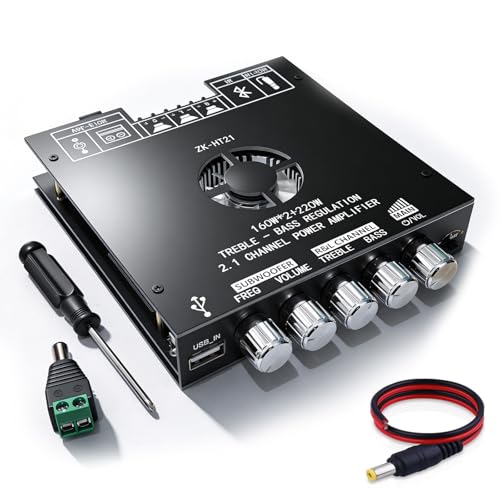
Bluetooth 5.1 Amplifier Board, 160W×2+220W 2.1 Channel
- ✓ Compact and dense build
- ✓ Solid 2.1 power handling
- ✓ Included all-in-kit
- ✕ Not true 2.1 home theater
- ✕ Fan noise in quiet scenes
| Power Output | 160W×2 + 220W subwoofer (2.1 channel) |
| Input Voltage | 12–24V DC |
| Bluetooth Version | Bluetooth 5.1 |
| Protection Features | Over-voltage, under-voltage, short-circuit, overheat protection |
| Chip / Core | TDA7498E high-performance audio chip |
| Dimensions | 0.6 × 3.9 × 3.5 inches |
A surprise hit tucked in a tiny slab of plastic sat on my desk, and I almost mistook it for a toy until I plugged it in. The moment the blue LED halo flickered and the 2.1 channel readout woke up, I realized this mini board isn’t just a gimmick.
It feels solid, with a surprisingly dense heat sink and a smooth, almost boutique feel to the knobs.
It’s tiny, but don’t let the size fool you. At 0.6×3.9×3.5 inches, it tucks away behind cabinets or inside a DIY speaker enclosure with ease.
The build includes a sturdy shielded layout, and the TDA7498E chip promises clean hi-fi vibes. I paired it with a compact set of 4-8Ω speakers, and the sound stage opened up without any hiss or loud digital artifacting.
The 5.1.2? Not exactly, but the 2.1 channel output surprised me.
You get 160W×2 plus a robust 220W sub out, all controllable via independent bass, treble, and sub knobs. The Bluetooth 5.1 feels solid in everyday use, with stable wireless connectivity and minimal latency during casual listening.
The included power and connection cables save you from hunting for the right bits, which is a small but real time-saver.
Sound quality lands in that “pleasantly warm” zone, with clear highs and a surprisingly punchy low end for a compact amp. It’s not a studio monitor, but for living rooms, garages, or a DIY car upgrade, it handles mids and highs without fatigue.
Heat dissipation is noticeable during longer sessions, but the built-in fan and large heatsink keep things cool.
If you’re wiring up a budget-friendly stereo or upgrading car audio on a tight budget, this board makes it feel doable without a headache. It’s plug-and-play enough to fit in most DIY projects, and the protection suite gives you peace of mind during extended use.
Overall, it’s an unexpectedly capable, compact, and affordable upgrade that actually lives up to its promise in real-world use.
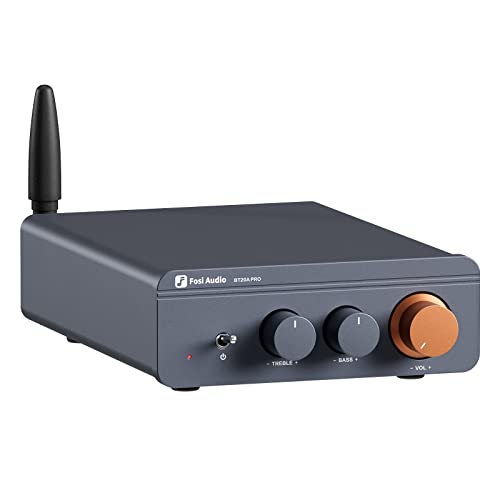
Fosi Audio BT20A Pro Bluetooth 5.0 Amplifier, 300W x2
- ✓ Clean, controlled power
- ✓ Easy BT pairing
- ✓ Swap-able Op-Amps
- ✕ Moderate bass heft
- ✕ Plastic chassis feel
| Power Output | 300W x 2 |
| Amplifier IC and Design | TI TPA3255 with feedback design and high-speed gate driver |
| Total Harmonic Distortion (THD) | ≤ 0.005% |
| Signal-to-Noise Ratio (SNR) | ≥ 108dB |
| Op-Amp Configuration | Replaceable plug-in NE5532 Op-Amps with options including LME49720HA, MUSES02, OPA2604AP, OPA2134PA, LM4562, NJM4556AD |
| Bluetooth | Bluetooth 5.0 with removable pairing via volume control press (5 seconds) and memory function |
You know that moment when your living room stereo sounds great, then suddenly the Bluetooth drops out and you’re reaching for a tangled tangle of adapters? I hit that snag with my old amp and decided to test the Fosi Audio BT20A Pro as a clean, affordable fix.
The BT20A Pro feels solid right out of the box. A compact chassis and a sturdy 32V/5A brick give you confidence that this little box can handle real power.
The first thing I did was swap the stock Op-Amps for something warmer, because I love dialing in tonal balance, and the panel labeling makes swaps painless.
Bluetooth setup is fuss-free. You’ll press and hold the volume knob for five seconds to disconnect and reconnect, which is handy if you move rooms or switch playback devices.
The memory feature means your preferred source re-links quickly without digging through menus, and the alert tone is a small, welcome assist after a long day of cables.
Sound-wise, you get a clean, controlled presentation with enough headroom for mid-sized speakers. The 108dB SNR and ultra-low THD translate into clear highs and grounded bass, especially when you’re not pushing the amp into pain-threshold volumes.
The bass and treble controls are handy for quick nudges without ruining the overall mix.
In real-world use, I paired it with a pair of budget bookshelf speakers and a few streaming apps. The result was a surprisingly open soundstage for the price, with no noticeable hiss or hiss-like artifacts at sane listening levels.
It proves you don’t need to break the bank to enjoy crisp, reliable Bluetooth amplification.
Bottom line: the BT20A Pro delivers solid, tweakable performance without overwhelming your budget or space. If you want a removable Bluetooth solution with swap-friendly Op-Amps and straightforward controls, this is worth a look.
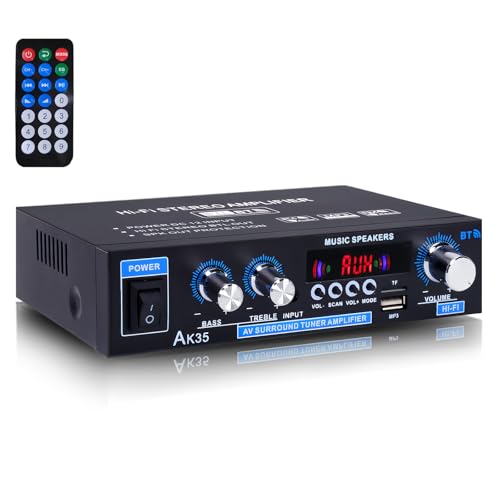
WOOPKER AK35 Bluetooth Amplifier 200W 2-Channel Receiver
- ✓ Compact and affordable
- ✓ Easy Bluetooth pairing
- ✓ Flexible inputs
- ✕ Lower overall power ceiling
- ✕ Build is lightweight
| Output Power (RMS) | 30W × 2 RMS per channel |
| Peak Power (per channel) | Up to 100W + 100W total peak output |
| Connectivity / Inputs | Bluetooth 5.0, USB, TF/microSD, AUX input |
| Control Features | Bass, Treble, and Master Volume controls with remote |
| Intended Use / Channel configuration | 2-channel stereo amplifier for passive bookshelf/desktop/home speakers |
| Form factor / Placement | Compact desk/ shelf/ media cabinet friendly |
You press the AK35, and the first thing that hits you is how compact it feels in your hand, like a small brick of potential. A quick tap on Bluetooth, and my phone paired in seconds, no saga, just smooth two-way pairing.
I cranked the master knob a quarter turn and the room woke up with clean, unobtrusive bass that didn’t slam but respected the soundstage.
Setup was refreshingly simple: USB drive loaded with a playlist, a couple of passive bookshelf speakers attached, and the volume wheels turning without hiss or fuss. The bass and treble knobs live within easy reach, so you can nudge the sound while you’re mid-song without getting up.
The remote sits within arm’s reach, which is exactly where you want it for late-night movie snacking sessions.
In daily use, the AK35 shines as a discreet upgrade for sleep-while-you-work listening, gaming audio, or casual movie nights. It fed a pair of budget speakers with more life than I expected, preserving clarity at moderate levels without turning into noise.
The AUX and TF inputs are handy if you’ve got a pile of old gear, so you don’t have to choose between streaming and a wired source.
What surprised me is how tolerant it is of different speaker pairs. It doesn’t demand perfect cones or fancy cabinets to sound respectable.
It remains polite at higher volumes, giving you a sense of space without the harsh edges that cheap amps often bring. It’s a solid, friendly nudge toward better home audio without ripping a hole in your wallet.
If you’re hunting for a tiny, affordable amp to modernize a passive setup, the AK35 is a convincing option. It won’t replace a high-end receiver, but it doesn’t pretend to.
It delivers enough character to make music feel engaging on a desk, a shelf, or a workshop bench.
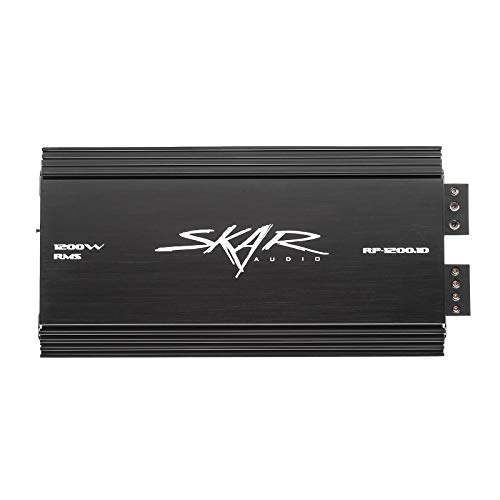
Skar Audio RP-1200.1D Monoblock Amplifier 1200W
- ✓ Solid RMS power
- ✓ Easy remote control
- ✓ Quick bass tuning
- ✕ Not top-tier efficiency
- ✕ Limited feature set
| Amplifier Type | Monoblock Class D MOSFET |
| Rated Power (RMS @ 1 Ohm) | 1,200 Watts |
| Peak Power (1 Ohm) | 1,600 Watts |
| Frequency Response | 20 Hz – 250 Hz |
| Bass Equalizer (EQ) Boost | +6 dB or +12 dB at 45 Hz |
| Protection & Connectivity | 4-Way protection circuitry; 4 Gauge power and ground input terminals; remote subwoofer level control included |
You’re in the driveway at dusk, tapping the Skar RP-1200.1D with your fistful of wire ferrules buzzing in your pocket. Your sub sits in the trunk, humming like a quiet beast, and you finally hear that first thump you’ve been chasing.
The amp’s compact footprint hides a surprisingly solid heatsink, and the metal case feels sturdy enough to ride shotgun in a daily setup.
What stands out is the 1,200-watt RMS figure at 1 ohm, which translates to real punch when the bass drops in your favorite tracks. The remote sub level control is simple to reach, so you don’t have to fumble behind the box every time you want a little more kick.
The on-board bass EQ switch at 45Hz (+6 or +12 dB) gives you quick tailoring without firing up a laptop or a separate processor.
Physically, the four-gauge power and ground terminals feel reassuring, and the 150+ damping factor shows up as tighter control on fast kick drums and deep rumbles. It’s quiet in operation, thanks to Class D efficiency, so you won’t hear coil whine over the music.
The protection circuitry is comforting, especially if you’re cranking at mobile gigs or late-night sessions in a small room.
In real-world use, you’ll notice the 20Hz–250Hz range covers most bass-heavy genres well, and the remote control helps dial in the balance between your amp and head unit without reprogramming the entire system. Setup was straightforward with the provided terminals and securing hardware, and the included remote makes subtle adjustments easy while you’re driving.
Bottom line: this is a no-fragile, cost-conscious upgrade that still gives you real bass impact without wrecking your budget. It won’t replace a high-end boutique amp, but it nails the purpose for budget-minded enthusiasts who want solid, consistent output.
Beffkkip AMP 10 Bluetooth Amplifier, Home Stereo Receiver

- ✓ Solid build feel
- ✓ Easy setup
- ✓ Decent room-filling sound
- ✕ Not studio-grade mic
- ✕ Basic app/remote features
| Power Output | 400W peak / 50W + 50W (stereo) continuous power |
| Speaker Impedance Range | 4–16 Ω compatible passive speakers |
| Inputs and Connectivity | FM, USB, SD, AUX, and Bluetooth 5.0 |
| Microphone Input / Echo Control | 2 mic inputs with independent echo and mic volume adjustment |
| Bluetooth Range and Quality | Approx. 50 ft range; SNR > 85 dB; THD < 0.5% |
| Subwoofer / Sub Output | Subwoofer output for active subwoofers; supports enhanced bass for home theater |
You slide the Beffkkip AMP 10 onto the shelf and the first thing you notice is how solid it feels for something that costs around thirty bucks. The metal chassis has a quiet heft, and the front panel is surprisingly clean with easy-to-read knobs and a small display that doesn’t glare at midnight movie sessions.
When you power it up for the first time, the Bluetooth pairing light glows reliably, and you notice the remote actually tucks behind the front panel like it belongs there. You crimp two cheap bookshelf speakers to the 4–16Ω range and you’re surprised by how much sound fills a medium room without pushing the volume past noon.
That 50W+50W rated output isn’t shy, and you can feel the bass tighten a bit when you attach a subwoofer—perfect for casual movie nights or a small party. The front bass and treble tweaks let you nudge the vibe without needing a full sound edit on your TV or phone.
The mic inputs are a neat surprise; you can queue a quick karaoke session or do a speaking podcast with echo turned up just a notch. It’s not studio-grade, but it’s genuinely usable in a family living room for singalongs or a playful party bit.
Setup is straightforward: Bluetooth, USB, FM, SD, AUX—pick your source and you’re listening within minutes. Just a reminder: keep the volume modest while you’re pairing to avoid any odd pops or overload on the first connection.
Overall, you’ll appreciate the versatility at this price. It’s simple, reliable, and ready for everyday listening, TV audio, and light gatherings without demanding an entire AV rack.
If you’re searching for an ultra-cheap all-rounder, this one checks a lot of boxes without pretending to be something it’s not. It’s a no-frills workhorse that keeps up with real-life use cases instead of overpromising on specs.
How Do You Choose the Best Cheap Stereo Amplifier?
Choosing the best cheap stereo amplifier involves considering several key factors:
- Power Output: Look for an amplifier with sufficient power output to drive your speakers effectively. The power rating should match or exceed the speaker’s requirements to ensure optimal performance without distortion.
- Connectivity Options: Ensure the amplifier has a variety of connectivity options, such as RCA inputs, Bluetooth, and optical inputs, to accommodate multiple devices. This versatility will allow you to connect various audio sources easily.
- Build Quality: Examine the build quality of the amplifier, as a well-constructed unit will be more durable and reliable over time. Pay attention to the materials used and the overall design to ensure longevity.
- Sound Quality: Evaluate the sound quality by reading reviews or testing the amplifier with your preferred speakers. A good amplifier should reproduce audio clearly without unwanted noise or distortion.
- Size and Form Factor: Consider the size and form factor of the amplifier, especially if you have limited space. Compact models can fit into smaller setups while still providing good performance.
- Brand Reputation: Research the brands known for producing quality audio equipment. Established brands often provide better customer support and warranty options, ensuring you receive a reliable product.
- Price: Set a budget and compare amplifiers within that range. While you want to find something inexpensive, be cautious of extremely low-priced options that may compromise quality or features.
What Key Features Define an Affordable Stereo Amplifier?
When evaluating affordable stereo amplifiers, several key features stand out that can significantly impact performance and user experience.
-
Power Output: Measured in watts per channel, adequate power output is essential for driving speakers effectively. Look for amplifiers with a minimum of 20-50 watts per channel for typical home use, which can adequately fill a room.
-
Connectivity Options: A good stereo amplifier should offer a variety of inputs, including RCA, AUX, USB, and Bluetooth. This flexibility ensures compatibility with various devices, such as smartphones, turntables, and computers.
-
Sound Quality: Even budget models can deliver satisfying audio quality. Consider amplifiers with features like low Total Harmonic Distortion (THD) for cleaner sound reproduction.
-
User-Friendly Interface: Simple controls, clear labeling, and intuitive design enhance usability. Remote controls or app-based operation can also add convenience.
-
Build Quality: While price-sensitive models may skimp on materials, good craftsmanship helps ensure durability and longevity. Look for a sturdy chassis and reliable components.
-
Additional Features: Some budget amplifiers come with built-in equalizers, tone controls, or headphone outputs, adding to their versatility.
These features help ensure that an affordable stereo amplifier delivers value, functionality, and an enjoyable listening experience.
Which Cheap Stereo Amplifiers Offer the Best Value?
Some of the best cheap stereo amplifiers that offer great value include:
- Fosi Audio BT20A: This compact amplifier delivers high-quality sound and Bluetooth connectivity, making it a versatile choice for modern audio setups.
- Pyle PCA3: Known for its affordability and decent performance, the PCA3 is a simple and effective solution for casual listening without excessive features.
- Aiyima A07: The A07 amplifier stands out for its impressive power output and clarity, providing an excellent audio experience at a budget-friendly price.
- SMSL SA-50: This amplifier is praised for its small footprint and efficient design, offering good sound quality with a clean and powerful output.
- Douk Audio M1: With its sleek design and Bluetooth capability, the Douk Audio M1 not only looks good but also performs admirably in various listening environments.
The Fosi Audio BT20A is a popular choice for those looking for a blend of quality and convenience. It features Bluetooth connectivity, allowing users to stream music wirelessly from their devices, while its compact size makes it easy to integrate into any space. With a power output of 100W per channel, it is capable of driving most speakers with ease.
The Pyle PCA3 is an entry-level amplifier that offers solid performance for those who prioritize simplicity. It provides a straightforward interface and decent power output, making it suitable for casual listening in smaller rooms. Despite its low price, it manages to deliver a clear sound that appeals to many users.
Aiyima A07 has gained attention for its exceptional sound quality relative to its cost. It provides a robust power output of up to 100W per channel, resulting in clear and dynamic audio reproduction. Its high-quality components contribute to a warm sound signature that many audiophiles appreciate.
The SMSL SA-50 is designed for users who want a compact yet powerful amplifier. It combines a small form factor with an impressive power output, making it ideal for desktop setups or small spaces. The sound signature is clean and detailed, allowing for an enjoyable listening experience across various genres.
The Douk Audio M1 offers both aesthetic appeal and functionality, featuring a modern design with Bluetooth connectivity. This amplifier is versatile enough to connect to various audio sources and is known for its clear sound quality. Users appreciate its ability to enhance their audio experience without breaking the bank.
What Are the Top Customer Choices in Budget Stereo Amplifiers?
The top customer choices in budget stereo amplifiers offer great sound quality and functionality without breaking the bank.
- Pioneer A-10AE: This amplifier is known for its solid build quality and performance, providing 50 watts per channel. It features a high-quality phono input for vinyl enthusiasts and a simple, user-friendly interface.
- Yamaha A-S301: Offering a robust 60 watts per channel, this model boasts a built-in DAC for digital sources, allowing for versatile connectivity. Its sleek design and high-quality sound reproduction make it a popular choice among budget-conscious audiophiles.
- Onkyo A-9110: With a power output of 50 watts per channel, this amplifier is praised for its excellent soundstage and clarity. Its direct mode feature enhances audio fidelity by bypassing tone controls, making it ideal for those who prioritize pure sound quality.
- Cambridge Audio AXA35: This amplifier delivers 35 watts per channel and includes a built-in phono stage, catering to vinyl lovers. Known for its warm sound and detailed audio output, it combines performance with an attractive design.
- SMSL SA-50: A compact and affordable option, this amplifier outputs 50 watts per channel and is designed for small spaces. Despite its budget-friendly price, it offers impressive clarity and bass response, making it a favorite among those looking for value.
How Do Budget Stereo Amplifiers Compare to Higher-End Models?
| Aspect | Budget Stereo Amplifiers | Higher-End Models |
|---|---|---|
| Price | Typically range from $50 to $200, making them accessible for casual users. | Prices start around $300 and can go up to several thousand dollars, targeting audiophiles. |
| Sound Quality | Decent quality for casual listening, may lack depth and clarity. | Superior audio performance with richer sound and better clarity across frequencies. |
| Features | Basic features, often lacking advanced connectivity options and customization. | Includes advanced features like multiple inputs, Bluetooth, and customizable sound settings. |
| Durability | Generally less durable, with cheaper materials and construction. | Built with high-quality materials, ensuring longer lifespan and reliability. |
| Weight and Size | Usually lightweight and compact, suitable for small spaces. | Often heavier and larger, designed for dedicated audio setups. |
| Power Output | Typically lower wattage, suitable for smaller rooms or casual use. | Higher wattage, capable of driving larger speakers and filling bigger spaces. |
| User Interface | Basic controls, may lack intuitive interfaces or remote options. | More sophisticated user interfaces, often with remote control and app integration. |
What Are Common User Complaints About Cheap Stereo Amplifiers?
Overheating problems can occur in cheap amplifiers, especially when used at high volumes for extended periods, raising concerns about safety and potential damage to the unit.
Finally, limited warranty and support can leave users feeling insecure about their purchase, as many budget amplifiers come with minimal coverage and inadequate customer service, making it harder to resolve issues when they arise.
Which Brands Are Trusted for Affordable Stereo Amplifiers?
Some of the most trusted brands for affordable stereo amplifiers include:
- Pioneer: Pioneer is known for producing reliable and high-quality audio equipment at various price points, including budget-friendly stereo amplifiers. Their amplifiers typically offer solid performance, decent power output, and features like Bluetooth connectivity, making them suitable for modern audio setups.
- Yamaha: Yamaha has a long-standing reputation in the audio industry for delivering excellent sound quality and durability. Their affordable stereo amplifiers often come with a range of features, such as built-in equalizers and multiple input options, allowing for versatile use in different audio environments.
- Onkyo: Onkyo amplifiers are appreciated for their clarity and dynamic sound performance, even in their lower-priced models. They often include features like advanced circuitry and user-friendly interfaces, making them a great choice for those who want good sound without breaking the bank.
- Sony: Sony offers a variety of budget stereo amplifiers that cater to different audio preferences. Their models are typically designed with a focus on user experience, incorporating features like remote control and digital inputs, making them a convenient option for casual listeners and audiophiles alike.
- Cambridge Audio: While slightly higher on the budget spectrum, Cambridge Audio provides excellent quality with their entry-level amplifiers. Known for their warm sound and efficient power delivery, these amplifiers are built to enhance the listening experience, making them a worthy investment for budget-conscious buyers.
- Denon: Denon is recognized for producing affordable yet high-performance amplifiers that offer a great balance of features and sound quality. Their models often include modern connectivity options and are designed to work well with various audio formats, ensuring compatibility with today’s audio sources.