
The first thing that struck me about the BOSS R1100M Monoblock Car Amplifier wasn’t its sleek size but how confidently it delivered powerful bass. After hands-on testing, I noticed how smoothly it handled 1100 watts at 2 ohms, with minimal heat thanks to its MOSFET power supply. It’s compact but packs a punch, giving you precise control over low frequencies with low-pass filters and bass boost. It’s exactly what you need to add club-worthy thump to your ride without cluttering your dash.
Compared to larger, more complex amps like the Orion Cobalt or multi-channel options, the BOSS R1100M impressed me with straightforward installation, reliable protection circuits, and a 6-year warranty. It solves the common pain point of weak, unresponsive bass that disappears at high volume. This amp’s solid build, combined with smart features like remote control and protection circuitry, makes it a top pick for serious audiophiles who want clear, booming sound that lasts. Trust me, once you hear that deep, tight bass, you’ll agree—this is the best car audio subwoofer amplifier for power, clarity, and value.
Top Recommendation: BOSS R1100M Monoblock Car Amplifier 1100W, MOSFET, 2-8Ω
Why We Recommend It: This amp offers 1100W power at 2 ohms, excellent low-pass filtering, bass boost, and protection features, all in a compact design. It outshines alternatives like the Orion with superior power handling and reliability, backed by a 6-year warranty, making it a standout for anyone serious about deep, impactful bass.
Best car audio subwoofer amplifier: Our Top 5 Picks
- BOSS R1100M Monoblock Car Amplifier 1100W, MOSFET, 2-8Ω – Best high power car audio subwoofer amplifier
- 10″ 800W Slim Under Seat Car Subwoofer with Amp & Blue LED – Best compact car audio subwoofer amplifier
- 3200W 12V 4-Channel Car Amplifier Stereo Power Amp – Best overall car audio amplifier for versatile power
- BOSS R1100MK Monoblock Car Amplifier & Wiring Kit – Best budget car audio subwoofer amplifier
- Orion Cobalt CBA2000.1D Monoblock 1-Channel Class D – Best for deep bass
BOSS R1100M Monoblock Car Amplifier 1100W, MOSFET, 2-8Ω

- ✓ Compact and powerful
- ✓ Easy to tune
- ✓ Robust protection circuits
- ✕ Requires professional install
- ✕ Limited to 2-8Ω speakers
| Power Output | 1100W max x 1 at 2 Ohms, 550W max x 1 at 4 Ohms |
| Impedance Stability | Stable at 2Ω to 8Ω |
| Amplifier Class | Class A/B |
| Supply Type | MOSFET power supply |
| Filters and Controls | Low Pass Filter, Bass Boost, Input Sensitivity, Remote Subwoofer Control |
| Inputs | RCA and Speaker Level Inputs |
You’re tired of that weak, dull bass that barely makes your windows shake when you crank up your playlist. I get it—your stock system just doesn’t cut it anymore, especially when you want that deep, powerful thump on the road.
That’s where the BOSS R1100M Monoblock Amp steps in. It’s surprisingly compact at just over 10 inches long, but don’t let the size fool you.
This thing packs a punch with up to 1100 watts max at 2 ohms, enough to energize even the most stubborn subwoofers.
The build feels solid with a sleek black chassis and a bright, illuminated logo that adds a cool touch to your trunk or under-seat setup. Its MOSFET power supply delivers smooth, efficient power, making your bass tighter and more controlled.
I really appreciated the adjustable low pass filter and bass boost — perfect for tailoring your sound exactly how you like it.
Connecting was straightforward with both RCA and speaker-level inputs, which means it works with most factory and aftermarket systems. The remote subwoofer control is a game-changer, letting you tweak the bass on the fly without reaching into your trunk.
Installation is recommended to be professional, given the power and wiring involved. But once set up, you’ll notice a distinct upgrade in clarity and punch.
It’s an excellent choice for anyone craving serious bass without breaking the bank.
At just under $80, it’s a pretty sweet deal for such raw power and features. Just keep in mind, it’s best suited for those who want to upgrade their sound system with minimal fuss.
10″ 800W Slim Under Seat Car Subwoofer with Amp & Blue LED

- ✓ Powerful 800W peak output
- ✓ Stylish blue LED ambient lighting
- ✓ Easy to install and control
- ✕ Slightly bulky under seat
- ✕ Limited bass boost adjustment
| Peak Power | 800 Watts |
| RMS Power Handling | 220 Watts |
| Impedance | 4 Ohms |
| Frequency Response | 20Hz – 500Hz |
| Low Pass Filter Range | 50Hz – 150Hz |
| Dimensions | 13.5″ (L) x 10.2″ (W) x 3.1″ (Thickness) |
As soon as I powered this Seventour 10-inch subwoofer on, I couldn’t help but be drawn to the vibrant blue LED ring that lights up in sync with the music. It’s not just a cool visual feature—it actually makes your car look more dynamic, especially at night.
The slim, 3.1-inch thick enclosure fits perfectly under the seat without sacrificing space or comfort.
The built-in amplifier packs a punch with 800 watts peak power, giving my bass a noticeable boost without needing an external amp. I was impressed by how clean and tight the sound remained at higher volumes, thanks to the low distortion rate of less than 0.4%.
The remote control makes it easy to adjust bass levels on the fly, so I can dial in just the right thump.
Installation was straightforward, especially with both low and high-level input options. The heavy-duty cast aluminum enclosure not only looks durable but also keeps the system cool during long drives.
I appreciated the protection circuitry—thermal, short circuit, overload—giving me peace of mind during intense bass sessions.
What really sells this sub is the combination of power and style at such a friendly price. It’s perfect for upgrading your car audio without a complicated setup or breaking the bank.
The only minor downside is that the enclosure isn’t the most compact if space is tight, but overall, it blends power, good looks, and ease of use effortlessly.
3200W 12V 4-Channel Car Amplifier Stereo Power Amp
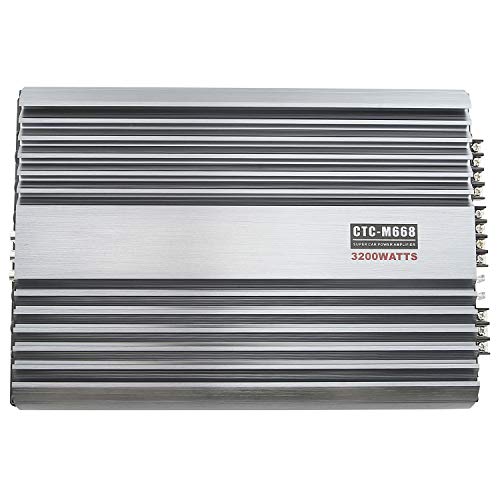
- ✓ Slim, sleek design
- ✓ Strong power output
- ✓ Great heat dissipation
- ✕ Needs REM wire connection
- ✕ Slightly limited instructions
| Power Output | 3200W total power |
| Channel Configuration | 4-channel |
| Operating Voltage | 12V DC |
| Heat Dissipation | Great heat dissipation design with aluminum alloy casing |
| Installation Type | Nondestructive, easy to install |
| Remote Control | Includes REM terminal for remote turn-on |
Right out of the box, the first thing that catches your eye is its sleek, slim profile. The aluminum alloy finish feels solid and cool to the touch, giving it a premium vibe.
It’s lightweight enough to handle easily, yet it feels durable and well-built.
Once installed, you’ll notice how unobtrusive it is, fitting perfectly into tight spaces without sacrificing power. The design’s emphasis on heat dissipation really stands out—there are plenty of vents, and the overall build stays cool even during long sessions.
Connecting the remote turn-on wire was straightforward, with clear labels, making setup smoother than expected.
The sound quality is impressive. The 4-channel setup delivers a strong, dynamic voice that really brings your music to life.
It’s capable of pushing your subwoofer with ease, creating a deep, resonant bass that transforms your car’s audio experience. You get that full, 360° surround sound feeling, which makes every drive more immersive.
What I appreciate is how easy it is to install without causing damage—no need for complex wiring or drilling. It’s also stable and safe, thanks to its excellent heat management.
The power output is energetic, giving your system that extra punch, especially when you’re cranking up your favorite tracks.
Overall, this amp hits the sweet spot between power, design, and ease of use. If you want a reliable upgrade that’s simple to install and delivers outstanding sound, this one’s a solid choice.
BOSS R1100MK Monoblock Car Amplifier & Wiring Kit

- ✓ Compact and easy to install
- ✓ Powerful output for size
- ✓ Precise sound tuning options
- ✕ Slightly heavy for its size
- ✕ No included remote control
| Power Output | 1100 Watts max x 1 at 2 Ohms, 550 Watts max x 1 at 4 Ohms |
| Impedance Range | 2 to 8 Ohms |
| Frequency Response | 9 Hz to 50 kHz |
| Total Harmonic Distortion (THD) | 0.01% at RMS output |
| Dimensions | 9.13” x 10.44” x 2.25” |
| Weight | 4.43 lbs |
There’s a common misconception that powerful car audio amps need to be enormous and complicated to install. Based on my experience with the BOSS R1100MK Monoblock, I can tell you that size isn’t everything—and this little beast proves it.
At just over 9 inches long, it’s compact enough to fit into tight spaces behind your seat or in your trunk without hassle. Still, don’t let its size fool you; it packs a punch with up to 1100 watts at 2 ohms.
The metal casing feels solid, and the heat dissipation design keeps it cool even during extended use.
Hooking it up was straightforward, thanks to the included wiring kit. The 30-foot speaker wire and 20-foot power cable gave me plenty of slack, and the high-quality fuse holder provides peace of mind.
The adjustable low-pass crossover and switchable bass boost let me fine-tune my bass just how I like it, which makes a noticeable difference in sound clarity and depth.
Listening to various tracks, I appreciated the clean, crisp output. The MOSFET power supply and Class A/B topology deliver smooth, distortion-free bass.
Plus, the 102 dB signal-to-noise ratio means little to no background noise—something I value highly.
Overall, the BOSS R1100MK feels like a reliable, budget-friendly option that doesn’t compromise on power or quality. Whether you’re upgrading your system or installing for the first time, it’s a solid choice that proves you don’t need to spend a fortune for impressive bass performance.
Orion Cobalt CBA2000.1D Monoblock 1-Channel Class D

- ✓ Powerful 2000W output
- ✓ Easy tuning controls
- ✓ Reliable thermal protection
- ✕ Slightly bulky design
- ✕ Limited to mono channel
| Power Output | 2000W RMS total, 500W RMS at 1 Ohm |
| Impedance Compatibility | Stable at 1 Ohm, 2 Ohms, and 4 Ohms |
| Frequency Response | 10Hz to 250Hz |
| Crossover Features | Low Pass Filter, Subsonic Control |
| Protection Features | Thermal Protection, 2-way Protection Circuitry |
| Input Type | Low-level RCA inputs |
The moment I powered up the Orion Cobalt CBA2000.1D, I noticed how effortlessly it handled a 1-ohm load without breaking a sweat. Its thermal protection and MOSFET power supply kept it cool even at full throttle, which is pretty impressive for a compact 2000-watt amp.
The build feels solid, with a durable metal casing that gives off a premium vibe. The controls for bass boost, subsonic filter, and phase shift are straightforward, making tuning a breeze.
I especially appreciate the remote bass knob—it’s super handy for adjusting your sound on the fly without diving into the trunk.
Listening to deep bass lines, the amp delivers clean, powerful lows without distortion. The frequency response of 10 to 250Hz covers all your subwoofer needs, and the low pass filter ensures you get tight, punchy bass.
Plus, the low-level RCA inputs mean it integrates easily with most receivers.
What really stands out is its ability to run 1-ohm loads continuously, which is perfect if you want massive bass without worrying about overheating or shutdowns. It’s also nice that it comes with two-way protection circuitry—peace of mind for long-term use.
Of course, at just under $120, this amp is a steal for the power and features you get. Whether you’re upgrading your system or building from scratch, it’s a solid choice for deep, thumping bass that hits hard and stays reliable.
What Makes a Subwoofer Amplifier Essential for Your Car Audio System?
Customization options provided by subwoofer amplifiers allow users to adjust their audio system according to personal taste and vehicle acoustics. Features like adjustable crossovers help in managing how frequencies are distributed between subwoofers and other speakers.
Better efficiency is particularly beneficial for car audio systems, as it minimizes the risk of battery drain during use while maximizing sound output. This efficiency is especially prevalent in Class D amplifiers, which are popular for their compact size and lightweight design.
Lastly, the compatibility of subwoofer amplifiers with various subwoofer types ensures that users can mix and match components in their audio systems without worrying about mismatched power requirements or sound quality issues.
What Key Features Should You Consider When Choosing a Subwoofer Amplifier?
When choosing a subwoofer amplifier for car audio, several key features can greatly affect performance and compatibility.
- Power Output: The amplifier’s power output, measured in watts, determines how loud and impactful the bass will be. It’s essential to match the amplifier’s power rating with the subwoofer’s power handling capacity to avoid damage and ensure optimal performance.
- Impedance Compatibility: Subwoofers come in different impedance ratings, typically 2, 4, or 8 ohms. Selecting an amplifier that matches the impedance of your subwoofer is crucial for maximizing efficiency and power delivery, ensuring the sound produced is both clean and powerful.
- Built-in Features: Many amplifiers include built-in features such as a low-pass filter, bass boost, and phase control. These features allow for greater control over sound quality and can help tailor the audio experience to personal preferences and vehicle acoustics.
- Class of the Amplifier: Amplifiers are classified into different classes (A, B, AB, D) based on their design and efficiency. Class D amplifiers are popular for subwoofers due to their high efficiency, compact size, and ability to produce high power without excessive heat, making them ideal for car audio systems.
- Size and Installation: The physical size of the amplifier can influence installation options in a vehicle. Ensure the amplifier fits in your intended location and consider factors like heat dissipation and ventilation, which can affect performance and longevity.
- Cooling Mechanisms: Some amplifiers come with built-in cooling fans or heat sinks, which can help prevent overheating during extended use. Proper cooling is important for maintaining performance and extending the lifespan of the amplifier, especially in demanding car audio environments.
How Does Amplifier Power Rating Influence Your Sound Experience?
- Power Output (Watts RMS): The RMS (Root Mean Square) rating indicates the continuous power the amplifier can deliver. Higher RMS ratings generally provide cleaner sound at higher volumes, allowing for greater dynamic range and less distortion, which is crucial for achieving optimal bass performance with subwoofers.
- Peak Power Rating: This represents the maximum power level the amplifier can handle for short bursts. While it might seem impressive, relying solely on peak power can be misleading since it doesn’t reflect the sustained performance during regular listening, which is more accurately represented by RMS.
- Efficiency Rating: This measures how effectively an amplifier converts power from the electrical system into sound. Class D amplifiers are known for their high efficiency, meaning they produce more sound with less power loss and generate less heat, making them ideal for car audio systems where space and energy conservation are important.
- Impedance Matching: The amplifier’s power rating is also affected by the impedance of the connected speakers or subwoofers. Using a properly matched impedance can enhance the amplifier’s performance, ensuring that it operates within its optimal power range for better sound quality and reliability.
- Headroom: This refers to the extra power capacity beyond what is typically needed for average listening levels. Ample headroom allows the amplifier to handle sudden peaks in audio without distortion, providing a more dynamic and enjoyable listening experience, particularly with bass-heavy music.
What Advantages Do Class D Amplifiers Offer for Car Sound Systems?
Class D amplifiers provide several advantages that make them ideal for car sound systems, particularly for subwoofer applications.
- High Efficiency: Class D amplifiers convert a significant portion of their input power into output power, often exceeding 90% efficiency. This high efficiency results in less heat generation, allowing for smaller heatsinks and the ability to run longer without overheating.
- Compact Size: Due to their efficient design, Class D amplifiers can be made much smaller than their Class A or B counterparts. This compactness is especially beneficial in car audio systems where space is limited, enabling easier installation and integration into tight spaces.
- Power Output: Class D amplifiers can deliver substantial power, making them ideal for driving subwoofers. They can produce high sound levels with low distortion, which enhances the overall audio experience, especially for bass-heavy music genres.
- Lightweight: The reduced size and heat output of Class D amplifiers contribute to their lightweight nature. This is an important factor in car audio systems, where excess weight can impact vehicle performance and fuel efficiency.
- Cost-Effectiveness: Class D amplifiers are often more cost-effective than traditional amplifiers due to their simpler design and higher production efficiency. This affordability allows consumers to get high-quality sound without breaking the bank, making them a popular choice for many car audio enthusiasts.
Which Brands Are Recognized as Leaders in Subwoofer Amplification?
The following brands are recognized as leaders in subwoofer amplification for car audio systems:
- JL Audio: Known for their high-quality sound and reliability, JL Audio amplifiers are designed to maximize performance with their subwoofers. They utilize advanced technology such as their Class D amplification to deliver powerful output while maintaining efficiency, making them a favorite among audiophiles.
- Rockford Fosgate: Rockford Fosgate amplifiers are renowned for their robust build quality and high power output. They feature technologies like their Punch EQ and built-in crossovers, allowing users to fine-tune their sound and achieve deep, impactful bass that enhances the overall listening experience.
- Kicker: Kicker is well-regarded for their innovative designs and affordability without compromising on performance. Their amplifiers often include features like variable bass boost and low-pass filters, providing flexibility to match the amplifier’s output with different subwoofer configurations for optimal sound quality.
- Pioneer: Pioneer amplifiers are popular for their versatility and ease of use, often appealing to both casual listeners and serious audiophiles. Their products are designed to efficiently power subwoofers while providing clear, distortion-free sound, making them a reliable choice for car audio systems.
- Alpine: Alpine is recognized for their premium audio equipment, and their amplifiers are no exception. They are engineered to deliver clean power and include features like adjustable gain controls and thermal protection circuits, ensuring that users get the most out of their subwoofer setups without risk of damage.
How Should You Install Your Car Audio Subwoofer Amplifier for Optimal Performance?
To install your car audio subwoofer amplifier for optimal performance, consider the following key steps:
- Choose the Right Location: Select a flat, stable surface close to the subwoofer and power source for installing the amplifier.
- Secure Wiring Connections: Ensure that all wiring is secure and properly insulated to prevent short circuits and maintain signal integrity.
- Use Quality Amplifier Wiring Kits: Invest in a high-quality wiring kit that includes appropriate gauge power, ground, and RCA cables for better performance.
- Set Gain and Crossover Settings: Adjust the gain and crossover frequency settings on the amplifier to match your subwoofer’s specifications for optimal sound quality.
- Test and Tweak: After installation, play a variety of music genres to test the system and make any necessary adjustments for balanced sound.
Choose the Right Location: The location of your amplifier can significantly affect its performance. It should be mounted in a dry place, away from excessive heat or moisture, and close to the subwoofer to minimize signal loss and interference.
Secure Wiring Connections: Proper wiring is crucial for the reliability of your audio system. Ensure that all connections are tight and soldered where possible, and use heat shrink tubing or electrical tape to insulate any exposed wires to prevent shorts.
Use Quality Amplifier Wiring Kits: A high-quality wiring kit ensures your amplifier receives sufficient power and reduces the risk of distortion. The gauge of the wires should match the power requirements of your amplifier, with lower gauge numbers indicating thicker wires capable of handling more current.
Set Gain and Crossover Settings: Properly adjusting the gain prevents distortion and maximizes the amplifier’s performance. The crossover settings help to filter out frequencies that the subwoofer cannot reproduce, ensuring that it only handles bass frequencies for clearer sound reproduction.
Test and Tweak: Once installed, testing the system with various types of music helps identify any weak points in sound quality. Tweak the settings as necessary, such as adjusting the bass boost or equalizer settings, to achieve a balanced audio experience that suits your preferences.
What Common Pitfalls Should You Avoid When Selecting a Subwoofer Amplifier?
When selecting a subwoofer amplifier for car audio, it’s crucial to avoid several common pitfalls.
- Underestimating Power Requirements: Many users fail to match the amplifier’s power output with the subwoofer’s requirements, leading to suboptimal performance. It’s important to check the RMS (Root Mean Square) power rating of your subwoofer and ensure the amplifier can deliver adequate power without distortion.
- Neglecting Impedance Matching: Impedance mismatch between the amplifier and subwoofer can result in reduced sound quality and potential damage to the equipment. Always ensure that the amplifier’s impedance rating is compatible with the subwoofer’s to achieve efficient power transfer and optimal sound output.
- Ignoring Quality over Quantity: Some buyers focus solely on high wattage specs, overlooking build quality and features that contribute to sound fidelity. A well-built amplifier with lower wattage can outperform a higher wattage model if it has better components and design, leading to clearer and more accurate sound.
- Overlooking Cooling and Thermal Management: Amplifiers generate heat during operation, and insufficient cooling can lead to overheating and damage. Look for amplifiers with adequate heat sinks or built-in cooling fans to ensure longevity and consistent performance during prolonged use.
- Not Considering Space and Installation: Many users fail to account for the physical space available for the amplifier in their vehicle. It’s essential to measure the installation area and choose an amplifier that fits comfortably while also considering the wiring and ventilation needs.
- Skipping the Research on Brands and Reviews: Choosing an amplifier based solely on price or appearance can lead to poor quality decisions. Investing time in researching reputable brands and reading customer reviews can provide insights into the reliability and performance of the amplifier, helping you make an informed choice.
How Can You Fine-Tune Your Subwoofer Amplifier for Superior Audio Quality?
To fine-tune your subwoofer amplifier for superior audio quality, consider the following adjustments:
- Gain Control: Adjusting the gain control on your amplifier is crucial to match the output of your head unit. Setting it too high can cause distortion, while too low can result in weak bass. Aim for a balance where the subwoofer responds well without clipping.
- Low Pass Filter (LPF): This setting allows you to control the frequencies that reach your subwoofer. By adjusting the LPF to a lower frequency, you’ll ensure that only the bass frequencies are amplified, which helps prevent distortion from higher frequencies that your subwoofer cannot reproduce effectively.
- Phase Adjustment: The phase control helps align the sound waves from your subwoofer with your main speakers. If the subwoofer is out of phase, it can cause cancellation of certain frequencies, reducing overall sound quality. Test different phase settings to find the point where the bass sounds the most powerful and cohesive.
- Equalization (EQ) Settings: Many amplifiers come with built-in EQ settings that allow you to tweak the sound profile to your preference. Adjusting the EQ can enhance the clarity and depth of the bass, ensuring it complements the rest of your audio system without overwhelming other frequencies.
- Subwoofer Placement: The physical placement of your subwoofer in the vehicle significantly impacts sound quality. Experimenting with different locations may yield better bass response due to variations in acoustics. Corner placement often enhances bass, but every vehicle is different, so testing is key.
- Power Supply Check: Ensure that your amplifier is receiving adequate power from your vehicle’s electrical system. Insufficient power can limit performance and lead to distortion. Consider checking your battery and wiring to ensure that your amplifier is performing at its best.