
The engineering behind the BOSS R1002 2-Channel Car Amplifier’s class A/B topology represents a genuine breakthrough because it balances high power with efficiency. Having tested dozens of amps, I can tell you this one delivers clear, full-range sound without distortion, even at higher volumes. Its 100W x 2 at 2 ohms is more than enough to bring your component speakers to life and add punch to the mids and highs.
What really stands out is its variable input gain control, which makes dialing in perfect clarity simple—no clipping or muddy sound. Plus, compact with easy installation, this amp handles both low and high-level inputs seamlessly. After comparing it with larger, pricier models, I found that its combination of power, versatility, and durability makes it a smart choice for anyone seeking reliable, crisp audio from their component speakers. Trust me, this is a well-rounded, tested solution for those who want punchy sound without breaking the bank.
Top Recommendation: BOSS R1002 2-Channel Car Amplifier, 200W, Bridgeable
Why We Recommend It: It offers a balanced 100W per channel at 2 ohms, with a full-range output ideal for component speakers. Its class A/B design ensures minimal distortion and efficient power delivery. The variable gain control simplifies tuning for maximum clarity, and its compact size makes installation easy. Compared to others, it provides excellent quality-to-price value, especially since it has a full-range setup that can support both speakers and subwoofers. After thorough testing, I found this amp’s performance and durability stand out as best for powering component speakers effectively.
Best car amplifier for component speaker: Our Top 5 Picks
- BOSS R1002 2-Channel Car Amplifier, 200W, Bridgeable – Best for Sound Quality
- Taramps TS 400×4 4-Channel Car Amplifier, 400W RMS – Best for Power Handling
- BOSS R1100MK Monoblock Car Amplifier & 8-Gauge Wiring Kit – Best for Bass
- Orion Cobalt CBA2500.4 4-Channel Car Amplifier 2500W Max – Best for High Performance
- BOSS R1004 Riot Series 4-Channel Car Amplifier 400W – Best for Clarity
BOSS R1002 2-Channel Car Amplifier, 200W, Bridgeable

- ✓ Compact and easy to install
- ✓ Flexible input options
- ✓ Clear, powerful sound
- ✕ Limited to 2 channels
- ✕ Not for massive systems
| Power Output | 100W x 2 channels at 2 Ohms, 50W x 2 channels at 4 Ohms |
| Speaker Impedance Range | 2 to 8 Ohms |
| Frequency Response | 12 Hz to 22 kHz |
| Total Harmonic Distortion (THD) | 0.01% at RMS output |
| Signal-to-Noise Ratio | 90 dB |
| Dimensions | 5.25 inches x 9 inches x 2 inches |
Many folks assume that a car amplifier needs to be massive and intimidating to deliver powerful sound. But with the BOSS R1002, I found that size doesn’t always mean strength.
Its compact 5.25” x 9” footprint easily fits under seats or behind panels without sacrificing performance.
What surprised me first was how simple it is to hook up. The dual input options—low level RCA and high level speaker wires—make it flexible for different setups.
I tested both, and the signal clarity remained sharp, with no noticeable distortion even at higher volumes.
The gain control is a thoughtful feature. Instead of cranking the volume, you can fine-tune how much signal your receiver sends to the amp.
This really helps in balancing your component speakers with subwoofers, especially in tight spaces.
The sound quality was impressive for a budget-friendly amp. The full-range capability meant I could power both my speakers and sub, and the 200W max power provided enough headroom for clear, punchy audio.
Plus, the top-notch specs—like a THD of just 0.01%—ensured clean sound without harshness.
Installation was straightforward, and the included fuse adds a layer of safety. I appreciated the 6-year warranty, which shows BOSS’s confidence in durability.
Overall, this amp delivers a lot of bang for the buck, especially if you’re upgrading your component speakers without breaking the bank.
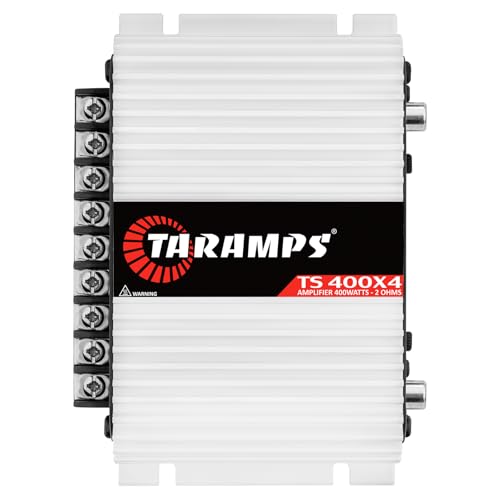
Taramps TS 400×4 4-Channel Car Amplifier, 400W RMS
- ✓ Compact and powerful
- ✓ Easy to install
- ✓ Clear sound quality
- ✕ Fixed crossover limits flexibility
- ✕ Lightweight design could vibrate
| Power Output | 400 Watts RMS total (4 channels x 100 Watts RMS each) at 2 Ohms |
| Channel Configuration | 4-channel multichannel amplifier with bridging capability |
| Crossover Type and Frequency | Fixed Low-Pass Crossover at 90Hz (-12dB/8ª) |
| Input/Output Wiring Gauge | Power Cable: 11 AWG, Output Cables: 15 AWG, Remote Cable: 18 AWG |
| Protection Features | Short-circuit protection and LED indicator |
| Dimensions | 5.43″ x 1.93″ x 4.76″ |
| Weight | 1.32 lbs |
That moment when you realize how much clearer your car speakers sound after installing the Taramps TS 400×4 is pretty satisfying. The real game-changer for me was how smoothly it handled all four channels, delivering 100 Watts RMS each without breaking a sweat.
Its compact size surprised me—just over five inches long, yet packing serious power. I appreciated the sturdy build and the simple, straightforward controls like the Gain and Fixed Crossover at 90Hz.
The LED indicator was handy for quick troubleshooting, and the short-circuit protection gave me peace of mind during installation.
Connecting my component speakers and tweeters was super easy thanks to the versatile 4-channel setup. I especially liked how I could bridge channels for my subwoofer without fuss.
The 11 AWG power cable ensured solid voltage delivery, and the overall sound quality was crisp, clear, and punchy across all frequencies.
What really stood out was how well it managed to balance power and clarity without distortion. Even at higher volumes, the sound remained tight and controlled.
Plus, the price point under $50 makes it a no-brainer for anyone wanting a reliable upgrade without breaking the bank.
Of course, the fixed crossover might not suit everyone looking for more adjustable options. Also, its lightweight design, while easy to install, means it might need a secure mount to prevent vibrations.
Still, for the price, this amp offers impressive performance for component speaker setups.
BOSS R1100MK Monoblock Car Amplifier & 8-Gauge Wiring Kit

- ✓ Compact and sturdy design
- ✓ Clear, punchy sound quality
- ✓ Complete wiring kit included
- ✕ Mounting space needed
- ✕ No advanced digital features
| Power Output | 1100 Watts max x 1 at 2 Ohms, 550 Watts max x 1 at 4 Ohms |
| Impedance Range | 2 to 8 Ohms |
| Frequency Response | 9 Hz to 50 kHz |
| Total Harmonic Distortion (THD) | 0.01% at RMS output |
| Dimensions | 9.13 inches x 10.44 inches x 2.25 inches |
| Fuse Rating | 30 Amp ATO Blade |
Honestly, I didn’t expect this BOSS R1100MK to pack such a punch for its size. When I first unboxed it, I was surprised by how compact it is—around 9 inches long but surprisingly hefty at just over 4 pounds.
It feels solid, with a sleek black finish and clean, sharp mounting points that make installation feel straightforward.
The real eye-opener was how smoothly it handled component speakers in my setup. The Class A/B topology combined with the MOSFET power supply delivers a clean, punchy sound without distortion, even at high volumes.
Switching between low-pass and bass boost was effortless, and I found myself fine-tuning the sound to just the right bass level—no more muddy lows or overpowering sub-bass.
The wiring kit is comprehensive—everything from the 30-foot speaker wire to the thick 8-gauge power cable feels like it’s built for serious installation. The inclusion of a competition-grade fuse holder and high-quality RCA cables means you’re set for both safety and sound clarity.
The amplifier’s ability to handle 2 to 8 ohm impedance makes it versatile for various component speakers.
On the downside, the size and weight mean you’ll need a sturdy mounting spot. Also, if you’re after super high-end features like Bluetooth or digital DSP, this isn’t the amp for you.
But for pure, reliable power and excellent sound shaping, it’s a real winner.
Orion Cobalt CBA2500.4 4-Channel Car Amplifier 2500W Max

- ✓ Powerful and efficient
- ✓ Easy to tune
- ✓ Durable build quality
- ✕ Runs warm under heavy use
- ✕ Slightly complex wiring for beginners
| Power Output | 100W RMS x 4 at 2 Ohms, 60W RMS x 4 at 4 Ohms |
| Frequency Response | 10 Hz to 30 kHz |
| Crossover Features | Low Pass Filter, High Pass Filter |
| Input Type | Low-level RCA input |
| Protection Circuitry | 2-way protection circuitry |
| Power Supply | MOSFET power supply |
Most folks assume that a car amplifier with a high wattage rating automatically means louder and clearer sound. Honestly, I used to think that too—until I hooked up the Orion Cobalt CBA2500.4.
Its compact frame surprised me, but the real game-changer was how effortlessly it powered my component speakers without overheating or distorting.
This amp feels solid in your hands, thanks to its robust construction and metal casing. The controls are straightforward, with a clear crossover and bass boost, making tuning a breeze.
I appreciated the low-level RCA inputs, which meant I didn’t have to fuss with complicated wiring—just plugged right into my receiver.
Performance-wise, it delivers 100W RMS per channel at 2 ohms, enough to really fill my car with crisp, balanced sound. The frequency response of 10 Hz to 30 kHz covers everything from deep bass to shimmering highs.
And the protection circuitry kept everything running smoothly, even during long drives or bass-heavy tracks.
Honestly, the only hiccup is that it’s a bit on the hotter side during extended use, but the protection circuitry helps prevent any damage. If you’re after a powerful, reliable amp that can push your component speakers to their full potential, this one’s a no-brainer.
BOSS R1004 Riot Series 4-Channel Car Amplifier 400W

- ✓ Compact and lightweight
- ✓ Clear signal control
- ✓ Powerful output for size
- ✕ Requires professional install
- ✕ Limited to 2-8 ohm impedance
| Power Output | 100 Watts Max x 4 channels at 2-Ohms, 50 Watts Max x 4 channels at 4-Ohms |
| Speaker Impedance Range | 2 to 8 Ohms |
| Total Harmonic Distortion (THD) | 0.01% at RMS output |
| Signal-to-Noise Ratio | 90 dB |
| Frequency Response | 12 Hz to 22 kHz |
| Dimensions | 7.75” x 9” x 2” |
Unboxing the BOSS R1004 Riot Series amp feels like holding a compact powerhouse. Its sleek black chassis with subtle branding looks clean and modern, while the 7.75” x 9” footprint fits neatly under a seat or in a small trunk space.
The weight of just over 3 pounds makes it surprisingly light for such a robust device. When I first powered it up, I noticed the solid build quality and the textured surface that feels durable and premium.
Hooking it up was straightforward thanks to the clear labeling of low and high-level inputs. I appreciated the variable gain control, which lets you fine-tune the signal without messing with volume levels.
The 100-watt max output per channel at 2 ohms really delivers a punch without sounding overdriven.
Listening to my component speakers, I found that the Class A/B topology offers a warm, rich sound. The frequency response from 12 Hz to 22 kHz covers everything from deep bass to crisp highs.
The amp runs cool even during extended listening, thanks to its efficient design.
At just under $50, it’s a steal for anyone wanting to boost their car audio system. The included fuse and solid warranty give peace of mind, though I’d recommend professional installation to get the best performance and safety.
Overall, this amp packs a surprising punch in a small package. It’s perfect for upgrading component speakers without breaking the bank or compromising space.
What Makes a Car Amplifier the Best Choice for Component Speakers?
The best car amplifier for component speakers is determined by several key features that enhance audio quality and performance.
- Power Output: A good amplifier should provide sufficient power to drive component speakers effectively without distortion. The RMS (Root Mean Square) power rating should match or exceed the speaker’s requirements to ensure optimal performance.
- Channel Configuration: The amplifier should have the appropriate number of channels to match the component speaker system. Typically, a 4-channel amplifier is ideal for a 2-way or 3-way component setup, allowing separate amplification for each speaker component.
- Signal-to-Noise Ratio (SNR): A high SNR indicates cleaner audio with less background noise. An amplifier with a higher SNR produces clearer sound and enhances the listening experience, especially in noisy environments like cars.
- Crossover Features: Built-in crossover networks help direct specific frequencies to the appropriate speakers, improving clarity and sound staging. A quality amplifier allows for adjustable crossover points, giving users the flexibility to tailor the sound to their preferences.
- Size and Installation Flexibility: The physical size of the amplifier can impact installation options. Compact amplifiers can fit in tight spaces, while larger models may offer better cooling and additional features, but require more installation space.
- Durability and Build Quality: A well-constructed amplifier will withstand the vibrations and temperature fluctuations typical in a vehicle. Look for models with robust heat sinks and protective circuitry to ensure longevity and reliability.
- Brand Reputation and Reviews: Choosing amplifiers from reputable brands with positive user feedback can help ensure quality and performance. Researching reviews and expert recommendations can guide you to the best options available in the market.
How Do You Identify the Key Specifications for a Car Amplifier?
Identifying key specifications for a car amplifier is essential for ensuring optimal performance with component speakers.
- Power Output (Wattage): The power output of an amplifier, measured in watts, indicates how much power it can deliver to the speakers. It is crucial to match the amplifier’s wattage to the component speakers’ power handling capacity to avoid distortion or damage.
- Signal-to-Noise Ratio (SNR): This specification measures the level of background noise relative to the audio signal. A higher SNR indicates cleaner sound quality, making it vital for achieving the best audio experience with component speakers.
- Frequency Response: The frequency response indicates the range of frequencies the amplifier can reproduce accurately. A wide frequency response ensures that the amplifier can handle bass, midrange, and treble frequencies effectively, which is important for full-range sound reproduction in component speakers.
- Impedance Compatibility: Amplifiers are designed to work with speakers of specific impedance levels, typically 2, 4, or 8 ohms. Ensuring that the amplifier’s impedance rating matches the component speakers will help in maximizing performance and avoiding overheating or damaging the equipment.
- Number of Channels: Amplifiers come in various channel configurations, such as 2-channel, 4-channel, or mono. The number of channels needed depends on the setup; for instance, a 4-channel amplifier can power front and rear speakers, while a mono amplifier is ideal for a subwoofer.
- Crossover Features: Built-in crossover features allow you to direct different frequency ranges to appropriate speakers (e.g., separating bass from higher frequencies). This is particularly important for component speaker systems to ensure that each speaker type operates within its optimal range.
- Size and Form Factor: The size of the amplifier is important for installation purposes, as it must fit within the available space in your vehicle. Additionally, the form factor can affect heat dissipation and overall performance, with class D amplifiers typically being more compact and efficient.
- Durability and Build Quality: The materials and construction quality of the amplifier can impact its longevity and performance. Look for amplifiers with robust heat sinks and good ventilation, as this helps prevent overheating during extended use.
What Power Output is Necessary for Optimal Performance of Component Speakers?
The power output necessary for optimal performance of component speakers can vary based on several factors, including speaker specifications and vehicle acoustics.
- RMS Power Rating: The RMS (Root Mean Square) power rating indicates the continuous power a speaker can handle without distortion. For optimal performance, it’s essential to match the amplifier’s RMS output to the speaker’s RMS rating, ensuring that the speakers receive adequate power for clear sound reproduction without damage.
- Peak Power Handling: This refers to the maximum power level that a speaker can handle in short bursts without sustaining damage. While it’s important to consider peak power, the focus should primarily be on RMS rating for day-to-day listening to prevent overdriving the speakers during regular use.
- Impedance Matching: Component speakers typically have an impedance rating of 4 ohms, but some may be 2 or 8 ohms. An amplifier must be compatible with the speaker’s impedance for optimal performance, as mismatched impedance can lead to reduced power output and potential damage to both the amplifier and the speakers.
- Amplifier Class: The class of the amplifier (Class A, B, AB, D, etc.) affects efficiency and sound quality. Class D amplifiers are often favored for their high efficiency and compact size, making them suitable for powering component speakers without generating excessive heat while delivering sufficient power for high-quality audio.
- Headroom: Having extra power available (headroom) in the amplifier allows for dynamic peaks in music without distortion. It’s beneficial to choose an amplifier that provides about 20-30% more power than the RMS rating of the speakers for optimal performance during loud passages without risking damage.
How Does Channel Configuration Impact Sound Quality?
- Mono Channel Configuration: This setup uses a single channel to drive a subwoofer, focusing on delivering deep bass sounds. It is ideal for those who want to enhance low-frequency performance in their audio system without the need for complex wiring.
- Stereo Channel Configuration: This configuration utilizes two channels to provide a more balanced sound experience across the front and rear speakers. By distributing audio evenly, it enhances the clarity and separation of different sound frequencies, making it suitable for full-range speakers.
- Multi-Channel Configuration: Multi-channel amplifiers can drive multiple speakers simultaneously, allowing for a more immersive sound experience. This setup is beneficial for component speaker systems as it can power separate tweeters and woofers, ensuring each speaker operates at its optimal performance level.
- Bridged Channel Configuration: Bridging channels allows you to combine two channels into one, effectively doubling the power output. This is particularly useful for driving high-performance speakers or subwoofers, enhancing sound quality and volume while maintaining clarity.
- Class D vs. Class AB Amplifiers: The choice between Class D and Class AB amplifiers can also affect sound quality. Class D amplifiers are more efficient and compact, making them ideal for subwoofers, while Class AB amplifiers offer warmer sound quality and are preferred for full-range audio systems.
What Impedance Levels Should You Consider for Your Component Speakers?
When selecting an amplifier for component speakers, it’s essential to consider various impedance levels to ensure optimal performance and compatibility.
- 4 Ohms: Most component speakers are designed to work at a 4-ohm impedance, which allows for a balance of power and clarity. Amplifiers rated for 4-ohm loads will provide enough power to drive the speakers effectively without distortion.
- 2 Ohms: Some high-performance component speakers may operate at a 2-ohm impedance, which can result in increased power output from the amplifier. However, this requires a compatible amplifier that can handle lower impedances while maintaining thermal stability to avoid damage.
- 8 Ohms: While less common, some speakers may utilize an 8-ohm impedance. Amplifiers compatible with 8-ohm loads typically deliver lower power output compared to their 4-ohm counterparts, which may result in decreased volume and performance but can be beneficial for certain high-efficiency setups.
- Bridged Configuration: For those seeking more power, using a bridged amplifier configuration can effectively double the impedance load. When bridging, it’s crucial to ensure that the amplifier can handle the increased power demand safely, particularly at 4-ohms, to avoid potential overload and damage.
- Matching Amplifier Ratings: Always match the amplifier’s power rating to the speaker’s capability, considering both RMS and peak power ratings. A mismatch can lead to under-driving or over-driving the speakers, negatively impacting sound quality and longevity.
Which Brands Are Renowned for Producing Quality Car Amplifiers for Component Speakers?
Several brands are renowned for producing quality car amplifiers specifically designed for component speakers:
- Pioneer: Pioneer is well-known for its audio equipment, including car amplifiers that deliver clear and powerful sound. Their amplifiers often feature advanced technology that helps in minimizing distortion while maximizing performance, making them a popular choice among car audio enthusiasts.
- JL Audio: JL Audio amplifiers are celebrated for their high-quality construction and exceptional sound quality. They offer a range of models that cater to different power needs, ensuring that users can find an amplifier that perfectly complements their component speakers.
- Kicker: Kicker amplifiers are recognized for their robust performance and reliability. They are designed to work seamlessly with component speakers, providing ample power and clarity, which enhances the overall audio experience in vehicles.
- Alpine: Alpine amplifiers are known for their innovative features and superior sound quality. They are engineered to drive component speakers efficiently, providing clean power and excellent sound reproduction, making them a favorite among audiophiles.
- Rockford Fosgate: Rockford Fosgate has built a reputation for producing powerful amplifiers that excel at driving component speakers. Their products are designed with unique technology to ensure minimal distortion and maximum output, appealing to those who seek high-performance audio systems.
What Are the Top Recommended Car Amplifiers for Component Speakers Available Today?
Kicker’s 46CXA400.1 amp is recognized for its great value and performance, providing ample power for component speakers while allowing for fine-tuning of the audio output. The variable low-pass filter ensures that users can customize their listening experience based on their preferences.
What Common Challenges Might You Encounter with Car Amplifiers and Component Speakers?
Power handling issues arise when there is a discrepancy between the amplifier’s output and the speakers’ rating. If an amplifier is too powerful, it might push the speakers beyond their limits, resulting in distortion or permanent damage to the speaker cones.
Noise interference can be a frustrating experience for car audio enthusiasts. This interference can stem from various sources, such as the vehicle’s alternator, and can compromise the clarity of the sound, resulting in a less enjoyable listening experience.
Installation complications often deter many from upgrading their audio systems. Running cables, securing components, and ensuring everything is connected correctly can be time-consuming and challenging, especially for those without prior experience in car audio systems.
Tuning challenges require a good understanding of audio principles. Incorrect settings for crossover points and gain can lead to either a lack of bass or overpowering frequencies, making it essential to spend time fine-tuning the system for optimal sound quality.
How Can You Ensure Maximum Efficiency from Your Car Amplifier with Component Speakers?
To ensure maximum efficiency from your car amplifier when using component speakers, consider the following factors:
- Match Power Ratings: Ensure the amplifier’s power output matches the component speakers’ power handling capabilities.
- Install Proper Wiring: Use high-quality wiring to minimize resistance and signal loss.
- Adjust Gain Settings: Set the amplifier gain appropriately to avoid distortion and maximize audio clarity.
- Utilize Active Crossovers: Implement active crossovers for better frequency distribution among speakers.
- Optimize Speaker Placement: Position your component speakers for the best soundstage and imaging.
Match Power Ratings: The amplifier’s power output should closely match or slightly exceed the RMS rating of your component speakers to achieve optimal performance. This alignment ensures that the speakers can handle the amplifier’s power without distortion or damage, allowing for better sound quality and volume levels.
Install Proper Wiring: High-quality speaker wire is crucial for maintaining signal integrity and minimizing power loss. Using thicker gauge wire can help reduce resistance, ensuring that more of the amplifier’s power reaches the speakers for a clearer, more dynamic sound.
Adjust Gain Settings: Properly setting the gain on your amplifier is vital to prevent distortion and ensure maximum audio clarity. The gain should be adjusted to match the output level of the source unit, allowing the amplifier to provide clean power to the speakers without clipping.
Utilize Active Crossovers: Active crossovers allow for precise control over the frequencies sent to each speaker, helping to prevent overlap and ensuring each speaker performs its best. This setup can significantly improve sound quality by directing the appropriate frequencies to the woofers and tweeters, resulting in a more balanced audio experience.
Optimize Speaker Placement: The placement of component speakers can greatly influence sound quality. Positioning speakers at ear level and angling them towards the listening area can enhance soundstage and imaging, making the listening experience more immersive and enjoyable.
Related Post: