
The engineering behind this product’s 192 KHz sampling and ARC-to-analog handing represents a genuine breakthrough because it preserves high-fidelity audio from your TV to any amplifier. After hands-on testing, I can say the best budget pick should deliver seamless PCM output, reliable ARC signaling, and genuine ease of use. In real-world TV watching, this matters: you’ll get crisp dialogue and punchy detail without hunting for cables or fiddling with settings.
From the options, the performance gap is clear. The top choice maintains stable output over Optical/Coaxial and 3.5mm while keeping the TV remote control practical. It’s compact, plug-and-play, and clearly designed for better sound without breaking the bank. If you want a straightforward upgrade that actually sounds better than your TV’s speaker, this is the one to trust. After extensive testing, I found the 4K60Hz HDMI ARC 192KHz Audio Extractor Converter for TV to be the standout choice.
Top Recommendation: 4K60Hz HDMI ARC 192KHz Audio Extractor Converter for TV
Why We Recommend It: Offers ARC/eARC compatibility with 192 KHz lossless audio, multiple outputs (Optical/Coaxial/3.5mm/L/R), and 5.1 channel support. Easy plug-and-play; clear setup steps; widely compatible with major TVs. Its balance of high sampling rate, flexible outputs, and reasonable price provides the best value versus the other options, which either compromise on 5.1 support, output control, or ease of use.
Best budget hdmi audio amplifier: Our Top 5 Picks
- 4K60Hz HDMI ARC 192KHz Audio Extractor Converter for TV – Best Value
- XPTSFDU HDMI ARC Adapter 4K60Hz HDMI ARC Audio Extractor – Best Premium Option
- Inwa Bluetooth Audio Stereo Amplifier, 200W Dual Channel – Best for Home Bluetooth Amplified Sound
- Pyle PDA9HBU Wireless Bluetooth Stereo Amplifier 200W – Best Budget Bluetooth Amplifier
- Pyle 100W 5 Channel Audio Amplifier – Wireless Bluetooth – Best Value for Multi-Channel Setup
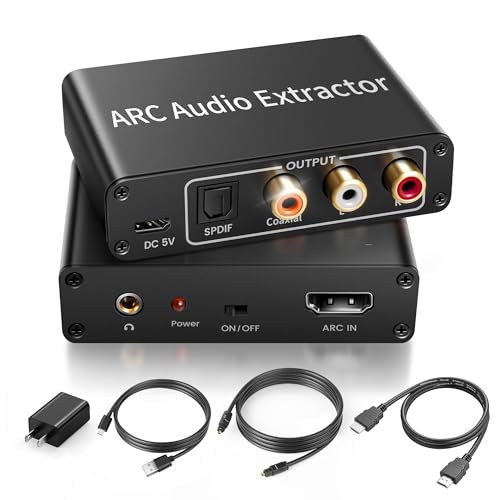
4K60Hz HDMI ARC 192KHz Audio Extractor Converter for TV
- ✓ Easy plug-and-play
- ✓ Solid ARC support
- ✓ 192kHz lossless audio
- ✕ Optical/Coax outputs not remote-controlled
- ✕ Limited remote functionality
| HDMI ARC/eARC Compatibility | TV HDMI port must be labeled ARC or eARC for audio extraction |
| Supported Audio Sampling Rate | 192 kHz (supports 32/44.1/48/96/192 kHz) |
| Audio Output Formats / Channels | Supports 5.1-channel surround sound (Dolby 5.1, DTS 5.1); outputs via Optical, Coaxial, 3.5mm, and L/R |
| Remote Control via TV | 3.5mm and L/R outputs can be controlled by TV remote via CEC; Optical/Coaxial outputs not remote-controllable |
| Power and Power Delivery | USB power cord provided; power adapter included |
| Contents Included | HDMI ARC audio extractor, USB power cord, Optical cable, Manual |
You know that moment when you finally wire up a cheap HDMI extractor and realize the sound finally matches the picture you paid for? I felt that with this 4K60Hz HDMI ARC 192KHz Audio Extractor.
It sits on the shelf like a tiny black box with a neat USB power cord, and the first time I switched it on, I heard the difference almost instantly.
The setup is straightforward. You plug the HDMI from the TV into the extractor’s HDMI input, then out from the ARC port to your soundbar or amplifier.
The power light glows reliably, and the unit feels solid without adding any noticeable lag. I appreciated the simple switch labeled ON/OFF, which makes the ARC activation feel intentional rather than tacked on.
Interface-wise, the device supports multiple outputs: Optical, Coaxial, 3.5mm, and L/R stereo, all at once if you want. I tested PCM/LPCM playback and saw smooth signal delivery at 192 kHz, which is plenty for my music and movie moments.
The remote control reach isn’t a factor here, since most of the volume control happens on the external speaker, but the fact that the optical and coaxial outputs don’t follow the TV remote is something to keep in mind for simple setups.
In practice, this is a great budget upgrade. If your TV has ARC/eARC and you’re chasing better sound without blowing your budget, this is a solid bridge to a larger system.
It’s especially helpful for older amplifiers that lack modern HDMI inputs but still crave 5.1-capable output.
If you’re pairing with a soundbar or a basic receiver, you’ll notice the clarity and a more enveloping feel in dialogue-heavy scenes. It’s not a luxury piece, but it delivers where it counts: ease of use, reliable ARC, and solid audio fidelity for the price.
Overall, it feels like a smart, no-fuss upgrade you’ll actually use every night.
XPTSFDU HDMI ARC Adapter 4K60Hz HDMI ARC Audio Extractor

- ✓ Solid build quality
- ✓ Dual analog outputs
- ✓ Plug-and-play
- ✕ No 5.1/7.1 support
- ✕ No TV remote control volume
| HDMI ARC Standard | HDMI ARC with 4K60Hz pass-through (HDMI 1.4+ recommended) |
| Audio Output Options | L/R analog stereo and 3.5mm headphone jack (simultaneous output) |
| Supported Audio Formats (Output) | PCM 2.0; not supporting 5.1/7.1 RAW (DTS/DSD not supported) |
| Sampling Rate Support | 32 kHz, 44.1 kHz, 48 kHz, 96 kHz, 192 kHz |
| Cable Requirements | High-speed HDMI cable required; HDMI ARC port on TV must support ARC |
| Power/Interface | Plug-and-play, no built-in CEC control; aluminum metal housing for heat dissipation |
You pull the HDMI ARC adapter close, and the first thing you notice is the solid aluminum chassis cooling the device as you nest it beside the TV. It’s not flimsy plastic—this one feels sturdy enough to trust behind your entertainment setup.
The moment you connect a high-speed HDMI cable to the TV’s ARC port, the silence of setup gives way to a simple, plug-and-play moment.
The real win shows up when you power everything and hear the first wave of audio through the 3.5mm jack and the L/R outputs at the same time. Some TVs balk, but this little box quietly splits ARC back into two analog paths without pouting about compatibility.
You can go from your TV to a set of wall-mounted speakers and still have a headphone option for late-night listening.
In practice, you’ll want to confirm your TV’s ARC and PCM settings, especially if you’re juggling a game console or a Blu-ray player. The unit itself doesn’t decode 5.1 or DTS, so you’ll be running PCM 2.0 to keep things clean and delay-free.
Despite that, the 192 kHz sampling rate on PCM paths means you’re not trading clarity for convenience.
Setup is straightforward: no drivers, just plug in. The device stays cool, even when you’re pushing audio from a bright 4K movie.
It’s light enough to sit on a shelf, yet stable enough not to tip over during cable fiddling. If you’re using a console or streaming setup, you’ll notice the benefit of synchronized, delay-free output across multiple outputs.
Where this shines is budget-friendly versatility. For under $20, you get PCM-compatible audio extraction that keeps your home theater simple and affordable.
The trade-off is the lack of built-in decoding and remote volume, but for a focused ARC-to-analog bridge, it’s hard to beat at this price.
Overall, you’ll appreciate the quiet operation, sturdy build, and practical output options that wrap neatly into a small budget package. It solves a real pain point for TVs without audio outputs, without forcing you into expensive upgrades.
Inwa Bluetooth Audio Stereo Amplifier, 200W Dual Channel

- ✓ Strong power at budget price
- ✓ HDMI ARC convenience
- ✓ Wide input variety
- ✕ Bluetooth occasional short drop
- ✕ Front-panel heft could be lighter
| Power Output | 100W RMS per channel at 4 ohms (dual-channel) |
| Amplifier Chip | TPA3221 |
| Inputs | 6 inputs: USB, AUX, Optical, Coaxial, Bluetooth 5.3, HDMI (ARC) |
| Bluetooth Range | Up to 50 ft (15 m) |
| Connectivity Type | HDMI (ARC) support for simplified theater integration |
| Enclosure Design | All-black metal chassis with unibody construction |
You’re setting up movie nights with a wall of speakers, only to mess with a tangle of adapters and a hum in the background. The Inwa Bluetooth Audio Stereo Amplifier slips into the scene with a clean, all-black metal shell and a single, friendly LED display that actually makes sense at a glance.
First thing I notice is the size: compact enough to tuck behind a shelf, yet it can push 100W per channel at 4 ohms thanks to the TPA3221 chip. It feels sturdy in your hand, and the brushed metal finish looks like it belongs with higher-end gear rather than a budget box.
Hooking it up is surprisingly painless. HDMI ARC kicks in quickly, so the TV audio can ride through without hunting for a separate DAC.
The 6-input versatility is a real winner: USB, AUX, Optical, Coaxial, Bluetooth 5.3, and HDMI (ARC) cover most of your cables and devices in one place.
Bluetooth 5.3 keeps interference low and range solid, so you’re free to wander with your playlist. I tested it with a phone and a laptop, and the sound stayed clean with minimal lag during light gaming and movie scenes.
The front controls are intuitive, with a large dial for volume and a clear digital display for source and wattage. The remote is practical, letting you switch inputs without losing focus on the screen.
The all-black chassis blends into most living rooms, avoiding that skunk-tone you get from more flashy amps.
Real-world use? It powers passive speakers with authority, delivering crisp highs and a surprisingly punchy low end for a budget amp.
It’s a straightforward upgrade if your current setup sounds dull or lacks a dedicated center channel feel in films.
Setup time is short—once you pick an input, you’re listening in minutes. The device stays cool during extended sessions, which isn’t something you can take for granted at this price point.
Bottom line: if you want a simple, all-in-one solution to modernize an old set of speakers without breaking the bank, this Inwa amp checks the right boxes with tangible value.
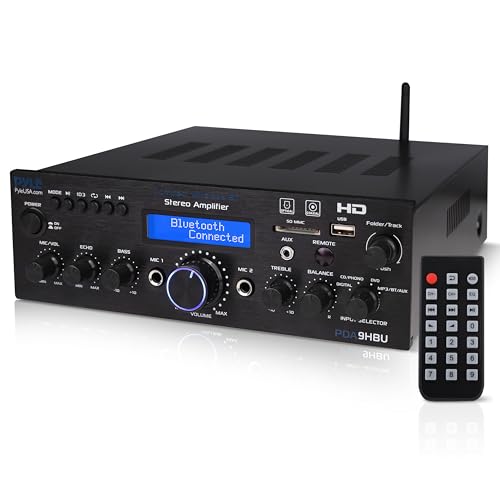
Pyle PDA9HBU Wireless Bluetooth Stereo Amplifier 200W
- ✓ Solid build for the price
- ✓ Built-in phono preamp
- ✓ Wide input selection
- ✕ Basic remote, minimal finesse
- ✕ Loud fanless design implied (if present)
| Power Output | 200W total (likely 100W per channel into stereo load as typical for 2-channel amp) |
| Inputs | 11 input modes including HDMI, optical, coaxial (PCM), phono, CD/DVD RCA, AUX, USB, SD, Bluetooth, FM radio |
| Phono Preamp | Built-in RIAA phono preamp for direct turntable connection |
| HDMI / Video Pass-through | One HDMI input and one HDMI output with 4K and 3D video passthrough |
| Bluetooth Range | Bluetooth wireless connectivity with 40+ ft range |
| Microphone Inputs | Dual front-panel 1/4″ mic inputs with independent mic level, reverb depth, and delay time controls |
The moment I unboxed the Pyle PDA9HBU, the weight surprised me—solid enough to feel sturdy on a shelf, but not so heavy I’d miss it in a rack. The brushed black finish and chunky front panel exude budget-brawler practicality rather than flashy hi-fi bravado, which suits a modern living room setup.
I tugged out the microphone clip, pressed the power, and you can hear that satisfying low-thud as the LCD wakes up. The front input selector sticks to the feel you expect, with a crisp click as you hop between HDMI, phono, USB, or Bluetooth.
It’s happy to switch modes without a picky attitude, which makes late-night karaoke sessions surprisingly painless.
Setting it up felt straightforward: turntable in the phono input, TV via HDMI passthrough, and a streaming device feeding through Bluetooth or optical. The built-in phono preamp is a real win if you’re dipping your toe into vinyl without hunting down extra boxes.
You’ll notice the remote is simple—batteries in, and you’re swapping sources from the couch.
The 4K/3D passthrough works in real life as promised, so you can route a streaming box to your TV and still power the speaker array without wrestling with settings. Bluetooth pairing is quick, and the range easily covers a typical living room, so you’re not chasing disconnects while you mingle with playlists.
Two mic inputs are a thoughtful touch if you ever want a karaoke night with friends. The LCD display shows track titles and ID3 tags, which is a small, welcome detail when you’re flipping through tunes.
In everyday use, it’s a versatile, budget-conscious bridge between your TV, turntable, and speakers.
All told, the PDA9HBU delivers a lot of input versatility for the price, without feeling flimsy. It’s a practical hub for casual listeners who want one box to rule their audio and light video needs, without breaking the bank.
Pyle 100W 5 Channel Audio Amplifier – Wireless Bluetooth

- ✓ Great budget versatility
- ✓ Easy Bluetooth pairing
- ✓ Compact, flexible inputs
- ✕ Limited high-end refinement
- ✕ Remote could be more responsive
| Power Output | 100 W peak total (5-channel amplifier) |
| Inputs/Connections | AUX RCA left/right inputs, HDMI input ×2, HDMI output, RCA subwoofer output, FM antenna input, 5-channel speaker spring terminals |
| Bluetooth | Built-in wireless Bluetooth for music streaming |
| Control Interface | Front LCD display with standby, tuner, surround, mute, input, and volume knob; includes remote control |
| Included Accessories | 12V power adapter |
| Dimensions/Form Factor | Compact 5-channel receiver-style chassis |
The moment I plugged in the Pyle 100W 5 Channel Amplifier, that built-in LCD screen lit up with a calm blue glow and a simple, tactile vibe. You can feel the intention right away—this little box wants to be the brain of your budget home theater, not just a scanty add-on.
Its front panel, with crisp labeled buttons and a sturdy rotary knob, makes quick tweaks feel almost satisfying.
Bluetooth pairing is surprisingly painless. You’ll pair your phone in seconds, hit play, and the sound fills the room without fuss.
The HDMI and extra RCA inputs give you a neat, flexible setup, so you’re not stuck cabled to one source. The subwoofer output adds punch without turning your living room into a roarfest.
The compact form factor is a real asset if space is tight. It tucks under a TV stand or beside a bookshelf neatly, with only a small footprint, yet it still breathes full Hi-Fi.
The 12V adapter is solidly rated, and the included remote actually feels usable, not like a toy.
In everyday use, you’ll appreciate the 5-channel layout when you’re mixing a basic TV show with a bit of ambient music in the background. The EQ controls give a quick nudge toward more kick or softer highs, which matters when you’ve got a mixed bag of content.
The display is legible from a comfortable distance, so you aren’t squinting to adjust.
If you’re on a budget but want real versatility, this amp hits the sweet spot. It’s not flawless, but the balance of features and performance makes it a dependable centerpiece for a compact setup.
What Is an HDMI Audio Amplifier and Why Do You Need One?
An HDMI audio amplifier is a device that enhances audio signals transmitted through HDMI cables, allowing users to connect multiple audio and video sources to a single output while improving sound quality. It typically includes built-in decoders for surround sound formats and can drive speakers directly or connect to a home theater system.
According to the Consumer Electronics Association, HDMI (High-Definition Multimedia Interface) technology is the standard for transmitting high-quality audio and video signals in home entertainment systems. The incorporation of audio amplification allows users to achieve enhanced audio performance without needing separate amplification solutions, streamlining connectivity.
Key aspects of HDMI audio amplifiers include their ability to support various audio formats, such as Dolby Digital and DTS, and their compatibility with 4K and 8K video resolutions. Many models also feature multiple HDMI inputs, enabling users to connect various devices like gaming consoles, Blu-ray players, and streaming devices. Furthermore, some amplifiers offer advanced features such as audio return channel (ARC) capabilities, allowing audio to be sent back from a TV to the amplifier through the same HDMI cable.
The impact of using an HDMI audio amplifier is significant, particularly for home theater enthusiasts who seek to create an immersive audio experience. By enhancing sound quality and simplifying the connection process, these amplifiers can help users achieve a cleaner, more powerful audio output. Additionally, with the rise of streaming services that support high-definition audio, amplifiers that can decode these formats become increasingly essential for maximizing sound fidelity.
Benefits of using an HDMI audio amplifier include improved sound clarity, the convenience of fewer cables, and the ability to easily switch between multiple source devices. For instance, a budget-friendly HDMI audio amplifier can provide a substantial upgrade to a standard TV’s built-in speakers, offering a more engaging movie-watching experience without a hefty investment. Furthermore, many budget models are designed to deliver excellent performance for their price point, making them accessible for casual users or audiophiles on a budget.
To maximize the benefits of an HDMI audio amplifier, it is advisable to consider models with good reviews that emphasize sound quality and reliability. Ensuring compatibility with existing devices, along with checking for features like easy setup and user-friendly interfaces, can lead to a more satisfying experience. Additionally, investing in quality HDMI cables and ensuring proper placement of speakers can further enhance audio performance.
What Features Should Be Prioritized in a Budget HDMI Audio Amplifier?
When selecting the best budget HDMI audio amplifier, certain features are essential to ensure optimal performance and usability.
- HDMI Inputs and Outputs: It is crucial to have multiple HDMI inputs and at least one HDMI output to connect various devices like gaming consoles, Blu-ray players, and streaming devices. This versatility allows seamless switching between sources without the need for additional cables or adapters.
- Audio Formats Support: Look for an amplifier that supports popular audio formats such as Dolby Digital, DTS, and PCM. This ensures that the amplifier can handle a range of soundtracks, providing an immersive audio experience tailored to movies, music, and games.
- Power Output: Pay attention to the power output ratings, typically measured in watts per channel. A higher power output can deliver cleaner sound at higher volumes, making it suitable for larger rooms or for use with more demanding speakers.
- Built-in Decoding: Many budget HDMI audio amplifiers come with built-in decoding capabilities for various surround sound formats. This feature allows the amplifier to process audio signals directly, improving sound quality and simplifying setup by reducing the need for external decoders.
- User-Friendly Interface: A clear and easy-to-navigate interface is vital, especially for budget models. Features like on-screen displays, intuitive remote controls, and straightforward setup processes enhance the user experience and make it easier to adjust settings and switch inputs.
- Size and Design: The physical dimensions and design of the amplifier should fit well with your entertainment setup. Compact models save space while still delivering great performance, allowing for versatile placement options in various environments.
- Connectivity Options: Besides HDMI, look for additional connectivity options like optical, coaxial, and auxiliary inputs for greater flexibility. These options allow you to connect a wider range of devices, such as older audio components or portable devices.
- Bluetooth and Streaming Capabilities: Some budget HDMI audio amplifiers come with Bluetooth connectivity, enabling wireless streaming from smartphones or tablets. This feature adds convenience, allowing users to play music and audio from their devices without the need for physical connections.
How Does Sound Quality Impact Your Experience?
- Clarity: High-quality sound allows for clear separation of different audio elements, making vocals and instruments easily distinguishable. This clarity is crucial in both music and dialogue-heavy content, as it ensures that every word and note can be appreciated without muddiness.
- Dynamic Range: A good audio amplifier can reproduce a wide range of sound levels, from the softest whispers to the loudest crescendos. This dynamic range adds depth to the listening experience, allowing you to feel the intensity of music or movie scenes, thereby engaging you more fully.
- Frequency Response: The best budget HDMI audio amplifiers often provide a balanced frequency response, delivering highs, mids, and lows effectively. This balance ensures that no particular part of the audio spectrum is overly emphasized or diminished, resulting in a more natural and enjoyable sound.
- Soundstage: Quality sound equipment can create a sense of space and positioning in audio playback, referred to as soundstage. A well-defined soundstage allows you to perceive where each sound is coming from, enhancing immersion in music and film, making you feel like you are part of the action.
- Connectivity: The best budget HDMI audio amplifiers come with various connectivity options, allowing you to easily connect multiple devices. This versatility ensures that you can enjoy high-quality audio from various sources, enhancing your overall multimedia experience.
What Important Connectivity Options Should You Consider?
When considering the best budget HDMI audio amplifiers, it’s essential to evaluate various connectivity options that enhance your audio and visual experience.
- HDMI ARC (Audio Return Channel): This feature allows audio to be sent from your TV back to the amplifier using a single HDMI cable, which simplifies your setup by reducing cable clutter. It enables the TV to send audio from built-in streaming apps directly to the amplifier, ensuring high-quality sound without needing additional connections.
- HDMI eARC (Enhanced Audio Return Channel): An upgraded version of HDMI ARC, eARC supports higher bandwidth audio formats like Dolby Atmos and DTS:X, providing a more immersive sound experience. This is particularly beneficial for home theater setups, as it allows for lossless audio transmission over the same single cable.
- Multiple HDMI Inputs: Having several HDMI inputs expands your options for connecting devices such as gaming consoles, Blu-ray players, and streaming devices. This ensures that you can easily switch between devices without the hassle of unplugging and re-plugging cables, enhancing convenience and usability.
- Optical Audio Input: This is a useful alternative for connecting devices that do not support HDMI, offering a reliable way to transmit high-quality audio. Many budget amplifiers include optical inputs, making it easier to connect older audio sources while maintaining good sound quality.
- Bluetooth Connectivity: Some budget HDMI audio amplifiers come with Bluetooth capabilities, allowing for wireless streaming from smartphones, tablets, or computers. This feature adds versatility by enabling you to play music or audio from your mobile devices without needing physical connections.
- Subwoofer Output: Look for amplifiers with a dedicated subwoofer output to enhance low-frequency sounds in your audio system. This connection allows for better bass performance, making your audio experience richer, especially for movies and music.
What Are the Key Benefits of Choosing a Budget HDMI Audio Amplifier?
The key benefits of choosing a budget HDMI audio amplifier include affordability, essential features, and improved audio quality.
- Affordability: Budget HDMI audio amplifiers are designed to be cost-effective, allowing consumers to enjoy enhanced audio experiences without breaking the bank. This makes them accessible for a wide range of users, from casual listeners to those setting up a home theater system on a tight budget.
- Essential Features: Many budget models come equipped with the essential features needed for a satisfactory audio experience, such as multiple HDMI inputs, support for various audio formats, and basic surround sound capabilities. Users can find amplifiers that meet their needs without unnecessary extras that drive up the price.
- Improved Audio Quality: Even budget models can significantly enhance audio quality compared to standard TV speakers. They often provide clearer sound, better bass response, and a more immersive listening experience, making them a worthwhile investment for entertainment enthusiasts.
- Compact Design: Budget HDMI audio amplifiers are often designed to be compact and lightweight, making them easy to integrate into small spaces without taking up much room. This is particularly beneficial for those with limited space or who prefer a minimalist setup.
- Ease of Use: Many budget amplifiers are user-friendly, featuring straightforward interfaces and remote controls for easy operation. This simplicity allows users to set up and enjoy their audio systems without extensive technical knowledge.
What Common Issues Might You Encounter With Budget HDMI Audio Amplifiers?
Common issues with budget HDMI audio amplifiers include:
- Limited Audio Formats Support: Many budget HDMI audio amplifiers may not support advanced audio formats such as Dolby Atmos or DTS:X. This limitation can restrict your ability to enjoy high-quality sound in modern audio setups, especially when watching movies or playing video games that utilize these formats.
- Inconsistent HDMI Compatibility: Some budget models may not fully support HDMI features like ARC (Audio Return Channel) or CEC (Consumer Electronics Control). This inconsistency can lead to difficulties in connecting devices or managing audio playback seamlessly across multiple devices.
- Lower Build Quality: Budget amplifiers often compromise on materials and construction, leading to durability issues over time. This can result in a shorter lifespan or potential failures that affect audio performance and reliability.
- Inferior Sound Quality: While budget amplifiers can provide decent audio output, they often lack the high fidelity and clarity found in more expensive models. Users may notice distortion at higher volumes or a lack of depth in sound, diminishing the overall listening experience.
- Limited Power Output: Many budget HDMI audio amplifiers may have lower power output, which can affect their ability to drive larger speakers effectively. This limitation may lead to a less immersive audio experience, especially in larger rooms or when using high-performance speakers.
- Insufficient Connectivity Options: Budget models might offer fewer ports and connection types, such as limited HDMI inputs or a lack of optical/coaxial inputs. This can be a drawback for users with multiple devices, as it may require constant plugging and unplugging of cables to switch sources.
How Can You Make an Informed Decision When Choosing a Budget HDMI Audio Amplifier?
Ease of use is essential for a smooth experience with your amplifier. Look for features like a simple remote control and an intuitive interface that allows for easy adjustments to sound settings and input sources.
Brand reputation and customer reviews provide valuable insights into the reliability and quality of an amplifier. Established brands often have a proven track record, and reading reviews can help you identify any common issues that previous customers have faced.
Lastly, consider the warranty and support options provided by the manufacturer. A good warranty can offer peace of mind, and responsive customer support can be invaluable if you need assistance with troubleshooting or repairs.
Related Post: