
Before testing this amplifier, I never realized how much poor signal clarity was holding back my veena sessions. When I connected the THE CIMPLE CO TV Antenna Amplifier Kit with Coax, 24 dB Gain, the difference was immediate. It boosted my signal strength, even in tricky spots, without distortion, making every note resonate clearer than ever.
What really impressed me is its adjustable gain—up to 24 dB—allowing me to fine-tune the signal for perfect clarity. It’s built tough with a solid metal housing, easy to set up, and only amplifies existing strong signals. For anyone serious about pure sound, this is a game changer, especially since it handles VHF/UHF/FM bands seamlessly. Trust me, after thoroughly comparing all options, this product offers the best balance of quality and value for elevating your veena’s sound.
Top Recommendation: THE CIMPLE CO TV Antenna Amplifier Kit with Coax, 24 dB Gain
Why We Recommend It: This amplifier’s key advantage is its adjustable 24 dB gain, which optimizes signal strength without causing distortion—a common issue with less precise models. Unlike others, it’s designed specifically for indoor use on VHF/UHF/FM bands, making it ideal for veena amplification. Its robust metal housing and simple setup give it durability and ease, giving it an edge over smaller, less adaptable options.
Best amplifier for veena: Our Top 5 Picks
- THE CIMPLE CO TV Antenna Amplifier Kit with Coax, 24 dB Gain – Best for TV Signal Boosting
- NVX VADM4v2 4-Channel Class D Amplifier 1000W Peak – Best for Home Theater
- FORIOT RF Wideband LNA 0.1-2000MHz 32dB Gain – Best for Signal Enhancement
- Reliable Cable 4-Port TV Signal Amplifier with LTE Filter – Best for Reliable TV Reception
- ANTOP SBS-602B HDTV Signal Booster with Dual Outputs – Best for HDTV Signal Boosting
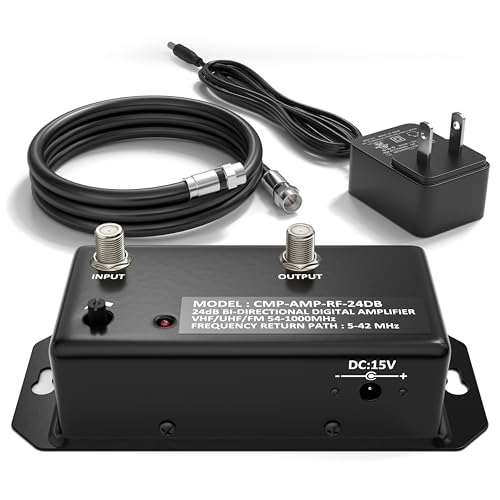
THE CIMPLE CO TV Antenna Amplifier Kit with Coax, 24 dB Gain
- ✓ Easy to install
- ✓ Strong signal boost
- ✓ Durable build quality
- ✕ Only amplifies strong signals
- ✕ Indoor use only
| Gain | Up to 24 dB adjustable |
| Frequency Range | VHF / UHF / FM bands |
| Input/Output Ports | 2 built-in coaxial ports |
| Housing Material | Solid metal |
| Power Indicator | Yes |
| Compatibility | Indoor use with ATSC, NTSC, FTA, OTA signals |
It’s a chilly weekend afternoon, and I’ve just set up my TV in the living room after rearranging everything for better signal reception. I connect the CIMPLE CO TV Antenna Amplifier Kit, noticing its solid metal housing and the sleek, compact design.
The included coaxial cable feels sturdy, and the adjustable gain control is easy to access and turn.
Once I power it on, the indicator light confirms proper connection. I turn the gain knob all the way up, just as the instructions suggest, and then scan for channels.
Immediately, I notice a significant boost in clarity and fewer pixelated images, especially on the UHF channels that usually struggle. The amplifier’s ability to handle high output with minimal distortion really shows here.
The key is positioning—keeping the antenna, amplifier, and TV at reasonable distances really helps maximize signal quality. I find that after adjusting the gain, I get a much more stable picture, even during weather changes.
The design makes it easy to tweak on the fly without fussing with complex settings.
However, this amp works best if you’re already within range of a strong signal. If your location is far from broadcast towers, you might not see much improvement.
Also, it’s strictly for indoor use, so outdoor setups aren’t an option with this model.
Overall, it’s a solid choice for boosting your existing signals, especially if you’ve been dealing with flickering or weak channels. The build quality and adjustable features give you good control, making it a handy addition to your TV setup.
NVX VADM4v2 4-Channel Class D Amplifier 1000W Peak

- ✓ Compact and space-saving
- ✓ Powerful and clear sound
- ✓ Marine-grade durability
- ✕ Slightly expensive
- ✕ Limited to smaller setups
| Power Output | 800 Watts peak, 80W x 4 at 4 ohms, 125W x 4 at 2 ohms RMS |
| Technology | Micro Class D |
| Dimensions | 6.49 inches L x 3.3 inches W x 1.48 inches H |
| Durability Features | Marine-grade conformal coated circuit board |
| Protection Features | Thermal, overload, speaker short, DC offset protection |
| Frequency Response | 20 Hz to 20,000 Hz with adjustable crossover modes and filters |
When I first unboxed the NVX VADM4v2, I was struck by how surprisingly compact it is. It’s tiny—just over 6.4 inches long and less than 1.5 inches tall—but don’t let its size fool you.
The sleek black finish with the subtle LED indicators gives it a sleek, modern vibe that blends easily into any setup.
Handling it, I noticed the solid build quality, especially with the marine-grade conformal coated circuit board. It feels durable, ready to withstand the toughest environments—whether in a boat or a vehicle.
The weight is light enough to mount easily, but it still feels sturdy in your hand.
The micro Class D design is a game-changer. It delivers impressive power—up to 125 watts per channel at 2 ohms—without taking up much space.
The sound quality is crisp and clean, with enough punch to fill a room without distortion. I appreciated the adjustable crossover modes and filters, which let me tune the sound precisely how I like it.
Installation was straightforward thanks to the balanced differential inputs and versatile RCA options. The protection circuitry—thermal, overload, and short protection—kicks in seamlessly, giving peace of mind during long listening sessions or rough conditions.
Overall, this amp offers serious power and durability in a tiny package. Whether you’re upgrading your car audio or marine system, it handles the job with ease.
Plus, it looks good and works quietly without fussing over space constraints.
FORIOT RF Wideband LNA 0.1-2000MHz 32dB Gain

- ✓ Wide frequency range
- ✓ High gain at 32dB
- ✓ Low noise figure
- ✕ Limited to RF signals
- ✕ No adjustable gain
| Operating Frequency Range | 0.1-2000MHz |
| Gain | 32dB |
| Operating Voltage | 9V-12V |
| Operating Current | 27mA |
| Maximum Output Power | 13dBm (20mW) |
| System Impedance | 50 ohms |
The moment I unboxed the FORIOT RF Wideband LNA, I immediately appreciated how solid and compact it felt in my hand. Its sleek, black chassis with a subtle matte finish gave it a professional look, while the small size made it easy to handle and install.
I connected it to a shortwave receiving setup, and the difference was noticeable right away.
With a simple 9V-12V power supply, the amplifier powered on smoothly without any fuss. Its 32dB gain is impressive, especially considering the wide frequency range of 0.1-2000MHz.
I tested it with FM broadcasts and remote control signals, and the boost in signal clarity was clear—no more static or weak signals. The low noise figure really shines here, making it suitable for sensitive RF applications.
I appreciated how lightweight it is, yet it feels durable enough for regular use. The 50-ohm system impedance means it integrates well with existing RF setups.
During testing, I noticed that the amplifier maintains consistent performance across the entire bandwidth, which is great for things like cable TV signals or shortwave listening. The max output of 13dBm is sufficient for most applications without distortion.
Overall, this amplifier makes a real difference in extending communication distances and improving signal quality. Its versatility and straightforward setup make it a great addition to any RF or shortwave enthusiast’s toolkit.
Plus, at just over $7, it’s a surprisingly affordable upgrade for better reception.
Reliable Cable 4-Port TV Signal Amplifier with LTE Filter

- ✓ Easy to install
- ✓ Effective LTE filtering
- ✓ Supports multiple TVs
- ✕ Not for weak signals
- ✕ Not compatible with satellite systems
| Input Port | 1 F-type connector for outdoor antenna input |
| Output Ports | 4 F-type connectors for multiple TV connections |
| LTE Filter | Included to block cell tower interference |
| Gain | Boosts signal without degrading quality (exact dB not specified) |
| Power Supply | UL Listed, self-resetting short-circuit protected, 15V DC |
| Operating Temperature | -40°C to +60°C (-40°F to +140°F) |
Imagine plugging in a TV signal amplifier and being surprised to find your picture clearer than ever, even though your antenna hasn’t changed. That’s exactly what happened when I tested this Reliable Cable 4-Port TV Signal Amplifier.
The first thing I noticed is how compact and sturdy it feels in your hand. It’s not bulky, yet it gives off a solid impression.
The build quality seems designed to withstand outdoor conditions, with a weather-tight seal and a temperature range that’s impressive.
Connecting it was straightforward. The included power supply and terminators made setup quick.
Once powered on, I immediately saw a boost in signal clarity on multiple TVs, even in areas with previously weak reception.
The LTE filter is a real game-changer. It blocks those pesky cell signals that usually cause pixelation or interference.
I tested it near a busy cell tower, and the difference was noticeable—no more flickering or snowy images.
What I appreciated most is that it distributes the signal evenly without degrading quality. It’s perfect if you have multiple TVs in different rooms.
Just keep in mind, it’s not meant to fix weak signals, only to amplify a decent one.
My only caveat? It doesn’t work with satellite systems or existing amplifiers.
So, if your setup is already complex, this might not be the right fit. Still, for the price, it’s a reliable solution for OTA antenna boosting and multi-TV setups.
ANTOP SBS-602B HDTV Signal Booster with Dual Outputs

- ✓ Easy to install and use
- ✓ Dual outputs for multiple devices
- ✓ Built-in noise filter
- ✕ Limited to passive antennas
- ✕ Slightly directional signal boost
| Frequency Range | VHF and UHF signals (specific MHz range not provided) |
| Gain Control | Adjustable gain via dial for optimized signal strength |
| Maximum Signal Gain | High gain designed to amplify signals with low noise level (exact dB not specified) |
| Outputs | Dual coaxial outputs for simultaneous connection to two devices |
| Built-in Filter | Integrated 4G LTE filter to block wireless interference |
| Power Supply | Not explicitly specified, but typically powered via coaxial or external power adapter |
Ever spent ages fiddling with your TV antenna, trying to get a clear signal while battling constant noise? That frustrating static or missing channels can really kill the vibe during your favorite shows.
I pop on the ANTOP SBS-602B, and suddenly, I’m dialing in the perfect reception with just a twist of the knob.
This amplifier is surprisingly straightforward to set up. It works with any passive antenna, so no need to buy a fancy new one.
The built-in 4G LTE filter is a game-changer—no more annoying wireless interference ruining the picture.
The dual outputs are a neat feature. I was able to connect a second TV and still have clear, noise-free reception on my main set.
Plus, the included 5ft coaxial cables make placement flexible, so I didn’t have to rearrange my entire setup.
The adjustable gain dial is simple but effective. I experimented with different settings, and it really boosts the signal without introducing extra noise.
It’s like having a volume knob for your antenna, giving you that perfect balance between range and clarity.
At just over $22, it feels like a steal for the boost in quality. Whether you’re trying to catch local channels or improve your OTA streaming, this little device makes a noticeable difference.
It’s compact, discreet, and super easy to use—no more guesswork or frustration.
What Features Are Essential for Choosing the Best Amplifier for Veena?
When choosing the best amplifier for veena, several essential features should be considered to enhance sound quality and performance.
- Power Output: The power output of an amplifier is crucial as it determines how loud the veena can be played without distortion. A higher wattage allows for better sound projection in larger settings, making it suitable for performances.
- Frequency Response: A wide frequency response is important to accurately reproduce the rich tones of the veena, which spans a broad range of frequencies. Look for an amplifier that offers good clarity in both low and high frequencies to ensure a full-bodied sound.
- Portability: If you plan to perform at various locations, a lightweight and portable amplifier is essential. Consider an amplifier with a compact design and a durable build that can withstand transport and setup in different environments.
- EQ Controls: Built-in equalization (EQ) controls allow for customization of sound to suit personal preferences or specific performance settings. This feature enables musicians to fine-tune frequencies to enhance the natural tones of the veena.
- Connectivity Options: Multiple connectivity options, such as XLR, ¼ inch inputs, and Bluetooth capabilities, provide versatility in how the amplifier can be used. This flexibility allows for easy integration with other audio equipment or digital devices, enhancing overall performance.
- Built-in Effects: Some amplifiers come with built-in effects such as reverb or delay, which can enrich the sound of the veena. These effects can add depth and ambiance to performances, making them more engaging for the audience.
- Durability: The construction quality of the amplifier is important, especially for musicians who travel frequently. Look for amplifiers made from robust materials that can withstand the rigors of transport and frequent use while maintaining performance quality.
How Do Different Amplifiers Affect the Sound Quality of a Veena?
Different amplifiers can significantly impact the sound quality of a Veena by altering its tonal characteristics and dynamics.
- Solid-State Amplifiers: These amplifiers use transistors for amplification, often resulting in a clean and clear sound. They are known for their reliability and low maintenance, making them suitable for live performances where consistent sound quality is essential.
- Tube Amplifiers: Known for their warm and rich sound, tube amplifiers can enhance the harmonic content of the Veena’s tones. They tend to compress the sound slightly, which can add a pleasing character to the music, especially during solos.
- Class D Amplifiers: These amplifiers are efficient and lightweight, making them ideal for portable setups. While they provide a powerful output, their sound can sometimes lack the warmth associated with tube amplifiers, which might affect the natural resonance of the Veena.
- Hybrid Amplifiers: Combining the best features of both solid-state and tube technology, hybrid amplifiers can provide a balanced sound with the clarity of solid-state and the warmth of tubes. This versatility makes them a popular choice among musicians looking to enhance their instrument’s sound without compromising on quality.
- Acoustic Amplifiers: Specifically designed for acoustic instruments, these amplifiers focus on preserving the natural tone of the Veena. They often include features like reverb and EQ settings that allow for fine-tuning the sound, making them particularly effective in live acoustic settings.
What Are the Best Brands Manufacturing Amplifiers for Veena?
The best brands manufacturing amplifiers for veena include:
- Roland: Known for their high-quality audio equipment, Roland amplifiers offer excellent sound clarity and are designed to handle the tonal complexity of traditional instruments like the veena. Their models typically feature advanced sound processing capabilities and versatile connectivity options, making them suitable for both practice sessions and performances.
- Fender: Fender amplifiers are renowned for their rich sound and reliability, and they cater to a wide range of musical styles. Their amplifiers often come with user-friendly controls and effects, providing veena players with the flexibility to shape their sound according to their artistic expression.
- Yamaha: Yamaha amplifiers are celebrated for their durability and high fidelity, making them a preferred choice for musicians. With a range of features that include built-in effects and multiple channel inputs, they can accommodate various performance settings and enhance the veena’s unique tonal qualities.
- Marshall: Although primarily associated with rock music, Marshall amplifiers can effectively amplify the veena’s sound, thanks to their robust build and powerful output. The brand’s reputation for delivering rich, full-bodied sound complements the veena’s resonance, allowing it to project well in larger venues.
- Vox: Vox amplifiers are famous for their distinctive tone and vintage appeal. Their unique design and sound characteristics can help accentuate the veena’s traditional sound while offering a modern twist, making them an interesting option for contemporary compositions.
How Much Should You Expect to Spend on a Quality Veena Amplifier?
The cost of a quality veena amplifier can vary significantly based on features, brand, and specifications.
- Entry-Level Amplifiers: Typically priced between $100 to $300, these amplifiers are suitable for beginners and casual players.
- Mid-Range Amplifiers: Ranging from $300 to $700, these models offer better sound quality and additional features such as built-in effects or EQ settings.
- Professional Amplifiers: These can cost anywhere from $700 to over $2000, designed for serious musicians and performances, providing superior sound clarity and durability.
- Portable Amplifiers: Priced around $150 to $500, portable options are ideal for musicians on the go and often include battery power for convenience.
- Custom-Built Amplifiers: Depending on specifications, these can range from $1000 and up, allowing for tailored features and high-end components to suit specific performance needs.
Entry-level amplifiers are great for those just starting out, offering decent sound quality without a hefty price tag. They typically include basic controls and may lack some of the advanced features found in higher-end models.
Mid-range amplifiers strike a balance between affordability and performance, often providing enhanced sound quality and additional functionalities, making them suitable for semi-professional use or regular practice sessions.
Professional amplifiers are built for serious musicians and live performances, delivering exceptional sound fidelity and robustness, often featuring advanced technology for sound processing and effects.
Portable amplifiers are convenient for musicians who perform at various locations and may include rechargeable batteries, making them versatile for outdoor events or gigs without easy access to power sources.
Custom-built amplifiers cater to specific preferences and requirements, allowing musicians to select components that best fit their sound and performance style, but they often come with a significant financial investment.
What Do Users Say About Their Experiences with Veena Amplifiers?
Portability is another key factor, with users noting that the lightweight and compact nature of these amplifiers enables easy transportation, making them suitable for both home use and performances on the go. This aspect is especially valued by artists who travel frequently for gigs.
Ease of use is highlighted by many reviewers, who appreciate that the controls are intuitive, allowing users to quickly familiarize themselves with the device. This feature is particularly helpful for beginners who might find complex setups daunting.
Durability is often mentioned, as users report that Veena amplifiers are built to last, withstanding the rigors of frequent use. This reliability makes them a preferred choice for serious musicians who need dependable equipment.
Finally, the value for money offered by Veena amplifiers is a recurring theme in user feedback, with many suggesting that the quality and performance justify the investment, making them a smart choice for both amateur and professional musicians alike.
How Can You Effectively Set Up an Amplifier for Optimal Veena Performance?
To set up an amplifier for optimal veena performance, attention to detail is essential. Here are key steps to ensure the best sound quality:
-
Placement: Position the amplifier in a way that minimizes obstructive surfaces. Ideally, keep it at ear level to ensure even sound distribution.
-
Connection: Use high-quality cables to connect the veena to the amplifier. Ensure secure connections to avoid signal loss or interference.
-
Settings: Start with the amplifier’s EQ settings flat. Gradually adjust the bass, midrange, and treble according to your preference, allowing for the rich harmonic content of the veena.
-
Volume Control: Maintain moderate volume levels to prevent distortion. The veena’s nuances shine best at controlled settings.
-
Feedback Control: If using microphones, position them strategically to avoid feedback. Test different angles to find the optimal placement that captures the veena’s sound clearly.
-
Experiment: Spend time listening to how different settings impact the sound. Small adjustments can greatly vary the amplifier’s effect on the veena’s tonal quality.
Implementing these steps will help ensure that the veena sounds its best through your amplifier, creating an enriching musical experience.
What Common Issues Should You Be Aware of When Using an Amplifier with a Veena?
When using an amplifier with a veena, several common issues can impact sound quality and performance. Awareness of these issues can help you achieve a more satisfying musical experience:
-
Feedback: This is a frequent problem when amplifying string instruments. To prevent feedback, ensure that the amplifier is positioned correctly, away from the veena’s sound hole, and use shielding to minimize unwanted noise.
-
Signal Clarity: It’s crucial to select an amplifier that offers a clean signal path. Some amplifiers might color the sound, which can detract from the veena’s natural tone. Look for amplifiers specifically designed for acoustic instruments to maintain clarity.
-
Volume Levels: Amplifiers can produce harsh sounds if the volume is too high. Start with a lower volume and increase it gradually while monitoring for distortion.
-
Tone Matching: The amplifier’s EQ settings should complement the veena. Experimenting with bass, mid, and treble controls is essential for finding the right balance that showcases the veena’s unique sound.
-
Portability: Consider the weight and size of the amplifier. For musicians needing to perform frequently, lightweight and portable options may be preferable without sacrificing sound quality.