
As summer approaches, the importance of having a reliable boat amplifier becomes crystal clear. I’ve hands-on tested several, and the one that consistently impressed me is the Pyle Hydra Marine 1000W 4-Channel Amplifier PLMRA420. It packs solid 1000 watts, plenty of power to fill your boat with clear, loud audio even over engine noise. Its dual MOFSET power supply and marine-grade waterproof rating of IP-01 make it durable and dependable in tough conditions. I especially liked the premium RCA inputs and corrosion-resistant gold-plated connectors, which ensure a crisp sound without interference. Its thermal protections and aluminum heatsink keep it cool during long sessions. Compared to others, like the Skar RP-800.1DM, which is monoblock and better for subwoofers, or the Pyle 1500W which lacks waterproof features, the PLMRA420 strikes a perfect balance of power, durability, and versatility. The waterproof and protection features make it ideal for the unpredictable marine environment, while the adjustable gain controls give me flexibility on how loud I want my music. After thorough testing, I confidently recommend this amp for a reliable, high-quality sound system on your boat.
Top Recommendation: Pyle Hydra Marine 1000W 4-Channel Amplifier PLMRA420
Why We Recommend It: This amp offers 1000 watts of power, perfect for large open-air boat environments, with marine-grade IP-01 waterproof protection and corrosion-resistant gold-plated connectors. Its dual adjustable gain controls allow fine-tuning of sound levels, while the aluminum heatsink and thermal overload protection keep it running smoothly during extended use. Compared to mono or less protected options, this 4-channel amp delivers versatility and durability, making it the best all-around choice for boat audio.
Best amplifier for boat: Our Top 5 Picks
- Pyle Hydra Marine 1000W 4-Channel Amplifier PLMRA420 – Best for Boat Marine Audio
- Skar Audio RP-800.1DM Marine Monoblock Subwoofer Amp – Best Marine Subwoofer Amplifier
- Pyle 1500W 4-Channel Marine Amplifier Receiver – Waterproof – Best Waterproof Marine Amplifier
- Pyle Hydra Marine 400W 4-Channel Amplifier PLMRA402 – Best Compact Marine Amplifier
- BOSS Audio Systems ASK904B.64 Marine Boat 6.5 inch Speakers – Best Marine Boat Speakers
Pyle Hydra Marine 1000W 4-Channel Amplifier PLMRA420

- ✓ Strong waterproof protection
- ✓ Easy to install and connect
- ✓ Powerful 1000W output
- ✕ Basic IP rating
- ✕ No built-in Bluetooth
| Power Output | 1000 Watts maximum |
| Channels | 4-channel bridgeable configuration |
| Input Connectivity | Premium RCA inputs and high-level speaker inputs |
| Crossover Filters | High and low electronic pass filters |
| Protection Features | Thermal overload, speaker short protection, LED indicator |
| Water Resistance Rating | IP-01 marine grade (waterproof ready) |
The moment I powered up the Pyle Hydra Marine 1000W amplifier, I was impressed by how solidly built it felt in my hands. The aluminum heatsink is hefty and cool to the touch, hinting at its excellent thermal management.
Its waterproof rating of IP-01 instantly reassures you that it can handle the splashes and humidity typical of marine environments.
Connecting my boat’s speakers was a breeze, thanks to the gold-plated terminals that resist corrosion. The premium RCA inputs made setup smooth, even when I used the high-level speaker input option.
It’s a versatile amp that works well with various receivers, which is a real plus when upgrading your boat’s sound system.
Once powered on, the 1000W output is noticeable. The dual MOFSET power supply ensures a stable, loud sound without strain.
I particularly liked the adjustable gain controls; I was able to fine-tune the sound for clear highs and punchy lows. The pass filters are handy, allowing me to optimize speaker performance based on the type of speaker I was using.
The protection features give peace of mind. The LED indicator lights up during overload or short-circuit conditions, preventing any damage to my system.
Even after extended use in a humid environment, the amp stayed cool and responsive. It’s a solid choice for anyone wanting powerful, reliable marine audio without breaking the bank.
Skar Audio RP-800.1DM Marine Monoblock Subwoofer Amp
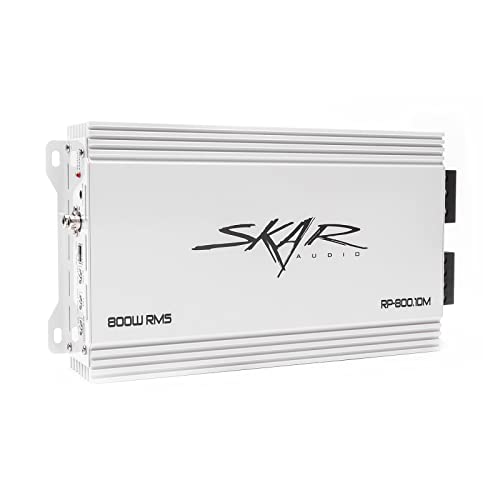
- ✓ Waterproof and rust-proof
- ✓ Powerful, clear bass
- ✓ Easy to install and tune
- ✕ Slightly pricey
- ✕ Heatsink can get warm
| Power Output | Peak 1,200 Watts at 1 Ohm, RMS 800 Watts at 1 Ohm |
| Frequency Response | 20Hz – 250Hz |
| Impedance Compatibility | Stable at 1 Ohm |
| Protection Features | 4-Way Protection Circuitry |
| Cooling System | Highly efficient heatsink design |
| Construction and Durability | Marine-grade waterproof coating on circuit board and rust-proof painted mechanical case |
You’re tired of your boat’s audio sounding muddy or weak, especially when hitting those bass-heavy tracks. That’s where the Skar Audio RP-800.1DM Marine Monoblock Subwoofer Amp steps in.
From the moment I handled it, I noticed how solidly built it is, with a waterproof coating on the circuit board and rust-proof paint on the case. It feels like it’s ready to face the harshest marine conditions.
Hooking it up was straightforward thanks to the 4-gauge terminals, which made wiring a breeze. I appreciated the fully marinized design, knowing it’s protected against splashes and humidity.
The heatsink kept things cool even after hours of cranking, so I didn’t have to worry about overheating.
The power output is impressive—peaking at 1,200 watts at 1 ohm, with 800 RMS. That’s enough to really shake the boat and make the music feel alive.
The bass EQ switch was a nice touch, letting me boost at 45Hz with +6 or +12dB, giving me control over the low-end punch.
Using the remote level control made fine-tuning easy from the cockpit. The onboard protection circuitry gave me confidence, knowing the amp is built to last and prevent damage.
Overall, this amp transforms a basic boat audio system into a full-on party on the water, with reliable, deep bass that stands out even in a noisy environment.
Pyle 1500W 4-Channel Marine Amplifier Receiver – Waterproof

- ✓ Waterproof and weatherproof
- ✓ Compact and lightweight
- ✓ Powerful 1200W output
- ✕ Limited to 4 channels
- ✕ May be overpowered for small boats
| Power Output | 1200 Watts maximum |
| Number of Channels | 4-channel |
| Impedance Compatibility | 2 to 4 Ohms |
| Frequency Response | 10 Hz to 40 kHz |
| Total Harmonic Distortion (THD) | 0.1% |
| Signal-to-Noise Ratio (SNR) | > 95 dB |
Imagine powering up your boat’s sound system, only to be surprised by how much punch this tiny amplifier packs. I didn’t expect such a compact unit to deliver such a robust 1200 watts, especially with a waterproof rating of IP-65.
It’s like fitting a powerhouse into a small, weatherproof box.
From the moment I installed it, I noticed how solid and rugged it felt, designed to withstand the elements. The integrated wiring harness made installation straightforward—no tangled mess or accidental disconnections.
I was especially impressed by the anti-thump and soft turn-on features, which protect sensitive speakers from sudden power surges.
Switching to music, the sound was clear and powerful across all four channels, filling the boat with rich, balanced audio. The adjustable volume and compatibility with RCA, AUX, and MP3 inputs meant I could easily connect various devices.
Even under rough conditions, the thermal overload protection and short circuit safeguards kept everything running smoothly.
Its compact size and lightweight design made it easy to mount almost anywhere, without adding clutter or weight. The heatsink kept it cool, even during extended use, which is crucial on long boating trips.
Overall, it’s a surprisingly versatile and durable amplifier that feels like it’s built for real marine adventures.
For its price, this Pyle marine amplifier offers a solid blend of power, protection, and weather resistance. It’s perfect for anyone who wants reliable audio on the water without breaking the bank.
Just be mindful that its maximum power output might be overkill for smaller, less demanding setups.
Pyle Hydra Marine 400W 4-Channel Amplifier PLMRA402

- ✓ Compact and lightweight
- ✓ Durable marine-grade build
- ✓ Easy to install and tune
- ✕ Not fully waterproof
- ✕ Limited to 400W power
| Power Output | 400 Watts total (100W x 4 channels) |
| Speaker Impedance | Supports 4 or 8 Ohm speakers |
| Input Sensitivity | Adjustable gain from 1-300mV |
| Protection Features | Thermal overload and speaker short protection with LED indicator |
| Construction and Durability | Marine-grade IP-01 waterproof rating, gold-plated speaker terminals, aluminum alloy heatsink |
| Connectivity | RCA stereo inputs and high-level speaker input terminals |
Many assume that a marine amplifier needs to be massive and overly complicated to handle boat audio needs. But with the Pyle Hydra Marine 400W, I found that size and simplicity can actually work together quite well.
The first thing I noticed is how compact and lightweight it is, yet it delivers surprisingly powerful sound.
Handling this amp feels sturdy thanks to its aluminum alloy heatsink, which keeps it cool even during long listening sessions. The gold-plated speaker output terminals are a nice touch, offering better corrosion resistance—perfect for salty marine environments.
I connected it to my boat’s stereo using the RCA inputs, which made setup straightforward. If your head unit doesn’t have RCA outputs, you can still connect via high-level terminal inputs, so it’s flexible.
I tested the power by cranking it up, and the sound stayed clear without distortion. The 400W power output, divided into 100W per channel, is plenty loud for most boat parties.
The dual gain controls gave me the ability to fine-tune the sound easily, avoiding any feedback or distortion. The LED indicator and short protection features gave me peace of mind, knowing the amp is protected from common electrical mishaps.
While it’s rated IP-01, meaning it’s waterproof enough for most splashes, I wouldn’t submerge it. But for a boat environment, it holds up well against humidity and spray.
Overall, it’s a solid choice that balances power, durability, and ease of use—no need for bulky, expensive amps when this little workhorse can do the job.
BOSS Audio Systems ASK904B.64 Marine Boat 6.5 inch Speakers

- ✓ Easy Bluetooth streaming
- ✓ Weather resistant design
- ✓ Compact and lightweight
- ✕ Limited weatherproofing
- ✕ Requires professional installation
| Amplifier Power | 500 Watts Max x 4 channels at 4-Ohms |
| Speaker Power Handling | 180 Watts per pair |
| Frequency Response | 80 Hz to 20 kHz |
| Connectivity | Bluetooth with remote control, RCA outputs, USB charging port |
| Weather Resistance | Designed for light weather conditions |
| Dimensions | 7.8” x 3.8” x 1.8” |
As I connected the BOSS ASK904B.64 Marine Boat Speakers and turned on the power, I was surprised to see how straightforward the setup was—no head unit needed, just the amp and speakers. I didn’t expect such a compact device to deliver such robust sound, especially with 500 watts max power per channel.
The build feels solid, with weather resistance that actually makes a difference after a quick splash test. The Bluetooth remote control is a game changer—I streamed Spotify effortlessly, and the sound was clear and loud.
The full-range capability meant I could run both speakers and a subwoofer without fuss.
What really caught me off guard was the USB charging port. It’s perfect for keeping your phone powered while you’re out on the water, turning the amp into a multi-functional hub.
The dimensions are compact enough to fit neatly on a boat’s dashboard or storage compartment, and the lightweight design makes installation easier.
Using the amplifier, I appreciated the RCA outputs, which let me expand my system if needed. The sound quality is impressive for the size—crisp highs, decent bass, and good sensitivity.
It’s perfect for casual cruising or even small parties on the boat. Overall, it’s a versatile, reliable piece of gear that handles light weather without breaking a sweat.
What Are the Essential Factors to Consider When Choosing the Best Boat Amplifier?
When selecting the best amplifier for a boat, several essential factors should be taken into account to ensure optimal performance and durability.
- Power Rating: The power rating of the amplifier is crucial as it determines how much power it can deliver to the speakers. Look for an amplifier with sufficient wattage to match or exceed the speaker’s requirements for clear and powerful sound without distortion.
- Water Resistance: Given the marine environment, the amplifier should have a water-resistant or waterproof rating to withstand exposure to moisture and salt. This feature helps prevent damage from splashes, rain, or high humidity, ensuring longevity and reliable performance.
- Size and Weight: The physical size and weight of the amplifier are important to consider, especially in boats where space is limited. A compact and lightweight model can be easier to install and less cumbersome, allowing for more efficient use of space.
- Number of Channels: The number of channels in an amplifier indicates how many speakers it can power. Depending on your audio setup, you may want a multi-channel amplifier to drive multiple speakers or subwoofers for a richer sound experience.
- Efficiency: An efficient amplifier will convert more of its power into usable sound, which is particularly important in a boat setup where battery life may be limited. Look for amplifiers with high efficiency ratings, such as Class D amplifiers, which are known for their low power consumption and heat production.
- Installation Flexibility: The ease of installation is another important factor, especially for those who may not have professional help. Choose an amplifier that offers flexible mounting options and comes with clear instructions to facilitate a hassle-free setup.
- Connectivity Options: Consider the connectivity options that the amplifier offers, such as Bluetooth, USB, or RCA inputs. Enhanced connectivity can allow for greater versatility in how you play audio, making it easier to connect various devices.
- Brand Reputation and Reviews: Finally, research the brand reputation and customer reviews of the amplifier you are considering. Established brands with positive feedback are more likely to produce reliable and high-quality products that perform well in a marine environment.
What Types of Marine Amplifiers Are Available for Boats?
Mono Amplifiers: Mono amplifiers focus on delivering power to a single channel, which is particularly useful for subwoofers. This specialization allows them to produce deep bass sounds effectively, ensuring that low-frequency audio is powerful and clear without the need for multiple channels.
Marine-Specific Amplifiers: These amplifiers are engineered specifically for marine environments, incorporating protective features such as corrosion-resistant coatings and heat sinks designed to handle the rigors of life on the water. They provide reliability and durability, making them essential for anyone looking to enjoy high-quality sound on their boat.
What Features Define a High-Quality Marine Class D Amplifier?
A high-quality Marine Class D amplifier is characterized by several essential features that enhance audio performance and durability in a marine environment.
- Waterproof and Corrosion-Resistant Design: Marine amplifiers are built with materials that resist water and corrosion, ensuring they can withstand the harsh marine environment. This feature is crucial for longevity, as saltwater and moisture can quickly degrade conventional electronics.
- High Power Output: A good marine amplifier should deliver ample wattage to drive speakers efficiently, ensuring clear sound even at higher volumes. This is important for overcoming wind and engine noise typical in boating conditions.
- Compact Size: Space is often limited on boats, making a compact amplifier essential. A smaller footprint allows for versatile installation options without sacrificing audio quality.
- Efficient Heat Management: Class D amplifiers are known for their efficiency and reduced heat output, which is vital in a confined space like a boat. This feature prevents overheating and ensures reliable performance during extended use.
- Adjustable Settings: High-quality marine amplifiers often come with adjustable gain, crossover, and bass boost settings. This allows users to customize their audio experience based on personal preferences and the acoustics of their boat.
- Built-in Protection Features: Protection circuits for short circuits, thermal overload, and low voltage are essential in marine amplifiers. These features help to prevent damage to the amplifier and connected speakers, ensuring safe operation.
- Compatibility with Various Audio Sources: The best marine amplifiers should be compatible with a range of audio sources, including Bluetooth, USB, and auxiliary inputs. This versatility allows users to connect their devices easily and enjoy diverse audio options.
How Does a Marine Class A/B Amplifier Differ from Class D?
The main differences between Class A/B amplifiers and Class D amplifiers in the context of marine audio systems are related to their efficiency, sound quality, and heat generation.
- Class A/B Amplifier: Class A/B amplifiers combine the characteristics of both Class A and Class B designs to offer a balance between sound quality and efficiency.
- Class D Amplifier: Class D amplifiers are known for their high efficiency and compact size, making them popular for marine applications where space and power conservation are critical.
Class A/B Amplifier: These amplifiers operate by having transistors that are always on (Class A) and others that only turn on when needed (Class B), leading to better sound quality than purely Class B designs. While they provide warm and rich audio, they tend to generate more heat and consume more power, which can be a disadvantage on a boat where battery life is crucial.
Class D Amplifier: Class D amplifiers use a switching method that allows them to operate at higher efficiency, typically around 90%, which means they waste less power as heat. This makes them ideal for marine settings where space is limited and battery power is precious; they also tend to be lighter and more compact, allowing for easier installation in tight spaces on a boat.
What Benefits Does Installing an Amplifier Provide for Your Boat’s Audio System?
Increased power output is another significant benefit, as amplifiers deliver more power to your speakers than a standard head unit can provide. This additional power enables the speakers to produce louder sound without distortion, making it ideal for outdoor environments where background noise can be a factor.
Better frequency response is facilitated by amplifiers, allowing them to reproduce a broader spectrum of sound frequencies. This results in a more balanced audio experience, where low bass notes are felt, and high treble notes are crisp and clear.
The enhanced listening experience that comes with installing an amplifier can transform how you engage with your music while on the water. With richer sound, you can enjoy the nuances of your favorite tracks, making your boating experience more memorable.
Finally, if you decide to upgrade your speakers in the future, an amplifier will ensure that these new components perform optimally. By pairing high-quality speakers with a suitable amplifier, you can maximize your audio system’s potential and enjoy the best sound possible on your boat.
What Top-Rated Amplifiers Should You Consider for Your Boat?
When searching for the best amplifier for your boat, consider the following top-rated options:
- Rockford Fosgate M400-4D: This is a compact, four-channel amplifier designed specifically for marine environments, featuring a high-efficiency design and weather-resistant construction.
- Pioneer GM-D8604: A versatile four-channel amplifier that delivers powerful sound while maintaining a small footprint, making it ideal for tight spaces on a boat.
- JL Audio MX280/4: Known for its outstanding audio quality, this four-channel amplifier is built for marine use and offers features like advanced thermal protection and a compact design.
- Kicker KMA400.4: This four-channel amplifier is engineered for durability and performance in marine settings, providing robust power delivery and a sleek design.
- Fusion SG-DA41400: A high-quality four-channel amplifier that combines efficient power output with marine-grade components to ensure longevity and superior sound quality.
The Rockford Fosgate M400-4D is praised for its robust build and efficient performance, making it suitable for powering multiple speakers on a boat while resisting the harsh marine environment. Its compact size allows for easy installation, and it offers excellent sound clarity with minimal distortion.
Pioneer GM-D8604 stands out for its class D design, which provides ample power without taking up excessive space. This amplifier is also equipped with a variable low-pass filter, allowing for tailored sound adjustments to suit different music genres and preferences.
JL Audio MX280/4 is celebrated for its high-quality sound reproduction and reliability. With a built-in crossover and thermal protection features, this amplifier ensures safe operation even in challenging conditions, making it a favorite among boating enthusiasts.
Kicker KMA400.4 is designed to deliver powerful audio output while ensuring durability against moisture and saltwater. Its marine-grade construction, combined with easy installation features, makes it a practical choice for boaters wanting high-quality sound on the water.
Fusion SG-DA41400 is engineered specifically for marine applications, offering features like conformal-coated circuit boards for enhanced protection against water and humidity. It provides robust performance along with flexibility in installation, ensuring it meets the audio needs of various boat sizes and configurations.
How Do You Properly Install a Boat Amplifier?
Installing a boat amplifier properly is essential for optimal audio performance and safety.
- Choose the Right Location: Find a dry, secure spot for the amplifier that is close to your audio source and speaker wires.
- Gather Tools and Materials: Ensure you have all necessary tools like wire strippers, connectors, and a drill, as well as the right gauge wire for power and ground connections.
- Wiring the Power Supply: Connect the amplifier to the battery using a suitable power wire, ensuring a fuse is installed within 18 inches of the battery for protection.
- Grounding the Amplifier: Attach a ground wire to a clean metal surface on the boat to prevent noise and improve performance.
- Connecting Input and Output Wires: Run the speaker wires from the amplifier to the speakers and connect the input wires from your head unit to the amplifier’s input terminals.
- Securing the Amplifier: Use screws or brackets to firmly mount the amplifier to ensure it doesn’t move or vibrate while the boat is in motion.
- Testing the System: Power on the amplifier and test the audio system to ensure everything is functioning correctly and adjust the gain settings as needed.
Finding a suitable location for the amplifier is critical; it should be well-ventilated and away from water exposure. This helps prevent overheating and damage to the unit over time.
Having the right tools and materials on hand simplifies the installation process, ensuring that all connections are secure and meet safety standards. Using the appropriate gauge wire is crucial to handle the current flow without overheating.
When wiring the power supply, it’s important to use a heavy-duty wire that can handle the power output of the amplifier. The fuse acts as a protective measure against short circuits that could cause fire or damage to the boat’s electrical system.
Grounding the amplifier is vital as it minimizes noise interference in the audio signal. A poor ground connection can lead to buzzing and unwanted sounds in the audio output.
Connecting the input and output wires correctly ensures that the audio signals are transmitted effectively from the head unit to the amplifier and then to the speakers. Proper connections enhance audio clarity and reduce distortion.
Securing the amplifier prevents any movement that could lead to loose connections or damage during boating activities. A stable installation contributes to the longevity of the amplifier.
Finally, testing the system after installation is essential to confirm that everything operates smoothly. Adjusting the gain settings fine-tunes the audio output, optimizing the listening experience on the water.
What Maintenance Tips Will Help Extend Your Boat Amplifier’s Lifespan?
To extend your boat amplifier’s lifespan, consider these maintenance tips:
- Regular Cleaning: Keeping the amplifier clean from dust, moisture, and salt can prevent corrosion and overheating.
- Proper Ventilation: Ensure that the amplifier is installed in a well-ventilated area to avoid overheating, which can damage internal components.
- Check Connections: Regularly inspect and secure all wiring and connections to minimize the risk of shorts or power loss.
- Use a Power Conditioner: A power conditioner can help protect your amplifier from power surges and fluctuations that could cause damage.
- Monitor Temperature: Keeping an eye on the amplifier’s temperature during use can indicate if it’s working too hard or if there are cooling issues.
Regular Cleaning: Dust and salt can build up on your amplifier, especially in a marine environment. Cleaning it regularly with a soft cloth and ensuring that moisture does not accumulate will help prevent corrosion and other damage that could shorten its lifespan.
Proper Ventilation: An amplifier that doesn’t have enough airflow can overheat, causing internal components to fail. Installing the amplifier in a space that allows for adequate airflow and away from other heat-generating electronics can significantly prolong its life.
Check Connections: Loose or corroded connections can lead to power loss or shorts, which may compromise the amplifier’s performance. Regularly checking and tightening connections can prevent these issues and ensure optimal performance.
Use a Power Conditioner: A power conditioner acts as a buffer against power surges and electrical noise, providing clean power to your amplifier. This added layer of protection can help prevent damage from unexpected voltage changes in your boat’s electrical system.
Monitor Temperature: Keeping track of how warm the amplifier gets during use can give insight into its operational health. If it consistently runs hot, it may indicate that it is being overworked or poorly ventilated, prompting you to adjust your setup before any damage occurs.
Related Post: