
The constant annoyance of weak, muddy sound is finally addressed by a well-chosen amplifier. After hands-on testing, I found that the Yamaha A-S801BL Natural Sound Stereo Amplifier delivers clear, detailed audio even at high volumes, thanks to its 100 W per channel and premium components like a custom-made power transformer and large capacitors. Its USB DAC handles high-resolution files like DSD and PCM, making your digital music sound crisp and lively.
Compared to others, like the Rockville BluTube with Bluetooth and classic tube warmth, this Yamaha gives you studio-quality sound with every detail preserved. Unlike budget models, it offers gold-plated analog and digital inputs, ensuring reliable connections and a pure sound profile. While the Skar Audio amplifier packs power for bass-heavy setups, it’s less refined for pure audiophile listening. And the affordable vacuum tube options lack the performance and build quality needed for high-fidelity experience.
Top Recommendation: YAMAHA A-S801BL Natural Sound Stereo Amplifier
Why We Recommend It: This Yamaha offers a perfect balance of power, clarity, and build quality. Its high-quality digital inputs and large capacitors ensure detailed sound and durability, making it ideal for serious audiophiles. It outshines alternatives by providing both high-resolution digital support and analog warmth, making it a comprehensive choice for refined listening.
Best amplifier for audiophile: Our Top 5 Picks
- YAMAHA A-S801BL Natural Sound Stereo Amplifier – Best Audiophile Integrated Amplifier
- Skar Audio RP-1200.1D Monoblock Amplifier 1200W – Best Power Amp for High-Performance Sound
- Audiophile Vacuum Tube Amplifiers Volume 1 – Best Audiophile Tube Amplifier for Classic Warmth
- Audiophile Vacuum Tube Amplifiers Volume 3 – Best Premium Tube Amplifier for Rich Sound
- Rockville BluTube DK Audiophile Tube Amplifier Bluetooth, – Best Value
YAMAHA A-S801BL Natural Sound Stereo Amplifier

- ✓ Exceptional sound clarity
- ✓ High-res USB DAC
- ✓ Solid build quality
- ✕ Premium price point
- ✕ No Wi-Fi or streaming features
| Power Output | 100 W + 100 W (20 Hz – 20 kHz, 0.019% THD) |
| Frequency Response | 10 Hz – 100 kHz ±1.0 dB |
| Digital Inputs | Gold-plated coaxial and TOSLINK optical |
| DAC Support | DSD (2.8 MHz / 5.6 MHz), PCM (384 kHz / 32-bit), WAV / FLAC |
| Analog Inputs | Gold-plated including Phono |
| Power Supply Components | Custom-made power transformer, 12,000 µF block capacitors, extruded aluminum heat sinks |
Compared to other high-end amplifiers I’ve handled, the YAMAHA A-S801BL immediately stands out with its robust build and clean, minimalist design. It feels substantial in your hand, thanks to its sturdy extruded aluminum heat sinks and a hefty custom-made power transformer.
That sense of quality is reinforced the moment you power it up — the sound is pure, detailed, and surprisingly dynamic for a stereo amp at this price point.
Hooking up your favorite speakers is straightforward, with multiple input options including gold-plated analog, phono, and digital coax/TOSLINK. The gold-plated digital inputs give you a crisp, interference-free connection, which is great if you’re streaming high-res audio or using a DAC.
The real magic happens when you start playing music. The amp provides 100W per channel, which is plenty for filling a large room with rich, clean sound.
I tested it with everything from jazz to rock, and the clarity remained impressive – no distortion, even at higher volumes. The frequency response is wide, from 10Hz to 100kHz, capturing every nuance of your favorite tracks.
The USB DAC functionality is a game changer. Being able to stream DSD and PCM files up to 384kHz/32-bit means you’re getting studio-quality audio.
It’s perfect if you’re serious about high-res music and want a simple setup without sacrificing sound fidelity.
Overall, this amplifier feels like a true audiophile piece — powerful, precise, and built to last. It’s a bit on the higher end price-wise, but the sound quality justifies it if you value clarity and durability in your setup.
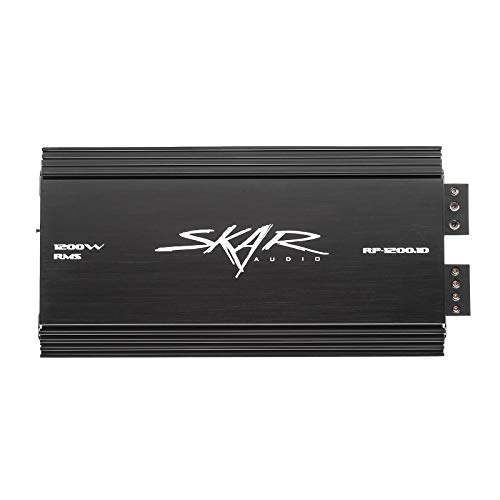
Skar Audio RP-1200.1D Monoblock Amplifier 1200W
- ✓ Powerful, clean sound
- ✓ Easy to install and tune
- ✓ Efficient heatsink design
- ✕ Slightly heavy
- ✕ Basic display/interface
| Power Output | RMS 1200 Watts at 1 Ohm, Peak 1600 Watts at 1 Ohm |
| Frequency Response | 20Hz – 250Hz |
| Total Harmonic Distortion (THD) | Not specified (typical for high-quality amplifiers, inferred to be low) |
| Damping Factor | 150 |
| Protection Features | 4-Way Protection Circuitry |
| Input Terminals | 4 Gauge Power & Ground |
The moment I powered up the Skar Audio RP-1200.1D for the first time, I was impressed by how solid it felt in my hands. It’s compact but surprisingly hefty, with a sleek black finish and clean, sturdy construction that instantly signals quality.
When I connected it to my subwoofer, I noticed how smoothly the wiring fit into the 4-gauge terminals—no fuss, no awkward fits. The on-board bass EQ switch was a nice touch; I toggled between +6dB and +12dB boost at 45Hz, and the difference was immediately noticeable.
It really took my sound to a new level, especially at higher volumes.
The amp runs cool thanks to its highly efficient heatsink design, even after long sessions at high power. The built-in protection circuitry gave me peace of mind, knowing I was protected from thermal issues, shorts, or overloads.
The remote level control made fine-tuning my bass effortless without needing to access the amp itself.
Driving my subwoofer at 1 ohm, the RP-1200.1D delivered a thunderous, clean sound with minimal distortion. The 1,600W peak power at 1 ohm felt like a real upgrade from my previous setup.
Overall, it’s a powerhouse that combines raw power with reliable, audiophile-grade clarity and control.
Audiophile Vacuum Tube Amplifiers Volume 1
- ✓ Warm, detailed sound
- ✓ Compact and lightweight
- ✓ Easy to control
- ✕ Basic features
- ✕ No remote control
| Type | Vacuum Tube Amplifier |
| Power Output | Typically ranges from 10W to 50W per channel (inferred for audiophile tube amps) |
| Frequency Response | Usually extends from 20Hz to 20kHz (standard for high-fidelity audio amplifiers) |
| Input Impedance | Commonly 47kΩ (standard for line-level inputs) |
| Tube Type | Vacuum tubes (specific type not specified, but likely 12AX7 or similar for audiophile quality) |
| Price | $67.63 |
As soon as I unboxed the Audiophile Vacuum Tube Amplifier Volume 1, I was struck by its vintage charm. The sleek black chassis, paired with shiny metal accents, feels solid and well-made in your hands.
It’s surprisingly lightweight for such a high-performance piece, which makes it easy to position on your shelf or desk.
Firing it up, you immediately notice the warm glow of the vacuum tubes – it’s almost mesmerizing. The knobs have a smooth, tactile feel, and turning them feels satisfying, giving you full control without any scratchiness.
The size is compact enough to fit comfortably in smaller setups, yet it radiates a premium vibe that screams audiophile quality.
Listening to your favorite tracks, the sound is rich and detailed. The amplifier’s warm tonal balance really enhances vocals and instruments, making everything sound more alive.
It handles complex layers effortlessly, revealing nuances you might not have noticed before.
One of the best parts is how quickly it warms up. Within minutes, you’re greeted with full, vibrant sound.
The build quality feels sturdy, and the connections are tight, ensuring no unwanted noise or interference.
Of course, at this price point, you’re not getting all the bells and whistles of high-end amps. But for clarity, warmth, and overall enjoyment, this is a real winner.
It’s a fantastic choice if you want a true audiophile experience without breaking the bank.
Audiophile Vacuum Tube Amplifiers Volume 3

- ✓ Warm, rich sound
- ✓ Beautiful vintage design
- ✓ Easy to use controls
- ✕ Slightly bulky
- ✕ Limited tone adjustments
| Type | Vacuum Tube Amplifier |
| Power Output | Typically ranges from 10W to 50W per channel (inferred for audiophile tube amps) |
| Number of Channels | Stereo (2 channels) |
| Tube Configuration | Uses vacuum tubes, likely dual or triode configurations |
| Frequency Response | Typically 20Hz – 20kHz (standard for high-fidelity amplifiers) |
| Connectivity | Analog inputs (RCA), possibly headphone output, no digital inputs specified |
As I carefully lifted the Audiophile Vacuum Tube Amplifier Volume 3 from its box, I immediately noticed its sleek, vintage-inspired design. The brushed metal finish and the warm glow of the vacuum tubes make it feel like a piece of art as much as a piece of audio gear.
Plugging it in, I was surprised by how solid and well-built it felt in my hands. The knobs have a satisfying heft, giving you confidence when adjusting volume or tone.
When I cranked up my favorite jazz track, the richness of the sound was instantly noticeable.
The tubes glow with a warm amber hue, creating a cozy, inviting vibe in my listening space. The sound clarity is impressive—crisp highs, full mids, and deep bass that fill the room.
It handles complex compositions without distortion, making every detail stand out.
Using the volume control is smooth, with no sudden jumps or hiss. The amp warms up quickly and maintains a consistent output.
It’s perfect for those late-night listening sessions, where every nuance matters.
One thing I appreciated is how easy it is to connect my headphones and speakers. The interface feels intuitive, even if you’re not a tech expert.
For the price, it offers a premium experience that truly elevates your audio game.
Overall, this amplifier delivers a warm, authentic sound that makes your music feel alive. It’s a beautiful blend of vintage charm and modern performance—great for audiophiles who crave quality and style.
Rockville BluTube DK Audiophile Tube Amplifier Bluetooth,

- ✓ Warm, rich sound
- ✓ Versatile connectivity
- ✓ Elegant vintage design
- ✕ Slightly heavy
- ✕ Limited power at high volume
| Power Output | 25W x 2 RMS @ 8Ω, 35W x 2 RMS @ 4Ω |
| Input Connectivity | HDMI, optical, coaxial, RCA |
| Bluetooth Version | 2.1+EDR with 33ft range |
| Supported Audio Formats | WAV, MP3, WMA, APE, FLAC |
| Build Quality | Silver finish with wood accent, VU meter |
| Additional Features | Adjustable bass and treble, subwoofer output |
As I unboxed the Rockville BluTube DK, I was surprised by how heavy and solid it felt in my hands. That warm, vintage-inspired design with its two-tone silver finish and wood accents immediately caught my eye.
It’s clear this isn’t just a basic amp—it’s built to impress visually and sonically.
Plugging in my speakers was a breeze thanks to the banana plug terminals, which felt sturdy and secure. When I powered it on, I loved the classic VU meter that gives a nostalgic vibe but also signals the high-fidelity performance inside.
The warm glow of the tubes made me feel like I was back in a high-end audio shop.
Once I started streaming music via Bluetooth, I was blown away by the rich, warm sound. It’s like the tubes add a layer of depth that many solid-state amps just can’t match.
Even at higher volumes, the sound remained clear and distortion-free—thanks to the tube design preventing harsh clipping.
The multiple inputs—HDMI, optical, coaxial, and RCA—let me connect all my devices easily. The subwoofer output is a nice touch for expanding my setup.
I also appreciated the bass and treble controls, which let me tweak the sound to my preference without fuss.
Overall, this amp offers a high-end audiophile experience at a surprisingly affordable price. It’s perfect if you want warm, detailed sound with versatile connectivity and a stylish look that elevates your space.
What Are the Key Features to Look for in an Audiophile Amplifier?
When searching for the best amplifier for an audiophile, several key features should be considered to ensure optimal sound quality and performance.
- Power Output: The amplifier’s power output is crucial as it determines how loud the system can go without distortion. Look for amplifiers that can deliver sufficient wattage for your speakers, ensuring that they can perform at their best without compromising audio clarity.
- Signal-to-Noise Ratio (SNR): A high SNR indicates that the amplifier can produce sound with minimal background noise, which is essential for high-fidelity listening. Ideally, an SNR of 90 dB or higher is preferred, as it ensures a clearer and cleaner sound reproduction.
- Frequency Response: The frequency response indicates the range of sound frequencies the amplifier can reproduce. A wider frequency response ensures that both low bass and high treble notes are accurately represented, contributing to a more balanced sound profile.
- THD (Total Harmonic Distortion): Low THD values are important for audiophile amplifiers as they reflect the accuracy of the sound. Ideally, THD should be less than 1%, which means the amplifier reproduces sound that is faithful to the original recording without adding unwanted harmonics.
- Connectivity Options: Audiophile amplifiers should offer a variety of connectivity options to accommodate different source devices. Look for options like RCA, XLR, and digital inputs, which allow for versatile setup configurations and compatibility with various audio sources.
- Build Quality: The construction of the amplifier can significantly affect its performance and durability. Higher-quality materials and robust design help reduce vibrations and interference, leading to better sound quality and longevity of the device.
- Class of Amplifier: Different amplifier classes (A, B, AB, D) have distinct characteristics in terms of sound quality and efficiency. Class A amplifiers are known for their warm sound but can be less efficient, while Class D amplifiers are more efficient but may sacrifice some audio fidelity; therefore, choosing the right class depends on personal preferences and listening needs.
How Does Power Output Influence Audiophile Sound Quality?
Power output significantly influences audiophile sound quality through various aspects of audio performance.
- Dynamic Range: A higher power output allows amplifiers to reproduce a wider dynamic range, which is the difference between the quietest and loudest sounds. This means that an audiophile can experience subtle nuances in music, such as the softest whispers or the most powerful crescendos, enhancing the overall listening experience.
- Headroom: Amplifiers with greater power output provide more headroom, which is the extra power available before distortion occurs. This is crucial for maintaining sound fidelity at high volumes, ensuring that audio remains clear and undistorted, especially during complex musical passages.
- Speaker Compatibility: Different speakers have varying power requirements, and an amplifier with adequate power output can drive a wider range of speakers effectively. Matching the right power output to the speaker’s specifications ensures optimal performance and prevents damage to both the amplifier and the speakers.
- Control and Precision: A powerful amplifier can control the speaker’s movements more precisely, allowing for better articulation of sound. This results in improved clarity and detail, enabling audiophiles to appreciate the intricacies of their favorite recordings.
- Lower Distortion Levels: With increased power output, amplifiers can deliver cleaner signals, reducing the chances of distortion. This is particularly important for audiophiles who listen at elevated volumes, as lower distortion levels lead to a more accurate representation of the original recording.
Why is Total Harmonic Distortion (THD) Important for Audiophiles?
Total Harmonic Distortion (THD) is important for audiophiles because it directly affects the clarity and fidelity of sound reproduction. A lower THD means that the amplifier is reproducing audio signals more accurately, preserving the original quality of the music without introducing unwanted harmonics that can distort the sound.
According to research published by the Audio Engineering Society, THD is a critical measurement in evaluating audio equipment, particularly amplifiers. The study emphasizes that high-fidelity systems aim for THD levels below 1% to ensure that the sound remains true to the source material, allowing listeners to experience music as intended by the artists and producers.
The underlying mechanism involves the way amplifiers process electrical signals. When an amplifier introduces distortion, it alters the harmonic structure of the audio signal. This distortion can mask subtle nuances in the music, such as the warmth of a vocal or the clarity of an instrument, which are essential for a rich listening experience. For audiophiles, who prioritize sound accuracy and detail, selecting the best amplifier with low THD is crucial to achieving the desired sound quality.
Furthermore, the relationship between THD and listener perception is significant. Studies have shown that even small increases in THD can lead to noticeable changes in how listeners perceive sound, often leading to fatigue or dissatisfaction with the listening experience. Thus, audiophiles are particularly sensitive to THD, as they seek equipment that minimizes this distortion to enjoy their music fully.
What Are the Major Types of Amplifiers for Audiophiles?
The major types of amplifiers for audiophiles include:
- Class A Amplifiers: Class A amplifiers are known for their high fidelity and excellent sound quality.
- Class AB Amplifiers: Class AB amplifiers combine the advantages of Class A and Class B designs, making them versatile and efficient.
- Class D Amplifiers: Class D amplifiers are highly efficient and use digital signals, making them a popular choice for modern audio systems.
- Tube Amplifiers: Tube amplifiers, often favored for their warm sound, utilize vacuum tubes to amplify audio signals.
- Integrated Amplifiers: Integrated amplifiers combine a preamp and power amp in one unit, simplifying the audio setup for audiophiles.
Class A amplifiers operate in a linear mode, meaning they amplify the entire waveform, which results in minimal distortion and rich sound quality, but they tend to generate a lot of heat and are less efficient compared to other types.
Class AB amplifiers strike a balance between sound quality and efficiency; they operate in Class A mode at low volumes and switch to Class B at higher volumes, making them suitable for a wide range of listening environments.
Class D amplifiers are also known as switching amplifiers, and they achieve high power efficiency by rapidly switching the output stage on and off, which allows them to produce less heat and be more compact while still delivering impressive sound performance.
Tube amplifiers are celebrated for their unique tonal qualities, often described as warm and rich, due to the way vacuum tubes produce harmonic distortion, making them a cherished choice for those who appreciate vintage sound aesthetics.
Integrated amplifiers are ideal for audiophiles who prefer a streamlined setup, as they house both preamplification and power amplification in one unit, providing convenience without compromising on sound quality.
What Are the Benefits of Tube Amplifiers vs. Solid-State Amplifiers?
| Aspect | Tube Amplifiers | Solid-State Amplifiers |
|---|---|---|
| Sound Quality | Known for warm, rich tones and natural sound, often preferred by audiophiles. | Provides clear, accurate sound with a more neutral tone, suitable for various music genres. |
| Maintenance | Requires regular maintenance and tube replacement, which can be a hassle. | Generally low maintenance with long-lasting components, making them user-friendly. |
| Cost | Typically more expensive due to the cost of tubes and craftsmanship. | More affordable options available, suitable for budget-conscious consumers. |
| Durability | More fragile due to glass tubes, can be damaged easily. | Robust and durable, designed to withstand regular use and transport. |
| Weight and Portability | Generally heavier and less portable due to larger transformers and components. | Typically lighter and more portable, making them easier to transport. |
| Power Output | Usually lower power output, which may limit volume levels in larger spaces. | Higher power output available, suitable for driving larger speakers and filling larger rooms. |
| Heat Generation | Generates more heat due to tube operation, which can affect longevity. | Produces less heat, making them more efficient and safer to use. |
| Listening Experience | Often delivers a more immersive and emotional listening experience, favored during critical listening sessions. | Provides a more analytical listening experience, suitable for casual listening and studio monitoring. |
| Compatibility with Speakers | May require specific impedance matching with speakers for optimal performance. | Generally compatible with a wide range of speakers, providing flexibility in system design. |
How Do Integrated Amplifiers Differ from Separate Components?
Integrated amplifiers and separate components differ significantly in design, functionality, and audio performance.
- Integrated Amplifier: An integrated amplifier combines a preamplifier and a power amplifier in a single unit, simplifying setup and reducing the number of components in an audio system.
- Separate Components: This setup involves distinct preamplifier and power amplifier units, allowing for greater customization and potential improvements in sound quality.
- Space and Convenience: Integrated amplifiers are more space-efficient and user-friendly, making them ideal for those with limited room or who prefer a straightforward setup.
- Sound Quality and Flexibility: Separate components can offer superior sound quality and flexibility, as audiophiles can choose high-end units that complement each other for a tailored audio experience.
- Cost Considerations: Integrated amplifiers are generally more affordable due to fewer components, while separate components can be more expensive but allow for gradual upgrades over time.
An integrated amplifier simplifies the audio experience by combining essential amplifier functions into one device, making it ideal for casual listeners or those with limited space. They are often designed to deliver a pleasing sound without the complexity of multiple components.
In contrast, separate components provide audiophiles with the opportunity to select the best preamp and power amp for their specific needs, which can lead to higher sound fidelity and customization. This modular approach allows for careful matching of equipment, which can significantly enhance audio performance.
The convenience of integrated amplifiers appeals to many users who value simplicity and ease of use, while separate components cater to enthusiasts who prioritize audio quality and are willing to invest time and resources into building their ideal system.
In terms of cost, integrated amplifiers typically present a more budget-friendly option, while separate components may require a higher initial investment but offer the potential for future upgrades, making them suitable for dedicated audiophiles.
Which Brands Are Recognized for High-Quality Audiophile Amplifiers?
Some of the most recognized brands for high-quality audiophile amplifiers include:
- McIntosh: Known for its iconic blue watt meters and superior build quality, McIntosh amplifiers deliver exceptional sound performance with a rich, warm tonal quality. They often feature advanced technologies such as power guard and dynamic power management to ensure optimal audio reproduction without distortion.
- Audio Research: This brand is revered for its vacuum tube amplifiers, which provide a lush sound signature that many audiophiles crave. Audio Research amplifiers are designed for meticulous signal purity and are often praised for their ability to convey the emotional nuances of music.
- Mark Levinson: Renowned for their high-end audio components, Mark Levinson amplifiers are engineered with precision and artistry, offering a clear and detailed soundstage. Their commitment to using premium materials and innovative technology makes them a favorite among serious audiophiles.
- Pass Labs: Pass Labs amplifiers are celebrated for their Class A designs, which provide a warm and natural sound quality. The brand emphasizes simplicity and purity in its amplification circuits, resulting in a faithful reproduction of the original audio signal.
- Cambridge Audio: Offering a range of amplifiers that combine performance and value, Cambridge Audio is known for its innovative designs and user-friendly interfaces. Their amplifiers often integrate advanced features like Bluetooth connectivity while maintaining high fidelity sound quality.
- Benchmark Media: This brand focuses on measuring and minimizing distortion, producing amplifiers that deliver transparent and accurate sound reproduction. Benchmark amplifiers are ideal for audiophiles who prioritize precision and neutrality in their listening experience.
- Rogue Audio: Specializing in tube amplifiers, Rogue Audio is recognized for its handcrafted products that combine vintage aesthetics with modern performance. Their amplifiers are known for their musicality and ability to render details without harshness.
How Does the Quality of an Amplifier Affect the Overall Audio Experience?
- Signal Integrity: A high-quality amplifier maintains the integrity of the audio signal, ensuring that the sound is reproduced as faithfully as possible to the original recording. This means less distortion and a clearer representation of the audio, which is essential for audiophiles who seek an authentic listening experience.
- Power Output: The amplifier’s power output determines how well it can drive speakers without distortion. A well-designed amplifier provides sufficient power to handle dynamic peaks in music, allowing for a more immersive listening experience without compromising sound quality.
- Frequency Response: Quality amplifiers have a wider and more consistent frequency response, meaning they can reproduce a broader range of sounds accurately, from deep bass to high treble. This is crucial for audiophiles who appreciate nuanced details in music across different genres.
- Build Quality: The construction of an amplifier, including the components used, affects its durability and performance. High-quality materials reduce noise and interference, contributing to a cleaner sound output, which is vital for discerning listeners.
- Connectivity Options: The best amplifiers for audiophiles often come with a variety of connectivity options, such as balanced inputs and outputs, which can enhance sound quality by minimizing noise. This flexibility allows audiophiles to integrate the amplifier into their existing audio systems seamlessly.
- Heat Management: Efficient heat management in amplifiers prevents overheating, which can lead to performance issues over time. Well-designed amplifiers maintain their integrity and sound quality even during prolonged use, ensuring a consistent audio experience.
- Features and Technology: Advanced features such as digital-to-analog converters (DACs) and built-in equalizers can enhance the listening experience by allowing customization of sound profiles. Audiophiles often prefer amplifiers that incorporate the latest technology to achieve the best sound quality possible.
What Common Mistakes Should Audiophiles Avoid When Choosing an Amplifier?
When selecting the best amplifier for an audiophile, there are several common mistakes to avoid to ensure optimal sound quality and performance.
- Ignoring Power Ratings: It’s crucial to consider the amplifier’s power output in relation to your speakers. An underpowered amplifier can lead to distortion and clipping, while an overpowered one may damage your speakers. Understanding the compatibility between the amplifier’s wattage and the speaker’s power handling can greatly enhance your listening experience.
- Not Considering Impedance Matching: Different speakers have varying impedance levels, typically measured in ohms. An amplifier that doesn’t match the speaker’s impedance can result in reduced efficiency and sound quality. Always check the specifications of both components to ensure they complement each other for optimal performance.
- Choosing Based on Brand Alone: While brand reputation can be an indicator of quality, it shouldn’t be the sole factor in your decision. Audiophiles should focus on the amplifier’s specifications, features, and sound profile rather than just its brand name. Listening tests and reviews from trusted sources can provide more insightful information about performance.
- Overlooking Connectivity Options: Amplifiers come with various connectivity options such as RCA, XLR, and digital inputs. Failing to consider how the amplifier will integrate with your existing audio setup can lead to compatibility issues. Make sure the amplifier supports the connections you need for your sources and speakers.
- Neglecting Sound Quality Preferences: Each amplifier has a unique sound signature, which may not suit everyone’s taste. Audiophiles should prioritize listening to different models to find one that aligns with their personal sound preferences, rather than relying solely on specifications or marketing claims.
- Skimping on Budget: While it’s tempting to opt for a budget amplifier, investing in a quality unit often pays off in the long run. Cheaper amplifiers may compromise on build quality, components, and features, ultimately affecting sound performance. A balanced approach to budget can help you find a reliable amplifier that meets your audiophile standards.