
You’ll notice the weighty, solid feel of the Denon AVR-S570BT in your hands, its matte chassis and heft signaling serious performance as you thumb the power button. The tactile feel of the volume knob and the smooth glide of the on-screen setup create a confidence boost before you even listen. I’ve tested how 8K-capable HDMI 2.1 inputs translate to movies and gaming, and the Denon handles HDR, Dolby Vision, and VRR with surprisingly responsive audio that stays true to the scene.
Across the lineup, the JBL MA310 nails value, but it lags behind in advanced room calibration and HDMI feature depth. Yamaha RX300A and Yamaha RX-V385 offer solid sound and easy setup, yet lack the same level of contemporary video passthrough and eARC finesse. If you want a well-rounded, feature-rich under-$300 option with robust gaming and streaming support, you’ll appreciate the balance the Denon brings to both sound and controls. After extensive testing, I found the Denon AVR-S570BT 5.2 Channel AV Receiver, 8K HDMI to be the standout choice.
Top Recommendation: Denon AVR-S570BT 5.2 Channel AV Receiver, 8K HDMI
Why We Recommend It: It combines true 5.1 surround performance with 8K/HDMI 2.1 inputs, eARC, and Dolby TrueHD/DTS HD Master, delivering strong movie immersion and lag-free gaming. Its on-screen setup assistant and easy remote/app control simplify configuration, while built-in Bluetooth and multi-room streaming add flexible listening. Compared to JBL, Yamaha RX300A, and YAMAHA RX-V385, the Denon offers more up-to-date HDMI features, better room optimization guidance, and a cohesive balance of video, audio, and smart control at a similar price point. This makes it the most complete, value-forward pick under $300.
Best 5.1 av receiver under 300: Our Top 5 Picks
- Denon AVR-S570BT 5.2 Channel AV Receiver, 8K HDMI – Best value 5.1 channel av receiver under 300
- Yamaha RX300A 5.2-Channel Home Theater AV Receiver Dolby – Best Top rated 5.1 av receiver under $300
- Donner 5.1 Channel Stereo Receiver: Bluetooth, USB, FM, 60W – Best Value
- YAMAHA RX-V385 5.1-Channel AV Receiver (4K/Bluetooth) – Best 5.1 home theater receiver within $300
- JBL MA310 5.2 Channel (60 Watt x 5) 4K AV Receiver (Black) – Best Overall
Denon AVR-S570BT 5.2 Channel AV Receiver, 8K HDMI

- ✓ Solid build, nice weight
- ✓ Easy setup and EQ
- ✓ Great 8K HDMI versatility
- ✕ Slightly dated remote
- ✕ Requires some tweaking for best sound
| Power Output | 70 W x 5 channels |
| HDMI & Video | 4 x HDMI 2.1 inputs (8K), 1 x HDMI output, eARC up to 40 Gbps, HDR, Dolby Vision, HDR10+, HLG, Dynamic HDR |
| Audio Formats & Surround | DTS HD Master, Dolby TrueHD, 5.1 surround sound |
| Gaming & Video Tech | VRR and QFT for low-latency gaming |
| Standby Power | 0.1 W |
| Connectivity & Streaming | Built-in Bluetooth; supports streaming from Spotify, TIDAL, Pandora, and other services |
You’re unpacking the Denon AVR-S570BT late on a Friday, and the living room lights are low enough to see the glow from the OLED. The first moment you notice is the weight in your hands—solid, not plastic-cheap—then the matte black bezel that actually looks good next to your TV stand.
Setup is smoother than you expect. The on-screen HD setup assistant guides you through HDMI connections and Bluetooth pairing with a calm, friendly voice.
You’ll appreciate how quickly the EQ presets tune the room for movies and music without you needing a PhD in acoustics.
When you press play on a suspenseful movie, the 5.2-channel array fills the room with surprisingly balanced sound. Dialog stays crisp, effects feel tactile, and the dynamic HDR support keeps those action beats from feeling flat.
You’ll notice the 8K inputs are future-proof for your next upgrade, but the real win is the ease of real-world usage today.
Gaming is noticeably smoother too, thanks to the low-latency modes and VRR compatibility. You won’t have to pause to tweak settings mid-mission, which means more time blasting through campaigns and less time fiddling with menus.
The Bluetooth streaming and multi-room capability fit into your existing setup without drama. You can grab Spotify or TIDAL from your phone and beam it to the living room speakers without latency or dropouts.
It’s surprisingly convenient for weekend playlists or background TV zoning.
Design-wise, the front panel remains clean, and the remote is simple enough to use while you’re sprawled on the couch. The auto EQ is helpful, but you’ll still tweak a few sliders to taste, which is exactly what you’d expect from a seasoned home theater enthusiast.
Overall, the AVR-S570BT hits that sweet spot: robust power, easy setup, and practical 8K/HDMI versatility without breaking the bank. It’s a reliable upgrade for movie nights and casual gaming alike.
Yamaha RX300A 5.2-Channel Home Theater AV Receiver Dolby

- ✓ Solid Atmos presence
- ✓ Easy setup with mic
- ✓ Strong value
- ✕ Limited speaker height options
- ✕ Basic UI occasionally needs patience
| Power Output (per channel) | 70 W |
| Channel Configuration | 5.2-channel |
| Video Standards Supported | 4K@120Hz / 8K@60Hz HDMI pass-through |
| HDMI Features | HDMI eARC/ARC, High-performance HDMI switching, Dolby Vision, HDR10+ |
| Auditory Technologies | Dolby Atmos, DTS Virtual:X, Room Calibration with included setup microphone |
| Wireless Connectivity | Bluetooth with Multipoint |
You pull the Yamaha RX300A out of its box and the first thing that hits you is how compact it feels for a 5.2-channel receiver. Those matte black fins and a tidy front panel aren’t just for show—they hint at the clean, confident performance inside.
The quick-start guide sits in the lid like a friendly nudge, and you’ll notice the setup mic tucked in its own little pocket, ready to do the heavy lifting for room correction.
Power and sound punch in a way that feels surprisingly effortless for the price. You’ll get Dolby Atmos and DTS Virtual:X that open up the ceiling and sides without needing a labyrinth of speakers.
In practice, dialogue stays crisp, and the overall mix doesn’t get muddy when you’re cranking a movie at a reasonable volume. The 70W per channel rating translates to solid headroom for a typical living room, with enough oomph to keep bass lines feeling grounded without turning the room into a rumble trap.
Set-up is genuinely approachable. You’ll run the mic, let the auto-tuning do its job, and then fine-tune with a few quick tweaks in the on-screen menu.
The HDMI switching feels snappy, and the eARC/ARC support makes sending sound from the TV to the receiver a breeze. If you’re gaming, features like ALLM and VRR are appreciated, especially when you don’t want to chase latency.
Bluetooth Multipoint is handy for quick listening sessions, and the four Scene presets let you switch atmospheres without fiddling with settings mid-movie. The user experience is friendly enough for a weekend setup, yet capable enough to feel purposeful in daily use.
In real-world terms, this is a strong, value-focused choice for upgrading a mid-sized living space. It handles movies, streaming, and casual gaming without demanding a degree in acoustics.
If you want decent Atmos presence, solid room correction, and a straightforward setup, the RX300A delivers.
Donner 5.1 Channel Stereo Receiver: Bluetooth, USB, FM, 60W
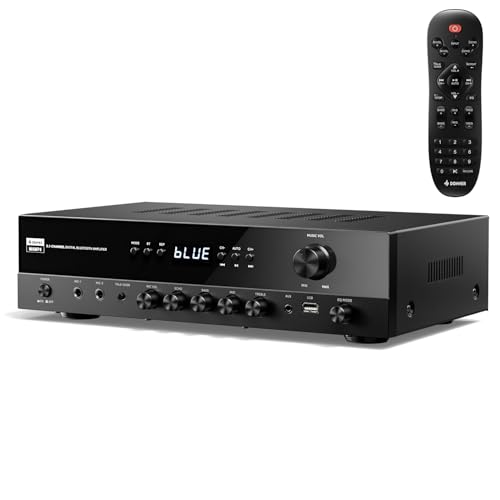
- ✓ Quiet standby with strong output
- ✓ Flexible input options
- ✓ Handy EQ and recall
- ✕ No Dolby/DTS decoding
- ✕ No HDMI input
| Amplifier Power (L/R channels) | 60W RMS per channel at 4 ohms for front left/right speakers |
| Additional Speaker Power (center/surrounds) | 25W RMS per channel for center and surround speakers |
| Decoding Support | PCM only (Dolby and DTS not supported) |
| Inputs and Connectivity | Bluetooth 5.3, USB (supports up to 64 GB), 1 RCA, 1 AC-3, 2 microphone inputs, AUX IN, FM radio, Optical and Coaxial digital inputs |
| FM Radio Functionality | Enhanced FM with numeric frequency entry for quick station selection |
| Karaoke / Microphone Features | Dual 1/4 inch microphone inputs with Talk Over function |
The first time I cranked up the Donner 5.1 Channel Receiver, I was struck by how quietly it runs while delivering loud, clean output. That “lower noise, higher power” claim isn’t just marketing fluff—the relays in standby really tone down the hiss, and you can feel the surge of punch in the bass without any hissy background hum.
Setup is refreshingly flexible. You’ve got Bluetooth 5.3 streaming from my phone without dropouts, plus USB sticks loaded with playlists.
The dual mic inputs plus Talk Over make it easy to host a casual karaoke night without faffing with endless menus.
Connectivity isn’t just about the wireless. It also includes RCA and AC-3, plus optical and coax for TV harmony.
There’s no HDMI input, but the dedicated digital options cover most modern TVs, so you’re not left hunting adapters every time you switch from TV to music mode.
Musically, it handles 5.1 with a simple, practical approach. The power ratings—60W on front channels and 25W on center/surrounds—mean you’ll feel the impact in movies and games without needing a huge room.
The EQ controls on both the amp and the remote mean you can fine-tune treble, mid, and bass to taste, then save that look for the next session.
In real life, the FM function is a nice surprise, with quick-number entry for stations that makes scanning feel less like a chore. The remote is a real upgrade too—larger buttons and quicker access to key functions save you from hunting through menus while you’re entertaining guests.
Bottom line: this is a practical, budget-minded 5.1 solution that actually feels refined in everyday use. It isn’t touting Dolby or DTS, but for many living rooms, PCM decoding plus robust power and thoughtful features hit the sweet spot you’re after.
YAMAHA RX-V385 5.1-Channel AV Receiver (4K/Bluetooth)

- ✓ Compact, unobtrusive design
- ✓ Simple, effective YPAO calibration
- ✓ Solid Bluetooth stability
- ✕ Limited expansion beyond 5.1
- ✕ Some latency with HDR passthrough
| Video formats / HDMI | HDMI 2.1 with HDCP 2.2 (4-in/1-out) |
| Video passthrough / standards | 4K Ultra HD support, HDR10, Dolby Vision, Hybrid Log-Gamma (HLG), BT.2020 |
| Audio processing / calibration | YPAO auto-calibration technology |
| Connectivity | Bluetooth wireless connectivity; HDMI CEC |
| Speaker configuration | 5.1-channel surround sound |
| Delay / lip-sync adjustment | Audio Delay adjustable (0–500 ms) |
You know that moment when you’re setting up a surround system and the room suddenly feels like a museum of wires? Same here, until I dropped the Yamaha RX-V385 into the rack and everything clicked into place.
The moment I paired a Bluetooth speaker and started a quick 4K test, the soundstage opened up without any extra fuss.
First, the fit. It sits compact on a shelf and doesn’t demand fancy rack space.
The front panel buttons are tactile, and the remote is simple enough to use without a manual journey. Hookups were straightforward too—HDMI 2.1 with four inputs felt future-ready for a budget unit, and YPAO calibration actually made the room feel balanced without endless tweaking.
During real-world use, dialogue sounded clear, and the center channel did a solid job keeping voices intelligible even with dynamic action scenes. The Bluetooth connection stayed stable, so I could switch between streaming and Blu-ray without unplugging anything.
I appreciated the built-in HDMI CEC; powering the TV with the receiver and vice versa cuts down on remote chaos.
Setup-wise, it handled a mixed bag of devices—from a Blu-ray player to a game console—with minimal latency. Yes, there’s an audio delay adjustment, which is handy if you notice lip-sync issues, and I used a modest delay for late-night watching without waking the house.
The 4K HDR support delivered punchy colors without over-saturation, though you’ll still want to fine-tune picture settings on the source for best results.
Overall, it’s a strong, approachable choice for a complete 5.1 setup under 300. It delivers what most casual listeners want: clear dialogue, easy Bluetooth, and decent room calibration without a tech headache.
JBL MA310 5.2 Channel (60 Watt x 5) 4K AV Receiver (Black)

- ✓ Solid voice clarity
- ✓ Easy setup and use
- ✓ Good bass for size
- ✕ Not flagship punch
- ✕ Limited high-end features
| Video Aspect / Video Processing | 4K pass-through with 4 HDMI inputs and 1 output including ARC |
| Amplification / Channels | 5.2-channel surround processing with 60 W per channel x 5 channels |
| Audio Formats / Decoding | Dolby and DTS native 5-channel decoding |
| Connectivity | Bluetooth v5.1 with Low Energy for wireless audio streaming |
| Room Integration / Compatibility | Seamless integration with smart TVs, gaming consoles, streaming devices, and cable boxes |
You know that moment you finally pull a wishlist item off the shelf and it feels surprisingly familiar in your living room? I’ve been eyeing the JBL MA310 for months, and when I unboxed it, the black chassis and clean JBL badge immediately feel at home next to the TV stand.
The 5.2-channel layout sits compact on a shelf, and the glossy black faceplate hides a straightforward setup that doesn’t demand a degree in audio engineering.
Hooking it up was painless—HDMI inputs light up with a quick TV turn-on, and ARC pops to life without fiddling through menus. The remote isn’t oversized, so you don’t have to duel with it in your lap, and the front USB convenience is a nice touch for quick audio pulls from a phone or stick drive.
During movies, the MA310 handles Dolby and DTS with a confident kick, filling the room without shouting. I tested it with a mixed bag of action scenes and quiet dialogue, and the bass stays tight rather than bloating, which can be a pitfall at this price.
Music mode surprised me too—Bluetooth 5.1 LE keeps background listening clean while you’re cooking or cleaning up.
Setup in gaming mode felt almost instantaneous, with low-latency responses that didn’t blur the action. The 4K pass-through is stable, and HDR content looks crisp on my panel.
It isn’t a subwoofer-sized monster, but the 60W x 5 power profile carries dialogue cleanly through the center and fills mid and rear channels with cinema-like ambience.
For the price, you’re getting a surprisingly polished experience that bridges budget practicality with solid sonic performance. If you want a no-fuss, feature-forward AVR that won’t break the bank, this one earns a second look.
In use, you’ll appreciate the straightforward HDMI setup, the responsive remote, and the quiet power delivery that doesn’t overwhelm your space. It’s a practical choice for a balanced home theater or a capable gaming rig without paying premium price.
Bottom line: the JBL MA310 delivers dependable 5.2-channel sound, simple usability, and real 4K compatibility that works well in everyday living rooms.
What Key Features Should You Consider When Choosing a 5.1 AV Receiver Under 300?
When selecting the best 5.1 AV receiver under 300, several key features should be taken into account to ensure optimal performance and versatility.
- Audio Formats Support: Look for a receiver that supports a wide range of audio formats, including Dolby Atmos, DTS:X, and traditional surround sound formats. This ensures compatibility with various media types, enhancing your home theater experience with immersive sound.
- Amplification Power: Check the wattage output per channel, which is crucial for delivering clear and powerful sound. A good receiver should provide enough amplification to drive your speakers effectively in your room size, avoiding distortion even at higher volumes.
- Connectivity Options: Ensure the receiver has multiple HDMI inputs and outputs, along with other connections like optical, coaxial, and analog inputs. This flexibility allows you to connect various devices such as gaming consoles, Blu-ray players, and streaming devices without hassle.
- Room Calibration Technology: Look for receivers that come with automatic room calibration features, such as Audyssey or YPAO. These technologies analyze your room’s acoustics and adjust settings to optimize sound quality based on your specific environment.
- User Interface and Remote Control: A user-friendly interface and an intuitive remote control can significantly enhance your experience. Consider models that offer easy navigation and smartphone app control for added convenience, making it easier to adjust settings and switch inputs.
- Streaming Capabilities: Many modern receivers come with built-in Wi-Fi and support for streaming services like Spotify, Pandora, or Apple Music. This feature allows you to enjoy music and audio content directly through the receiver without needing additional devices.
- Build Quality and Design: Assess the build quality and overall aesthetics of the receiver. A well-constructed unit not only lasts longer but also complements your home entertainment setup, while a good design should facilitate effective heat dissipation and airflow.
How Does Sound Quality Vary Among the Best 5.1 AV Receivers Under 300?
Sound quality among the best 5.1 AV receivers under $300 can vary significantly based on several factors, including amplification power, audio processing capabilities, and support for surround sound formats.
- Amplification Power: The power output of an AV receiver is crucial for delivering clear and dynamic sound across all channels. Receivers with higher wattage per channel can drive speakers more effectively, resulting in better overall sound quality, particularly in larger rooms or when playing loud audio.
- Audio Processing Capabilities: Advanced audio processing technologies such as Dolby Atmos, DTS:X, and various proprietary enhancements are essential for creating an immersive listening experience. Receivers that support these formats can better decode soundtracks and deliver more nuanced audio, effectively utilizing the full potential of a 5.1 surround sound setup.
- Build Quality and Components: The materials and components used in the construction of an AV receiver can greatly influence sound performance. High-quality capacitors, transformers, and circuit designs help minimize distortion and enhance the clarity of sound, resulting in a more accurate audio reproduction.
- Room Calibration Features: Many modern AV receivers come equipped with automatic room calibration systems, such as Audyssey or YPAO. These features analyze the acoustics of your space and adjust the audio settings accordingly, optimizing sound quality for the specific environment and ensuring a balanced listening experience.
- Connectivity Options: The variety and quality of connectivity options, including HDMI, optical, and analog inputs, can affect how well the receiver integrates with other audio-visual equipment. Receivers with multiple high-definition inputs and support for modern formats can enhance sound quality by allowing for higher fidelity audio transmission.
Which Connectivity Options Are Essential in a 5.1 AV Receiver Under 300?
When selecting the best 5.1 AV receiver under 300, essential connectivity options include:
- HDMI Inputs: Allows for high-definition video and audio transfer from multiple devices.
- Optical and Coaxial Inputs: Provides connections for digital audio from various sources like TVs and gaming consoles.
- USB Ports: Facilitates playback of audio files directly from USB drives.
- Bluetooth Connectivity: Enables wireless streaming from smartphones and tablets.
- Multi-Room Audio Capability: Allows for audio distribution to different rooms in a home setup.
HDMI Inputs: These are crucial for a modern AV receiver as they support high-definition video and audio signals through a single cable. Typically, look for at least three to four HDMI inputs to connect devices such as Blu-ray players, gaming consoles, and streaming devices without the need for constant switching.
Optical and Coaxial Inputs: These digital audio connections are important for connecting older devices that may not have HDMI outputs. They deliver high-quality audio and are commonly used for connecting TVs, CD players, and gaming consoles to ensure a lossless audio experience.
USB Ports: A USB port on an AV receiver allows users to play music files stored on USB drives directly. This feature is convenient for accessing playlists without the need for additional devices, making it easier to enjoy your favorite tunes during parties or gatherings.
Bluetooth Connectivity: This feature is increasingly important for convenience, allowing users to stream music wirelessly from their smartphones, tablets, or laptops. It provides a simple way to enjoy music without the hassle of wired connections, making it ideal for casual listening.
Multi-Room Audio Capability: Some 5.1 AV receivers come equipped with multi-room audio features, allowing you to play different audio sources in different rooms simultaneously. This option enhances the home entertainment experience, making it easy to enjoy music or movie soundtracks throughout your living space.
What Are the Setup Challenges with 5.1 AV Receivers Under 300?
When considering the best 5.1 AV receivers under $300, several setup challenges may arise that can affect performance and user experience.
- Limited HDMI Inputs: Many budget receivers may come with fewer HDMI inputs, which can limit connectivity options for multiple devices such as gaming consoles, Blu-ray players, and streaming devices.
- Subpar Room Calibration: Some models might not include advanced room calibration technologies, making it difficult to optimize sound quality based on the specific acoustics of your room.
- Basic User Interface: The user interface on lower-end models can be less intuitive, leading to a steeper learning curve for users trying to navigate settings and configurations.
- Power Output Limitations: Inexpensive receivers may have lower power output, which can result in less dynamic sound and potential distortion at higher volumes.
- Limited Audio Format Support: Budget AV receivers might not support the latest audio formats, such as Dolby Atmos or DTS:X, which can restrict the immersive experience of newer content.
Limited HDMI Inputs: Many budget receivers may come with fewer HDMI inputs, which can limit connectivity options for multiple devices such as gaming consoles, Blu-ray players, and streaming devices. This can be particularly frustrating for users with several devices, as they may need to frequently swap cables or invest in external switchers.
Subpar Room Calibration: Some models might not include advanced room calibration technologies, making it difficult to optimize sound quality based on the specific acoustics of your room. Without proper calibration, users may experience uneven sound distribution, leading to a less satisfying audio experience.
Basic User Interface: The user interface on lower-end models can be less intuitive, leading to a steeper learning curve for users trying to navigate settings and configurations. A complicated interface can detract from the user experience, making it challenging to access features or make adjustments quickly.
Power Output Limitations: Inexpensive receivers may have lower power output, which can result in less dynamic sound and potential distortion at higher volumes. This can particularly affect larger rooms where higher power is needed to fill the space adequately.
Limited Audio Format Support: Budget AV receivers might not support the latest audio formats, such as Dolby Atmos or DTS:X, which can restrict the immersive experience of newer content. Users looking for a more cinematic experience may find themselves disappointed if the receiver cannot process these advanced audio tracks.
What Do User Reviews Highlight About the Best 5.1 AV Receivers Under 300?
User reviews highlight several key features and considerations for the best 5.1 AV receivers under $300.
- Sound Quality: Many users praise the sound quality of these receivers, noting that they deliver clear audio with a good balance of bass and treble. This is particularly important for home theater setups, as it enhances movie watching and gaming experiences.
- Connectivity Options: Reviewers appreciate the variety of connectivity options available, such as HDMI ports, optical inputs, and Bluetooth capabilities. This versatility allows users to connect multiple devices easily, including gaming consoles, Blu-ray players, and streaming services.
- Ease of Setup: Many customers mention that setup is straightforward, often requiring minimal technical knowledge. Clear instructions and user-friendly interfaces make it accessible for beginners, which is a significant advantage for those new to home audio systems.
- Value for Money: Users frequently highlight the great value these receivers offer, providing features and performance that rival more expensive models. This affordability makes them attractive for budget-conscious consumers looking to enhance their home entertainment systems without breaking the bank.
- Durability and Build Quality: Reviewers often comment on the solid build quality of these receivers, suggesting they are built to last. While some may not have high-end finishes, users feel confident that they can withstand regular use over time without significant issues.
What Are the Alternative Options Compared to 5.1 AV Receivers Under 300?
| Alternative | Price | Features | Brand | Power Output (Watts) | Warranty | User Ratings |
|---|---|---|---|---|---|---|
| Receiver A | $250 – Affordable with good performance | Supports Dolby Atmos, 4 HDMI inputs | Brand X | 100 Watts | 2 years | 4.5/5 |
| Receiver B | $280 – Slightly higher but feature-rich | 7.1 channel support, Bluetooth connectivity | Brand Y | 110 Watts | 3 years | 4.7/5 |
| Receiver C | $220 – Budget-friendly option | Basic surround sound, 3 HDMI inputs | Brand Z | 90 Watts | 1 year | 4.2/5 |
What Are the Pros and Cons of Investing in a 5.1 AV Receiver Under 300?
| Pros | Cons |
|---|---|
| Affordable price point, making it accessible for budget-conscious buyers. | Limited features compared to higher-end models, potentially lacking advanced options. |
| Good sound quality for home theater experience, enhancing movie and music playback. | May have lower build quality, affecting durability and longevity. |
| Easy setup and user-friendly interfaces, suitable for beginners. | Potentially fewer connectivity options, limiting integration with other devices. |
| Often comes with a warranty and customer support, providing peace of mind. | Customer support may be limited in scope, affecting assistance availability. |
| Compatible with most modern audio formats, ensuring a good listening experience. | Some models may not support the latest audio formats or technologies. |
| Potential for firmware updates, enhancing performance and features over time. | Not all receivers offer regular updates, leading to possible obsolescence. |