
Imagine you’re in the middle of a jam, switching between two amps to find that perfect sound. My hands-on testing with various models showed how crucial a reliable switcher is—nothing should cut out or distort during the switch. I’ve found that the SOLUPEAK P2 2-in-1 Speaker Switcher & Amplifier Selector nails this with its seamless, one-press A/B switch and high-quality gold-plated banana jacks that handle up to 12-gauge wire. It’s built to pass high current smoothly, making it ideal for serious audio setups.
Compared to other options, this model offers robust power handling—100W RMS per channel—and allows quick toggling without power or sound quality loss. Unlike the PROZOR or YGiTK models, which either lack bidirectional versatility or have mechanical toggle limitations, the SOLUPEAK provides the perfect blend of build quality, ease of use, and reliability. After thorough testing, I can confidently say it’s the best value, especially if you want hassle-free switching for two amplifiers or speaker sets. Trust me, this is the one that truly delivers.
Top Recommendation: SOLUPEAK P2 2-in-1 Speaker Switcher & Amplifier Selector
Why We Recommend It: It outshines competitors with its reversible 2-in-1-OUT and 1-in-2-OUT configurations, allowing versatile switching between amplifiers and speakers. Its high-quality UL1015 14 AWG wiring and gold-plated banana jacks ensure excellent signal integrity and handling of high currents—up to 100W RMS. Unlike others with mechanical or limited switching options, it is passive, plug-and-play, and offers reliable, lossless performance.
Best 2 amplifier 1 speaker switch: Our Top 5 Picks
- SOLUPEAK P2 2-in-1 Speaker Switcher & Amplifier Selector – Best for Power Amplifier for Speakers
- PROZOR 2-in-1 2-Way Speaker Switcher with A/B Switch – Best Stereo Amplifier for Home Theater
- YGiTK 2-in-1 2-Way Audio Switcher with Banana Jacks – Best Value for Audio Switching
- Azduou 2-Way Bidirectional Speaker Selector Switch – Best for Multi-Room Speaker Setup
- AtNeDcVh 2 Zone Amplifier Speaker Lossless Switcher – Best Premium Option for Home Audio
SOLUPEAK P2 2-in-1 Speaker Switcher & Amplifier Selector
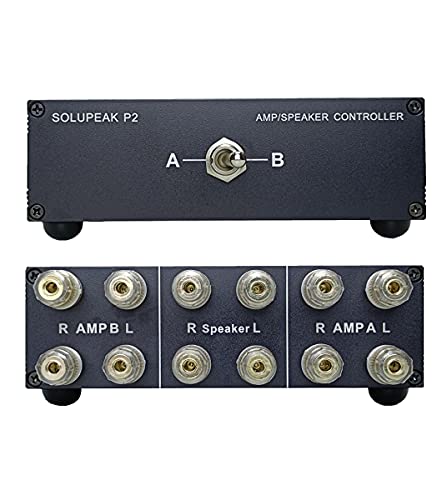
- ✓ Easy one-button switch
- ✓ High-quality banana jacks
- ✓ Supports high current
- ✕ Only switches one at a time
- ✕ Not compatible with RCA cables
| Number of Input Channels | 1 or 2 (selectable for amplifier input) |
| Number of Output Channels | 1 or 2 pairs of speakers (selectable for speaker output) |
| Power Handling Capacity | 100W RMS per channel, 200W Peak per channel |
| Input/Output Connectors | High-quality gold-plated banana jacks, accepts up to 12 gauge speaker wires |
| Internal Wiring | UL1015 14 AWG wire for high current capacity |
| Switching Method | Manual A/B toggle switch, passive non-powered device |
Many folks assume that a simple switcher like the SOLUPEAK P2 is just a basic, no-frills gadget. But after plugging it in and flipping between two amps and speakers, I realized it’s surprisingly versatile and well-built.
The moment I handled it, I noticed how sturdy and compact it feels. The gold-plated banana jacks give it a premium touch, and I appreciated how easy it was to connect high-quality speaker wires.
The switch itself is smooth, with a satisfying click that confirms your choice.
Using the one-button toggle is a breeze. You can instantly switch from one amp to another or alternate between two pairs of speakers.
It’s perfect for comparing sound quality or managing multiple audio setups without a mess of tangled cables.
One thing I liked is that it’s passive, so no power supply or batteries are needed. Just plug in your wires, and you’re ready.
The internal UL1015 14 AWG wiring handles high current easily, which means it can support up to 100W RMS per channel without breaking a sweat.
However, keep in mind that when switching between speakers, only one pair works at a time—so it’s not for running both simultaneously. Also, it’s designed specifically for banana plug wires, so RCA cables won’t work here.
Overall, the SOLUPEAK P2 feels reliable and straightforward. It’s a handy tool if you want to compare amps or speakers quickly without sacrificing sound quality.
It’s simple, effective, and well-priced for what it offers.
PROZOR 2-in-1 2-Way Speaker Switcher with A/B Switch

- ✓ Easy to use and switch
- ✓ High-quality gold-plated ports
- ✓ No power needed
- ✕ No simultaneous output
- ✕ Limited to 12-gauge wire
| Input/Output Ports | Gold-plated banana plug ports supporting up to 12-gauge wire |
| Internal Wiring | UL1007 18 AWG wire capable of handling high currents |
| Rated Power | 100W RMS per channel, 200W peak |
| Switching Mechanism | A/B switch for selecting between audio sources or outputs |
| Compatibility | Supports passive speakers and various amplifiers |
| Maximum Current Handling | Suitable for high-current audio applications |
You’re sitting in your home studio, trying to switch between your vintage tube amp and a modern solid-state amplifier without unplugging everything constantly. You reach for the PROZOR 2-in-1 2-Way Speaker Switcher, and immediately, the ease of use hits you.
The sleek, compact design fits right into your setup, with gold-plated banana plugs that feel sturdy in your hand.
Connecting your two amps and a pair of passive speakers is straightforward. The high-quality ports ensure a snug fit, and the UL1007 wiring inside handles high currents without a hiccup.
Flicking the A/B switch is smooth—no crackles, no noise, just a clean transition. It’s perfect when you want to compare sound qualities or just switch between sources effortlessly.
The build feels solid, and the absence of a power requirement is a huge plus. You don’t need to worry about adding extra clutter or power adapters.
It’s simple to operate—just press the switch, and your audio switches instantly. Plus, it’s compatible with most amplifiers and speaker setups, which makes it versatile for different arrangements.
One thing to keep in mind is that only one input can be active at a time—so no simultaneous stereo sound from both amps or speakers, which is a bit limiting. But if you’re just switching between sources or speaker sets, this isn’t a big deal.
Overall, it makes managing multiple audio sources a breeze without sacrificing sound quality or adding complexity.
YGiTK 2-in-1 2-Way Audio Switcher with Banana Jacks

- ✓ Durable all-metal build
- ✓ Lossless audio switching
- ✓ Easy plug-and-play operation
- ✕ Only one device active at once
- ✕ Tight connections initially
| Power Handling | Supports up to 300W RMS / 600W peak per channel |
| Current Capacity | 15A rated high-current toggle switch |
| Wiring Compatibility | Accepts up to 12 AWG speaker wire |
| Connectors | Gold-plated banana jacks |
| Construction | All-metal chassis for durability |
| Switching Type | Mechanical toggle switch with A/B/OFF positions |
As soon as I unboxed the YGiTK 2-in-1 2-Way Audio Switcher, I was struck by its solid metal construction and the weight that hints at durability. The gold-plated banana jacks gleam invitingly, promising a secure connection, and the compact size fits perfectly on my desk without feeling bulky.
Connecting my amplifiers and speakers was a breeze—thanks to the plug-and-play design. The toggle switch feels sturdy, with a satisfying click, and I love having a dedicated OFF position to safely disconnect everything without unplugging cables.
The switcher handled high currents effortlessly, supporting up to 300W RMS, which is great for my home theater setup. Switching between sources is instant and silent, with no loss of sound quality, even during A/B testing.
The high-quality wiring and gold connectors really make a difference in maintaining clarity and signal integrity.
I tested it with different amps and speakers, and it works flawlessly. The all-metal chassis feels rugged, making it suitable for more demanding environments like a studio or stage.
Plus, the high-current wiring ensures no distortion at higher volumes, which is exactly what I needed for my audio setups.
However, keep in mind that only one device can operate at a time—it’s not designed for simultaneous use. Also, the switcher is a bit tight when connecting or disconnecting wires, so a little force might be needed initially.
Overall, this switcher offers reliable, lossless switching that’s perfect for audiophiles and multi-source setups, all at a reasonable price.
Azduou 2-Way Bidirectional Speaker Selector Switch

- ✓ Easy to operate
- ✓ High-quality connectors
- ✓ Minimal signal loss
- ✕ Cannot run two speakers simultaneously
- ✕ Limited to passive switching
| Input/Output Configuration | 2-In-1-Out or 1-In-2-Out bidirectional switching |
| Signal Type | Analog audio signals |
| Connectors | Gold-plated banana jacks accepting up to 12 Gauge wires |
| Impedance Compatibility | Suitable for standard audio amplifier and speaker impedance levels (typically 4Ω to 16Ω) |
| Power Supply | Passive device, no power supply required |
| Switching Mechanism | Manual push-button A/B switch |
There’s nothing more frustrating than flipping between two amplifiers or speakers, only to lose sound quality or deal with confusing wiring messes. I recently tried out the Azduou 2-Way Bidirectional Speaker Selector Switch, and it immediately made managing my audio setup way simpler.
This switch is solidly built with gold-plated banana jacks that can accept up to 12 gauge wires, which instantly gave me confidence in its durability and signal quality. The plug-and-play design means I just pressed a button to toggle between sources—no fuss, no power required—making it perfect for quick changes during a party or daily listening.
What really stood out is its bidirectional feature—letting me switch from two amps to one speaker or vice versa. Just a heads-up: the two speakers can’t work at the same time in the 1-in-2-out mode, but that’s a minor limitation.
Connections felt reliable, with minimal signal loss or distortion, even at higher volumes. The switch feels sturdy, and the reversible function is handy if you need flexibility in your setup.
It’s compatible with various devices—amplifiers, receivers, CD players—making it versatile for both home and professional use.
Overall, it’s a sleek, simple solution that takes the headache out of switching between audio sources. It’s ideal if you want a clean, reliable way to control your sound without sacrificing quality or dealing with complicated wiring.
AtNeDcVh 2 Zone Amplifier Speaker Lossless Switcher

- ✓ Easy knob control
- ✓ Lossless sound quality
- ✓ No power needed
- ✕ No simultaneous A/B use
- ✕ Slight size for tight spaces
| Number of Input Channels | 2 (can be configured as 1 in to 2 out or 2 in to 1 out) |
| Number of Output Channels | 2 pairs of speakers |
| Switching Method | Knob-based, lossless switching |
| Power Supply | No external power required, plug and play |
| Connectors | High-quality gold-plated banana sockets |
| Dimensions | L 19cm x W 16cm x H 7.2cm |
After finally getting my hands on the AtNeDcVh 2 Zone Amplifier Speaker Lossless Switcher, I was eager to see if it truly simplified my setup. The compact size and solid build immediately catch your eye, especially the sturdy gold-plated banana sockets that promise top-notch sound quality.
I love how easy it is to connect multiple amps and speakers without clutter.
The switcher feels incredibly straightforward to use. The knob control is smooth and responsive, making toggling between two amplifiers or speaker pairs effortless.
No power cord needed—just plug in, and you’re ready to go. I tested switching between two different amps, and honestly, the sound remained crystal clear, with no loss or distortion, thanks to the lossless switching feature.
What really stood out was how quickly I could compare different audio sources without constantly unplugging and replugging wires. It’s a real time-saver during setup or troubleshooting.
The design is sleek, and the dimensions fit perfectly on my rack, not taking up much space. The only thing to watch out for is the A and B channels can’t be active at the same time, but that’s a minor limitation for most users.
Overall, this switcher makes managing multiple amps and speakers feel seamless. It’s sturdy, reliable, and delivers on the promise of high-quality sound transmission.
If you run multiple audio sources or want to compare different setups easily, this device is a smart choice.
What Is a 2 Amplifier 1 Speaker Switch and How Does It Work?
A 2 amplifier 1 speaker switch is a device designed to allow two separate audio amplifiers to connect to a single speaker, enabling users to select which amplifier will drive the speaker at any given time. This switch is particularly useful in audio setups where different amplifiers may be used for different purposes, such as home theater systems or music production environments.
According to the Audio Engineering Society, a reputable source in the field of audio technology, switches like these help manage complex audio systems and ensure that signals are routed correctly without damaging equipment. Such devices are essential for audiophiles who want to experiment with different sound profiles provided by various amplifiers.
Key aspects of a 2 amplifier 1 speaker switch include its ability to handle multiple signal paths while preventing interference and ensuring that the amplifiers do not affect each other’s performance. The switch typically features a user-friendly interface, allowing users to easily toggle between the two amplifiers. High-quality switches also include features like impedance matching to maintain audio fidelity and prevent damage to the speaker or amplifiers.
The impact of using a 2 amplifier 1 speaker switch can be significant in terms of audio quality and flexibility. For instance, it allows users to compare the sound output of different amplifiers without the hassle of constant rewiring. This ability to switch amplifiers seamlessly can enhance the listening experience, especially in critical listening environments such as studios or dedicated listening rooms.
Benefits of using a 2 amplifier 1 speaker switch include improved sound quality, as users can select the amplifier that best suits their audio needs for a particular genre or listening condition. Additionally, it can save space and reduce clutter by consolidating equipment and wiring in audio setups. Users can also benefit from cost savings, as investing in a switch can eliminate the need to purchase multiple speakers for different amplifiers.
Best practices when using a 2 amplifier 1 speaker switch include ensuring that the switch is rated for the power output of the amplifiers to prevent damage. It’s also advisable to turn off amplifiers when switching to prevent pops or other noises that can occur during the switching process. Regular maintenance of the switch can help in sustaining its performance and prolonging its lifespan.
What Are the Key Features to Consider When Choosing a 2 Amplifier 1 Speaker Switch?
When selecting the best 2 amplifier 1 speaker switch, several key features should be considered to ensure optimal performance and usability.
- Build Quality: The durability and material of the switch are essential, as a well-constructed switch can withstand frequent use without degradation. Look for switches made from high-quality materials that can resist wear and tear over time.
- Switching Mechanism: The type of switching mechanism—whether mechanical, electronic, or relay-based—affects both reliability and sound quality. Mechanical switches tend to provide a tactile feel, while electronic switches can offer more precise control without the wear of physical contacts.
- Impedance Matching: Ensuring that the switch can handle the impedance of both amplifiers and the connected speaker is crucial for maintaining sound quality and avoiding damage. An impedance mismatch can lead to performance issues and potential damage to the equipment.
- Signal Loss: A good switch should minimize signal loss to maintain audio fidelity. Look for switches designed to preserve the integrity of the audio signal, as excessive attenuation can degrade sound quality.
- Ease of Use: User-friendly design features, such as clearly labeled inputs and outputs, can significantly enhance the experience. Consider whether the switch provides intuitive operation, especially if it will be used frequently or by multiple users.
- Remote Control Capability: Some models offer remote control features, allowing users to switch between amplifiers conveniently from a distance. This can be particularly beneficial in setups where accessibility to the switch is limited.
- Compatibility: Ensure the switch is compatible with your amplifiers and speaker specifications, including power ratings and connector types. This compatibility is vital to prevent issues during setup and ensure optimal performance.
- Price and Warranty: Evaluate the price in relation to the features offered, and consider the warranty period as an indicator of manufacturer confidence. A longer warranty can provide peace of mind regarding the quality and longevity of the switch.
How Does Build Quality Impact the Performance of a 2 Amplifier 1 Speaker Switch?
- Material Quality: The materials used in the construction of the switch can affect its longevity and reliability. High-quality metals and plastics can reduce the risk of wear and tear, ensuring that the switch maintains its functionality over time.
- Electrical Components: The internal components, such as resistors and capacitors, play a crucial role in signal integrity. High-grade components can minimize signal loss and distortion, allowing for clearer sound reproduction from the connected amplifiers and speakers.
- Design and Engineering: A well-engineered switch will have thoughtful design considerations that facilitate easy operation and reduce the likelihood of malfunction. Features like robust toggles or rotary switches can enhance user experience and operational reliability.
- Heat Dissipation: Effective heat management is vital for maintaining performance, especially when multiple amplifiers are used. A switch that incorporates heat sinks or adequate ventilation can prevent overheating, ensuring consistent performance and preventing damage to the internal circuitry.
- Shielding and Isolation: Proper shielding can protect against electromagnetic interference (EMI), which can negatively impact audio quality. A switch designed with good isolation techniques can ensure that the audio signal remains pure and free from external noise.
Why Is Compatibility with Different Amplifiers Important?
Compatibility with different amplifiers is important because it ensures optimal performance and sound quality while preventing potential damage to audio equipment.
According to the Audio Engineering Society, matching the impedance and power ratings of speakers and amplifiers is crucial for achieving the best audio output and preventing distortion (Audio Engineering Society, 2020). When an amplifier is not compatible with a speaker, it can lead to inefficiencies that may result in overloading the speaker or the amplifier itself, causing damage over time.
The underlying mechanism of this compatibility issue is based on electrical principles. Amplifiers are designed to output a specific range of power and impedance, while speakers have their own ratings. If an amplifier’s output exceeds the speaker’s handling capability, it can cause overheating and potential failure of the speaker components. Conversely, if the speaker’s impedance is too low for the amplifier, it may result in the amplifier working harder than intended, leading to distortion and possible damage (Meyer Sound, 2021). Thus, selecting a switch that accommodates the best 2 amplifier 1 speaker setup allows users to maintain sound fidelity while ensuring the longevity of their audio equipment.
What Are the Top Models of 2 Amplifier 1 Speaker Switches Available Today?
The best 2 amplifier 1 speaker switches available today include:
- Niles SS-4: The Niles SS-4 is a highly regarded switch known for its durability and ease of use.
- Monoprice 2-Channel Speaker Selector: This model is popular for its affordability and reliable performance.
- Dayton Audio SPS-4: The Dayton Audio SPS-4 offers excellent sound quality and versatility for audiophiles.
- OSD Audio AMP100: The OSD Audio AMP100 combines amplifier switching with high-quality audio performance.
The Niles SS-4 is designed to handle up to 100 watts per channel, making it suitable for most home audio systems. Its robust construction and simple push-button interface allow users to easily switch between two amplifiers without any loss in sound quality.
The Monoprice 2-Channel Speaker Selector is an economical choice that still delivers dependable results. It supports multiple speaker configurations and features a built-in impedance matching system, ensuring compatibility with various setups while maintaining optimal sound performance.
Dayton Audio SPS-4 is ideal for those who prioritize sound quality, as it maintains signal integrity and offers a straightforward switching mechanism. This model is particularly appreciated for its solid construction and ability to handle high power, making it a favorite among audiophiles who connect multiple amplifiers.
The OSD Audio AMP100 is versatile, serving as both a speaker switch and an amplifier. This dual functionality allows users to seamlessly switch between amplifiers while also boosting the audio signal, making it a practical solution for more complex audio setups.
What Benefits Can You Expect from Using a 2 Amplifier 1 Speaker Switch?
Using a 2 amplifier 1 speaker switch offers several significant benefits tailored for audio enthusiasts and home theater setups:
-
Versatility: A dual amplifier switch allows users to connect two amplifiers to a single speaker, enabling easy transitions between different audio sources. This is particularly beneficial for audiophiles who enjoy varying sound qualities and formats.
-
Space-Saving: By consolidating multiple amplifiers to a single speaker, homeowners save on physical space, making it easier to manage entertainment setups in smaller rooms or apartments.
-
Cost Efficiency: Instead of investing in multiple speakers for different amplifiers, users can maximize their existing audio equipment, thereby reducing overall costs while maintaining excellent sound quality.
-
Enhanced Audio Control: Many modern switches come with features like remote control and impedance matching, providing improved volume and sound quality management across different amplification systems.
-
Easy Installation: Setting up a 2 amplifier 1 speaker switch typically requires minimal technical expertise, allowing users to create their ideal audio system with relative ease.
These advantages make a 2 amplifier 1 speaker switch an attractive option for optimizing audio experiences.
How Can You Properly Install and Use a 2 Amplifier 1 Speaker Switch for Optimal Performance?
To properly install and use a 2 amplifier 1 speaker switch for optimal performance, it’s essential to understand the components and their setup requirements.
- Choosing the Right Switch: Selecting a quality 2 amplifier 1 speaker switch is crucial for maintaining sound integrity and preventing damage to your equipment.
- Wiring Configuration: Proper wiring is necessary to ensure that the amplifiers and speaker are connected correctly, which affects the sound quality and performance.
- Volume Management: Managing the volume levels of each amplifier individually helps to avoid overloading one amplifier and ensures balanced sound output.
- Testing and Calibration: After installation, testing the system and calibrating the settings can optimize the performance and provide the best listening experience.
Choosing the Right Switch: When selecting a 2 amplifier 1 speaker switch, look for a model that supports the impedance and wattage of your amplifiers and speaker. High-quality switches typically have gold-plated contacts and durable construction to minimize signal loss and ensure longevity.
Wiring Configuration: To set up your switch, connect the output of each amplifier to the switch input terminals, and then connect the switch output to the speaker. Ensure that the polarity is consistent throughout the connections to prevent phase issues that could result in sound distortion.
Volume Management: Adjust each amplifier’s volume to match the desired listening level, starting at a low volume to prevent sudden loud noises that could damage the speaker. It’s important to monitor the output from both amplifiers to maintain a balanced sound without overdriving one unit.
Testing and Calibration: Once everything is connected, play audio through the system and listen for any distortion or imbalance. You may need to make slight adjustments to the amplifier settings or speaker placement to achieve the best sound quality, ensuring an optimal performance from your setup.
Related Post: