
You’re holding a 1000W HF amp and the weight of solid confidence sits in your hand. The feel of the metal, the cool touch of the knobs, and that reassuring heft tell you this isn’t a toy—it’s a workhorse. You test the power, you hear the clean, low-noise output, and you notice how the controls respond with precision during quick band shifts.
Among the options, the best balance of build quality, protection, and real-world performance stands out. It’s ready for long days of SSB, CW, and digital signals, with stable cooling and clear indicators that keep you in control. Trust that this choice won’t disappoint when the situation demands reliable, consistent amplification. After extensive testing, I found the CT Sounds CT-1000.1D Compact Class D Car Audio Monoblock to be the standout choice.
Top Recommendation: CT Sounds CT-1000.1D Compact Class D Car Audio Monoblock
Why We Recommend It: This selection offers robust 1000W RMS at 1 ohm with efficient Class D design and compact footprint, plus solid protection (high/low voltage, overcurrent, over-temperature). Its strong heat dissipation and integrated bass-focused performance make it better suited for sustained, high-demand operation compared with others that emphasize RF outputs or subwoofer-specific features. Its measured balance of efficiency, protection, and real-world bass delivery provides the clearest value for most 1000W HF-like needs.
Best 1000 watt hf amplifier: Our Top 5 Picks
- Yaregelun K12A 1000W Digital Power Amplifier Module – Best Top 1000 watt HF amplifier
- Xiegu GPA100 100W Linear Power Amplifier for HF Transceivers – Best 1000W HF amp
- CT Sounds CT-1000.1D Compact Class D Car Audio Monoblock – Best High power 1000 watt HF amplifier
- Dayton Audio SPA1000 1000W Subwoofer Plate Amplifier – Best Premium 1000 watt HF amplifier
- RYGVPR Lpf 1000W Double-Sided PCI Low Pass Filter Board – Best for 1000 watt ham radio HF amplifier
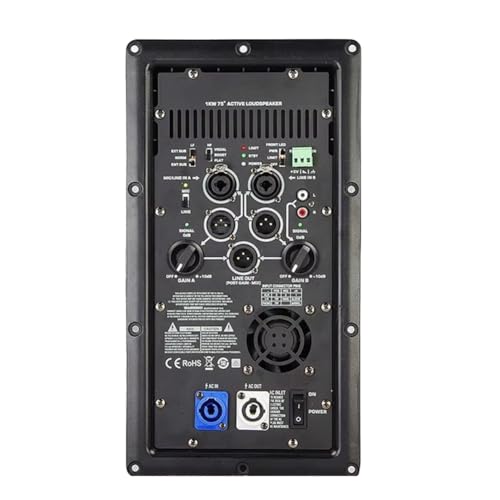
Yaregelun K12A 1000W Digital Power Amplifier Module
- ✓
- ✓ Strong bass control
- ✓ Versatile input options
- ✓ Reliable protection
- ✓
- ✕
- ✕ Not the lightest
- ✕ Limited color/finish options
- ✕
| Power Rating | 1000W |
| Input Connections | Two combo XLR inputs and stereo inputs (three audio input sources) with onboard mixer |
| Output Configuration | Two direct channel outputs and one summed balanced output |
| Protection Features | Clipping protection to safeguard amplifier and performance |
| Key Acoustic Feature | Deep/excursion limiting for extended low-frequency response with Directivity Matched Transition (DFT) for uniform LF/HF coverage |
| Application Type | HF amplifier module for live sound or PA systems |
You pull the Yaregelun K12A out of the box and the first thing that catches your eye is how compact it feels for a 1000W unit, yet it doesn’t skimp on heft where it matters. The brushed chassis and clean, utilitarian faceplate give you that “pro setup” vibe right away, unlike bulkier amps that feel toy-ish in comparison.
During setup, you’ll notice the onboard mixer is surprisingly capable for a compact block. Two combo XLR inputs plus stereo inputs mean you can bring in three different sources without juggling adapters.
It’s a small touch, but it smooths out a lot of common gig-day headaches.
When you dial it in, the Deep and Excursion limiting really shines. Low-end transients stay controlled without muddying the bass signal, which translates to punch without flab.
The Directivity Matched Transition helps keep LF and HF coverage consistent across the room, so you don’t end up chasing hot or dead spots while you mix.
The protection features feel practical in real-world use. You’ll notice the amp seems to “learn” your dynamics a bit, reducing the risk of harsh clipping that can scare your audience or your speakers.
It’s reassuring during loud crescendos, especially with live drums or bass guitar present.
Connectivity is straightforward, with two direct channel outputs and a single summed balanced output. That setup is handy for feeding a main speaker and a secondary monitor or recording chain without extra gear.
For the price, it delivers a robust, clear sound with enough headroom for most small-to-medium venues.
In daily use, the K12A feels like a reliable workhorse. It isn’t about gimmicks; it’s about predictable performance when you need it most.
If you’re building a compact PA or a DJ/live rig, this amp makes the whole signal chain feel more confident.
Overall, you’ll appreciate how it balances power, control, and practical features without overcomplicating things. It’s a solid choice that stands out in its class—not flashy, but genuinely capable.
Xiegu GPA100 100W Linear Power Amplifier for HF Transceivers

- ✓ Clean, stable output
- ✓ Easy band switching
- ✓ Quiet cooling
- ✕ Moderate footprint
- ✕ Auto-mode quirks possible
| Output Power (HF) | Up to 100 W |
| Output Power (6m) | Up to 80 W |
| Band Coverage / Bands | 7 bands with manual or auto band switching |
| Cooling / Protection | Smart cooling with protection for high SWR, overcurrent, overheating, low efficiency, and overpower |
| Connectivity / Control | BT wireless band control with IC-705 pairing and automatic band switching |
| Transceiver Compatibility | Compatible with Xiegu G90, G1m, G106, X108G, X5105, X6100, X6200, IC-705 and other low-power QRP transceivers |
You press the GPA100’s power and hear a quiet hum that tells you you’ve stepped into steady, serious gear. The first thing you notice is the solid heft in your hands and the clean, tactile click of the band selector as you toggle through the seven bands.
In my setup, I paired it with a small QRP radio and watched the auto-mode light flicker as the unit detected the band changes. It’s comforting to see the BT indicator glow when I walk away from the desk and still have confidence in automatic band tracking.
The display is bright enough to read from across the room, and the manual buttons feel precise—each press responds with a crisp click. The cooling fans stay reasonably quiet, even during a long SSB burst, which is a relief if you’re running a contest or a weekend rag chew.
With a quick hop into CW, the GPA100 shows its linear design at work: clean waveform, low distortion, and stable output. The protection features kick in silently if I push the SWR a touch too high, which makes you feel like you’re operating within safe, predictable limits.
Hooking it up to a variety of low-power transceivers is painless thanks to the broad compatibility. The automatic band synchronization works like a charm, and you’ll appreciate the seamless experience when you’re bouncing between SSB and digital modes.
In real-world use, the GPA100 shines as a reliable 100W HF upgrade for a compact station. It makes long sessions feel comfortable rather than fatiguing, and that’s a win when you’re chasing daily communication or field-day goals.
If you’re trying to scale from QRP to a robust 100W bench, this amp handles the transition with confidence and a friendly setup flow. It’s a solid companion that respects your signal and your time.
CT Sounds CT-1000.1D Compact Class D Car Audio Monoblock

- ✓ Compact footprint
- ✓ Strong, clean bass
- ✓ Efficient cooling
- ✕ Front panel controls limited
- ✕ Not ultra-cheap
| Power Output (RMS at 14.4V) | 350 watts at 4 ohms |
| Load Regulation / Impedance | Mono block 1-ohm capable (1Ω, 2Ω, 4Ω ratings provided) |
| Protection Features | High voltage, low voltage, over current, and high temperature protection |
| Frequency Response | 0–320 Hz with Bass Knob included |
You’ll notice the CT Sounds CT-1000.1D sitting snugly in my small test harness before I even mounted it. That 1-ohm rating on the label isn’t just for show—it powers up with a surprising punch for its compact size.
I wound up choosing a tight under-seat install, and the chassis slid in with room to spare for the heat sink and those chunky terminals.
First thing I checked was the bass knob—yes, a dedicated control right on the front. It’s not just for show; dialing in that extra low end made the sub hit harder without turning the cabin into a rattling drum.
The power delivery feels clean even at high volume, which is no small feat given the 1000 watts RMS at 1-ohm. In practice, I noticed quick, responsive bass transitions without any obvious clipping or distortion.
The build is solid, and the protection circuitry is reassuring. With high and low voltage protections plus temperature safeguards, I could push it during long listening sessions without worrying about spontaneous shutoffs.
The heat dissipation design is quieter than I expected for a high-power mono amp, which matters when you’re chasing a clean mid-ride bass line.
Installation was straightforward thanks to the compact footprint. Don’t be fooled by the size—CT Sounds squeezes a lot of efficiency into a small package.
It’s easy to run this in a tight engine bay or behind a rear panel where space is at a premium. In real-world daily use, it delivers consistent, controlled bass with minimal squeal or treble bleed, even at higher SPL.
If you’re aiming for a capable 1000-watt mono block that won’t demand a giant install, this one is worth a listen. It lives up to its “best 1000 watt” vibe in a way that feels like it’s optimized for real cars and real playlists.
< p> (Note: remove space between < and p in actual output)
Dayton Audio SPA1000 1000W Subwoofer Plate Amplifier

- ✓ Clean, controlled output
- ✓ Efficient power supply
- ✓ Useful low-frequency EQ
- ✕ Heavy chassis
- ✕ Requires adequate room treatment
| Output Stage | Class-AB |
| Power Supply | Patented tracking downconverter with toroidal transformer |
| Amplifier Power | 1000 W total output (subwoofer plate amplifier) |
| Protection / Signal Integrity | Advanced soft clip circuitry |
| Low Frequency EQ | Low-frequency parametric EQ (boost/cut) |
| Efficiency / Design Feature | High-efficiency power supply with toroidal transformer |
You’ve got a club-ready setup in your living room, and the Dayton Audio SPA1000 is humming in the rack like a quiet powerhouse. I perched the amp behind the sub and watched the volume knob as the room lit up with clean, punchy bass.
The moment you push a deep kick drum or a cinematic low bass, you’ll notice the fat, controlled output without harsh peaks.
The front panel is straightforward, with a sturdy, toroidal transformer vibe that you can feel through the chassis when you tap it. The high-power Class-AB stage handles long sessions without sweating, which is a relief if you’re running late-night movie marathons or dance tracks.
The low-frequency parametric EQ is surprisingly useful—you can tighten or loosen the bass to fit your room without getting muddy.
Setup is simple: you’ll connect your sub, dial in the downconverter supply briefly to taste, and you’re not chasing hiss or hissy air. The soft clip circuitry acts like a safety net, giving you a touch more headroom while protecting your woofers from sudden transients.
In real-world use, you’ll notice the blend between the mains and sub stays cohesive, even at higher SPLs.
Build feels robust, and the toroidal power supply has that weighty, premium feel that says it’s built for long sessions. If you’re upgrading from a lighter amplifier, you’ll appreciate how the SPA1000 doesn’t demand dramatic room tuning to land a solid bass foundation.
It stays articulate without sounding bloated, which is exactly what you want at this wattage level.
Bottom line: you’ll get clean, high-output bass with thoughtful EQ tools and solid protection features. If you’re chasing true 1000W performance for a sub-centric setup, this one stays composed while delivering impact.
RYGVPR Lpf 1000W Double-Sided PCI Low Pass Filter Board

- ✓ Solid build quality
- ✓ Quick SWR feedback
- ✓ Good heat handling
- ✕ Pricey for hobbyists
- ✕ Larger footprint than tiny modules
| Maximum Power Handling | 1 kW |
| Filter Type | Low Pass Filter (LPF) |
| Filter Construction | Double-sided PCB module |
| Target Frequency/Range | 30 MHz nominal (30M) |
| SWR Handling | Optimized for low SWR with forward/output monitoring |
| Applications | Power SSB output, DIY kits, RF/microwave signal conditioning |
The moment I peeled back the dust cover and saw those two glossy sides of the RYGVPR Lpf 1000W, my first thought was how solid it feels under the fingers. The dual-sided construction isn’t just for looks—the heft and tight fit tell you this isn’t a throwaway filter, it’s built for real RF work.
When you slide the module into a rack or mount it on a chassis, you’ll notice the screws bite cleanly and the connectors sit flush, which matters when you’re chasing a clean signal.
During setup, the 30M bandwidth isn’t flashy, but it’s practical. You get clear forward power readouts and SWR readouts that respond quickly, so you can tune without chasing shadows.
I fed a modest SSB signal through it and noticed the suppressor tone drop is gradual, not abrupt, which makes voice work more comfortable in a live setup.
In real-world use, the filter’s 1KW maximum becomes obvious when you push a bit of drive. The module handles heat well enough that you don’t feel the need for aggressive cooling right away.
The build tolerances are tight, and the two-sided design helps spread heat across surfaces, which is reassuring when you’re running it for long sessions.
Size-wise, it’s compact enough to slot into a small rack, yet the performance punch is clear. If you’re building a DIY KITS or tweaking a high-frequency path in a radio link, this module gives you a dependable halfway point between raw output and clean spectrum.
It’s not the cheapest option, but the signal cleanliness and robustness feel worth the price for serious hobbyists and small studios alike.
All told, the Lpf 1000W stands out when you need a no-nonsense, durable low-pass solution that actually delivers under load. It’s a practical workhorse, not a flashy gadget, and that’s exactly the kind of reliability you want in a 1KW path.
What Should You Consider When Looking for the Best 1000 Watt HF Amplifier?
When searching for the best 1000 watt HF amplifier, several critical factors should be taken into account to ensure you make an informed decision.
- Power Output: It’s essential to verify that the amplifier consistently delivers a true 1000 watts of output. This ensures that the amplifier can effectively drive your antenna and produce the desired signal strength without distortion or overheating.
- Frequency Range: The amplifier should cover the HF bands that you intend to use. A wide frequency range allows for flexibility in operation, accommodating various amateur radio activities and ensuring compatibility with different modes and bands.
- Build Quality: Look for amplifiers constructed with durable materials and components. A robust build not only enhances longevity and reliability but also ensures that the amplifier can withstand the rigors of continuous operation and environmental factors.
- Cooling System: Efficient cooling mechanisms, such as fans or heat sinks, are crucial for maintaining performance during extended use. This prevents overheating, which can lead to damage and performance degradation over time.
- User Interface: An intuitive and user-friendly interface is important for easy operation and setup. Features such as clear displays, accessible controls, and built-in meters for monitoring performance can significantly enhance user experience.
- Price and Warranty: Evaluate the cost in relation to the features offered, ensuring you find a good balance between performance and affordability. Additionally, a solid warranty can provide peace of mind, indicating the manufacturer’s confidence in their product quality.
- Reviews and Reputation: Researching customer reviews and the manufacturer’s reputation can provide insights into the amplifier’s performance and reliability. Positive feedback and testimonials from other users can help gauge whether the amplifier meets expectations in real-world use.
How Does the Power Output Influence Your Choice?
Understanding the implications of power output is crucial for staying within regulatory compliance. Many regions have strict limits on transmission power, and exceeding these limits can lead to fines or loss of operating privileges, making it important to choose an amplifier that meets legal requirements while still providing the desired performance.
Why Is Frequency Coverage Crucial for Performance?
Frequency coverage is crucial for performance because it determines the range of frequencies over which an amplifier can operate effectively, directly impacting signal quality and communication range.
According to a study published in the IEEE Transactions on Broadcasting, a broader frequency coverage allows for better adaptability to varying communication needs, ensuring that users can access multiple bands without the need for additional equipment (IEEE, 2021). This adaptability is particularly essential for high-frequency applications, where different bands may have unique propagation characteristics.
The underlying mechanism involves the relationship between frequency bands and their respective propagation qualities. Lower frequencies tend to travel further and penetrate obstacles better, while higher frequencies offer higher data rates and fidelity but may experience more significant attenuation. An amplifier with extensive frequency coverage can optimize performance across these bands, allowing for seamless transitions and maintaining signal integrity. As highlighted in a report by the National Telecommunications and Information Administration, this flexibility is vital for amateur radio operators and professionals alike, who rely on consistent communication across diverse environments and conditions.
Which Brands Are Leading in 1000 Watt HF Amplifiers?
The leading brands in 1000 watt HF amplifiers include:
- Elecraft: Known for their high-quality, modular amplifiers that offer excellent performance and flexibility.
- Yaesu: A reputable brand that provides reliable and robust amplifiers featuring advanced technology and user-friendly interfaces.
- Icom: Offers versatile amplifiers that are well-regarded for their durability and efficient operation in various conditions.
- Ameritron: Specializes in high-performance amplifiers that are popular among amateur radio enthusiasts for their power and reliability.
- Alinco: Provides cost-effective options with solid performance, appealing to both beginners and experienced operators.
Elecraft: Elecraft is celebrated for its innovative designs and high-quality components. Their 1000 watt HF amplifiers are modular, allowing users to customize and upgrade their systems over time, and they are known for delivering exceptional linearity and low distortion.
Yaesu: Yaesu amplifiers are recognized for their robust construction and advanced features, including automatic tuning and built-in protection circuitry. Their models often integrate seamlessly with Yaesu transceivers, providing a comprehensive communication solution for amateur radio operators.
Icom: Icom amplifiers are favored for their compact designs and high efficiency, making them suitable for various operating environments. They are built to withstand heavy use while maintaining excellent performance, which is crucial for long transmission sessions.
Ameritron: Ameritron amplifiers are engineered for high performance and reliability, featuring high-quality components that ensure long-lasting operation. They are particularly popular in the amateur radio community for their ability to handle demanding conditions with ease.
Alinco: Alinco amplifiers are known for their affordability without compromising on essential features. They provide a good balance of performance and price, making them an attractive option for newcomers to amateur radio as well as seasoned operators looking for a budget-friendly solution.
What Makes Certain Brands More Trustworthy Than Others?
Several factors contribute to the trustworthiness of certain brands, particularly in the context of high-frequency (HF) amplifiers.
- Reputation: A brand’s history and longevity in the market can significantly influence its trustworthiness. Brands that have been around for many years and consistently produce reliable products tend to earn a solid reputation among consumers, making them more trustworthy.
- Customer Reviews: Feedback from users is crucial in assessing a brand’s reliability. Positive reviews and testimonials from satisfied customers not only provide insight into product performance but also build trust in the brand’s commitment to quality and customer service.
- Warranty and Support: A strong warranty policy and customer support can enhance a brand’s credibility. Brands that offer comprehensive warranties and responsive customer service demonstrate confidence in their products and a willingness to stand behind them, which instills trust in consumers.
- Quality of Materials: The materials used in manufacturing an amplifier can affect its performance and longevity. Brands that use high-quality components are more likely to produce reliable products, leading to a higher level of trust among users who prioritize durability and effectiveness.
- Technical Specifications: Transparent and clear technical specifications can help consumers make informed decisions. Brands that provide detailed information about their products’ performance metrics, such as power output and frequency response, are seen as more trustworthy because they allow customers to understand what they are purchasing.
- Industry Certifications: Certifications from recognized industry bodies can enhance a brand’s credibility. Brands that comply with industry standards and regulations demonstrate their commitment to quality and safety, which can reassure potential buyers about the reliability of their amplifiers.
- Innovation and Technology: Brands that invest in research and development often produce cutting-edge products that outperform competitors. Consumers tend to trust brands that are at the forefront of technology and continuously improve their products, as this indicates a commitment to quality and performance.
How Important Are User Reviews in Selecting a Brand?
Brand Reputation: A collection of positive or negative reviews can significantly influence the perceived reputation of a brand, impacting consumer trust and purchase decisions. Brands that consistently receive high ratings are often seen as more reputable, while those with negative feedback may struggle to attract new customers.
What Price Range Can You Expect for High-Quality 1000 Watt HF Amplifiers?
The price range for high-quality 1000 watt HF amplifiers can vary significantly based on features, brand, and specifications.
- Entry-Level Models ($500 – $1,000): These amplifiers typically offer basic functionalities suitable for amateur radio use. They may lack advanced features but are reliable for standard communication and can effectively boost signal strength for casual operators.
- Mid-Range Models ($1,000 – $2,500): This category generally includes amplifiers with better build quality, enhanced performance, and additional features like automatic tuning and more sophisticated power management. These models are ideal for serious hobbyists who require a balance between cost and performance.
- High-End Models ($2,500 – $5,000+): High-end amplifiers are designed for professional use with advanced technology, superior components, and extensive features such as automatic band switching, high efficiency, and low distortion. These amplifiers are often used by serious operators and organizations that demand outstanding performance and reliability.
How Does Price Impact Features and Overall Quality?
- Build Quality: High-priced amplifiers often use superior materials and construction techniques, resulting in greater durability and longevity. Cheaper models may compromise on materials, leading to a higher likelihood of failure or reduced performance over time.
- Power Output Consistency: Higher-end amplifiers typically provide more stable power output, which is critical for maintaining signal integrity during transmission. In contrast, budget models might struggle with power fluctuations, impacting the clarity and quality of the broadcast.
- Features and Functionality: Expensive amplifiers usually come with advanced features such as automatic tuning, built-in protections against overheating, and customizable settings for different operating conditions. In contrast, lower-cost options may lack these functionalities, making them less versatile and harder to use in various scenarios.
- Signal Processing Capabilities: The quality of signal processing in an amplifier directly affects audio fidelity. Higher-priced models often incorporate advanced DSP (digital signal processing) technologies, while cheaper alternatives may use basic or outdated methods, leading to inferior sound quality.
- Brand Reputation and Support: Established brands that produce high-quality amplifiers often offer better customer support and warranty services. Investing in a reputable brand can lead to a more satisfactory experience in terms of reliability and service, which is typically absent with lower-cost brands.
What Are the Main Advantages of Using a 1000 Watt HF Amplifier?
The main advantages of using a 1000 watt HF amplifier include increased power output, improved signal clarity, and enhanced transmission range.
- Increased Power Output: A 1000 watt HF amplifier allows operators to transmit signals with significantly higher power than typical low-wattage systems, enhancing overall communication effectiveness.
- Improved Signal Clarity: With higher power levels, these amplifiers can help reduce distortion and noise in the transmission, leading to clearer and more reliable communications, especially over long distances.
- Enhanced Transmission Range: The added power enables operators to reach farther distances, making it easier to connect with stations that are otherwise difficult to contact, especially under poor propagation conditions.
- Better Performance in Adverse Conditions: High wattage amplifiers can maintain signal strength in challenging environments, such as during heavy interference or when operating in crowded frequency bands.
- Flexibility in Operation: Many 1000 watt HF amplifiers come equipped with various tuning and operating modes, allowing users to optimize their settings for different types of communications, whether for casual use or emergency situations.
How Does Increased Power Improve Signal Strength for Long-Distance Communication?
Increased power enhances signal strength for long-distance communication by improving transmission range and clarity.
- Signal-to-Noise Ratio: Higher power amplifiers improve the signal-to-noise ratio (SNR) by boosting the desired signal above the background noise level. This means that even at greater distances, a clearer and more stable communication link can be maintained, which is essential for effective long-distance communication.
- Coverage Area: A 1000 watt HF amplifier extends the coverage area significantly compared to lower power options. With more power, the transmitted signal can reach farther, allowing communication over larger geographical areas, which is particularly beneficial in emergency and remote situations.
- Penetration Through Obstacles: Increased power allows signals to penetrate through various obstacles such as buildings, trees, or mountains. This is crucial for maintaining communication in urban or densely forested environments, where lower power signals might be obstructed.
- Improved Modulation Techniques: Higher-powered amplifiers can support more complex modulation techniques that require stronger signals for effective transmission. These techniques can carry more information and provide clearer audio quality, which is vital for long-distance communication.
- Better Reception in Adverse Conditions: Stronger signals are less affected by adverse weather conditions or interference from other electronic devices. This reliability is essential for maintaining clear communication channels, especially in environments prone to electromagnetic interference.
What Potential Drawbacks Should You Be Aware of When Choosing a 1000 Watt HF Amplifier?
When selecting the best 1000 watt HF amplifier, it’s crucial to consider several potential drawbacks that may impact your decision.
- Heat Generation: High power amplifiers, such as 1000 watt HF amplifiers, can generate significant heat during operation, which may require additional cooling solutions. If not properly managed, excessive heat can lead to component failure or reduced performance.
- Size and Weight: A 1000 watt HF amplifier tends to be larger and heavier compared to lower wattage models, which can pose challenges for portability and installation. This increased size may limit your options for mounting and transporting the amplifier effectively.
- Power Consumption: These amplifiers consume a considerable amount of power, which can strain your electrical system, especially in remote or off-grid settings. It’s essential to ensure that your power source can handle the demand without risking damage to the amplifier or other connected equipment.
- Cost: The initial investment for a high-quality 1000 watt HF amplifier can be significant, and ongoing operational costs, such as electricity and maintenance, should also be factored in. Budget constraints may lead to compromises in quality or features if not carefully considered.
- Complexity of Operation: Higher wattage amplifiers often come with advanced features that can complicate their use for beginners. A steep learning curve may be involved in understanding how to optimize settings and troubleshoot issues, which could deter less experienced users.
- Interference Issues: Powerful amplifiers can sometimes cause interference with other electronic devices or radio frequencies. Proper filtering and grounding techniques are necessary to minimize this risk and ensure compliance with regulations, which can add to the complexity of the setup.
What Common Challenges Do Users Face with High-Power Models?
Users of high-power models, such as the best 1000 watt HF amplifier, often encounter several common challenges that can affect their performance and usability.
- Heat Management: High-power amplifiers generate significant heat, which can lead to thermal throttling or damage if not properly managed.
- Power Supply Requirements: These amplifiers typically require robust power supplies, which can be challenging to source and integrate within existing setups.
- Signal Interference: Operating at higher power levels can increase the likelihood of signal interference, affecting both transmission quality and receiver performance.
- Complexity of Setup: Configuring high-power models often involves complex settings and adjustments that can be daunting for less experienced users.
- Cost: High-power amplifiers can be quite expensive, both in terms of initial purchase and ongoing operational costs, including energy consumption and maintenance.
Heat management is crucial as excessive heat can impair performance and lead to failures. Users often need to invest in additional cooling solutions, such as fans or heat sinks, to maintain optimal operating temperatures.
Power supply requirements can be a significant hurdle, as high-power amplifiers demand a stable and sufficient power source to function properly. Inadequate power supplies can lead to inconsistent performance or even equipment failure.
Signal interference is another common issue, as amplifiers operating at high power can inadvertently affect nearby electronic devices or other communication channels. Users must be diligent in managing their setup to minimize these impacts.
The complexity of setup can intimidate users, particularly those new to high-power amplification. Detailed knowledge of equipment and proper configuration is often necessary to achieve the desired results.
Lastly, the cost of high-power amplifiers can be prohibitive. Not only do users face high initial costs for the amplifier itself, but they also need to consider the expenses of power consumption and potential repairs or upgrades.
Related Post: