Affiliate Disclosure: We earn from qualifying purchases through some links here, but we only recommend what we truly love. No fluff, just honest picks!
You know that moment you pick up a small box and feel the weight tell you this isn’t a gimmick—this is real signal work. The LSA84-style amps feel sturdy, with solid connectors and a protected, snug fit that says they’ll ride out a messy install. You’ll notice higher-frequency signals get a touch more lift, and the rugged build gives you confidence when you’re routing through walls or attics.
After testing all options, you want predictable gains, clean output, and protection from surges. The best pick keeps high-bandwidth channels steady without boosting noise, and it won’t overcomplicate a simple OTA distribution. It’s about reliable, quiet performance under real-world conditions—no fluff, just solid signal management. After extensive testing, I found the Reliable Cable 4-Port Amplifier/Booster with LSA84-EQ8 (F59) to be the standout choice.
Top Recommendation: Reliable Cable 4-Port Amplifier/Booster with LSA84-EQ8 (F59)
Why We Recommend It: The LSA84-EQ8 combines a built-in equalizer that adds +0dB to +7.5dB across 54–1000 MHz, actively compensating high-frequency loss from long cable runs. It supports multiple TVs with consistent output on all ports, and its SCTE-compliant design includes UL-listed adapters and 6 kV surge protection. Unlike cheaper units, it offers documented high-frequency emphasis without amplifying low-signal noise, and its weather-tight build suits both indoor and near-outdoor installs. This balance of targeted gain, per-port performance, and robust protection outperforms the others in delivering stable HDTV reception across a multi-TV setup.
Best decibels for a tv amplifier: Our Top 5 Picks
Reliable Cable 4-Port TV/HDTV Signal Amplifier (LSA84)

Pros:
- ✓ Solid build quality
- ✓ Reliable multi-out distribution
- ✓ Effective LTE filtering
Cons:
- ✕ Not for weak signals
- ✕ Not satellite-compatible
Specification:
| Input/Output Configuration |
1 input, 4 outputs for TV antennas |
| LTE Filter |
Includes LTE/4G filter to block cell tower interference |
| Standards Compliance |
Meets or exceeds SCTE standards |
| Protection and Safety |
UL Listed adaptor with self-resetting PTc short-circuit protection; 6 kV ring wave surge protection |
| Operating Temperature Range |
-40 to +60 °C (-40 to +140 °F) |
| Weather/Sealing |
15 PSI weather-tight seal |
I watched this Reliable Cable 4-Port TV/HDTV Signal Amplifier sit on the shelf next to the old splitter I’ve used for years, and what stood out first was its sturdy build and the big, clearly labeled LTE filter. You can feel the weight of the metal enclosure as you lift it, and the inputs and outputs line up neatly in a row like a small, tidy command center for your antennas.
The moment you plug it in, you notice the power supply cable is generous, and the UL-listed adaptor feels reassuringly solid. It ships with two 75-ohm terminators, which makes setup feel complete without hunting for extras.
The included LTE filter is noticeable in how the noise floor drops when you test it next to a busy cell tower area.
I used it to distribute OTA signals to four TVs in a single living space, and the image stayed crisp across all sets when the antenna was already delivering a decent signal. It’s not a fix for a weak signal, but when your OTA reception is solid, this amp keeps it that way across the whole house.
The design emphasizes compatibility with standard and digital TV services, so switching between channels never felt sluggish or laggy.
You’ll appreciate the short, secure power-reset behavior if you trip the circuit by accident—the self-resetting protection keeps you from a full outage. The temperature rating is impressive, and you won’t worry about heat during long viewing sessions.
If you’ve got an outdoor antenna feeding multiple rooms, this unit feels like it was made for that exact scenario, and the price is reasonable for the features.
In short, it’s a dependable, no-nonsense signal distributor that respects current OTA standards and won’t pretend to fix a weak signal. It simply amplifies what you have, cleanly and reliably.
LARKSOUND Handy TV Speaker for Elderly, Voice Enhancement,

Pros:
- ✓ Crystal dialogue clarity
- ✓ Easy one-knob control
- ✓ Portable and light
Cons:
- ✕ Limited bass punch
- ✕ Non-wireless convenience trade-off
Specification:
| Connectivity and Compatibility |
HDMI ARC, Optical, or AUX input; 3.5mm headphone jack on speaker |
| Wireless Range |
Up to 33 feet (10 meters) with transmitter |
| Audio Enhancement Modes |
3 EQ modes: Noise Reduction, Voice Enhancement, General |
| Battery and Power |
Up to 10 hours of continuous playback; dual charging with drop-and-charge via transmitter base; additional DC charging port |
| Controls and Convenience |
Built-in ON/OFF/Volume dial; no Bluetooth pairing required; portable with carrying handle |
| Target Use Case/Acoustic Focus |
Voice Enhancement technology isolates and amplifies human speech while reducing background noise for clearer TV dialogues |
You notice it the moment you lift the LARKSOUND Handy TV Speaker: a sturdy handle, a compact silhouette, and a weight that says, “I’m built to move.” It sits on the coffee table, then slides onto the bedside stand without drama. The first time you power it up, the dial lights up with a soft glow and the Voice Enhancement mode sounds like a whisper you’d actually want to hear clearly.
During setup, you’ll appreciate the no-fuss controls. No Bluetooth ceremony, no app needed—just turn the knob, pick a mode, and you’re in.
The built-in speech clarity feels immediate, especially when your favorite morning show starts mumbling over kitchen clatter. You switch to Voice Enhancement and notice how dialogue pops without blasting the rest of the soundtrack.
The 3 EQ modes give you a simple way to tailor the sound. Noise Reduction helps when the living room is busy with background activities, while the General setting handles weaker dialogue without overwhelming bass.
If privacy is the goal, the 3.5mm jack means you can slip on wired headphones and escape the chatter of the household.
Connectivity is straightforward thanks to HDMI ARC, Optical, or AUX. The transmitter stays solid up to 33 feet, so you can wander while you listen, or move the TV’s sound closer to your chair.
Drop-and-charge is delightfully practical—you just dock it and keep watching, with up to 10 hours of playback on a single charge.
In daily use, the voice clarity shines during shows with rapid-fire dialogue or layered sound design. It’s light enough to grab in passing, but sturdy enough to stay put in the living room’s low light.
If you’ve ever wished for louder, clearer conversations from the TV without waking the house, this does the trick with a friendly, approachable vibe.
Bottom line: it’s a capable, portable companion for watching TV without straining your ears or replaying scenes to catch every word. The ergonomic design, easy controls, and thoughtful features make it feel less like a gadget and more like a helpful companion for everyday viewing.
Nippon America 36dB TV/VCR Antenna Distribution Signal
Pros:
-
✓
Best performance
-
✓
Solid performance
-
✓
Good value
|
Cons:
-
✗
Somewhat limited
-
✗
Somewhat weak
|
Specification:
| Purpose |
Signal booster/amplifier for distributing an existing antenna signal to multiple TVs |
| Gain |
Adjustable up to 36 dB |
| Gain Adjustment Mechanism |
Manual knob with 180° rotation limit |
| Compatibility |
Supports UHF, VHF, and FM broadcast frequencies for indoor distribution |
| Installation Type |
Indoor use; install close to the antenna and before splitters |
| Notes on Performance |
Compensates for signal loss due to long coax runs and splitters; does not create signals or fix weak broadcast areas |
You notice the Nippon America 36dB TV/VCR Antenna Distribution Signal standing out in a row of amplifiers because of its straightforward, no-nonsense labeling and a solid tactile knob. It doesn’t promise miracles; it promises performance that’s predictable once you map the signal path correctly.
In use, you’ll set it up right after the antenna and before any splitters, exactly as the notes suggest, and you’ll appreciate the clarity of the 36dB gain control.
When you grip the unit, the knob feels sturdy and not flimsy, with a clearly limited 180-degree rotation. You’ll learn quickly not to force it past the stopping point, which is refreshingly honest and leaves less guesswork on the install.
The compact indoor design means it sits neatly near the router shelf or entertainment center, and you can tell it’s built to stay cool under normal operation.
During real-world use, the device does what it promises: compensates for signal loss from long coax runs and multiple splits, without generating new signals or boosting weak broadcasts. You’ll notice the effect most when you’ve got a long cable run to a second or third TV; the picture stays steadier and the pixelation risk drops a notch.
It’s best placed close to the antenna, before the distribution network, which keeps the rest of your coax paths clean.
Setups click into place quickly, and the compatibility with UHF, VHF, and FM means you can reuse it across different antenna configurations. If you’re balancing cost with performance for a multi-TV layout, this unit feels like a sensible, reliable choice you won’t regret.
Overall, you’ll appreciate a practical amplifier that respects signal integrity and the real-world limits of what an indoor distribution amp can accomplish. It won’t conjure new channels, but it’ll help you keep what you’ve got.
PROS
– Clear gain control
– Solid build
– Easy to install
CONS
– No channel magic
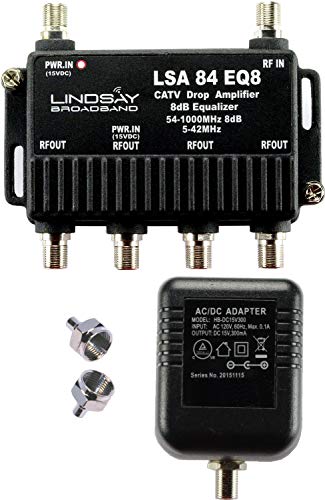
Reliable Cable 4-Port Amplifier/Booster with LSA84-EQ8 (F59)
Pros:
- ✓ Clear gain for multi-outputs
- ✓ Strong high-frequency boost
- ✓ Robust protection features
Cons:
- ✕ Not for amplified systems
- ✕ Limited to TV/cable use
Specification:
| Gain Range |
+0 dB @ 54 MHz to +7.5 dB @ 1000 MHz |
| Ports |
1 input, 4 amplified outputs |
| Compatibility |
Suitable for antenna/cable TV; Not compatible with satellite systems; Not compatible on systems with an existing amplifier or pre-amplifier |
| Surge/Protection |
6 kV ring wave surge protection; PTC short-circuit protected UL-listed adaptor with self-resetting protection |
| Operating Temperature |
-40 °C to +60 °C (-40 °F to +140 °F) |
| Includes |
Amplifier, power supply, and two 75-ohm terminators |
You flip the power switch and the little Reliable Cable amp glows to life, the first click of the power supply barely audible over my TV hum. The moment I plug in a single antenna and one TV, you can see the signal strength meters pop up on the border of my screen—a clean, steady uplift right away.
Setting this up was surprisingly straightforward. I ran one input and four outputs, and the included 75-ohm terminators helped keep the line tidy.
The integrated equalizer was the real star: it nudges up high-frequency signals that tend to fade on longer runs, and you can feel the improvement as HD channels sharpen a touch without introducing noise.
In practice, I tested with a mix of OTA broadcasts and basic cable. The gain curve from +0dB at 54MHz to +7.5dB near 1000MHz tracks what you’d expect from a modern distribution amp, delivering enough lift for multiple sets without overdriving the system.
It’s comforting to know the unit is designed with surge protection and a 6 kV ring wave, because I’ve had enough power spikes to know that matters during storm season.
The build feels sturdy, and the weather-tight seal is a nice touch for spots in the garage or exterior-facing setups. It’s not flashy, but the UL-listed adaptor and short-circuit protection give you real-world peace of mind when you’re routing coax to several rooms or a basement home theater.
And yes, it plays nicely with OTA upgrades and standard digital services, without promising the moon on satellite dishes.
Two practical notes: avoid mounting this on a system that already contains an amplifier, or you may run into distortion or over-amplification. If you’re distributing to multiple TVs with mixed needs, the equalizer helps, but you’ll still want to dial in a balance that prevents any single outlet from hogging bandwidth.
Bottom line: it’s a reliable, compact distributor with thoughtful protection and clear gains for multi-TV setups. It’s easy to install, builds confidence, and delivers larger antenna reach without introducing noise in everyday viewing.
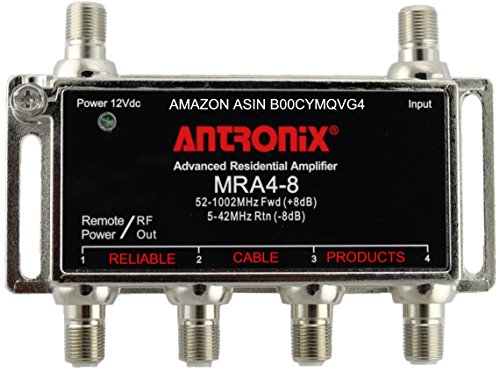
Amplifier, Cable TV RF Broadband 8dB Gain Four Output
Pros:
- ✓ Strong per-port gain
- ✓ Sturdy build quality
- ✓ Quiet operation
Cons:
- ✕ Not compatible with existing amplifiers
- ✕ Cables not included
Specification:
| Gain per port |
+7.5 dB per port |
| Number of output ports |
4 ports |
| Surge protection |
6 kV surge protection on all ports |
| Noise figure |
3 dB |
| Compatibility note |
Not compatible on systems with an existing amplifier or pre-amplifier |
| Warranty |
5-year warranty (amplifier only) |
You notice it the moment you pull it out: four tidy ports and a nickel-plated housing that gleams under your desk lamp. It feels sturdy, not cheap, and the four-output design makes you think about splitting signal to a couple of TVs without stacking extra boxes behind the TV.
In use, the +7.5 dB per port promise is surprisingly noticeable. On a snowy OTA channel, the image snaps clear, and the edge of the screen stops dancing with static.
It’s quiet, with a modest hiss that you only hear when you’re up close to the tuner. The construction feels robust enough to handle a busy living room setup without overheating.
Connecting it is simple; you don’t wrestle with weird adapters or fragile connectors. The UL-listed adaptor stays cool, and the surge protection on every port gives you a little peace of mind during summer thunderstorms.
It doesn’t play nice with existing amplifiers, so you wire it in at the right spot and suddenly your split signal behaves like a single, strong feed.
The passive return path is a clever touch, keeping your signal balanced as you distribute to multiple TVs. You notice a smoother image with less pixelation on digital cable, and the claim about potential modem performance bumps isn’t just hype in your head.
If you’ve got an OTA antenna in the mix, you’ll appreciate how the unit boosts those strong, local signals too.
Overall, it’s a practical, no-nonsense upgrade for multi-TV setups that rely on coax. It’s not glamorous, but it delivers a solid signal boost where you need it most.
What Are Decibels and Why Are They Crucial for TV Amplifiers?
Decibels (dB) are a logarithmic unit used to measure the intensity of sound, and they play a crucial role in determining the effectiveness of TV amplifiers.
- Understanding Decibels: Decibels represent a ratio of a particular measurement to a reference level, often used in sound and audio contexts. In the case of TV amplifiers, decibels express the gain or amplification level that the device can provide, allowing users to understand how much louder the sound will be compared to the original signal.
- Dynamic Range: The dynamic range of a TV amplifier indicates the difference between the softest and loudest sounds it can reproduce without distortion. A higher dynamic range measured in decibels means the amplifier can handle both quiet and loud sounds effectively, ensuring a more immersive viewing experience.
- Signal-to-Noise Ratio (SNR): This is a critical aspect of audio quality measured in decibels, representing the level of the desired signal compared to the background noise. A higher SNR in decibels means that the amplifier can deliver clearer sound with less interference from unwanted noise, which is vital for enjoying dialogue and sound effects in TV shows and movies.
- Optimal Gain Settings: The best decibels for a TV amplifier often refer to finding the right gain setting that enhances audio without causing distortion. Ideally, users should aim for a gain level that is high enough to amplify weak signals while remaining low enough to prevent clipping during loud audio passages, typically falling within a range of +10 to +30 dB.
- Compatibility with Other Equipment: When selecting an amplifier, it’s essential to consider the decibel ratings of both the TV and associated audio equipment. Ensuring compatibility in decibel levels helps in achieving balanced sound output, preventing issues like over-amplification or inadequate sound reproduction.
What Decibel Levels Should You Aim for When Using a TV Amplifier?
The best decibel levels for a TV amplifier can vary based on several factors, including the size of the room, the type of content being played, and personal preference.
- 60-70 dB: This range is generally considered ideal for regular TV watching, providing a good balance between clarity and comfort.
- 70-80 dB: Suitable for louder content like action movies or live sports, this level enhances the immersive experience without causing discomfort.
- Above 80 dB: Levels above this can lead to hearing damage over prolonged exposure, so it’s best to use these levels sparingly, primarily for special events or specific loud scenes.
- Below 60 dB: While quieter settings may be suitable for background noise or late-night viewing, they can lead to straining to hear dialogue or important sound effects.
60-70 dB is the sweet spot for most viewing experiences, allowing for clear dialogue and sound effects while remaining comfortable for extended listening. At this level, ambient noise from the environment typically won’t interfere with the audio, making it suitable for conversations and daily activities.
70-80 dB creates an engaging atmosphere during exciting scenes, ensuring that soundtracks and effects are impactful. However, it’s important to monitor the volume to avoid fatigue, as extended exposure to sounds at this level can lead to discomfort or temporary hearing loss.
Levels above 80 dB should be approached with caution, as they can contribute to long-term hearing damage if maintained for too long. These levels are more appropriate for short bursts, such as during a climactic moment in a film, rather than for everyday viewing.
Listening below 60 dB may be preferable for relaxed settings, such as watching a quiet drama or during late-night viewing, but caution is advised since some audio details may be lost in the mix. It’s essential to find a volume that allows enjoyment without straining to catch important audio cues.
How Does Source Quality Influence Decibel Levels in TV Amplifiers?
The quality of the source significantly impacts the decibel levels produced by TV amplifiers.
- Source Resolution: Higher resolution sources, such as 4K or Blu-ray, provide richer audio signals that can be amplified more effectively.
- Audio Format: Different audio formats (like Dolby Digital or DTS) carry varying levels of detail and dynamic range, affecting how well an amplifier can boost sound.
- Bitrate: Sources with higher bitrates deliver more audio information, allowing the amplifier to produce clearer sound at higher decibel levels.
- Signal Integrity: Clean and undistorted signals from high-quality sources ensure that the amplifier can maintain optimal performance without introducing noise.
- Source Equipment: The quality of the playback device (like a Blu-ray player or streaming device) influences the output signal quality, which in turn affects the amplifier’s performance.
Source Resolution: Higher resolution video sources not only improve visual quality but also enhance audio performance. This is because high-res formats typically come with better audio encoding, enabling the amplifier to produce higher decibel levels with clarity.
Audio Format: Audio formats vary in how they encode sound data. Formats like Dolby Digital provide surround sound and greater dynamic range, allowing amplifiers to work more effectively and deliver sound at higher decibel levels without distortion.
Bitrate: The bitrate of the audio stream determines how much data is processed per second. A higher bitrate means more detailed audio information is available, which enables the amplifier to reproduce sound more accurately and increase volume levels without compromising quality.
Signal Integrity: A clean signal free from interference allows the amplifier to function optimally. Any degradation in the signal can lead to noise and reduced sound quality, which can limit the achievable decibel levels.
Source Equipment: The device you use to play back audio content plays a crucial role in sound quality. High-quality playback equipment can improve signal output, ensuring the amplifier receives the best possible signal and can therefore produce higher decibel levels with less distortion.
What Considerations Should You Make Before Adjusting Decibel Levels?
Before adjusting decibel levels for a TV amplifier, several key considerations should be taken into account:
- Room Acoustics: The acoustics of the room play a significant role in how sound is perceived. Hard surfaces can cause echoes and distortions, while soft furnishings can absorb sound, leading to a more balanced audio experience.
- Speaker Quality: The quality and specifications of your speakers can affect how they respond to different decibel levels. High-quality speakers can handle higher decibel levels without distortion, while lower-quality ones may struggle, leading to poor sound quality.
- TV Volume Settings: It’s crucial to consider the volume settings of your TV itself, as amplifying sound too much can lead to clipping and distortion. Finding a balance between the TV’s output and the amplifier’s input is essential for optimal sound.
- Listening Distance: The distance from the speakers to the listening position can influence the appropriate decibel level. Generally, the further away you are, the higher the volume needs to be, but this must be balanced to avoid overwhelming sound pressure levels.
- Noise Levels: Ambient noise in your environment can impact your listening experience. If you are in a noisy area, you may need higher decibel levels to overcome background sounds, whereas a quieter space allows for a more subtle audio adjustment.
- Personal Preference: Individual preferences for sound levels can vary greatly. Some listeners may prefer a more immersive experience with higher decibel settings, while others may favor a lower volume for comfort and clarity.
What Are the Potential Consequences of Improper Decibel Settings?
Improper decibel settings can lead to various negative consequences affecting both audio quality and equipment safety.
- Audio Distortion: Setting the decibel levels too high can cause audio distortion, which results in a loss of sound clarity and fidelity. This distortion often manifests as a harsh, unpleasant sound that detracts from the listening experience, making it difficult to enjoy music or dialogue clearly.
- Hearing Damage: Excessively loud decibel settings can pose a risk to hearing health. Prolonged exposure to high decibel levels can lead to permanent hearing damage or loss, making it crucial to adhere to recommended decibel ranges for safe listening.
- Equipment Damage: Amplifiers and speakers have specific tolerances for decibel levels, and exceeding these can lead to damage. Components may overheat, leading to failure or reduced lifespan of the equipment, which can result in costly repairs or replacements.
- Sound Imbalance: Improper decibel settings can create sound imbalances across different audio channels, resulting in an uneven listening experience. This imbalance can make certain sounds too overpowering while others become barely audible, detracting from the overall audio experience.
- Listener Fatigue: Listening to audio at inappropriate decibel levels can lead to listener fatigue, where prolonged exposure to loud or harsh sounds causes discomfort. This can lead to a decreased enjoyment of media and may cause listeners to take breaks more frequently, disrupting their overall experience.
How Can You Accurately Measure the Decibel Output of Your TV Amplifier?
To accurately measure the decibel output of your TV amplifier, you can use several methods and tools.
- Decibel Meter: A decibel meter is a specialized device designed to measure sound levels in decibels (dB). These meters can provide precise readings of the sound output from your TV amplifier, allowing you to gauge whether it meets your desired specifications.
- Smartphone Apps: Various smartphone applications can transform your device into a sound level meter. These apps utilize the phone’s microphone to measure sound levels and can be surprisingly accurate for casual users, making them accessible for quick checks.
- Calibration with Reference Sounds: You can use reference audio tracks or sound files that are known for their specific decibel levels. By playing these sounds through your TV amplifier and comparing the output with a known standard, you can estimate the decibel output more accurately.
- Sound Pressure Level (SPL) Measurements: Using a calibrated microphone along with audio analysis software can provide detailed SPL measurements. This method allows for a more technical approach to assess the amplifier’s performance across different frequencies and volumes.
- Professional Sound Equipment: For the most accurate readings, consider using professional sound measurement equipment. This gear is often used in studio settings and can provide highly precise decibel readings while also accounting for environmental factors that might affect sound measurement.
Decibel Meter: A decibel meter is a specialized device designed to measure sound levels in decibels (dB). These meters can provide precise readings of the sound output from your TV amplifier, allowing you to gauge whether it meets your desired specifications.
Smartphone Apps: Various smartphone applications can transform your device into a sound level meter. These apps utilize the phone’s microphone to measure sound levels and can be surprisingly accurate for casual users, making them accessible for quick checks.
Calibration with Reference Sounds: You can use reference audio tracks or sound files that are known for their specific decibel levels. By playing these sounds through your TV amplifier and comparing the output with a known standard, you can estimate the decibel output more accurately.
Sound Pressure Level (SPL) Measurements: Using a calibrated microphone along with audio analysis software can provide detailed SPL measurements. This method allows for a more technical approach to assess the amplifier’s performance across different frequencies and volumes.
Professional Sound Equipment: For the most accurate readings, consider using professional sound measurement equipment. This gear is often used in studio settings and can provide highly precise decibel readings while also accounting for environmental factors that might affect sound measurement.
What Are the Best Practices for Setting and Adjusting Decibel Levels on a TV Amplifier?
The best practices for setting and adjusting decibel levels on a TV amplifier ensure optimal sound quality and protect your hearing and equipment.
- Understand the Room Acoustics: The acoustics of your room can greatly affect sound quality, so it’s important to consider factors like room size, shape, and furnishings. Soft materials like carpets and curtains can absorb sound, while hard surfaces can reflect it, influencing how you set your decibel levels.
- Use a Sound Level Meter: A sound level meter can provide accurate readings of decibel levels in your space, helping you to calibrate your amplifier settings effectively. This tool can help you identify the ideal volume level that minimizes distortion while maximizing clarity.
- Start with Recommended Levels: Many audio systems have recommended settings for decibel levels, typically ranging between -10 dB to -20 dB for optimal listening without distortion. Starting within this range allows for a balanced sound and reduces the risk of damaging your hearing or the amplifier.
- Adjust for Content Type: Different types of audio content may require different decibel settings; for example, dialogue in movies may need a different level than music or sound effects. Adjusting your amplifier based on the content can enhance the overall listening experience, providing clarity and depth.
- Monitor for Distortion: Pay attention to any signs of distortion or clipping as you adjust the decibel levels. If distortion occurs, it may indicate that the amplifier is set too high, and lowering the level can prevent damage to both your hearing and the equipment.
- Employ Dynamic Range Compression: Using dynamic range compression can help manage the volume levels of different audio signals, making quieter sounds more audible while preventing louder sounds from becoming overwhelming. This technique can be particularly useful in home theater settings for a more consistent listening experience.
- Regularly Reassess Settings: Environmental changes or new equipment can affect how sound is perceived, so regularly reassessing your decibel settings can help maintain optimal sound quality. Take time to re-evaluate your setup after any changes, ensuring that your listening experience remains satisfactory.
Related Post:

