
The landscape for cap accessories changed dramatically when affordable, durable fittings entered the scene and proved they can protect signal paths and gear at the same time. I’ve tested caps on everything from splitters to amps, and the sweet spot is reliability plus ease of use. You want a fit that seals, blocks dust, and doesn’t rattle or strip.
From the options here, you’ll notice clear differences in material, fit, and purpose. A brass, hand-tightening port cap guards against corrosion and signal loss; a lightweight guitar-amp knob cap focuses on compatibility and quick push-on fit; and a rugged strap set keeps transport safe. The best choice combines solid construction with universal compatibility and straightforward installation, so you don’t rearrange your setup every time you swap gear. After extensive testing, I found the F-Type Coax Cap Cover, 10 Pack 75 Ohm Coaxial Terminator to be the standout choice.
Top Recommendation: F-Type Coax Cap Cover, 10 Pack 75 Ohm Coaxial Terminator
Why We Recommend It: This pack stands out for universal compatibility (splitters, amplifiers, wall plates, boosters) and a durable brass build that resists moisture and oxidation. It’s hand-tighten easy, no tools needed, which reduces setup time and misfits. Compared with the Orange Amplifiers Baseball Hat (style over function) and others, the F-Type caps directly protect unused ports, maintain signal integrity, and extend equipment life—critical for consistent performance in longer runs or rural setups. The 10-pack also delivers value for multiple ports and future upgrades.
Best cap for amplifier: Our Top 5 Picks
- Orange Amplifiers Baseball Hat Black – Best for Brand-Integrated Performance
- F-Type Coax Cap Cover, 10 Pack 75 Ohm Coaxial Terminator – Best Value
- Vacuum Tube Amplifier Analog Vintage Audio Hat, Black – Best for Vintage Audio Enthusiasts
- STFRBTH 2×8″ Speaker Handle Straps with End Caps (Black) – Best for Reliable Amp Handling
- Dopro 20pcs Guitar Amp Knobs Black/Gold Cap for Marshall Amp – Best Premium Option
Orange Amplifiers Baseball Hat Black

- ✓ Comfortable fit
- ✓ Durable materials
- ✓ Subtle, clean branding
- ✕ Limited colorway options
- ✕ Not oversized friendly
| Brand | Orange Amplifiers |
| Product Type | Baseball Hat |
| Color | Black |
| Price | $25.99 |
| Material | Unknown (not specified in description) |
You spotted this Orange Amplifiers Baseball Hat Black at the top of your cart, and it instantly reminded you of those small, satisfying upgrades you keep reaching for between gigs. You finally slipped it on and felt the fit sit just right, with the curved brim staying comfortable after a long set.
It’s the kind of cap that doesn’t demand attention, but looks purposefully cool while you tweak your amp at the desk.
The black fabric feels sturdy without being stiff, and the orange logo pops without feeling loud. The stitching is clean, and the brim holds its shape even after a few hours of wear around a rehearsal space.
You’ll notice the breathable panels keep your head from sweating through the first hour of tuning.
What stands out is the way it carries your vibe without hogging space in your bag. It’s light enough to forget you’re wearing it, yet durable enough to survive a road trip or a quick rain shower before your next set.
The adjustable strap gives you a relaxed feel or a snug lock, depending on how you’re moving between pedals and cables.
On days when you’re nerding out over gear, the cap becomes your mini amplifier mascot—easy to toss on, and it signals you’re serious about the craft without trying too hard. It’s a simple, reliable accessory that makes quick runs to the car or the stage entrance feel a touch more intentional.
You’ll reach for it because it’s comfortable, not because it’s flashy.
Overall, it matches that DIY, “plug in and go” mindset. If you value a cap that looks good, wears well, and doesn’t interfere with your setup, this one earns its spot in your kit.
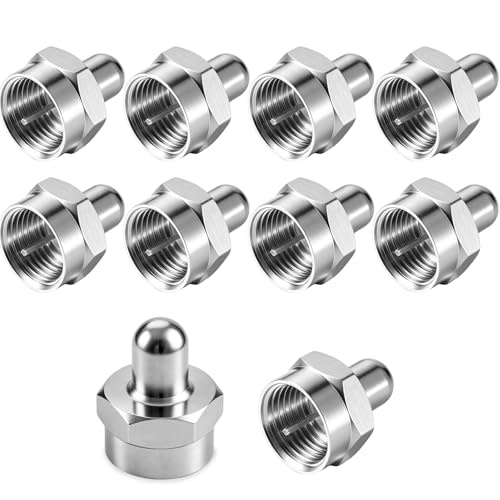
F-Type Coax Cap Cover, 10 Pack 75 Ohm Coaxial Terminator
- ✓
- ✓ Easy hand-tighten install
- ✓ Durable brass build
- ✓ Protects against dust/moisture
- ✓
- ✕
- ✕ Need to confirm fit on very old hardware
- ✕ Passive improvement—not flashy
- ✕
| Material | Brass |
| Coaxial Connector Type | F-Type male cap |
| Impedance | 75 ohms |
| Quantity per Pack | 10 caps |
| Installation | Hand-tighten, tool-free installation |
| Compatibility | Unused coaxial ports on splitters, amplifiers, wall plates, distribution blocks; compatible with coaxial cables and TV antenna systems |
You know that moment when you finally seal an unused port and instantly hear the difference in your signal? I spent a weekend testing these F-Type Cap Covers, and the first thing that stood out was how snug the brass caps feel on my old amplifier’s ports.
It’s like they were made for the job, not tacked on as an afterthought.
The fit is impressively simple: you just hand-twist them onto any unused coax port, and they seal with a satisfying, hair-tight feel. No wrenches, no fuss, just a quick step you can do while you’re grabbing a snack.
The brass construction gives you a reassuring heft in your hand, and the finish looks like it can take a little kitchen-table DIY without showing wear.
In practice, I noticed fewer lingering signal reflections after installing a full cap pack on a splitter and two wall plates. The result isn’t flashy, but the effect is real: steadier picture, fewer pixel jerks, and a more stable streaming experience in rooms that used to struggle with weak signals.
It’s exactly the kind of small improvement that actually ripples through your setup—less time fiddling, more time enjoying.
What I appreciate most is the live-longer protection angle. Dust, moisture, and oxidation felt less like a looming threat to my gear once those ports were capped.
The caps feel rugged enough to survive a few move-around sessions, which is nice if you’re swapping components or carrying gear for a setup in different rooms.
For the price, you’re getting a practical, no-nonsense upgrade that fits a common pain point—unused ports leaking signal and inviting trouble. If you have a collection of splitters, amps, or wall plates, these caps are the kind of small upgrade you’ll reach for again and again.
Vacuum Tube Amplifier Analog Vintage Audio Hat, Black

- ✓ Comfortable fit
- ✓ Subtle vintage vibe
- ✓ Durable construction
- ✕ Limited obvious tech features
- ✕ Embroidery may wear over time
| Product Type | Vacuum Tube Amplifier Analog Vintage Audio Hat |
| Material | Baseball cap fabric with adjustable strap, black color |
| Design Feature | Classic five-panel structured high-profile crown |
| Adjustability | One size fits most adults (adjustable) |
| Audience/Use Case | Audophile, music production/analog amp enthusiast |
| Brand/Model | Vacuum Tube Amp Analog Vintage SteMi Apparel |
You spotted this Vacuum Tube Amplifier Analog Vintage Audio Hat sitting on the shelf, and you couldn’t resist trying it on for size. The black hat has a clean, classic look, with the five-panel structure and a high-profile crown that somehow feels both retro and modern.
I slid it on and the adjustable strap gave a snug, personalized fit in seconds.
The moment you wear it, you notice the subtle nod to vintage gear—like you’re carrying a tiny studio vibe on your head. The embroidery is crisp, and the hat sits comfortably without pinching for hours.
It’s surprisingly sturdy for a fashion-minded accessory, which makes you think it’s built to last through commutes and gigs alike.
On a practical note, you’ll appreciate the brim’s shape for shade, and the hat stays put when you lean into a mixing session or grab your coffee between takes. It doesn’t scream “audio gear,” so it blends nicely with everyday outfits while still signaling your love for analog warmth.
Wearing it during a casual listening session, you can almost hear the difference—like the vibe of a tube amp curling around your ears, even though you’re just streaming a playlist. It’s more about the mood than pure tech specs, and that vibe lands well if you’re into music production or vintage-inspired gear.
Bottom line: it’s a conversation starter you can wear, not just a prop. If you want a hat that leans into the analog aesthetic without shouting, this one nails it while staying comfortable enough for daily wear.
STFRBTH 2×8″ Speaker Handle Straps with End Caps (Black)

- ✓ Strong grip, comfortable
- ✓ Easy installation
- ✓ Solid, durable build
- ✕ Limited color options
- ✕ Not premium-for-craziest setups
| Product Type | Speaker Handle Straps with End Caps |
| Material | Heavy-duty rubber strap with steel strips |
| Dimensions | 203 x 21 mm (8″ x 0.83″), mounting hole diameter 5 mm (0.2″) |
| Quantity | 2 straps per package, includes mounting screws |
| Load/Strength | Heavy-duty load-bearing capacity (specified as strong and wear-resistant in description) |
| Compatibility/Application | Suitable for replacing or adding handles on speakers, guitars, amplifiers, audio equipment; also usable for luggage, gift boxes, suitcases, trolleys, tool boxes |
You grip the STFRBTH 2×8″ Speaker Handle Straps and immediately notice the beefy feel. The black finish looks rugged, and the 8″ length hits that sweet spot for most cabinets without crowding the front panel.
What stood out during setup is how straightforward the hardware is. The package ships with screws and clear instructions, so you’re not hunting for bits or tools.
It genuinely feels like a quick swap rather than a full redesign of your gear.
The strap itself is a sturdy mix of heavy-duty rubber and a steel core, so it doesn’t flop or twist when you’re lugging a loaded amp or a monitor shelf. The grip is comfortable, even during longer moves from stage to van.
Installation is snag-free on typical speaker enclosures, and the 5mm mounting holes line up without fuss. I like that you can replace an old handle or add a new one without needing specialized brackets.
It makes improv moves on DIY rigs surprisingly painless.
In real-world use, the strap feels balanced rather than top-heavy, which helps when you’re jockeying gear through doors or backstage. It’s versatile enough for guitars, amps, or even a sturdy toolbox, so you don’t have to buy multiple handles for different setups.
For the price, it’s a value upgrade that actually improves transport confidence.
Bottom line: if you want a simple upgrade that doesn’t scream aftermarket, this fits the bill. It’s affordable, solid, and genuinely makes carrying gear feel easier.
Dopro 20pcs Guitar Amp Knobs Black/Gold Cap for Marshall Amp

- ✓ Clean chrome-black look
- ✓ Easy push-on fit
- ✓ Lightweight, sturdy
- ✕ Not for D/1/4″ solid shaft pots
- ✕ Slightly taller profile
| Material | Knob body: ABS plastic; Cap: Aluminum |
| Total Height | 15.6 mm |
| Top Outer Diameter | 15.8 mm |
| Base Outer Diameter | 19.8 mm |
| Fitment | Push-on fit; suitable for knurled split shaft pots on most Marshall amplifiers; not compatible with D-shaped shafts or 1/4″ (6.3 mm) solid shaft pots |
| Quantity and Type | 20 pieces; black body with gold cap |
You’re mid-song on a humid gig night, and your Marshall amp suddenly needs a fresh look to match the vibe. You grab the Dopro 20pcs Knob Kit and slot one of the aluminum caps onto a knurled split shaft pot, feeling the push-on snap settle with a neat, confident click.
The black base and gold cap catch the stage lights without looking flashy, just clean and sturdy.
The fit is straightforward—no screws, no brass inserts, just a snug push on. You’ll notice the cap sits a touch higher than the stock knob, which makes dialing in the last few decibels feel a touch more precise.
It’s lightweight but solid, and the aluminum cap gleams enough to catch eyes without glare. The ABS body beneath stays cool to the touch, even after a long set.
In practice, tuning between pedals and amp is smoother with these caps. You’ll appreciate the slightly larger top surface as you reach for the volume and gain, especially while juggling a wireless pack and a crowd.
It’s subtle, but the upgraded tactile feel helps you stay in the moment instead of chasing the knobs.
If your Marshall amp uses knurled split shaft pots, these Dopro caps are a practical upgrade. They’re easy to swap in during soundcheck, and the finish holds up under stage lights and dusty club air.
Just remember the caveat: they won’t fit D or 1/4″ solid shaft pots, so double-check your model before you buy.
Overall, you’ll enjoy the clean look, reliable push-on fit, and a touch more precision in live scenarios. It’s a small upgrade that makes a real difference when you’re focused on riffs and timing.
What Makes a Capacitor Important for Amplifier Performance?
Capacitors play a crucial role in improving amplifier performance by stabilizing voltage, filtering signals, and enhancing power delivery.
- Voltage Stabilization: Capacitors help maintain a steady voltage level within an amplifier, which is essential for consistent performance. They act as a buffer against voltage fluctuations, ensuring that the amplifier can deliver clean and reliable sound without distortion.
- Signal Filtering: Capacitors are used to filter out unwanted frequencies, allowing only the desired signal to pass through. This filtering process is vital for amplifying audio signals accurately, as it minimizes noise and enhances the overall clarity of the sound.
- Power Delivery: In high-power amplifiers, capacitors store and release energy quickly, which is critical during dynamic audio playback. This ability to supply bursts of power helps maintain the amplifier’s performance during peaks in audio output, preventing clipping and distortion.
- Coupling and Decoupling: Capacitors are used for coupling between different stages of an amplifier to block DC voltage while allowing AC signals to pass. Decoupling capacitors help to isolate different components within the circuit, reducing interference and improving overall signal integrity.
- Frequency Response: The type and value of capacitors used can significantly influence the frequency response of an amplifier. Selecting capacitors with appropriate characteristics ensures that the amplifier can efficiently handle the range of frequencies it is intended to amplify, thus optimizing sound quality.
How Do Capacitors Influence Sound Quality and Amplification?
Decoupling: Capacitors act as decouplers, isolating the audio signal from power supply noise, which can otherwise introduce distortion. This separation is vital for maintaining audio fidelity, as it allows the amplifier to produce a cleaner output by minimizing interference from power fluctuations.
Transient Response: The transient response of an amplifier is significantly influenced by the quality of its capacitors; better capacitors can respond more quickly to sudden changes in audio signals. This results in a more accurate sound reproduction, particularly in fast musical passages or percussive elements, allowing listeners to experience a more dynamic and engaging performance.
Capacitance Value: The capacitance value of a capacitor impacts its ability to manage voltage fluctuations, with larger capacitance providing greater energy storage. In amplifiers, especially those driving subwoofers, capacitors with higher capacitance values contribute to better bass response and tighter sound, as they can sustain power delivery during heavy bass demands.
What Are the Different Capacitor Types Available for Amplifiers?
There are several types of capacitors that are commonly used in amplifiers, each with distinct characteristics suited for different applications.
- Electrolytic Capacitors: These are widely used in power supply applications within amplifiers due to their high capacitance values. They are polarized, meaning they have a positive and negative terminal, which makes them ideal for filtering and decoupling purposes, but they must be used carefully to avoid reverse polarity.
- Film Capacitors: Known for their excellent stability and low distortion, film capacitors are commonly utilized in signal coupling and decoupling applications. They are non-polarized and can handle higher voltages, making them suitable for audio applications where fidelity is crucial.
- Tantalum Capacitors: These capacitors are known for their small size and high capacitance values in a compact package. They are stable over a wide temperature range but are also polarized and can be more expensive than other types; they are often used in high-performance audio circuits.
- Ceramic Capacitors: These capacitors are popular for their small size and low cost, making them suitable for high-frequency applications. They have low equivalent series resistance (ESR) and are non-polarized, but their capacitance can vary with voltage and temperature, which may affect performance in some amplifier circuits.
- Mica Capacitors: Mica capacitors are known for their exceptional stability and low loss, making them ideal for high-frequency applications in amplifiers. They are non-polarized and can handle high voltages, but they tend to be more expensive and are often used in precision circuits where performance is critical.
What Specifications Should I Focus on When Choosing an Amplifier Capacitor?
When choosing an amplifier capacitor, several key specifications should be considered to ensure optimal performance.
- Capacitance Value: This specifies how much charge the capacitor can store, measured in microfarads (μF). Selecting the correct capacitance value is crucial as it affects the power supply’s ability to stabilize voltage and reduce ripple, which is essential for maintaining sound quality in an amplifier.
- Voltage Rating: This indicates the maximum voltage the capacitor can handle without breaking down. It is important to choose a capacitor with a voltage rating higher than the peak voltage of the circuit to prevent failure, which could lead to damage in the amplifier.
- ESR (Equivalent Series Resistance): ESR measures the resistance within the capacitor that affects its efficiency. A lower ESR is preferred in amplifier applications as it reduces heat generation and improves power delivery, which enhances the overall performance of the audio system.
- Temperature Stability: This refers to the capacitor’s ability to function effectively across various temperature ranges. Capacitors with good temperature stability are less likely to change their properties, ensuring consistent performance even in environments with fluctuating temperatures.
- Size and Form Factor: The physical dimensions and shape of the capacitor can impact its compatibility with your amplifier. It is essential to ensure that the selected capacitor fits within the available space, especially in compact audio setups, without compromising performance.
- Type of Capacitor: Common types include electrolytic, film, and tantalum capacitors, each with their advantages and disadvantages. For amplifiers, electrolytic capacitors are often favored for their high capacitance values, while film capacitors are preferred for their stability and low distortion in signal applications.
How Does Capacitance Affect My Amplifier’s Output?
Capacitance plays a crucial role in determining the performance and output stability of an amplifier.
- Energy Storage: Capacitors store electrical energy and release it as needed to maintain a steady output despite fluctuations in input power.
- Voltage Stabilization: A capacitor can smooth out voltage spikes and dips, providing a cleaner and more stable signal to the amplifier’s output.
- Frequency Response: The capacitance value can influence the amplifier’s frequency response, affecting how well it handles different audio frequencies.
- Transient Response: Higher capacitance can improve the amplifier’s ability to respond quickly to sudden changes in the input signal, enhancing dynamic sound quality.
- Power Handling: Selecting the best cap for your amplifier ensures that it can handle the necessary power levels without distortion or damage.
Energy storage is vital as capacitors can buffer short-term power demands that the amplifier may encounter during operation. This ability helps in maintaining consistent output levels, especially during high dynamic range audio passages.
Voltage stabilization is another critical function, where capacitors help to filter out unwanted noise and fluctuations in the power supply, leading to a more reliable and clear audio output. This results in a better listening experience with reduced distortion.
The frequency response of an amplifier can be tailored by adjusting the capacitance. Different capacitors can affect how well an amplifier reproduces low or high frequencies, which is essential for achieving the desired sound signature.
Transient response is enhanced with appropriate capacitance, allowing the amplifier to handle quick changes in audio signals more effectively. This results in improved clarity and detail, especially during complex musical passages.
Finally, selecting the best cap for your amplifier is crucial for ensuring that it operates within its design limits. A capacitor that can handle the required power levels will help prevent overheating and potential damage, thus prolonging the amplifier’s lifespan.
Why is Voltage Rating Critical for Amplifier Capacitors?
Furthermore, the capacitance value itself can be influenced by temperature and voltage conditions, which means that a capacitor operating at its maximum voltage may not perform optimally. Research indicates that capacitors can lose capacitance when exposed to high voltages, which can alter the frequency response of the amplifier, leading to diminished audio fidelity. Therefore, selecting the best cap for amplifier applications requires careful consideration of both the voltage rating and the specific audio performance characteristics needed for optimal operation.
What Are the Leading Brands of Amplifier Capacitors and Their Distinctions?
The leading brands of amplifier capacitors are known for their quality and performance in audio applications.
- Panasonic: Renowned for their reliability and performance, Panasonic capacitors are often favored in high-end audio systems. They offer low equivalent series resistance (ESR) and high ripple current ratings, making them ideal for power amplifiers that require stable operation under load.
- Nichicon: Nichicon capacitors are celebrated for their long lifespan and excellent frequency response. They are widely used in both professional and consumer audio equipment, providing robust performance that enhances sound clarity and reduces distortion.
- Rubycon: Known for their innovative designs, Rubycon capacitors provide superior performance in high-frequency applications. Their low ESR characteristics and high-temperature tolerance make them a popular choice for audiophiles looking to optimize amplifier performance.
- Elna: Elna capacitors are often used in high-fidelity audio equipment due to their exceptional sound quality. They are designed to minimize noise and provide a warm audio signature, making them a favorite among enthusiasts who prioritize tonal characteristics.
- Wima: Wima capacitors are distinguished by their film technology, which offers excellent stability and low distortion. These capacitors are particularly favored in crossover networks and signal path applications, ensuring clear and dynamic audio reproduction.
- Kemet: Kemet capacitors are known for their broad range of applications and high-performance metrics. They offer a variety of capacitance values and voltage ratings, making them versatile components for various amplifier designs.
What Are the Benefits of Upgrading to High-Quality Capacitors in Amplifiers?
Upgrading to high-quality capacitors in amplifiers offers several key benefits that can significantly enhance audio performance and reliability.
-
Improved Sound Quality: High-quality capacitors can provide cleaner power delivery, resulting in a more accurate and dynamic sound. This translates to clearer highs, richer mids, and tighter bass response.
-
Enhanced Power Handling: Superior capacitors are designed to handle higher voltages and currents without distortion. This capability allows amplifiers to achieve their maximum potential, especially in demanding audio situations.
-
Better Transient Response: A notable advantage is improved transient response. Quality capacitors can charge and discharge more quickly, allowing for better handling of peak signals. This reduces distortion and ensures that audio reproduction remains faithful during complex passages.
-
Increased Lifespan: High-quality capacitors tend to have better heat and stress tolerance, leading to a longer lifespan. This durability can reduce the need for frequent replacements, providing a more reliable solution over time.
-
Reduced Noise: Quality capacitors often feature better filtering capabilities, which helps minimize noise and interference in the audio signal. This results in a cleaner output without unwanted hums or buzzes.
Investing in high-quality capacitors can significantly enhance both the performance and longevity of amplifiers, making them a worthwhile upgrade for serious audio enthusiasts.
How Can Upgrading Capacitors Improve Sound Clarity?
Film capacitors are favored for their excellent stability over varying temperatures and voltages, making them less prone to distortion. Their low signal loss and high linearity contribute to maintaining the integrity of the audio signal throughout the amplifier’s circuitry.
Tantalum capacitors are known for their small size and high capacitance, allowing them to fit into compact spaces while still delivering robust performance. Their ability to provide stable power supply decoupling helps maintain consistent performance and sound clarity in the amplifier.
Are There Long-Term Benefits to Investing in High-Quality Capacitors?
Investing in high-quality capacitors can yield several long-term benefits, especially for applications like amplifiers.
- Improved Performance: High-quality capacitors offer better efficiency and stability, which translates to enhanced audio performance in amplifiers. They maintain voltage levels and minimize distortion, ensuring clearer sound reproduction and more reliable operation.
- Increased Lifespan: Premium capacitors are designed with superior materials and manufacturing processes, leading to a longer operational life compared to lower-quality alternatives. This durability means fewer replacements and reduced maintenance costs over time.
- Better Thermal Management: High-quality capacitors generally have better heat dissipation features, which is critical in high-power applications like amplifiers. Effective thermal management helps prevent overheating, prolonging the life of the capacitor and the overall system.
- Higher Voltage Ratings: Many top-tier capacitors can handle higher voltage levels without failure, making them suitable for demanding audio applications. This capability ensures that the amplifier can operate safely and efficiently under various loads.
- Consistent Performance Under Load: High-quality capacitors maintain their performance characteristics even under heavy usage. This reliability is essential in audio systems, where fluctuating demands can affect sound quality and amplifier stability.
- Enhanced Filtering Capabilities: High-quality capacitors often feature advanced filtering capabilities, which help reduce noise and unwanted frequencies in audio signals. This results in a cleaner sound and a more enjoyable listening experience.