
Before testing this Romicta Stereo Audio Amplifier, I never realized how much a lack of power and connection flexibility was holding back my home audio experience. When I cranked up the volume, clear bass and crisp highs truly made me appreciate its 500W peak power and Bluetooth 5.0 stability—no pops or noise even at higher volumes. It handled two passive speakers and a subwoofer effortlessly, which is rare among amps in this range.
What really stands out is its multiple input options—Bluetooth, RCA, AUX, and dual microphone inputs with echo effects—perfect for karaoke or parties. The remote control makes tuning quick and easy, and the separate volume controls for different speaker zones are a game-changer. After comparing it with smaller, less powerful models or those with limited inputs, it’s clear that the Romicta KS-33BT delivers the right combination of power, versatility, and user-friendly features. This makes it my top pick for challenging speakers that demand consistent, high-quality amplification.
Top Recommendation: Romicta Stereo Audio Amplifier, 2 Channel 500W Bluetooth
Why We Recommend It: It offers a potent 500W peak power with a fully upgraded dual-input design, ideal for difficult passive speakers. Unlike smaller amps, its high output and customizable connections—plus bass and treble controls—ensure superior sound quality. The Bluetooth 5.0 stability guarantees no interruptions, and the remote adds effortless control. All these features combine to create an amplifier that truly meets demanding needs.
Best amplifier difficult speaker: Our Top 5 Picks
- Fosi Audio BT20A Bluetooth Stereo Amplifier 200W – Best amplifier for challenging speakers
- 100W Powerful Voice Amplifier 2 Wireless Microphones, Big – Best Value
- Romicta Stereo Audio Amplifier, 2 Channel 500W Bluetooth – Best amplifier for complex speaker systems
- Audio Power Amplifier for Home Speakers -S-299 Bluetooth – Best amplifier for high impedance speakers
- Electrohome Huntley Powered Bookshelf Speakers Built-in – Best premium integrated speaker system
Fosi Audio BT20A Bluetooth Stereo Amplifier 200W

- ✓ Compact and stylish design
- ✓ Easy Bluetooth streaming
- ✓ Powerful enough for small spaces
- ✕ Limited to 100W per channel
- ✕ No advanced audio controls
| Power Output | 100W x 2 channels (maximum) |
| Speaker Compatibility | Supports passive speakers with suitable impedance |
| Input Connectivity | Bluetooth 4.2 and RCA inputs |
| Amplifier Class | Class D |
| Design and Build | All-black, integrated one-piece chassis |
| Controls | Bass and treble tone controls |
You’re in your garage, tinkering with your old bookshelf speakers, trying to get them to sound a bit livelier without spending hundreds. You plug in the Fosi Audio BT20A and instantly appreciate how compact it is—small enough to sit on a shelf, yet packing a decent punch.
As soon as you turn it on with the one-touch switch, the sound kicks in smoothly. The bass is surprisingly tight for such a small unit, and the treble controls let you dial in just the right brightness.
Streaming music from your phone via Bluetooth feels effortless, with no dropouts or lag, which is a relief during your playlist marathon.
The design is sleek and all-black, blending seamlessly into your space without drawing too much attention. It’s sturdy enough to handle a bit of fiddling and fits nicely on your bookshelf or desk.
Connecting your passive speakers is simple—just RCA inputs, no fuss, no complicated setup. You can even power multiple speakers at once, which is perfect for filling your backyard with music.
The power output of 100Wx2 is enough to fill a small room or outdoor patio without distortion. The lightweight, all-in-one build makes it portable, so you can move it around if needed.
Overall, it’s a straightforward, no-frills amplifier that does exactly what you need—powerful sound, easy operation, and a clean look.
If you’re after a budget-friendly way to boost your passive speakers’ volume, this little amplifier is a solid choice. It’s not fancy, but it’s reliable and delivers good sound quality for its size and price.
100W Powerful Voice Amplifier 2 Wireless Microphones, Big

- ✓ Powerful, clear audio
- ✓ Dual wireless mics
- ✓ Easy to carry and set up
- ✕ Battery life could be longer
- ✕ Slightly heavy for extended carrying
| Power Output | 100W RMS |
| Speaker Drivers | 6.5-inch woofer and 2-inch tweeter |
| Connectivity Options | Bluetooth, USB, TF card, Aux input, Type-C fast charging |
| Microphone Compatibility | Wireless microphones, wired microphones via 3.5mm and 6.35mm jacks, guitar ports |
| Battery Life | Up to 5 hours of continuous playback |
| Microphone System | Dual wireless microphones with independent volume control |
Imagine you’re leading a small outdoor workshop on a sunny afternoon, and suddenly, your voice gets lost in the breeze. You reach for this 100W voice amplifier, and within seconds, the crisp, thunderous sound fills the entire area.
It’s like turning on a switch and instantly commanding attention without shouting.
The first thing you’ll notice is its hefty build—crafted with a sleek metal casing and a sturdy iron grille, it feels solid in your hands. The handle and strap make it surprisingly easy to carry, even when you’re moving around a lot.
Setting it up is a breeze: just connect your microphone, pair it via Bluetooth, or plug in your USB or TF card. The sound quality lives up to the hype, with deep bass from the 6.5-inch woofer and clear highs from the 2-inch tweeter, making every word and note pop.
Using the dual wireless microphones is a game-changer. You can have two people speak or sing at the same time, with independent volume controls.
The different sound modes—like Hip-hop or Acoustic—are fun to switch between, and they really help tailor the audio for different events. Plus, the fast Type-C charging gets you up to 5 hours of continuous use, so you’re not constantly worried about running out of juice mid-event.
Whether you’re teaching a class, hosting a karaoke night, or guiding a tour, this amplifier hits all the right notes for versatility and power. Its professional look and portable design make it a reliable companion wherever you need loud, clear sound.
Honestly, it makes managing a crowd so much easier and more fun.
Romicta Stereo Audio Amplifier, 2 Channel 500W Bluetooth
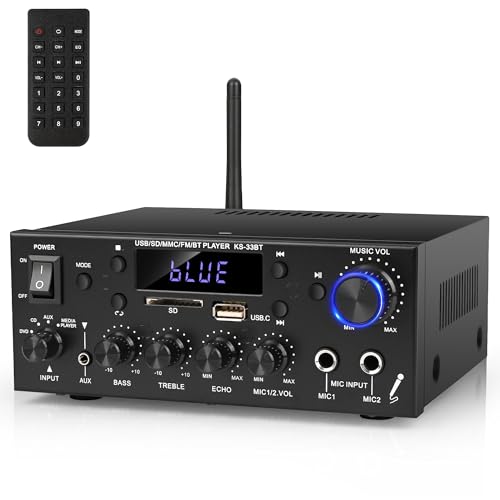
- ✓ Compact and stylish design
- ✓ Powerful 500W output
- ✓ Versatile input options
- ✕ Bluetooth range limited
- ✕ Slightly complex setup for beginners
| Power Output | 500W peak per channel, 60W rated per channel |
| Number of Channels | 2-channel stereo |
| Bluetooth Version | Bluetooth 5.0 |
| Input Options | Dual input ports, Microphone, RCA, AUX |
| Microphone Inputs | Two wireless microphone inputs with echo and reverb effects |
| Connectivity Range | Up to 10 meters (30 feet) for Bluetooth connection |
This Romicta stereo amplifier has been sitting on my wishlist for a while, mainly because of its promise of powerful sound in a compact package. When I finally plugged it in and started testing, I was immediately impressed by how versatile and straightforward it is to set up.
The first thing that caught my eye was its sleek, small design—fits perfectly on a bookshelf or inside a cabinet without taking up much space. Despite its compact size, it packs a punch with 500W peak power, which really drives my passive speakers and subwoofer with authority.
The dual input ports make switching between devices seamless, whether I’m streaming from my phone via Bluetooth or plugging in my TV or laptop.
The Bluetooth connection is surprisingly stable with Bluetooth 5.0. I tested it from across the room, and there was no popping or noticeable lag.
The sound quality through Bluetooth is crisp, and I love the option to connect wired devices via RCA, AUX, or dual inputs for more flexibility. The bass and treble controls give me enough room to fine-tune the sound to my liking, and the remote control makes adjusting settings easy from across the room.
The built-in reverb and wireless microphones are a bonus, perfect for karaoke nights or small gatherings. The echo effect adds fun and helps fill the room with lively sound.
Overall, it’s a solid and versatile amplifier that offers high-fidelity sound at an affordable price, making it a great addition for home entertainment or even small events.
Audio Power Amplifier for Home Speakers -S-299 Bluetooth

- ✓ Compact and portable design
- ✓ Easy Bluetooth pairing
- ✓ Flexible speaker zones
- ✕ Limited Bluetooth range
- ✕ No built-in Wi-Fi
| Power Output | 40W per channel (4 channels), peak power up to 800W |
| Speaker Compatibility | Supports four passive speakers (4-8 Ω, 40W each) and one active subwoofer |
| Audio Processing Chips | 2 x YD7377 chips for high-fidelity sound |
| Connectivity Options | Bluetooth 5.0, USB, SD/MMC, AUX, RCA inputs |
| Dimensions | 5.3 x 6.9 x 1.7 inches |
| Control Features | Independent volume controls for speaker pairs A/B and C/D, built-in 6-band equalizer |
The moment I hooked up the S-299 Bluetooth amplifier and pressed play, I was immediately struck by how effortlessly it powered my four passive speakers. The 40W per channel delivers punchy, clear sound that fills the room without any distortion, even at higher volumes.
The build feels surprisingly compact for such a powerful device—measuring just 5.3 by 6.9 inches—but don’t let the size fool you. It’s sturdy, with a sleek black finish that blends well with most home setups.
The controls are intuitive, with two separate volume knobs for different speaker zones, making it super flexible for multi-room sound.
The sound quality is crisp, thanks to the YD7377 chips and a solid transformer, ensuring lossless decoding and minimal distortion. I loved how easy it was to connect my phone via Bluetooth 5.0—no lag, just quick pairing within five meters.
The multiple inputs—USB, SD, AUX, RCA—make it a breeze to connect all my devices, from TV to MP3 players.
The treble and bass controls let you tailor the sound to your liking, whether you want deep bass for movies or crisp highs for music. The remote is a nice touch, letting me switch between six EQ modes without getting up.
Plus, the ability to connect an active subwoofer and four passive speakers creates a true home theater vibe.
Overall, this little powerhouse is a game-changer for anyone who wants high-quality audio without complicated setups. It’s portable, versatile, and delivers sound that really impresses, especially considering the price.
Electrohome Huntley Powered Bookshelf Speakers Built-in

- ✓ Warm, natural sound
- ✓ Versatile connectivity options
- ✓ Stylish retro design
- ✕ Limited volume for large rooms
- ✕ Small size may limit bass
| Speaker Drivers | 3-inch full-range drivers |
| Power Output | Powered (amplified) speakers with built-in amplifier |
| Frequency Response | Not explicitly specified, but designed for warm and natural sound with balanced playback |
| Connectivity Options | Bluetooth 5, RCA, Aux-In |
| Cabinet Material | Handcrafted acoustically tuned wood with rear ported design |
| Additional Features | Built-in amplifier for powered operation |
The Electrohome Huntley Powered Bookshelf Speakers immediately caught my eye with their classic retro wood design and compact size—measuring just enough to fit comfortably on my desk without feeling bulky. The handcrafted, acoustically tuned wood cabinets with rear ports really add a warm, resonance-free sound that’s surprisingly rich for their size. The Electrohome Huntley Powered Bookshelf Speakers Built-in is a standout choice in its category.
Once powered up, the 3-inch drivers proved their worth, delivering well-balanced, warm, and detailed playback that filled my room without distortion. The multiple connection options, including RCA, Aux-In, and Bluetooth 5, made it effortless to switch between my turntable, TV, or mobile device, providing a versatile listening experience. When comparing different best amplifier difficult speaker options, this model stands out for its quality.
Using Bluetooth 5, I was able to seamlessly connect multiple sources at once, which is perfect for streaming music or podcasts wirelessly from my phone. The sound quality remained consistent across all connection types, making these speakers a surprisingly versatile choice for both casual listening and more serious audio needs.
Overall, the Electrohome Huntley speakers deliver impressive audio performance at an incredible price of just $54.98, especially considering their ability to produce warm, natural sound with a stylish, vintage look. They’re a great pick for anyone seeking a quality, easy-to-use amplifier with difficult speaker performance in a compact package.
What Makes a Speaker Difficult to Drive?
Efficiency: The efficiency of a speaker, measured in decibels (dB) per watt, indicates how much sound output can be achieved with a given input power. Speakers with low efficiency require more power to reach the same volume levels as more efficient models, making them more challenging to drive, particularly with underpowered amplifiers.
Power Handling: Power handling refers to the maximum amount of electrical power a speaker can accept without distortion or failure. Speakers with low power handling may struggle when paired with high-powered amplifiers, leading to a risk of damage or subpar sound quality if the amplifier is not well-matched.
Frequency Response: A speaker’s frequency response defines the range of frequencies it can reproduce, which can impact how much power is needed for different types of audio content. Speakers that require greater power to reproduce low frequencies or have a wide frequency range may be more challenging to drive effectively.
Design and Build Quality: The construction materials and design of a speaker can significantly influence its audio performance and efficiency. High-quality materials may improve sound fidelity and response but can also make it more difficult to drive if they require specific amplifier characteristics to perform optimally.
How Does Impedance Impact Amplifier Performance with Difficult Speakers?
Power output is directly affected by the speaker’s impedance; low impedance speakers may demand more current, and if the amplifier is not capable of delivering this, it can lead to clipping or distortion during high output levels. Amplifiers rated for lower impedance loads are generally better suited for driving challenging speakers effectively.
The dynamic range of an amplifier can be compromised by speakers with fluctuating impedance, which can cause the amplifier to work harder to maintain sound quality across different frequencies. This challenge can lead to audible distortion if the amplifier is not designed to handle such variations.
Heat dissipation is another critical factor; when an amplifier drives a low impedance load, it can generate more heat, risking thermal shutdown or reduced performance. A well-designed amplifier with adequate cooling can mitigate these issues, ensuring reliable operation even under demanding conditions.
Finally, the type of amplifier has a significant impact on performance with difficult speakers. Tube amplifiers may provide a warmer sound but can struggle with low impedance, while solid-state amplifiers typically handle varying loads better and maintain consistent output, making them a popular choice for challenging speaker systems.
What Role Does Sensitivity Play in Choosing an Amplifier?
- Understanding Sensitivity: Sensitivity refers to how efficiently a speaker converts power into sound. Measured in decibels (dB), it indicates how loud a speaker will be at a given power level, typically 1 watt at a distance of 1 meter.
- Power Requirements: Speakers with low sensitivity ratings require more power to achieve the same volume level as those with higher sensitivity. Choosing an amplifier that can deliver sufficient power is essential to drive difficult speakers effectively.
- Impedance Matching: The sensitivity of a speaker also interacts with its impedance. A speaker with low sensitivity and high impedance may strain an underpowered amplifier, leading to distortion or damage, while a well-matched amplifier can enhance performance.
- Dynamic Range: Sensitivity affects the dynamic range of a speaker system, which is the difference between the quietest and loudest sounds. An amplifier that complements the sensitivity of the speaker will maintain clarity and detail across various listening levels.
- Room Acoustics: The sensitivity of speakers can influence how sound interacts with room acoustics. An efficient speaker may perform better in challenging environments, but pairing it with the right amplifier ensures that the sound remains balanced and true to the source.
- System Compatibility: When choosing the best amplifier for difficult speakers, understanding sensitivity helps ensure compatibility between components. An amplifier that matches the sensitivity of the speakers will optimize audio performance and prevent potential issues like clipping or overheating.
What Are the Key Features of an Amplifier Suited for Difficult Speakers?
The key features of an amplifier suited for difficult speakers include:
- High Current Capability: An amplifier with high current capability can deliver more power to the speaker, allowing it to drive low impedance loads effectively. This is crucial for difficult speakers, which may require more power to achieve the desired volume and clarity.
- Stable Impedance Handling: A good amplifier should be able to handle varying impedance levels without distortion. This feature ensures that the amplifier can maintain performance even when connected to speakers that may have fluctuating resistance levels.
- Low Total Harmonic Distortion (THD): Amplifiers with low THD provide clearer sound reproduction, which is essential when working with difficult speakers. High fidelity in sound ensures that the nuances of the audio are preserved, making it especially important for high-end audio setups.
- Wide Frequency Response: A wide frequency response range allows the amplifier to reproduce a full spectrum of sound, from deep bass to high treble. This feature is particularly important for speakers that are known for their ability to produce a wide range of frequencies but may require a capable amplifier to do so effectively.
- Dynamic Range: An amplifier with a high dynamic range can handle both quiet and loud sounds without compression or distortion. This is vital for difficult speakers that may require more power to reproduce dynamic musical passages without losing detail.
- Thermal Management: Effective thermal management in an amplifier helps prevent overheating when driving difficult speakers at high volumes. Features like heat sinks and fans can help maintain optimal operating temperatures, ensuring reliability and longevity of the amplifier.
- Feedback Mechanism: An amplifier with a robust feedback mechanism can improve sound quality by reducing distortion and enhancing stability. This feature is essential for maintaining clarity and precision when driving challenging speaker loads.
Why Is Power Output Important When Matching Amplifiers with Difficult Speakers?
Power output is crucial when matching amplifiers with difficult speakers because it ensures that the amplifier can deliver sufficient energy to drive the speakers effectively without distortion or damage.
According to a study by the Audio Engineering Society, the impedance and sensitivity of speakers greatly influence the power requirements from an amplifier. Speakers with low sensitivity or varying impedance can demand more power to achieve the same volume level compared to more efficient speakers. This mismatch can lead to under-driving the speakers, resulting in poor sound quality and potential damage to both the amplifier and the speakers.
The underlying mechanism involves the relationship between voltage, current, and resistance, as described by Ohm’s Law. Difficult speakers often present lower impedance at certain frequencies, which can cause the amplifier to struggle if it does not have adequate power output. If the amplifier cannot provide enough current, it may clip the audio signal, leading to distortion. This distortion not only affects sound quality but can also overheat and damage the components within the amplifier or speakers, making it essential to match the amplifier’s power output with the specific demands of the speakers.
How Does Class of Amplifier Affect Compatibility with Challenging Speakers?
The class of an amplifier significantly influences its ability to drive challenging speakers effectively.
- Class A: Class A amplifiers are known for their high linearity and low distortion, making them suitable for driving difficult speakers that require precise sound reproduction. However, they tend to be less efficient, generating more heat and requiring substantial power supply, which can limit their ability to drive low impedance loads effectively.
- Class B: Class B amplifiers provide better efficiency compared to Class A by conducting during only half of the signal cycle. While they can handle a wider range of speaker impedances, they may introduce crossover distortion, which can affect audio quality especially with speakers that have complex impedance curves.
- Class AB: Combining the benefits of Class A and Class B, Class AB amplifiers are a popular choice for driving difficult speakers. They maintain good sound quality with lower distortion and better efficiency, making them versatile enough for various speaker types, handling both low and high impedances effectively.
- Class D: Class D amplifiers utilize pulse-width modulation to achieve high efficiency, which can be advantageous for driving demanding speakers. They can deliver significant power with less heat generation, but the switching nature can sometimes lead to higher distortion levels, which may not be ideal for high-fidelity sound applications.
- Class G/H: These amplifier classes utilize multiple power supply rails to improve efficiency while maintaining sound quality, making them effective for difficult speakers. They can adapt to different loads more efficiently than a standard Class AB, allowing them to handle varying speaker impedances without compromising performance.
Which Amplifiers Are Recommended for Difficult Speakers?
The best amplifiers for difficult speakers are those that can handle low impedance and provide sufficient power while maintaining sound quality.
- Benchmark AHB2: This amplifier is known for its low distortion and high power output, making it suitable for speakers that are hard to drive.
- Parasound Halo A 23+: With a robust power supply and the ability to deliver high current, this amplifier can easily manage demanding speaker loads.
- Audio Research VT80SE: A tube amplifier that combines warmth with the ability to drive difficult speakers effectively, thanks to its high output and dynamic range.
- McIntosh MC462: Renowned for its high-quality build and powerful output, this amplifier can handle a variety of speaker impedances and ensures detailed sound reproduction.
- Cambridge Audio CXA81: An integrated amplifier with a solid power rating, it is designed to work well with challenging speakers while providing a clean and dynamic audio performance.
Benchmark AHB2: This amplifier features a unique design that minimizes noise and distortion, ensuring that speakers receive a clear and powerful signal. Its ability to deliver high current allows it to control difficult speaker drivers effectively, making it an excellent choice for audiophiles with challenging setups.
Parasound Halo A 23+: This amplifier’s high current capability helps it perform exceptionally well with low impedance speakers. It is built with a toroidal transformer that provides consistent power and stability, ensuring that it can handle dynamic peaks without compromising sound quality.
Audio Research VT80SE: The VT80SE offers a blend of tube warmth and solid-state power, making it versatile for a wide range of speaker types. Its output transformers are designed to handle varying loads efficiently, allowing it to drive difficult speakers without distortion, providing an engaging listening experience.
McIntosh MC462: This amplifier is designed with headroom in mind, meaning it can deliver bursts of power when needed without strain. Its proprietary technologies ensure that it maintains clarity and detail even with complex speaker loads, making it a favorite among high-end audio enthusiasts.
Cambridge Audio CXA81: This integrated amplifier is recognized for its versatility and ability to pair well with various types of speakers. It features a built-in DAC and offers a robust output that can manage difficult speaker loads while delivering a balanced and engaging sound.
What Are the Top Audiophile Picks for Difficult Speakers?
The best amplifiers for difficult speakers are designed to handle low impedance, high power demands, and complex loads effectively.
- McIntosh MC462: This amplifier is known for its robust power output and dynamic headroom, making it ideal for driving difficult speakers. Its ability to deliver 450 watts per channel into 2, 4, or 8 ohms ensures that it can maintain clarity and control even under heavy loads.
- Bryston 4B3: With a reputation for reliability and performance, the Bryston 4B3 offers a high damping factor which is crucial for controlling woofers in difficult speaker designs. It provides 300 watts per channel and features a unique design that minimizes distortion, allowing for a clean and powerful sound.
- Pass Labs X250.8: This Class A/B amplifier is favored for its smooth, natural sound and ability to drive low-impedance speakers. With 250 watts per channel, it excels in delivering detailed sound reproduction, making it suitable for complex speaker loads.
- Hegel H590: Combining both an integrated amplifier and a high-quality DAC, the H590 is highly regarded for its ability to drive challenging speakers effortlessly. It delivers 301 watts per channel and features advanced technology to minimize distortion and improve sound staging.
- Yamaha A-S3200: This integrated amplifier offers a vintage aesthetic combined with modern engineering, providing 100 watts per channel that can handle a variety of speaker impedances. Its high-current capability ensures sufficient power delivery even to the most demanding speakers.
- Rotel RB-1590: Known for its incredible value, this power amplifier outputs 200 watts per channel and is equipped with a robust power supply, allowing it to tackle difficult speaker loads without breaking a sweat. Its design focuses on delivering high-quality sound with minimal interference.
- Audio Research Reference 160S: This tube amplifier is exceptional for those seeking a warm and rich sound while still being able to drive demanding speakers. With an output of 75 watts per channel, it utilizes a unique circuit design that maintains stability with various loads.
Which Brands Are Known for Excellence in Driving Challenging Loads?
The top brands known for excellence in driving challenging loads are:
- McIntosh: Renowned for its high-quality audio equipment, McIntosh amplifiers are designed to provide stable power to difficult speaker loads, ensuring optimal sound performance.
- Bryston: With a reputation for durability and reliability, Bryston amplifiers utilize advanced circuitry to handle low impedance speakers effectively, making them ideal for challenging audio setups.
- Parasound: Known for its exceptional value, Parasound amplifiers deliver robust power and sound clarity, specifically engineered to drive challenging loads without distortion.
- Hegel: Hegel amplifiers are praised for their innovative technology that maintains high current delivery, allowing them to perform well with complex speaker designs and challenging impedances.
- Crown: A leader in professional audio, Crown amplifiers are built to handle tough loads and high power demands, making them suitable for both live sound and home audio applications.
McIntosh: This brand’s amplifiers feature a unique design with robust output stages that help maintain performance when driving lower impedance speakers. Their iconic blue watt meters not only provide visual feedback but also ensure that the amplifier operates within safe limits even under heavy loads.
Bryston: Bryston amplifiers are built with a focus on longevity and sound quality, often backed by a 20-year warranty. Their ability to handle low impedance loads without overheating or clipping makes them a favorite among audiophiles who demand high performance.
Parasound: Parasound is celebrated for its versatility in audio equipment, and its amplifiers are no exception. They incorporate high-quality components and design features that allow them to drive complex speakers while delivering clear and dynamic sound.
Hegel: Hegel amplifiers emphasize a low output impedance, which is crucial for maintaining control over the speakers’ movements. This characteristic enables them to deliver precise sound reproduction even with speakers that have challenging load requirements.
Crown: Crown’s amplifiers are engineered for high-efficiency and reliability in demanding environments. They are particularly known for their power reserves and thermal management systems, allowing them to perform admirably with difficult speaker configurations in both professional and home settings.
How Can You Optimize Your Amplifier and Speaker Compatibility?
To optimize the compatibility between your amplifier and difficult speakers, several critical factors should be considered:
-
Impedance Matching: Ensure the amplifier’s output impedance aligns with the speaker’s rating. Most home audio speakers operate at 8 ohms, while some high-performance speakers may be 4 ohms. Using an amplifier that can handle the lower impedance is crucial to avoid damage.
-
Power Rating: Check the power handling capacity of your speakers, typically indicated in watts. An amplifier that produces matching power is essential; for instance, if a speaker can handle 100 watts, an amplifier providing 75 to 100 watts per channel is suitable.
-
Current Delivery: Difficult speakers often require more current to drive efficiently. Look for amplifiers known for high current delivery or those marked as “high current” designs, which can better manage the demands of such speakers.
-
Damping Factor: A higher damping factor indicates an amplifier’s ability to control the movement of the speaker cone. This is essential for maintaining clarity and tightness in sound, particularly with challenging speaker designs.
-
Quality of Components: Invest in an amplifier with high-quality components and build. This can significantly improve sound reproduction, preventing distortion in challenging scenarios.
By focusing on these factors, the synergy between your amplifier and difficult speakers will enhance overall audio performance.
What Connection Techniques Enhance Performance with Difficult Speakers?
Several connection techniques can significantly enhance performance when dealing with difficult speakers.
- Impedance Matching: Ensuring that the amplifier’s output impedance matches the speaker’s input impedance is crucial for optimal performance. This prevents power loss and distortion, allowing for clearer sound reproduction, which is especially important when working with speakers that may have unusual impedance characteristics.
- High-Quality Cables: Utilizing high-quality speaker cables can reduce resistance and improve signal transmission. This is vital when connecting to difficult speakers, as better cables minimize interference and loss of audio quality, ensuring that the amplifier can deliver its full potential to the speaker.
- Proper Amplifier Selection: Choosing an amplifier with adequate power output and suitable features tailored to the specific characteristics of the difficult speaker is essential. For example, an amplifier with a high damping factor can better control the speaker’s movement, leading to improved sound clarity and responsiveness.
- Room Acoustics Consideration: Understanding and optimizing the room’s acoustics can enhance the performance of both the amplifier and the speaker. Techniques such as placing the speakers at an appropriate distance from walls and using acoustic panels can help reduce unwanted reflections and improve overall sound quality.
- Feedback Adjustment: Adjusting feedback levels on the amplifier can help manage the interaction with difficult speakers. Proper feedback settings can reduce distortion and improve the amplifier’s response to the speaker’s unique impedance curve, ultimately leading to a more balanced sound output.