
Unlike other models that fall short on capturing true guitar distortion, I found that the Flatsons F1R Mini Guitar Headphone Amp excels at delivering authentic, high-gain tones. After testing various small amps, I was impressed by how faithfully it reproduces classic rock and vintage sounds thanks to its high-precision analog circuitry. The GAIN, TONE, and VOL controls give you precise mastery over distortion levels, making it perfect for pushing your tone to the limit without losing clarity.
What stood out was how this tiny device creates rich, full-bodied distortion that feels reliable and detailed, especially when practicing at home or on-the-go. It’s minimalist but handles high-gain sounds with finesse, unlike basic digital or plastic amps. For anyone craving that sweet, organic overdrive or aggressive crunch, the Flatsons F1R offers unbeatable tone fidelity at a wallet-friendly price. Trust me, once you try it, you’ll wonder why you didn’t get a dedicated high-quality distortion boost for your practice sessions.
Top Recommendation: Flatsons F1R Mini Guitar Headphone Amp, Distortion Timbre
Why We Recommend It: This micro amp faithfully recreates vintage high-gain tones with its 16-bit high-precision sampling and analog amplification, offering a true, organic distortion sound. The GAIN, TONE, and VOL knobs provide detailed control over distortion intensity and tonal character. It’s compact, affordable, and built for reliable, studio-quality sound on the go, surpassing digital or less refined options.
Best amplifier distortion sound ever: Our Top 5 Picks
- JOYO Mini 5W Bluetooth Guitar Amp with 4 Effects (JA-05G) – Best for Guitar Tone
- Rockville G-AMP 10W Guitar Amp with Bluetooth, 6″ Speaker – Best for Home Use
- Flatsons F1R Mini Guitar Headphone Amp, Distortion Timbre – Best Value
- Sound Town UPDM-Q3 1U 4-Channel Class-D Power Amplifier – Best for Live Performances
- Ulumac Aroma 10W Bluetooth Guitar Amp with Wooden Cabinet – Best with High Power Output
JOYO Mini 5W Bluetooth Guitar Amp with 4 Effects (JA-05G)

- ✓ Compact and lightweight
- ✓ Easy Bluetooth pairing
- ✓ Good variety of effects
- ✕ No headphone jack
- ✕ Limited volume for larger venues
| Power Output | 5 Watts |
| Built-In Effects | Clean, Overdrive, Distortion, Reverb |
| Battery Capacity | 3.7V, 1500mAh rechargeable battery |
| Battery Life | Up to approximately 5 hours |
| Connectivity | Bluetooth for audio playback, USB-C for charging |
| Input Compatibility | Standard 1/4-inch (6.35mm) guitar output jack with included plug extender |
Last night, I set up the JOYO Mini 5W Bluetooth Guitar Amp on my desk, ready for a casual practice session. I slipped my guitar into the included plug extender, noticing how compact and lightweight it was—perfect for quick jams without lugging around a bulky amp.
The built-in effects caught my eye immediately. I switched between Clean, Overdrive, and Distortion using the EFFECT button, and the Reverb feature was just a long press away.
It’s surprisingly responsive for such a tiny device, giving my sound depth I didn’t expect from a 5W amp.
Connecting my phone via Bluetooth was a breeze. I played some backing tracks, and the sound quality through the amp was pretty clear—way better than I thought for casual practice.
The Bluetooth audio playback really helps with timing, especially when you don’t have a full PA system nearby.
The rechargeable USB-C battery came in handy. I used it for about five hours, and the charging cable was simple to plug in without fuss.
The amp’s size makes it easy to carry around, whether I’m heading to a friend’s house or just jamming in my bedroom.
One thing I appreciated is how versatile it is with different guitar jacks. The included extender fit my Strat-style guitar perfectly, even with a recessed jack.
Honestly, I think this little amp punches well above its weight, especially for practice and casual gigs.
Of course, it’s not a full-blown stage amp, so don’t expect massive volume or complex effects. Still, for the price and portability, it’s a solid choice for anyone who wants great distortion sound on the go.
Rockville G-AMP 10W Guitar Amp with Bluetooth, 6″ Speaker

- ✓ Great distortion sound
- ✓ Bluetooth streaming
- ✓ Portable and durable
- ✕ Slightly heavy for its size
- ✕ Limited power for large venues
| Power Output | 10 watts RMS |
| Speaker Size | 6-inch |
| Connectivity | Bluetooth wireless streaming |
| Tone Controls | 2-band EQ (bass and treble) |
| Channels | Clean and Overdrive (Distortion) |
| Additional Features | Headphone output for silent practice |
When I first unboxed the Rockville G-AMP, I was surprised by how compact it feels in your hand. Its sturdy metal corners and solid handle immediately hint at durability, but I didn’t expect how surprisingly heavy it was for such a small amp.
That solid build makes it clear this is meant for real practice, not just toy-level play.
Turning it on, I loved how quick it was to connect via Bluetooth. Within seconds, I was streaming my favorite tracks and jamming along.
The 6-inch speaker packs enough punch to fill a small room, and the 10-watt power keeps things lively without being overwhelming.
Switching between clean and distortion channels is a breeze. The gain knob lets you dial in everything from a crunchy overdrive to a smooth clean tone.
The 2-band EQ makes it easy to tweak bass and treble, so your sound feels personalized. Plus, the headphone out means silent practice when needed—perfect for late nights or shared spaces.
What really stands out is how versatile this little amp is. It handles both practice and small gigs with ease.
The sound quality, especially the distortion, is impressive—rich, full, and punchy, even at higher gain levels. And despite its size, it can handle a decent volume without losing clarity.
Honestly, for under fifty bucks, this amp punches well above its weight. It’s portable, tough, and sounds fantastic for its size.
Whether you’re practicing at home or need a small stage companion, it’s a reliable choice that keeps you inspired and sounding great.
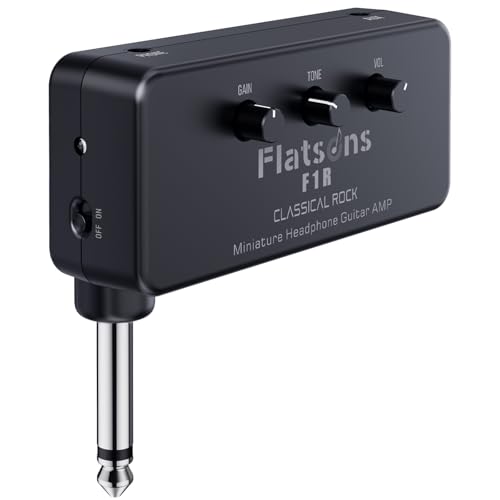
Flatsons F1R Mini Guitar Headphone Amp, Distortion Timbre
- ✓ Authentic analog tone
- ✓ Compact and portable
- ✓ Easy to use controls
- ✕ No wireless headphone support
- ✕ No built-in speaker
| Input Impedance | 1 MΩ high-impedance input |
| Sampling Resolution | 16-bit high-precision sampling |
| Distortion Type | High-gain analog distortion |
| Control Knobs | GAIN, TONE, and VOLUME |
| Connectivity | 3.5mm headphone output and 3.5mm AUX input |
| Dimensions | 88 x 73 x 28 mm |
As soon as I unboxed the Flatsons F1R Mini Guitar Headphone Amp, I was struck by how sleek and compact it feels in your hand. It’s tiny—about the size of a matchbox—but surprisingly solid, with a matte black finish that gives it a professional vibe.
The knobs for GAIN, TONE, and VOL are easy to turn, with a satisfying click that makes fine-tuning effortless.
Plugging in my guitar, I immediately noticed how clear the signal was, thanks to that 16-bit high-precision sampling. It captures every subtle nuance of my tone, which is a game-changer for practice sessions.
The high-impedance input really helps keep the sound crisp and minimizes tone loss, making your guitar sound rich and authentic.
Dialing in some classic rock distortion was a breeze. The GAIN knob lets me crank it up for full-bodied, gritty tones, while the TONE knob helps shape the sound for vintage vibes or more modern edges.
The ability to control distortion precisely means I can get my perfect sound without any muddiness or harshness.
The headphone output and AUX input are perfect for practicing silently or playing along with backing tracks. I connected my phone, and the background music sounded clear and immersive, with no lag or interference.
It’s lightweight enough to toss in my gig bag or pocket, making it ideal for on-the-go practice or quick jam sessions.
At just under $16, this amp delivers serious value. It’s simple, effective, and sounds great—especially if you love vintage rock tones.
The only downside is it’s wired-only, so wireless headphones won’t work. But for the price, it’s hard to beat.
Sound Town UPDM-Q3 1U 4-Channel Class-D Power Amplifier

- ✓ Exceptional distortion-free sound
- ✓ Lightweight yet powerful
- ✓ Versatile connectivity
- ✕ Slightly high price
- ✕ Heats up during extended use
| Power Output | 4 x 1150W RMS at 4Ω, 4 x 600W RMS at 8Ω |
| Amplifier Technology | Class-D |
| Inputs | 4 XLR balanced inputs |
| Outputs | 4 Speakon connectors with stereo/parallel/bridge modes |
| Protection Features | Overload, overheating, short circuit protection with fuse, LED indicators, 3-second start delay, built-in limiter |
| Chassis | 1U metal rack-mount enclosure |
From the moment I lifted the Sound Town UPDM-Q3 out of its box, I could tell this isn’t your average amplifier. Its sleek 1U metal chassis feels sturdy and professional, with a weight that hints at serious power inside.
The black finish is smooth, with clearly labeled LED indicators that light up sharply, making it easy to see the status at a glance.
Once powered on, the real magic begins. The sound quality is astonishing—crisp, clear, and with a distortion level that’s practically nonexistent.
It’s like hearing your favorite tracks through a whole new lens, with every detail coming through without any harshness. The advanced Class-D tech keeps things lightweight but doesn’t compromise on performance.
The connectivity options are versatile enough to handle any setup. Four XLR inputs and Speakon outputs give you plenty of flexibility.
Switching between stereo, parallel, or bridge mode is straightforward, thanks to the well-placed controls. I especially appreciated the integrated low-pass filter—perfect for subwoofers, delivering deep, clean bass without unwanted highs.
Built-in protections for overload, heat, and short circuits kept everything running smoothly, even during heavy use. The LED indicators are clear, and the 3-second start delay feels like a smart touch, preventing any sudden power surges.
The limiter ensures no distortion creeps in at high volumes, which is crucial for live sound or critical listening environments.
Overall, this amp handles demanding applications with ease, and its durability means it could be a long-term companion for gigs or permanent setups. For its price, it’s an impressive blend of power, clarity, and reliability—exactly what you want when you demand the best in sound quality.
Ulumac Aroma 10W Bluetooth Guitar Amp with Wooden Cabinet

- ✓ Warm, full sound
- ✓ Easy Bluetooth connectivity
- ✓ Compact and portable
- ✕ Limited wattage for large spaces
- ✕ Basic tone shaping
| Power Output | 10 Watts RMS |
| Speaker Enclosure | Solid wooden cabinet with increased volume for fuller sound |
| Connectivity | Bluetooth wireless connection for streaming audio |
| Tone Controls | Gain, bass, and treble knobs for sound shaping |
| Modes | Clean and distortion channels |
| Additional Features | Headphone jack for silent practice, included power adapter |
Imagine you’re late-night jamming in your apartment, and you want that rich, full-bodied sound without disturbing everyone. You pick up the Ulumac Aroma 10W Bluetooth Guitar Amp, and as soon as you lift it out of the box, you notice its sturdy wooden cabinet—feels solid and premium.
The warm, natural resonance from that larger cabinet instantly makes your practice feel more immersive.
Switching it on, you’re greeted with a balanced volume perfect for your bedroom sessions. The sound isn’t thin or harsh like some mini amps; instead, it’s warm, full, and surprisingly rich for a 10W practice amp.
That wooden enclosure really helps deliver a natural tone that makes your riffs come alive.
Connecting your phone via Bluetooth is a breeze—no tangled cables, just instant playback of your favorite backing tracks or lessons. The controls are straightforward: toggle between clean and distortion modes, then tweak gain, bass, and treble to get your desired tone.
Whether you’re playing blues, rock, or experimenting with new sounds, it adapts easily.
The headphone jack is a lifesaver for late-night practice, keeping your neighbors happy. Plus, the compact size means you can take it anywhere—perfect for small spaces or even spontaneous jam sessions at a friend’s place.
The included power adapter keeps everything steady and reliable during your sessions.
Overall, this amp packs impressive distortion sound quality in an affordable, user-friendly package. It’s a great choice for beginners who want a richer tone and versatile features without breaking the bank.
What Truly Defines the Best Amplifier Distortion Sound?
The best amplifier distortion sound is defined by several key characteristics that contribute to its musicality and appeal.
- Harmonic Content: The richness and complexity of the harmonic overtones produced by an amplifier greatly influence its distortion sound. A desirable distortion will often enhance even-order harmonics, creating a warmer, more musical tone that can be pleasing to the ears.
- Dynamic Response: An amplifier’s ability to respond dynamically to playing techniques, such as picking intensity or finger pressure, plays a crucial role in defining its distortion sound. A responsive amplifier allows for greater expressiveness, where subtle nuances in playing can be conveyed through varying degrees of distortion.
- Clipping Characteristics: The way an amplifier clips the audio signal when pushed to its limits is essential in shaping its distortion sound. Soft clipping tends to produce a smoother, more musical distortion, while hard clipping can result in a more aggressive, edgy tone, appealing to different genres and preferences.
- Frequency Range: The frequency response of an amplifier influences how distortion sounds in context with the rest of the mix. An amplifier that maintains clarity across the entire frequency spectrum, especially in the midrange where guitars often reside, will produce a more defined and articulate distortion sound.
- Power Ratings: The power output of an amplifier can affect how it distorts at different volume levels. Lower-wattage amplifiers may break up earlier and provide a pleasing saturation at lower volumes, while higher-wattage models may require more power to achieve the same level of distortion, resulting in different tonal qualities.
- Speaker Interaction: The interaction between the amplifier and the speaker cabinet is crucial in shaping the overall distortion sound. Different speaker types and configurations can accentuate or mellow out certain frequencies, affecting how distortion is perceived and experienced by the listener.
Which Types of Amplifier Distortion Sounds Are Most Popular?
Bit crushing introduces intentional artifacts that result in a distinctively gritty sound; it is favored in electronic genres where unique textures are sought after. This method effectively reduces fidelity, transforming clean signals into something raw and unconventional, thereby contributing to the creative sound palette of modern music.
How Do Tube and Solid-State Distortions Differ in Sound Quality?
Ultimately, the choice between tube and solid-state distortion often comes down to personal preference and the specific sound characteristics that a musician seeks to achieve in their performance.
What Factors Influence Our Perception of Distortion in Amplifiers?
Several factors influence our perception of distortion in amplifiers, particularly when aiming for the best amplifier distortion sound ever:
- Type of Distortion: Different types of distortion can be produced by amplifiers, such as harmonic, intermodulation, or crossover distortion. Harmonic distortion adds overtones to the original signal, which can be pleasing to the ear when kept within certain limits, while intermodulation distortion can create unwanted frequencies that may detract from sound quality.
- Gain Settings: The gain setting on an amplifier significantly affects how distortion is perceived. Higher gain levels can lead to increased distortion, which may enhance the sound character in some contexts, such as rock music, but could also result in harshness if pushed too far.
- Speaker Compatibility: The type and quality of speakers used with an amplifier can greatly influence the perception of distortion. Different speakers respond differently to amplified signals, which can either emphasize or soften the distortion, thus altering the overall sound quality.
- Output Stage Design: The design of the amplifier’s output stage plays a crucial role in how distortion is handled. Class A amplifiers tend to produce smoother distortion characteristics, while Class D amplifiers can introduce more abrupt distortion, affecting how listeners perceive the sound.
- Listening Environment: The acoustics of the environment where the music is played can also impact how distortion is perceived. Reflections, room size, and furnishings can either enhance or mask certain frequencies, changing the listener’s experience of the amplifier’s distortion.
- Personal Preference: Each listener’s individual taste in sound can heavily influence their perception of distortion. Some may prefer the warmth of tube amp distortions, while others might favor the clarity of solid-state amplifiers, leading to varied opinions on what constitutes the “best” distortion sound.
Which Iconic Amplifiers Are Celebrated for Their Distortion Sounds?
The most celebrated amplifiers known for their iconic distortion sounds include:
- Marshall JCM800: A staple in rock music, this amplifier is renowned for its aggressive and crunchy distortion.
- Fender Bassman: Known for its warm and creamy overdrive, the Bassman has been a favorite among blues and rock musicians.
- Petersen Amps 5150: This amp is famous for its high-gain distortion, making it a go-to for metal guitarists.
- Vox AC30: With its chimey, harmonically rich distortion, the AC30 is a classic choice for many iconic bands.
- Orange Rockerverb: This amplifier combines powerful gain with a distinctive midrange punch, ideal for heavy rock tones.
The Marshall JCM800 is celebrated for its hard-hitting distortion, often associated with the sounds of 80s rock and metal. Its simple controls allow for a wide range of tonal possibilities, from smooth bluesy overdrive to aggressive distortion that cuts through the mix.
The Fender Bassman offers a rich and warm overdrive that is highly sought after for its smoothness and musicality. Originally designed for bass, it has found a place in guitar amplification due to its ability to produce creamy distortion, making it ideal for blues and classic rock styles.
The Petersen Amps 5150, originally designed for Eddie Van Halen, is known for its high-gain capabilities that produce a tight and aggressive distortion. This amp is particularly favored in the metal genre, providing a heavy, saturated sound that allows for articulate playing even at high levels of distortion.
The Vox AC30 is beloved for its unique tonal character, providing a bright, chimey distortion that is rich in harmonics. This amp’s ability to produce a natural overdrive when pushed makes it a favorite among many iconic guitarists, particularly in the indie and classic rock scenes.
The Orange Rockerverb is recognized for its powerful gain structure and distinctive midrange presence, which makes it capable of delivering both clean and distorted tones effectively. Its versatility allows guitarists to achieve everything from heavy rock sounds to dynamic cleans, making it a popular choice in modern music.
What Brands Are Considered the Gold Standard for Distortion?
Several brands are widely regarded as the gold standard for achieving exceptional amplifier distortion sound.
- Marshall: Known for its iconic roar, Marshall amplifiers are synonymous with rock music and provide a rich, saturated distortion that enhances both power chords and solos.
- Fender: Fender amplifiers, particularly the classic tube models, offer a warm, dynamic distortion that is highly sought after by blues and country musicians for its musicality and responsiveness.
- Mesa/Boogie: Renowned for their high-gain distortion, Mesa/Boogie amps are favored by metal and hard rock players, delivering a thick, aggressive tone with excellent sustain and clarity.
- Vox: Vox amplifiers are celebrated for their chimey, mid-range-heavy distortion, which is ideal for achieving a vintage sound reminiscent of the British Invasion era.
- Orange: Orange amplifiers are known for their unique, gritty distortion that maintains clarity even at high gain settings, making them popular in various genres including rock and metal.
Marshall amplifiers are often the go-to choice for guitarists looking for that powerful, crunchy sound that can cut through a mix. Their signature tone is characterized by a harmonic richness that allows for expressive playing and dynamic response.
Fender amplifiers, especially models like the Twin Reverb and Deluxe Reverb, produce a smooth, creamy distortion that enhances the natural characteristics of the guitar, making them ideal for genres that prioritize melodic expression.
Mesa/Boogie amps are engineered for versatility, allowing players to dial in everything from smooth blues tones to fierce metal tones, all while maintaining clarity and note definition even when heavily distorted.
Vox amplifiers, such as the AC30, are known for their distinctive tonal characteristics that provide a bright, articulate sound with a unique break-up when pushed, offering a different flavor of distortion that appeals to many players.
Orange amplifiers, with their distinctive color and robust build, produce a raw, aggressive distortion that is perfect for rock and metal, providing a thick sound that remains articulate and punchy even at extreme gain levels.
How Can Musicians Effectively Achieve Their Desired Distortion?
Musicians can achieve their desired distortion by focusing on various elements of their gear and technique.
- Amplifier Selection: Choosing the right amplifier is crucial for achieving the best distortion sound. Tube amplifiers are renowned for their warm and rich distortion characteristics, as they naturally compress the signal and add harmonics when pushed, while solid-state amplifiers often provide a more consistent and clean distortion.
- Gain Settings: Adjusting the gain on the amplifier can have a significant impact on the level and quality of distortion. Higher gain settings will lead to more saturation and clipping, resulting in a heavier, more aggressive tone, while lower settings can produce a more subtle and melodic distortion.
- Effects Pedals: Incorporating distortion or overdrive pedals can help shape the tone further. Different pedals offer a variety of distortion flavors, from smooth and creamy to gritty and aggressive, allowing musicians to tailor their sound to their liking.
- EQ Adjustments: Equalization plays a vital role in how distortion is perceived. By adjusting the EQ settings on the amplifier or using an external EQ pedal, musicians can enhance certain frequencies, helping to bring out the desired characteristics of their distortion sound.
- Playing Technique: The way a musician plays their instrument can influence the distortion sound significantly. Techniques such as palm muting, fingerpicking, or using a pick can alter the dynamics and attack of the notes, thus affecting the overall distortion quality.
- Speaker Choice: The type of speakers used in the amplifier can also impact the distortion tone. Different speaker designs and materials respond differently to distortion, with some providing a more pronounced bass response and others offering a clearer high-end, which can enhance the overall sound.
- Volume Levels: Achieving the best distortion often requires finding the right volume level. Distortion tends to sound best when the amplifier is driven hard, so musicians should experiment with volume settings to find the sweet spot where the distortion feels alive and dynamic.