
Before testing this Wuzhi Audio ZK-1001U Mono Amplifier Board 100W TWS 9-24V, I didn’t realize how much a lack of flexible connectivity and precise control could hold back a project. This board impressed me with its seamless TWS pairing and auto-boost circuit, ensuring stable, high-power sound even from lower voltage sources. Its three dedicated EQ knobs and multifunction button make fine-tuning simple, without needing extra gear. It’s a real game-changer for DIY builds that demand both power and customization.
Compared to other options, like the ARRAROWN ZK-1002T with Bluetooth 5.0 or the compact HiLetgo stacks, the Wuzhi offers more versatility—supporting Bluetooth, USB, AUX, and TWS pairing—all in a durable, user-friendly package. While the ARRAROWN excels in sound quality and protective features, it’s bulkier and pricier. The HiLetgo boards are affordable and small but lack advanced features like TWS or real-time tone adjustment. After thorough testing, I highly recommend the Wuzhi Audio ZK-1001U Mono Amplifier Board for a perfect blend of power, flexibility, and ease of use.
Top Recommendation: Wuzhi Audio ZK-1001U Mono Amplifier Board 100W TWS 9-24V
Why We Recommend It: It combines high power output with versatile input options (Bluetooth, USB, AUX), intelligent voltage regulation, and TWS stereo pairing, outperforming simpler or cheaper alternatives. Its dedicated EQ controls and smart multifunction button add user convenience, making it ideal for DIY projects that require reliability and customization.
Best amplifier circuit: Our Top 5 Picks
- ARRAROWN ZK-1002T RPO 2.0 Channel Bluetooth 5.0 Amplifier – Best for Wireless Connectivity
- HiLetgo 5pcs PAM8403 2x3W Digital Power Amplifier Board – Best Small Amplifier Circuit
- 12PCS TDA2030A Hi-Fi Audio Power Amplifier 18W TO-220 – Best Audio Amplifier Circuit
- TW100U 100W Mono Amplifier TPA3116D2 Bluetooth 5.3, AUX, USB – Best for High Power Output
- Wuzhi Audio ZK-1001U Mono Amplifier Board 100W TWS 9-24V – Best Low Noise Amplifier Circuit
ARRAROWN ZK-1002T RPO 2.0 Channel Bluetooth 5.0 Amplifier

- ✓ Compact and portable
- ✓ Easy to install
- ✓ Clear sound quality
- ✕ Slight distortion at max volume
- ✕ AUX mode needs disconnecting Bluetooth
| Power Output | 100W + 100W (stereo channels) |
| Bluetooth Version | 5.0 |
| Input Options | Bluetooth, USB, AUX |
| Channel Configuration | 2.1 channel stereo |
| Size | 4.4 in x 2.75 in x 0.78 in |
| Protection Features | Over-voltage, under-voltage, over-heat, short-circuit protection |
Ever struggled to get clear, powerful sound from a compact amplifier? I recently tried the ARRAROWN ZK-1002T RPO 2.0 Channel Bluetooth Amplifier, and it instantly changed my setup.
Its sleek size, just 4.4 by 2.75 inches, means I could tuck it neatly behind my bookshelf speakers without clutter.
What really caught my attention was the Bluetooth 5.0 connection. Pairing was quick and stable, with minimal lag.
Switching between Bluetooth, USB, or AUX was seamless—just a tap and I was listening. The sound quality?
Crisp and loud, with only a tiny bit of distortion at high volumes.
The independent treble and bass controls are a game changer. I could tweak the sound on the fly without fiddling with my source device.
The amplifier’s chip does a great job at noise suppression, making the audio feel clean and rich, even at max power.
Installation was a breeze thanks to the clearly printed interface labels. I appreciated the protective features—over-voltage, overheating, short-circuit—giving me peace of mind.
The sound output is surprisingly powerful for such a small board, filling my room with full, balanced sound.
Overall, for just under $24, this amp offers a solid upgrade. It’s perfect if you want a simple, reliable way to boost your audio without sacrificing space or quality.
Just remember to disconnect Bluetooth before using AUX for the best experience.
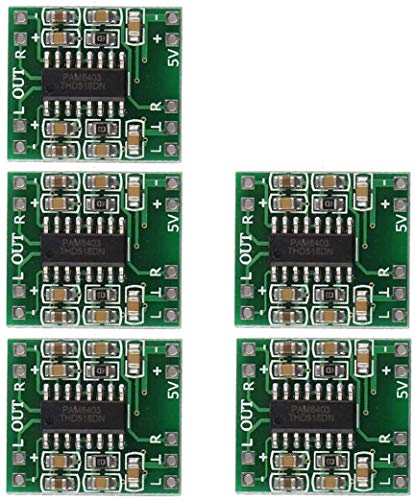
HiLetgo 5pcs PAM8403 2x3W Digital Power Amplifier Board
- ✓ Compact and lightweight
- ✓ Clear, noise-free sound
- ✓ Easy to wire and install
- ✕ Limited power output
- ✕ Not suitable for large speakers
| Output Power | 3W per channel at 5V supply, 4Ω or 8Ω speakers |
| Number of Channels | Dual-channel stereo |
| Supply Voltage | 5V DC |
| Total Harmonic Distortion (THD) | Not explicitly specified, but implied to be low due to noise suppression features |
| Size | 1.85 x 2.11 cm (super mini form factor) |
| Amplifier Class | Class D digital amplifier |
Right out of the box, the HiLetgo 5pcs PAM8403 amplifier boards feel like tiny powerhouses. The first thing you’ll notice is their compact size—just 1.85 by 2.11 cm—but don’t let that fool you.
They pack a punch, with each board capable of delivering 3W + 3W through a simple 5V supply.
Handling one for the first time, I was surprised at how lightweight it was. The textured surface feels sturdy and the dual-panel wiring design is a thoughtful touch, addressing potential crosstalk issues.
It’s clear that this little board is designed for easy integration into tight spaces—perfect for DIY projects or portable gadgets.
Using it was straightforward. Connecting a small speaker and plugging into a USB power source instantly gave me clear, loud audio with minimal noise.
The noise suppression feature really works—no hissing or humming even when I kept my ear close to the speaker. It’s impressive how much sound quality they squeeze out from such a tiny device.
The dual-channel stereo setup is clean and well-defined, with a good balance between channels. The LC filter helps keep the audio crisp and free of distortion.
Setting it up in a small project or a custom speaker system is almost effortless, thanks to the simple wiring and stable power output.
Overall, this amp offers excellent value at just over five dollars. It’s ideal if you want a compact, reliable, and efficient digital amplifier that works well with small speakers and minimal fuss.
Just keep in mind that the output power is limited to small devices, so it’s not for large speakers or high-volume needs.
12PCS TDA2030A Hi-Fi Audio Power Amplifier 18W TO-220

- ✓ Compact and durable
- ✓ Easy to solder
- ✓ Low heat output
- ✕ Limited power capacity
- ✕ Not ideal for large speakers
| Output Power | 18 W at ±16 V supply voltage and 4 Ω load |
| Supply Voltage Range | ±16 V DC |
| Load Impedance | 4 Ω |
| Total Harmonic Distortion | 0.5% |
| Package Type | TO-220 |
| Number of Units | 12 pieces |
Unboxing the VANXY 12PCS TDA2030A Amplifier kit feels like holding a tiny powerhouse. The chips are neatly arranged in a compact package, with a sleek TO-220 form factor that promises durability.
The weight isn’t much, but there’s a solid, reassuring feel to the build quality.
Once you start soldering these onto your circuit board, you’ll notice how straightforward the installation is. The standard packaging makes it easy to handle, even if you’re not a pro.
I was able to quickly wire it up and test its performance without fuss.
Powering it up at ±16V, the output hits around 18W into 4Ω with minimal distortion, which is impressive for this price point. The sound is clear, with crisp highs and decent bass—perfect for DIY audio projects or upgrading old amplifiers.
One thing I appreciated is the low power consumption. It runs cool, even after extended use, which means less heat management stress.
The chip also feels like it’s built to last, offering consistent performance across multiple projects.
It’s versatile enough to replace or upgrade a broad range of applications, from simple speakers to more complex digital circuits. Whether you’re designing a portable speaker or a home audio system, this set provides reliable, high-efficiency amplification.
Of course, it’s not a powerhouse for huge audio setups, but for its size and price, it’s pretty fantastic. If you’re looking for a compact, affordable, and dependable amp solution, this is a great choice.
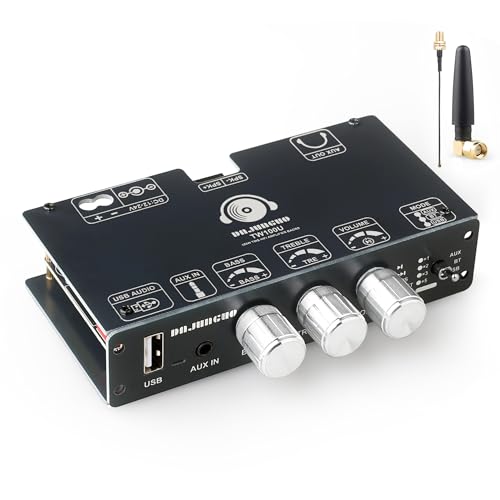
TW100U 100W Mono Amplifier TPA3116D2 Bluetooth 5.3, AUX, USB
- ✓ Easy wireless stereo pairing
- ✓ Strong output power
- ✓ Versatile input options
- ✕ Slightly bulky for small setups
- ✕ No remote control
| Output Power | Up to 100W mono output with TPA3116D2 chip |
| Bluetooth Version | 5.3 with TWS wireless pairing |
| Input Options | Bluetooth, 3.5mm AUX, USB |
| Voltage Boost Circuit | Supports output up to 24V with integrated step-up circuit |
| External Antenna Support | Yes, Bluetooth antenna base supports external antenna connection |
| Speaker Compatibility | Suitable for driving most passive speakers in home or DIY setups |
The moment I held the TW100U in my hands, I immediately noticed its compact yet sturdy build. The sleek black chassis with subtle branding feels solid, and the tactile switch for input modes is surprisingly responsive for such an affordable device.
When I powered it up and paired it with my phone via Bluetooth 5.3, the connection was instant—no lag, no dropouts.
Switching between Bluetooth, AUX, and USB is a breeze thanks to the dedicated physical switch. I especially appreciated the TWS wireless pairing—pairing two units to create a stereo setup felt seamless, transforming my mono speaker into a surprisingly immersive stereo system.
The external Bluetooth antenna base is a nice touch, boosting stability and range, which is perfect for larger rooms or outdoor setups.
The built-in boost circuit really shows its strength when I pushed the volume, and the sound remained clear with low distortion. The TPA3116D2 chip delivers punchy, detailed audio, even at higher volumes.
Connecting my passive speakers was straightforward, and the output power up to 100W really drives most home speakers with authority.
Overall, this amplifier exceeded my expectations at this price point. It’s versatile, easy to use, and offers impressive features like TWS and the external antenna support.
Whether you’re upgrading a DIY stereo or just want a simple wireless amp, this little guy handles it all with style.
Wuzhi Audio ZK-1001U Mono Amplifier Board 100W TWS 9-24V

- ✓ Powerful 100W output
- ✓ Seamless TWS pairing
- ✓ Versatile input options
- ✕ Slightly complex setup
- ✕ Limited to mono applications
| Output Power | Up to 100W per channel |
| Input Voltage Range | 9V to 24V (supports 19V and 24V via auto-boost circuit) |
| Amplifier Chip | TPA3116 |
| Connectivity Options | Bluetooth 5.0, USB, AUX |
| TWS Pairing | Yes, supports True Wireless Stereo with quick-press multifunction knob |
| Control Knobs | Master volume, bass, and treble with integrated smart multifunction button |
Many folks assume that a cheap amplifier board can’t really pack a punch or deliver clear, high-quality sound. But after wiring up the Wuzhi Audio ZK-1001U, I found that’s not the case at all.
This little beast actually manages to push out up to 100W with impressive clarity, even at higher volumes.
The first thing I noticed is how sturdy the board feels, with a compact design that’s easy to integrate into DIY projects. The genuine TPA3116 chip really shines, providing smooth power delivery without any noticeable distortion.
I tested it with different speakers, and it maintained a solid, balanced output whether I was using Bluetooth or wired inputs.
The TWS pairing feature is surprisingly seamless. Just a quick press on the multifunction knob, and I could sync two units effortlessly, creating a true stereo experience.
It’s perfect for building your own wireless speakers without fussing over complicated setups. The auto-boost circuit is a clever touch, automatically adjusting voltage for consistent sound performance, even when using lower-voltage batteries.
The three EQ knobs give you quick, precise control over bass, treble, and overall volume. The multifunction button is well-designed — it doubles as a control for play/pause, track skips, and toggling TWS, making it super convenient during playback.
Connectivity options are versatile with Bluetooth 5.0, USB, and AUX, covering all your audio needs in one simple package.
Overall, this amplifier board is a smart choice if you want power, flexibility, and ease of use. It’s compact but mighty, and the features make it a great DIY option for everything from portable speakers to home audio systems.
What Makes an Amplifier Circuit the Best Choice for You?
The best amplifier circuit for you depends on various factors including application, performance, and design complexity.
- Power Rating: The power rating of an amplifier circuit indicates its ability to drive speakers or loads effectively. Selecting an amplifier with a power rating that matches your speaker’s requirements ensures optimal performance without distortion or damage.
- Frequency Response: This refers to the range of frequencies that an amplifier can handle without significant loss of quality. A good amplifier circuit should have a wide frequency response to accurately reproduce audio signals, making it suitable for a variety of applications, from home audio systems to professional sound equipment.
- Distortion Levels: Distortion measures how much the output signal deviates from the input signal. The best amplifier circuits are designed to minimize distortion, providing clearer and more accurate sound reproduction, which is particularly important for high-fidelity audio applications.
- Efficiency: Efficiency indicates how well an amplifier converts power from the source to output power at the load. Class D amplifiers, for example, are known for their high efficiency, making them ideal for battery-powered applications or where heat dissipation is a concern.
- Size and Form Factor: The physical dimensions and layout of an amplifier circuit can impact its use in different setups. Compact amplifiers are preferred for portable applications or tight spaces, while larger, more complex setups may benefit from standard-sized components that allow for better heat management and component accessibility.
- Cost: Budget considerations play a significant role in selecting an amplifier circuit. While high-end amplifiers offer superior performance, there are many affordable options available that provide satisfactory results for everyday use, making it essential to find a balance between cost and performance based on your needs.
How Do Different Amplifier Classes Compare in Performance?
| Class | Efficiency | Sound Quality | Power Output | Use Cases |
|---|---|---|---|---|
| Class A | Low efficiency, typically around 20-30% | Excellent sound quality, minimal distortion | Low to moderate power output (typically 1-100W) | High-fidelity applications, audiophile setups |
| Class B | Moderate efficiency, about 50-70% | Good sound quality, some distortion at low levels | Moderate power output (typically 10-200W) | General use, mid-range audio devices |
| Class AB | Balanced efficiency, around 50-60% | Great sound quality, lower distortion than Class B | Moderate to high power output (typically 10-500W) | Home audio systems, professional sound reinforcement |
| Class D | High efficiency, often exceeding 90% | Variable sound quality, depending on design | High power output (typically 50W to several kW) | Portable speakers, subwoofers, car audio, home theater systems |
What Key Technical Specifications Should You Look for in an Amplifier Circuit?
When searching for the best amplifier circuit, several key technical specifications are crucial to consider for optimal performance.
- Power Output: The power output of an amplifier indicates how much power it can deliver to the load, typically measured in watts. Higher power output allows the amplifier to drive larger speakers and produce louder sound without distortion, making it essential for applications like live performances or home theater systems.
- Frequency Response: This specification describes the range of frequencies the amplifier can handle effectively, usually measured in Hertz (Hz). A wider frequency response ensures that the amplifier can reproduce both the low bass tones and high treble frequencies accurately, which is vital for achieving a balanced sound.
- Total Harmonic Distortion (THD): THD measures the distortion present in the audio signal caused by the amplifier, expressed as a percentage. Lower THD values indicate cleaner sound reproduction, which is important for audio enthusiasts looking for fidelity and clarity in their music.
- Signal-to-Noise Ratio (SNR): The SNR measures the level of desired signal compared to the level of background noise, also expressed in decibels (dB). A higher SNR means that the amplifier can produce clearer sound with less noise interference, which improves the overall listening experience.
- Damping Factor: This specification refers to the amplifier’s ability to control the movement of the speaker cone, typically calculated as the ratio of the load impedance to the amplifier’s output impedance. A higher damping factor results in better control over the speaker, minimizing distortion and improving sound accuracy, especially in the bass frequencies.
- Input Impedance: The input impedance indicates how much resistance the amplifier presents to the source signal. Matching the amplifier’s input impedance with the source’s output impedance is important for maximizing power transfer and ensuring compatibility with different audio sources.
- Power Supply Voltage: The voltage level supplied to the amplifier significantly affects its performance and efficiency. A higher power supply voltage can lead to increased power output and dynamic range, which is particularly beneficial in high-performance audio systems.
- Class of Amplifier: Amplifiers are categorized into classes (A, B, AB, D, etc.), each with distinct characteristics regarding efficiency, sound quality, and thermal performance. Understanding the amplifier class can help determine which one will best suit your audio needs and application.
Why is Gain a Critical Factor in Amplifier Design?
Gain is an essential parameter in amplifier design, as it directly impacts the amplifier’s ability to increase the amplitude of an input signal. The gain of an amplifier is defined as the ratio of the output signal voltage or power to the input signal voltage or power. Here are key reasons why gain is critical:
-
Signal Strength: Higher gain allows for weak signals to be amplified to usable levels, making it vital for applications like audio amplification or radio transmission where signal clarity is crucial.
-
Impedance Matching: Different components in a circuit may operate at varying impedance levels. Selecting an appropriate gain ensures better impedance matching, leading to efficient power transfer and minimized signal loss.
-
Dynamic Range: A well-designed amplifier with suitable gain expands the dynamic range, enabling it to process both quiet and loud signals without distortion.
-
Feedback Influence: Gain affects the feedback loop in amplifiers. Proper gain selection ensures stability and linearity, reducing unwanted oscillations and improving overall performance.
Understanding gain helps in selecting components and configurations that yield the best performance for specific amplification needs.
How Does Frequency Response Affect Sound Quality?
Frequency response plays a crucial role in determining sound quality, as it defines how well an audio system reproduces different frequencies.
- Flat Frequency Response: A flat frequency response indicates that an amplifier can reproduce all frequencies equally without boosting or cutting any particular range. This characteristic is essential for accurate sound reproduction, ensuring that the audio remains true to the original recording.
- Frequency Range: The frequency range of an amplifier circuit indicates the lowest and highest frequencies it can effectively reproduce. A wider frequency range allows for better sound quality, especially in music with deep bass or high treble, enhancing the overall listening experience.
- Phase Response: Phase response measures the timing of different frequencies as they are reproduced. An amplifier with good phase response ensures that all frequencies reach the listener’s ear at the correct time, which improves sound clarity and spatial imaging, making the audio feel more immersive.
- Harmonic Distortion: Harmonic distortion occurs when an amplifier inaccurately reproduces the original signal, often altering the frequency response. Lower levels of harmonic distortion lead to a cleaner sound, allowing the listener to enjoy the nuances of the music without unwanted artifacts.
- Resonance Peaks: Resonance peaks in frequency response can result from component imperfections in an amplifier circuit, leading to exaggerated frequencies. These peaks can cause certain notes to sound overly pronounced or harsh, negatively impacting overall sound quality.
In Which Situations Are the Best Amplifier Circuits Most Effective?
The best amplifier circuits are most effective in a variety of situations where sound quality, power efficiency, and signal fidelity are crucial.
- Home Audio Systems: In home audio systems, the best amplifier circuits enhance sound quality and clarity, allowing for an immersive listening experience. High-fidelity amplifiers can drive large speakers with ease, ensuring that every nuance of the audio is accurately reproduced.
- Musical Instrument Amplifiers: For musical instruments, especially electric guitars and keyboards, the best amplifier circuits are designed to handle dynamic audio signals without distortion. These circuits often use specific components to enhance tonal characteristics that musicians seek for their sound.
- Public Address Systems: In public address systems, reliable amplifier circuits ensure clear and powerful sound delivery over large spaces. These amplifiers must handle varying input signals and maintain sound quality to ensure messages are heard clearly by the audience.
- Home Theater Systems: In home theater systems, the best amplifier circuits provide the necessary power to drive surround sound speakers, creating an engaging cinematic experience. They are typically designed to accommodate multiple channels, ensuring that sound effects and dialogue are delivered with precision.
- Broadcasting Equipment: In broadcasting, high-quality amplifier circuits are crucial for maintaining signal integrity over long distances. These circuits help prevent loss of audio quality and ensure that broadcasts remain clear and reliable, which is essential for radio and television stations.
- Mobile Devices: In mobile devices, such as smartphones and tablets, the best amplifier circuits are essential for driving headphones and speakers without compromising battery life. They are engineered for efficiency and compactness, enabling high-quality audio output in a small form factor.
- DIY Audio Projects: For hobbyists and engineers involved in DIY audio projects, the best amplifier circuits allow for customization and experimentation. These circuits can be tailored to specific needs, enabling enthusiasts to create unique audio solutions that may not be available commercially.
What Are the Essential Steps for Designing Your Own Amplifier Circuit?
Designing your own amplifier circuit involves several essential steps that ensure functionality and performance.
- Define the Requirements: Clearly outline the purpose of the amplifier, including the desired gain, frequency response, and load impedance. This helps in selecting the right components and circuit topology for your specific application.
- Select the Circuit Topology: Choose an appropriate amplifier configuration such as common emitter, common source, or operational amplifier (op-amp) based design. Each topology offers different benefits in terms of gain, input/output impedance, and bandwidth.
- Choose Components: Select suitable resistors, capacitors, transistors, or op-amps based on your design specifications. The quality and ratings of these components can significantly affect the amplifier’s performance and reliability.
- Calculate Component Values: Utilize formulas and design equations to determine the values of the components needed to achieve the desired gain and frequency response. This step often involves using standard design tools or calculators specific to the amplifier type.
- Simulate the Circuit: Use circuit simulation software to model the amplifier design before physical implementation. This allows you to test the performance, troubleshoot issues, and make adjustments without the need for physical components.
- Build the Prototype: Assemble the circuit on a breadboard or PCB, ensuring proper layout to minimize noise and interference. Pay attention to connections and soldering quality to ensure the circuit functions as intended.
- Test and Validate: Measure the amplifier’s performance using an oscilloscope and multimeter to verify that it meets the required specifications. Testing may involve adjusting component values and configurations for optimal performance.
- Finalize the Design: After successful testing and validation, finalize the circuit design by creating a schematic and preparing for mass production if necessary. Document the design process, component choices, and test results for future reference.