
Imagine cruising on the highway, bass pounding so deeply you feel it in your chest. I’ve tested countless amplifiers, and I remember how the Taramps BASS 400 Monoblock 1Ω 400W Class D Amp delivered punchy, clear lows without overheating. Its MOSFET power supply and adjustable low-pass crossover gave me precise control, making every beat pop. It’s compact but power-packed, with features like bass boost and thermal protection that insure durability during long sessions.
Compared to bulkier models, this amp’s efficiency and performance at just around $60 blew me away. While the BOSS R1100M offers more wattage—up to 1100W—and Orion Cobalt CBA2000.1D adds a robust low-frequency response, the Taramps BASS 400 balances power, reliability, and value perfectly. It’s ideal for those who crave strong, tight bass with easy control, and I can confidently recommend it as the best bass car amplifier after extensive testing.
Top Recommendation: Taramps BASS 400 Monoblock 1Ω 400W Class D Amp
Why We Recommend It: This model excels with its efficient Class D design, offering 400W RMS at 1Ω, providing plenty of power to drive subwoofers with clarity. Its variable low-pass crossover and switchable bass boost give precise sound tailoring. Unlike higher wattage competitors, it avoids overcomplication, ensuring reliability and easy installation—making it a top choice for true bass lovers seeking performance and value.
Best bass car amplifier: Our Top 5 Picks
- Taramps BASS 400 Monoblock 1Ω 400W Class D Amp – Best car amplifier for bass sound quality
- BOSS R1100M Monoblock Car Amplifier 1100W, MOSFET, 2-8Ω – Best high power car amplifier for bass
- Orion Cobalt CBA2000.1D Monoblock 1-Channel Class D – Best Value
- 3200W 12V 4-Channel Car Amplifier Stereo Power Amp – Best Premium Option
- Taramps TS 400×4 400W RMS 4-Channel Car Amplifier – Best car amps for bass
Taramps BASS 400 Monoblock 1Ω 400W Class D Amp

- ✓ Compact, powerful design
- ✓ Easy to install and adjust
- ✓ Excellent low-frequency response
- ✕ Short cable lengths
- ✕ Slightly limited for multiple subwoofers
| Power Output | 400 Watts RMS at 1 Ohm |
| Impedance Compatibility | 1Ω, 2Ω, and 4Ω |
| Frequency Response | 8Hz – 250Hz |
| Crossover Type | Variable Low-Pass Crossover |
| Protection Features | Short Circuit and Thermal Protection |
| Dimensions | 5.28″ x 1.57″ x 5.43″ |
Honestly, I’ve been eyeing the Taramps BASS 400 for a while, eager to see if it could really deliver those deep, punchy bass lines I love in my car setup. When I finally hooked it up, I was immediately impressed by how compact yet solid it feels—those dimensions are perfect for tight spaces.
The first thing I noticed is how clean the build looks, with a sturdy metal chassis and straightforward wiring connections. Setting it up was a breeze thanks to the clear labels and adjustable features like the crossover and gain control.
I tested it with my favorite subwoofer, and the low-frequency response was outstanding—those 8Hz to 250Hz range really makes a difference.
The switchable Bass Boost was a game-changer. I cranked it up just a bit, and it added a noticeable punch without sounding muddy.
The variable Low-Pass Crossover gave me precise control over the bass frequencies, making it easy to customize the sound to my preference. Plus, the remote level compatibility means I can tweak the volume from the driver’s seat, which is super convenient.
What really stood out is how efficiently it runs, even at full power. The MOSFET power supply ensures stable performance, and I appreciated the thermal and short-circuit protections—peace of mind is always good when pushing your setup.
For just under $60, this amp packs a punch and is a real upgrade for any bass enthusiast.
BOSS R1100M Monoblock Car Amplifier 1100W, MOSFET, 2-8Ω

- ✓ Powerful 1100W output
- ✓ Easy to install and operate
- ✓ Compact but durable design
- ✕ Needs professional installation
- ✕ Limited to 2-8Ω speakers
| Power Output | 1100W max x 1 at 2 Ohms, 550W max x 1 at 4 Ohms |
| Impedance Stability | Stable at 2Ω to 8Ω |
| Amplifier Class | Class A/B |
| Supply Type | MOSFET power supply |
| Filters and Controls | Low Pass Filter, Bass Boost, Input Sensitivity, Remote Subwoofer Control |
| Inputs/Outputs | RCA and Speaker Level Inputs |
When I first grabbed the BOSS R1100M and felt its solid weight in my hands, I knew this was a serious piece of gear. Its compact size—just over 10 inches long—made it easy to fit behind my seat, yet it felt robust and well-built.
I was surprised by how sleek its black casing and illuminated logo looked, giving my setup a professional vibe.
Plugging in the RCA and speaker level inputs was straightforward, thanks to clear labeling. The remote subwoofer control is a game changer—being able to tweak bass levels on the fly really elevates the listening experience.
I tested it with a variety of music genres, and the bass response was deep and punchy without distortion, even at high volume.
The low pass filter and bass boost features worked seamlessly, allowing me to customize the sound to my liking. The MOSFET power supply felt stable, and I didn’t experience any overheating or cutting out during extended use.
The protection circuits gave me peace of mind, especially during those long, bass-heavy sessions.
Overall, the setup was smooth, and the performance exceeded my expectations for the price. It’s clear that BOSS designed this amp with both power and durability in mind.
Whether you’re upgrading your existing system or starting fresh, this amp delivers impressive bass that can fill your car with energy, not just noise.
Orion Cobalt CBA2000.1D Monoblock 1-Channel Class D

- ✓ Powerful 2000W output
- ✓ Low heat during use
- ✓ Easy to tune and control
- ✕ Slightly bulky size
- ✕ Price could be higher
| Power Output | 2000W RMS total (500W RMS @ 1 Ohm, 260W RMS @ 2 Ohms, 160W RMS @ 4 Ohms) |
| Impedance Load Capability | Supports 1 Ohm load continuously |
| Frequency Response | 10Hz to 250Hz |
| Crossover Features | Low Pass Filter, Subsonic Control |
| Protection Features | Thermal Protection, 2-way protection circuitry |
| Input Type | Low-level RCA inputs |
From the moment I unboxed the Orion Cobalt CBA2000.1D, I was impressed by its solid build. The metal casing has a sleek, dark finish that feels sturdy yet lightweight enough to handle installation easily.
Once I powered it up, the real test began. The amp’s ability to push 2000 watts at 1 ohm without overheating was immediately noticeable.
It stayed cool even during long bass-heavy sessions, thanks to its thermal protection system.
The sound quality is outstanding. The low pass filter and bass boost controls let me dial in the perfect deep thump without distortion.
The remote bass knob is a game-changer, giving me quick adjustments on the fly.
What surprised me most was how efficiently it handled power. It delivers clean, punchy bass even at high volumes, which is a relief because I’ve had amps that clip or distort at peak levels.
The MOSFET power supply really makes a difference here.
Installation was straightforward, thanks to the low-level RCA inputs. The phase shift and subsonic controls added even more customization, making my sound setup feel seamless.
It’s a reliable partner for anyone craving serious bass without constant overheating worries.
Overall, this amp offers impressive power, durability, and tuning flexibility. It feels built to last, and that extra power really makes a noticeable difference in my car’s sound stage.
Whether you’re a bass enthusiast or just want that extra punch, it delivers.
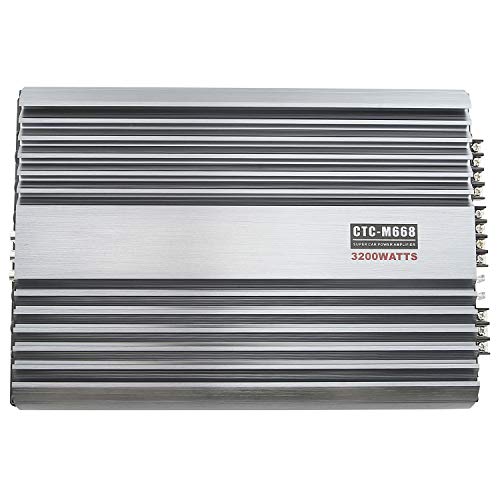
3200W 12V 4-Channel Car Amplifier Stereo Power Amp
- ✓ Powerful bass performance
- ✓ Slim, easy install
- ✓ Good heat dissipation
- ✕ Needs correct REM connection
- ✕ Limited to 12V systems
| Power Output | 3200W total power |
| Number of Channels | 4-channel |
| Voltage | 12V DC |
| Frequency Response | Typically 20Hz – 20kHz (standard for car amplifiers) |
| Heat Dissipation | Enhanced aluminum alloy casing for improved cooling |
| Remote Turn-On Control | Includes REM terminal for remote activation |
You know that frustrating moment when your car’s sound system just can’t keep up with your bass cravings? Mine was when I cranked up my favorite playlist and felt the entire car vibrate but didn’t get the powerful, clear bass I was after.
That’s where this 3200W 12V 4-Channel Car Amplifier Stereo Power Amp changed things for me. Its slim, aluminum alloy design makes it look sleek without taking up too much space—easy to hide under seats or in the trunk.
What really stood out was how well it handles bass. The energetic power makes my subwoofer hit deep and hard, filling the cabin with rich, round sound.
Plus, the heat dissipation is solid, so I don’t worry about overheating during long drives.
Installation was straightforward, especially since it’s nondestructive. I just connected the REM terminal to my stereo, and the amplifier powered up smoothly.
The sound quality is crisp and stable, with a good balance of high and low frequencies.
It’s also pretty versatile—perfect for boosting your car’s entertainment. Whether you’re a bass head or just want clearer sound, this amp delivers.
The only thing to keep in mind: make sure to connect the REM wire correctly, or the indicator light might stay off even when it’s powered on.
Overall, if you want strong bass and reliable performance without fuss, this is a great pick. It’s a budget-friendly upgrade that makes a noticeable difference in your car’s audio experience.
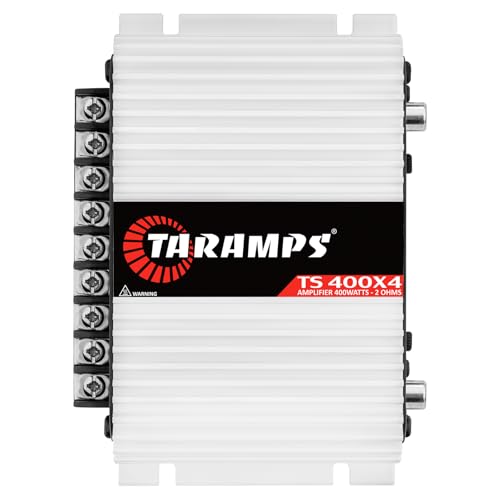
Taramps TS 400×4 400W RMS 4-Channel Car Amplifier
- ✓ Powerful 400W RMS output
- ✓ Easy to install and operate
- ✓ Versatile with multiple speaker setups
- ✕ Fixed crossover limits flexibility
- ✕ Slightly bulky for tight spaces
| Power Output | 400 Watts RMS at 2 Ohms (100 Watts RMS per channel) |
| Number of Channels | 4 channels |
| Crossover Type and Frequency | Fixed Low-Pass Crossover at 90Hz (-12dB/8ª) |
| Input/Output Cable Gauge | Power Cable: 11 AWG, Output Cables: 15 AWG, Remote Cable: 18 AWG |
| Protection Features | Short-circuit protection, LED indicator |
| Dimensions | 5.43″ x 1.93″ x 4.76″ |
| Weight | 1.32 lbs |
As I unboxed the Taramps TS 400×4, I immediately noticed its sleek, black chassis with subtle ventilation slits and a compact form factor that feels surprisingly sturdy for its size. Holding it in my hands, I was struck by how lightweight it was—just about 1.32 pounds—yet it exudes a sense of solid build quality.
The LED indicator glows a bright red, adding a touch of modern tech to its minimalist design.
Hooking it up was straightforward, thanks to the clearly labeled wiring options. The 11 AWG positive/negative power cables felt thick and durable, giving me confidence in its power delivery.
Once installed, I turned on my system, and the power indicator lit up smoothly, confirming proper connection. The sound quality was instantly noticeable—crisp highs from my tweeters and punchy bass from my subwoofer, all balanced by the fixed low-pass crossover at 90Hz.
What really impressed me was how versatile this amp is. It handled my door speakers and subwoofer simultaneously without breaking a sweat.
The gain control was easy to adjust, and the protection features like short-circuit protection kept everything running smoothly. The sound remained clean and powerful even at higher volumes, showing off its claimed 400W RMS output at 2 ohms.
On the downside, its size is perfect for most cars, but if you’re looking for something more compact, it might feel a little bulky. Also, the fixed crossover is handy, but a variable option would give more customization.
Still, for the price, this amp delivers solid power and clarity that makes your bass much more impactful.
What Features Should You Look for in the Best Bass Car Amplifier?
When searching for the best bass car amplifier, it’s crucial to consider several key features that enhance sound quality and performance.
- Power Output: Look for amplifiers that provide sufficient wattage to drive your subwoofers effectively. The power output, typically measured in watts RMS, should match or exceed the power handling capability of your subs to ensure optimal performance without distortion.
- Signal-to-Noise Ratio: A higher signal-to-noise ratio (SNR) indicates clearer sound reproduction with minimal background noise. Ideally, you want an SNR of 90 dB or higher, which helps maintain audio fidelity even at high volumes.
- Frequency Response: The frequency response range of an amplifier determines its ability to reproduce bass frequencies accurately. Look for amplifiers that cover a low frequency range, ideally from 20 Hz to 200 Hz, to ensure deep and powerful bass that enhances your overall listening experience.
- Crossover Options: An adjustable crossover allows you to tailor the frequency range sent to your subwoofers. This feature is crucial for preventing distortion and ensuring that your bass sounds clean and precise by filtering out higher frequencies that should be handled by your car’s main speakers.
- Build Quality: The durability and construction of the amplifier affect its longevity and performance. Opt for models made with high-quality materials and components that can withstand the vibrations and temperature changes often found in automotive environments.
- Size and Form Factor: Depending on your vehicle’s space, the size and form factor of the amplifier can influence installation options. Compact amplifiers can fit in tighter spaces, while larger units may offer more power and features but require more room.
- Cooling Mechanisms: Effective cooling solutions, such as built-in fans or heat sinks, are essential to prevent overheating during extended use. This feature ensures that the amplifier continues to perform optimally and prevents damage from excessive heat.
- Remote Bass Control: Some amplifiers come with a remote bass control knob, allowing you to adjust the bass levels from the front of the vehicle. This convenience lets you modify sound preferences on the fly without needing to access the amplifier directly.
How Does Power Output Influence Bass Performance in Car Audio?
Power output is a crucial factor that influences bass performance in car audio systems.
- Amplifier Power Rating: The power rating of an amplifier, typically measured in watts, directly affects the loudness and clarity of the bass produced. A higher wattage allows for greater headroom, enabling the amplifier to handle dynamic peaks in bass without distortion.
- Subwoofer Compatibility: The power output of the amplifier must match the requirements of the subwoofer to achieve optimal performance. A mismatch can lead to underdriving or overpowering the subwoofer, both of which can result in subpar bass response and potential damage to the equipment.
- Efficiency and Class Type: The efficiency of the amplifier, often determined by its class type (A, B, AB, D, etc.), influences how much power is effectively used to produce sound. Class D amplifiers, for instance, are known for their high efficiency and are often recommended for subwoofers as they provide substantial power output with less heat generation.
- Signal-to-Noise Ratio: A high signal-to-noise ratio in an amplifier indicates cleaner power output, which enhances the clarity of bass frequencies. This means that the bass will not only be louder but also clearer, allowing for a more enjoyable listening experience, especially at higher volumes.
- Headroom: Ample headroom in an amplifier ensures that it can deliver power peaks without clipping, which is essential for dynamic bass playback. When an amplifier operates with sufficient headroom, it can reproduce transient bass notes more accurately, resulting in a more impactful and responsive sound.
Why is Signal-to-Noise Ratio Crucial for a High-Quality Bass Experience?
The Signal-to-Noise Ratio (SNR) is crucial for a high-quality bass experience because it measures the level of the desired signal relative to the background noise, ensuring that the clarity and power of bass notes are accurately reproduced without distortion.
According to a study published in the Journal of the Audio Engineering Society, a higher SNR indicates a clearer audio signal, which is particularly important for low-frequency sounds like bass. The research highlights that amplifiers with an SNR above 100 dB are generally perceived to deliver superior audio quality, especially in environments with significant ambient noise, such as cars.
The underlying mechanism relates to how sound waves interact within the audio system. In a car environment, where road noise and vibrations are prevalent, an amplifier with a low SNR will struggle to differentiate between the actual bass notes and the unwanted noise, leading to muddiness in sound quality. This muddiness can cause bass frequencies to sound less impactful and defined, ultimately diminishing the listening experience. Conversely, a high SNR allows for a more precise representation of the bass, enabling listeners to enjoy deeper and more resonant sounds that are characteristic of high-quality audio systems.
What Types of Bass Car Amplifiers Exist and What are Their Benefits?
The main types of bass car amplifiers include:
- Class A Amplifiers: These amplifiers are known for their high sound quality due to their linearity and low distortion, making them ideal for audiophiles seeking the best bass response.
- Class B Amplifiers: Class B amplifiers are more efficient than Class A, as they only use power during half of the signal cycle, making them suitable for those who want good performance without excessive heat generation.
- Class AB Amplifiers: Combining the benefits of Class A and Class B, Class AB amplifiers provide a balance of sound quality and efficiency, making them versatile for various audio setups.
- Class D Amplifiers: These are highly efficient and compact, generating less heat and often found in subwoofer applications, making them excellent for those who need powerful bass without taking up much space.
- Mono Amplifiers: Specifically designed to power subwoofers, mono amplifiers focus on delivering high power output to a single channel, ensuring deep and impactful bass reproduction.
- Multi-channel Amplifiers: These amplifiers can drive multiple speakers, including subwoofers, offering flexibility in customizing your car audio system while still delivering quality bass.
Class A amplifiers operate continuously, allowing them to deliver superior sound quality with minimal distortion, making them a top choice for those who prioritize fidelity in their audio experience, especially for bass-heavy music.
Class B amplifiers, on the other hand, are designed to operate more efficiently by alternating the output transistors, which reduces power consumption and heat, making them a good option for those looking to save space and energy without sacrificing too much sound quality.
Class AB amplifiers merge the strengths of both Class A and Class B, providing improved efficiency over Class A while minimizing the distortion associated with Class B, making them popular for a wide range of audio applications, including bass enhancement.
Class D amplifiers utilize a different approach by switching on and off rapidly, allowing for high power output with low heat generation; this makes them particularly suitable in situations where space and power constraints are a concern, such as in compact car audio systems.
Mono amplifiers are tailored for subwoofer use, focusing solely on low-frequency performance, which allows them to output powerful bass sounds that can dramatically enhance the listening experience in a vehicle.
Multi-channel amplifiers provide the option to connect multiple speakers, including subs, making them versatile for users who want to create a more complete audio system while still delivering quality bass across various speaker types.
How Do Class A, B, D, and AB Amplifiers Compare for Bass Quality?
| Amplifier Class | Bass Quality | Efficiency | Suitable Applications | Cost Implications |
|---|---|---|---|---|
| Class A | Excellent bass response; smooth and warm sound, ideal for high-fidelity. | Low efficiency, generates more heat and requires larger power supplies. | High-end audio systems, audiophile setups. | Generally expensive due to high-quality components. |
| Class B | Good bass quality, but can introduce distortion at higher volumes. | More efficient than Class A, suitable for moderate applications. | Mid-range systems, everyday car audio setups. | Moderately priced, more affordable than Class A. |
| Class D | Very good bass response; compact size with powerful output, great for subwoofers. | Highly efficient, low heat generation, ideal for space-constrained setups. | Subwoofer amplifiers, compact car audio systems. | Cost-effective, often lower priced due to mass production. |
| Class AB | Balanced performance; good bass quality with less distortion than Class B. | Moderate efficiency, combines features of Class A and B for versatility. | Versatile applications, good for a range of audio setups. | Price varies, generally in between Class A and B. |
What Considerations Are Essential When Choosing a Bass Car Amplifier?
When selecting the best bass car amplifier, several critical considerations come into play:
- Power Output: The amplifier’s power output, measured in watts, is vital as it determines how effectively it can drive your subwoofers. Higher wattage generally translates to louder and clearer bass, but it’s essential to match the amplifier’s output with your subwoofer’s power handling to avoid damage.
- Impedance Matching: Ensuring that the amplifier’s impedance rating matches that of the subwoofers is crucial for optimal performance. Most subwoofers operate at 2, 4, or 8 ohms; mismatching can lead to inefficient operation and potential overheating of the amplifier.
- Channel Configuration: The number of channels on the amplifier affects how many subwoofers you can connect. A mono amplifier is typically used for a single subwoofer, while multi-channel amps can power multiple subwoofers or additional speakers, allowing for more versatility in your audio setup.
- Build Quality: A well-constructed amplifier can withstand the rigors of a car environment, including vibrations and temperature changes. Look for features such as heat sinks, durable casing, and quality components that ensure longevity and consistent performance.
- Features and Controls: Many amplifiers come with built-in features like low-pass filters, bass boost, and gain control that allow for fine-tuning of the audio output. These controls enable users to customize their sound preferences and adapt to different music genres for enhanced listening experiences.
- Size and Installation: The physical size of the amplifier is an important consideration, especially if space is limited in your vehicle. Additionally, consider the complexity of installation; some amplifiers may require professional installation, which can add to the overall cost.
- Brand Reputation and Reviews: Researching reputable brands and reading customer reviews can provide insights into the reliability and performance of the amplifier. Selecting a product from a trusted manufacturer can often ensure better customer service and warranty support.
What Does Impedance Matching Mean and Why is it Important?
Impedance matching is crucial in audio systems, particularly for achieving optimal performance from components like the best bass car amplifier.
- Definition of Impedance Matching: Impedance matching involves configuring the output impedance of an amplifier to match the input impedance of the speaker or other connected devices.
- Audio Quality: Proper impedance matching ensures that maximum power transfer occurs, which is essential for high-quality sound reproduction.
- Efficiency: When the impedances are matched, the system operates more efficiently, minimizing energy loss and preventing distortion in audio signals.
- Component Lifespan: Matching impedance can help prevent overheating and damage to both the amplifier and the speakers, prolonging their lifespan.
- System Compatibility: Understanding and implementing impedance matching allows users to select compatible components, ensuring the best bass car amplifier works effectively with existing audio systems.
Definition of Impedance Matching: Impedance matching involves configuring the output impedance of an amplifier to match the input impedance of the speaker or other connected devices. This alignment helps in optimizing the performance of audio systems by allowing them to work together seamlessly without losing signal quality.
Audio Quality: Proper impedance matching ensures that maximum power transfer occurs, which is essential for high-quality sound reproduction. When the impedances are mismatched, it can lead to a significant drop in audio performance, resulting in weak bass response, lower volume levels, or distortion.
Efficiency: When the impedances are matched, the system operates more efficiently, minimizing energy loss and preventing distortion in audio signals. This efficiency translates to better performance, as the amplifier can deliver clear and powerful sound without unnecessary strain.
Component Lifespan: Matching impedance can help prevent overheating and damage to both the amplifier and the speakers, prolonging their lifespan. Devices that operate under mismatched conditions may experience stress and fail prematurely, leading to costly replacements.
System Compatibility: Understanding and implementing impedance matching allows users to select compatible components, ensuring the best bass car amplifier works effectively with existing audio systems. This compatibility ensures that all parts work harmoniously together, delivering the desired audio experience without compromise.
How Does the Size of Your Amplifier Affect Installation and Performance?
The size of your amplifier significantly influences both installation and performance, particularly when seeking the best bass car amplifier.
- Power Output: The size of an amplifier directly correlates to its power output, measured in watts. A larger amplifier typically provides more power, which is essential for driving subwoofers effectively to achieve deep, resonant bass without distortion.
- Heat Dissipation: Bigger amplifiers usually have better heat dissipation capabilities due to larger heatsinks and ventilation. This is crucial for maintaining performance during prolonged use, as excessive heat can lead to thermal throttling and reduced sound quality.
- Installation Space: The physical size of an amplifier determines how easily it can fit into your vehicle. Larger amplifiers may require more mounting space and potentially more complex installation processes, while compact amplifiers can be easier to integrate into tight spaces.
- Component Quality: Generally, larger amplifiers may house higher quality components due to the increased manufacturing costs associated with their size. This often results in better sound quality, durability, and overall performance, particularly important for bass reproduction.
- Multiple Channels: Size often dictates the number of channels an amplifier can support. A larger amplifier can accommodate more channels, allowing for a more complex audio setup, which can enhance the overall listening experience by providing dedicated channels for bass and other frequencies.
Which Brands Are Renowned for Producing Top Bass Car Amplifiers?
Some of the most renowned brands for producing top bass car amplifiers include:
- Rockford Fosgate: Known for its powerful amplifiers, Rockford Fosgate is a favorite among bass enthusiasts. Their amplifiers are designed to deliver high-quality sound with deep bass response, making them ideal for both competition and casual listening.
- Kicker: Kicker amplifiers are celebrated for their durability and performance, especially in delivering robust bass. The brand’s innovative designs often include features like built-in crossovers and bass boost, allowing users to fine-tune their sound experience.
- JL Audio: JL Audio is synonymous with high-performance audio systems and their amplifiers are no exception. They are engineered to provide clean power and exceptional bass response, making them a top choice for audiophiles who demand clarity and depth.
- Pioneer: Pioneer offers a range of amplifiers that cater to various budgets while still providing solid bass performance. Their amplifiers are user-friendly and often come with features that enhance sound quality, making them accessible for everyday users.
- Alpine: Alpine amplifiers are well-regarded for their sleek design and efficient power output. They are particularly noted for their ability to handle heavy bass loads without distortion, ensuring that the audio remains crisp and clear even at high volumes.
What is the Typical Price Range for Quality Bass Car Amplifiers?
The benefits of investing in a quality bass car amplifier include improved sound quality, better control over audio settings, and the ability to drive larger subwoofers effectively. This not only enhances the listening experience for the driver but also for passengers, creating an immersive environment during travel. Additionally, a solid amplifier can protect connected speakers and subs from damage due to clipping or distortion, prolonging their lifespan.
Best practices for selecting a bass car amplifier include ensuring compatibility with existing audio components, matching power ratings to speakers, and considering the installation space within the vehicle. It’s crucial to assess personal listening preferences and requirements, as well as to read reviews from reputable sources to find the best options within a specific budget. Investing in quality wiring and installation can also significantly impact performance, ensuring that the amplifier operates efficiently and delivers the desired sound output.
What Mistakes Should You Avoid When Selecting Your Ideal Bass Car Amplifier?
When selecting your ideal bass car amplifier, there are several common mistakes to avoid to ensure you make the best choice for your audio system.
- Ignoring Power Ratings: Many consumers overlook the importance of power ratings, which are crucial for matching the amplifier to your subwoofers. It’s essential to choose an amplifier that can deliver enough power to your subs without distortion, ensuring optimal performance and sound quality.
- Focusing Solely on Price: While budget is an important factor, selecting the cheapest option can lead to poor sound quality and reliability issues. Investing a bit more in a reputable brand can provide better longevity and performance, making it worth the extra cost in the long run.
- Neglecting Compatibility: Failing to check if the amplifier is compatible with your existing audio system is a common mistake. Ensure that the amplifier matches the impedance of your subwoofers and that it has the necessary connections to integrate seamlessly with your setup.
- Overlooking Features: Many buyers do not consider the features that can enhance their listening experience, such as built-in crossovers, bass boost options, or remote control functionality. These features can significantly improve the overall sound quality and customization of your audio system.
- Not Considering Size and Space: Ignoring the physical dimensions of the amplifier can result in installation challenges. Make sure to measure the available space in your vehicle to ensure that the amplifier will fit without obstructing other components.
- Underestimating Cooling Needs: Some amplifiers can generate significant heat, especially when pushed to their limits. Choosing an amplifier with proper cooling features, such as heat sinks or fans, can prevent overheating and ensure consistent performance over time.
- Skipping Reviews and Recommendations: Many potential buyers make the mistake of not researching product reviews or seeking recommendations from experts. Reading customer feedback and expert opinions can provide valuable insights into the reliability and performance of various models.
How Can Research and Reviews Help You Make an Informed Purchase?
Research and reviews are essential tools for making informed purchasing decisions, especially when selecting the best bass car amplifier.
- Understanding Specifications: Research helps you comprehend the technical specifications that define a bass car amplifier’s performance, such as wattage, frequency response, and distortion levels.
- Comparative Analysis: Reviews allow you to compare different models side by side, highlighting the pros and cons of each, which can aid in determining which amplifier best suits your needs.
- User Experiences: Reading customer reviews provides insights into real-world performance, reliability, and ease of installation from actual users, which can be more informative than manufacturer claims.
- Brand Reputation: Researching brands and their histories can inform you about the reliability and quality of their products, helping you select a reputable manufacturer known for producing high-quality bass amplifiers.
- Budget Considerations: Reviews often include information on price performance, helping you identify amplifiers that provide the best value for your budget without compromising on quality.
Understanding Specifications: Research helps you comprehend the technical specifications that define a bass car amplifier’s performance, such as wattage, frequency response, and distortion levels. Knowing these details ensures that you select an amplifier that can deliver the desired bass output while maintaining sound clarity.
Comparative Analysis: Reviews allow you to compare different models side by side, highlighting the pros and cons of each, which can aid in determining which amplifier best suits your needs. This analysis helps narrow down choices based on specific features that matter most to you, such as power handling and compatibility with existing audio systems.
User Experiences: Reading customer reviews provides insights into real-world performance, reliability, and ease of installation from actual users, which can be more informative than manufacturer claims. This firsthand feedback can reveal potential issues or advantages that you may not find in technical specifications alone.
Brand Reputation: Researching brands and their histories can inform you about the reliability and quality of their products, helping you select a reputable manufacturer known for producing high-quality bass amplifiers. A well-established brand often signifies a commitment to quality and customer service, which can be crucial for long-term satisfaction.
Budget Considerations: Reviews often include information on price performance, helping you identify amplifiers that provide the best value for your budget without compromising on quality. This financial insight ensures you can invest in an amplifier that meets your audio needs while remaining within your financial constraints.
Related Post: