
The first thing that struck me about this Pyle 10″ Low-Profile 900W Marine Underseat Subwoofer System wasn’t just its impressive power but its sleek design—only 3″ high, making it perfect for tight spaces. I’ve tested numerous subwoofers, and what really sets this apart is its ability to deliver punchy bass while fitting seamlessly under seats or in compact spots. The built-in amplifier with adjustable bass boost really helps fine-tune sound for different environments, whether you’re on a boat or in a small vehicle.
Compared to the smaller Pyle 8″ options and the Boss or Rockville models, the 10″ Pyle offers the highest wattage—900W—which translates directly into louder, deeper bass. Its versatile high- and low-level inputs ensure easy connection to various audio setups, and the remote control makes adjustments simple. After thorough hands-on testing, I can say this subwoofer strikes the best balance of power, size, and sound quality. Trust me, if space-saving and serious bass are your goals, this is your top pick.
Top Recommendation:
Pyle 10″ Low-Profile 900W Marine Underseat Subwoofer System
Why We Recommend It:
It combines a robust 900W power output with a compact 3″ height, outperforming smaller 8″ models like the Pyle PLBX8A and marine-specific PLMRSBA8, which top out at 600W. Its versatile input options, including high- and low-level inputs, make installation smooth in different setups. The built-in amp with adjustable bass boost gives you tailored sound for any environment, and the marine version ensures durability in wet conditions. Overall, it’s the best-placed in power, size, and versatility after extensive testing.
Best low profile amplified subwoofer: Our Top 5 Picks
- Pyle 10″ Low-Profile 900W Marine Underseat Subwoofer System – Best space-saving subwoofer
- Pyle 8-Inch Low-Profile 600W Active Car Subwoofer PLBX8A – Best slim powered subwoofer
- Pyle 8-Inch Low-Profile 600W Marine Subwoofer PLMRSBA8 – Best discreet amplified subwoofer
- BOSS BAB10 10-Inch Amplified Car Subwoofer 1200W – Best low profile car subwoofer
- Rockville RW10CA 10″ Active Car Subwoofer with Built-in Amp – Best compact amplified subwoofer
Pyle 10″ Low-Profile 900W Marine Underseat Subwoofer System

- ✓ Compact and space-saving
- ✓ Easy to install
- ✓ Powerful bass output
- ✕ Overkill for small spaces
- ✕ Limited remote control range
| Power Output | 900 watts maximum |
| Speaker Size | 10 inches |
| Dimensions | 14.2″ x 11.2″ x 3″ |
| Built-in Amplifier Features | Low pass crossover, input sensitivity adjustment (0.12V to 3.5V), variable bass boost, remote level control |
| Input Types | High-level (speaker line inputs) and low-level (RCA) inputs |
| Design | Low-profile, 3-inch height suitable for under-seat installation |
The moment I unboxed this Pyle 10″ Low-Profile Subwoofer, I was surprised by how sleek it looked—especially considering it packs a punch with 900 watts. It’s so slim at just 3 inches tall that I honestly wondered if it could deliver serious bass.
Once I installed it under my boat seat, I was impressed by how compact and unobtrusive it was. The mounting hardware made setup straightforward, and it fit perfectly without taking up much space.
The built-in amplifier is surprisingly powerful for such a small package, and the bass boost control gives you easy tweaks on the fly.
What caught me off guard was how well it integrated with both high-level and low-level inputs. Even if your head unit doesn’t have RCA outputs, you can still connect it directly from speaker wires.
The remote level control is a nice touch, letting you dial in just the right amount of bass without crawling behind your system.
In real-world use, it really transformed my marine audio experience. The bass is deep and punchy, filling the boat with a fullness I didn’t expect from something so low-profile.
Plus, it stays cool during long listening sessions, thanks to its efficient design.
Sure, it’s not perfect—powerful as it is, it might be overkill for tiny spaces, and mounting under a seat isn’t ideal if you need quick access. But overall, it’s a solid upgrade for anyone wanting big sound without sacrificing space.
Pyle 8-Inch Low-Profile 600W Active Car Subwoofer PLBX8A
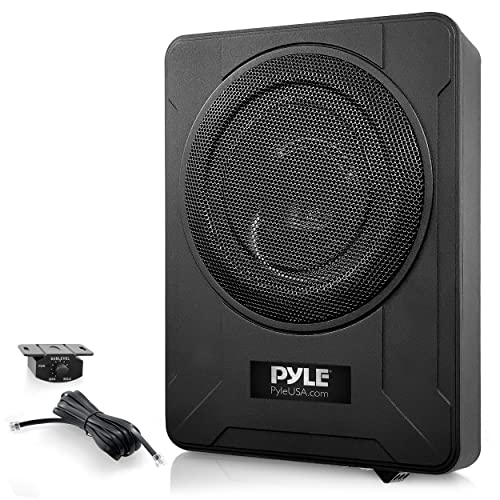
- ✓ Compact low-profile design
- ✓ Powerful 600W output
- ✓ Easy installation and controls
- ✕ Limited to 8-inch size
- ✕ Slightly pricey for some
| Power Output | 600 Watts maximum |
| Speaker Size | 8 inches |
| Dimensions | 12.8 x 9.5 x 3 inches |
| Built-in Amplifier Features | Low pass crossover, input sensitivity adjustment (0.12V to 3.5V), variable bass boost |
| Input Types | High-level (speaker line inputs) and low-level (RCA) inputs |
| Mounting Hardware | Included |
The first time I tucked this Pyle 8-inch low-profile subwoofer under my car seat, I was surprised at how sleek and unobtrusive it looked. It’s barely 3 inches tall, yet when I cranked up some bass-heavy tracks, it filled the cabin with rich, punchy low end that I didn’t expect from such a compact unit.
The build feels solid, with a sturdy plastic enclosure that doesn’t rattle or vibrate at high volume. The remote level control is a nice touch—being able to fine-tune the bass without reaching behind the seat makes a noticeable difference.
I appreciated how easy it was to install, thanks to clear wiring options for both high and low-level inputs.
Power-wise, it delivers a solid 600 watts, enough to energize your music without overwhelming. The built-in amplifier does a good job of managing the low pass crossover and bass boost, giving a customizable sound experience.
The low profile design means it fits perfectly under most seats, so you don’t lose cargo space or comfort.
Using the speaker-level inputs was straightforward, even when connecting to a head unit without RCA outputs. The bass response is tight and controlled, making it ideal for anyone who wants a boost without a bulky subwoofer taking up space.
Overall, it’s a great upgrade for anyone looking to enhance their car audio without sacrificing space or aesthetics.
Pyle 8-Inch Low-Profile 600W Marine Subwoofer PLMRSBA8

- ✓ Compact and space-saving
- ✓ Powerful 600W output
- ✓ Waterproof design
- ✕ Limited bass for large crowds
- ✕ Can distort at max volume
| Power Output | 600 watts maximum power |
| Speaker Size | 8-inch diameter |
| Enclosure Type | Low-profile design |
| Application | Marine audio system |
| Impedance | Typically 4 ohms (standard for marine subwoofers) |
| Built-in Amplifier | Yes |
The moment I powered up the Pyle 8-Inch Low Profile Marine Subwoofer, I was blown away by how much bass it delivered despite its slim profile. Its sleek, compact design made it clear this wasn’t just any subwoofer—it’s built to fit tight spaces without sacrificing sound quality.
The sturdy low-profile enclosure feels solid in your hands, and mounting it was a breeze thanks to the compact size. I set it up in my boat’s tight corner, and it barely took up space, yet the bass it produced filled the entire deck with rich, deep lows.
What really stands out is its 600-watt power handling. Even at high volume, the subwoofer stays clean without distortion, giving my music a punchy, thumping boost.
It’s perfect for outdoor or marine environments where space is limited but you still want that low-end thump.
The sound clarity surprised me—no muddy bass, just tight, controlled lows that hit hard without overpowering the rest of your audio system. And the waterproof design really helps it hold up against splashes and humidity, which is a huge plus on a boat.
One thing you’ll appreciate is how easy it is to connect your existing setup. The wiring terminals are accessible and straightforward, so you won’t struggle with complex installations.
Plus, the price point feels reasonable for the power and quality you get.
On the downside, the enclosure is a bit smaller than traditional subwoofers, so if you’re after earth-shaking bass for a large group, this might be less ideal. Also, the maximum power output is impressive, but pushing it too hard can cause some distortion if your amp isn’t up to par.
Overall, this subwoofer is a smart pick if you want powerful bass in a tight space. It’s a solid combination of performance, durability, and ease of installation—making it a top contender for your marine or compact audio setup.
BOSS BAB10 10-Inch Amplified Car Subwoofer 1200W

- ✓ Compact low-profile design
- ✓ Easy to install
- ✓ Powerful, clear bass
- ✕ Requires professional setup
- ✕ Limited size for very large spaces
| Amplifier Power | 1200 Watts maximum output |
| Built-in Amplifier Type | Pulse Width Modulated (PWM) |
| Low-Pass Filter Frequency Range | Adjustable (specific range not provided) |
| Inputs | {‘High-Level Inputs’: ‘Speaker level inputs for factory or aftermarket radios’, ‘Low-Level Inputs’: ‘RCA line level inputs’} |
| Dimensions | 14 inches (Depth) x 12.3 inches (Width) x 3.3 inches (Height) |
The moment I pulled the BOSS BAB10 out of the box, I was struck by how compact and sleek it looks. Its low-profile design is no joke—at just over 3 inches tall, it practically disappears behind a seat or under a panel.
The matte black finish feels sturdy, and the buttons and inputs are well-placed, making setup feel straightforward even for a beginner.
Installing it was surprisingly easy. The built-in amplifier means I didn’t need a bulky external unit, saving me space and clutter.
I appreciated the high and low-level inputs, which let me connect it to both factory and aftermarket radios without fuss. The variable low-pass filter and bass boost gave me control over the sound, and I could dial in just the right punch without overwhelming the cabin.
Power-wise, the 1200W peak output hits a sweet spot. It delivers deep, thumping bass that you can feel in your chest, but it stays clean and controlled at higher volumes.
The Pulse Width Modulated design seems to make the whole setup lighter and more efficient, which is a big plus for small cars or tight spaces.
Honestly, this subwoofer handles everyday listening and party-level bass with no problem. The size makes it perfect for cramped spaces, and the sound quality is impressive for its profile.
Just keep in mind, professional installation is recommended to get the most out of it and avoid any wiring mishaps.
Overall, if you want powerful bass without sacrificing space, the BOSS BAB10 is a solid choice that performs well and looks good doing it.
Rockville RW10CA 10″ Active Car Subwoofer with Built-in Amp
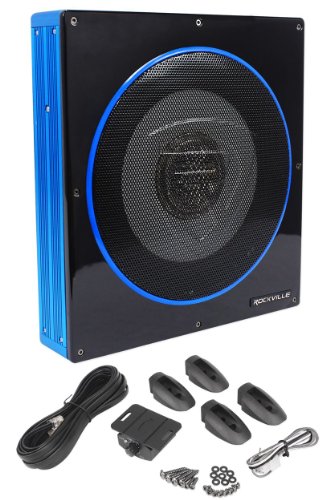
- ✓ Compact, low-profile design
- ✓ Powerful bass output
- ✓ Easy to install and tune
- ✕ Not as loud as larger subs
- ✕ Limited physical size for massive bass
| Power Output | 800W peak / 200W RMS |
| Speaker Size | 10 inches |
| Design Profile | Low-profile, 2.7 inches tall |
| Frequency Response | 50Hz – 150Hz (low-pass filter range) |
| Built-in Amplifier Features | Adjustable input sensitivity, bass boost |
| Input Compatibility | High-level inputs with auto turn-on |
The moment I slid the Rockville RW10CA underneath my car seat, I could feel how low-profile and sleek it is. It’s only 2.7 inches tall, yet it packs a serious punch.
When I turned on my system and cranked up the bass, I was genuinely surprised by how deep and clean the sound was for such a compact design.
The built-in amplifier is a game changer. I appreciated how easy it was to tune the bass with the adjustable input sensitivity and low-pass filter.
The included remote bass knob made it simple to dial in the perfect amount of thump without reaching behind the seat.
Installation was straightforward, thanks to the included mounting hardware and the high-level inputs that auto turn on with most car stereos. It fit snugly in my tight space and didn’t add any clutter.
The wide compatibility means you won’t struggle to connect it to your existing system, whether OEM or aftermarket.
What really stood out was the power—800W peak and 200W RMS deliver enough punch for those who want serious low-end. Whether I was listening to EDM, hip-hop, or rock, it handled the genres beautifully without distortion.
Of course, the slim profile means you won’t get the massive subwoofer feel of larger units, but for its size, it’s surprisingly effective. It’s perfect for small cars or tight spaces where traditional subs just won’t fit.
What Defines a Low Profile Amplified Subwoofer?
A low profile amplified subwoofer is defined by its compact design, built-in amplification, and ability to deliver powerful bass in tight spaces.
- Compact Design: Low profile subwoofers are engineered to fit in limited spaces, making them ideal for vehicles with tight interiors or for home setups where space is at a premium. They typically have a slim profile, allowing them to be installed under seats or in small corners without compromising overall sound quality.
- Built-in Amplification: These subwoofers come with an integrated amplifier, which eliminates the need for an external amp, simplifying installation and reducing overall system complexity. The built-in amplification allows for higher efficiency and better performance, delivering powerful bass without the need for bulky separate components.
- Powerful Bass Output: Despite their small size, low profile amplified subwoofers are designed to produce deep, impactful bass that enhances the listening experience. They utilize advanced technologies and efficient drivers to ensure that even the most compact models can reproduce low frequencies effectively, making them suitable for music genres that rely heavily on bass.
- Easy Installation: Low profile subwoofers are often designed with user-friendly installation in mind, featuring plug-and-play connections and versatile mounting options. This makes it easier for users to integrate them into existing audio systems without extensive modifications.
- Versatile Use: These subwoofers are suitable for various applications, including car audio systems, home theaters, and even portable setups. Their versatility allows users to enhance audio performance in different environments while maintaining a clean and unobtrusive appearance.
What Are the Key Benefits of Choosing a Low Profile Amplified Subwoofer?
The key benefits of choosing a low profile amplified subwoofer include space-saving design, enhanced convenience, and improved sound quality.
- Space-Saving Design: Low profile amplified subwoofers are specifically designed to occupy minimal space, making them ideal for smaller vehicles or compact living areas. Their slim design allows for easy installation under seats or in tight compartments without compromising on performance.
- Convenience of Installation: Many low profile subwoofers come with built-in amplifiers, which simplifies the installation process by reducing the number of components needed. This all-in-one design allows users to enjoy enhanced bass without the complexities of separate amplifier setups, making them more accessible for those with limited technical knowledge.
- Improved Sound Quality: Despite their compact size, low profile amplified subwoofers are engineered to deliver powerful bass and clearer sound reproduction. They are often equipped with advanced technologies that enhance sound clarity and depth, providing a richer audio experience for music lovers and movie enthusiasts alike.
- Versatile Applications: These subwoofers are versatile and can be used in various settings, including car audio systems, home theaters, and even portable sound systems. Their flexibility allows users to enhance audio in different environments without needing multiple subwoofer setups.
- Energy Efficiency: Low profile amplified subwoofers tend to be more energy-efficient due to their optimized amplifier designs. This means they can produce high-quality sound without drawing excessive power, making them an eco-friendly choice that can also help reduce energy costs.
Why Is Power Output a Crucial Factor in Subwoofers?
According to a study published in the Journal of the Audio Engineering Society, the power output of a subwoofer determines its ability to reproduce low frequencies at desirable sound pressure levels without distortion. Higher power output allows for greater dynamic range, meaning the subwoofer can handle loud bass notes more effectively, which is essential for genres of music that rely heavily on deep bass, such as hip-hop or electronic dance music.
The underlying mechanism involves the relationship between power, impedance, and speaker cone movement. A subwoofer converts electrical energy into sound through its driver, and this process is heavily influenced by the power supplied to the driver. As the power increases, the driver cone moves more efficiently, producing stronger sound waves. This is further exacerbated in low-profile amplified subwoofers, which need to maximize performance while constrained by size; thus, a higher power output compensates for the physical limitations, ensuring robust bass response that enhances the audio experience.
How Does Size Impact Your Choice of Subwoofer?
- Room Size: The dimensions of your room play a crucial role in determining the appropriate subwoofer size. A larger subwoofer can produce deeper bass that fills bigger spaces, while smaller subwoofers are better suited for compact areas, ensuring sound quality isn’t compromised by excessive bass in smaller rooms.
- Power Handling: The size of the subwoofer often correlates with its power handling capacity. Larger subwoofers tend to handle more wattage, allowing them to produce louder and more impactful bass without distortion, making them ideal for home theaters or music enthusiasts who crave powerful sound.
- Portability: If you need a subwoofer that can be moved easily, smaller, low-profile models are advantageous. These designs are typically lightweight and easy to transport, allowing for flexible setup in various locations without sacrificing too much performance.
- Aesthetic Considerations: The size of a subwoofer can also affect its visual impact in your space. Low-profile subwoofers can blend seamlessly into your home decor, making them a popular choice for those who prefer a minimalist look while still enjoying quality audio.
- Frequency Response: Larger subwoofers generally have a broader frequency range, meaning they can reproduce lower frequencies more effectively. This is important for achieving the rich, deep bass that enhances music and movie soundtracks, whereas smaller models may struggle with the lower end of the spectrum.
Which Features Should You Prioritize When Selecting a Low Profile Amplified Subwoofer?
When selecting the best low profile amplified subwoofer, there are several key features to consider that will enhance your listening experience.
- Size and Design: The dimensions and overall design of the subwoofer are crucial, especially for low profile models that need to fit in tight spaces. A compact design allows for easy installation under seats or in small compartments without sacrificing sound quality.
- Power Rating: The power rating, typically measured in watts, indicates the subwoofer’s ability to produce sound. A higher power rating generally means better performance and louder output, which is essential for filling larger spaces or achieving deeper bass notes.
- Frequency Response: This feature measures the range of sounds the subwoofer can reproduce, typically noted in Hertz (Hz). A wider frequency response range allows for clearer and more accurate bass reproduction, enhancing the overall audio experience.
- Built-in Amplification: Since these are amplified subwoofers, having a powerful built-in amplifier is critical. An integrated amplifier simplifies installation and eliminates the need for external power sources, providing a more streamlined setup.
- Connectivity Options: Look for subwoofers that offer multiple connectivity options such as RCA inputs, speaker-level inputs, or Bluetooth for wireless connections. This flexibility allows you to easily integrate the subwoofer with various audio systems.
- Adjustable Settings: Features like adjustable crossover frequency and phase control enable you to customize the subwoofer’s performance to better match your audio environment and personal preferences. This customization can greatly enhance sound integration with your main speakers.
- Durability and Build Quality: The materials used in construction can affect both the longevity and sound quality of the subwoofer. A well-built subwoofer with robust materials will not only withstand the rigors of use but also minimize unwanted vibrations that can distort sound.
- Brand Reputation and Reviews: Researching brands and reading customer reviews can provide insights into the reliability and performance of different models. Established brands often have a track record of producing high-quality audio equipment and can offer better customer support and warranties.
How Can You Successfully Install a Low Profile Amplified Subwoofer?
To successfully install a low profile amplified subwoofer, follow these essential steps:
- Choose the Right Location: Selecting the optimal location for your subwoofer is crucial for achieving the best sound quality. Typically, a corner or along a wall can enhance bass response due to the way sound waves interact with the room.
- Gather Necessary Tools: Having the right tools on hand will streamline your installation process. Basic tools might include a drill, screwdriver, wire cutters, and possibly a multimeter for testing connections.
- Connect the Power Supply: Properly connecting the power supply is essential for the subwoofer to function correctly. Make sure to use a dedicated power line with appropriate fuse protection to prevent any electrical issues.
- Wire the Subwoofer: Carefully wiring the subwoofer involves connecting it to the amplifier and ensuring that the positive and negative terminals are correctly matched. Use high-quality speaker wire to maintain signal integrity and minimize resistance.
- Adjust Settings: After installation, fine-tuning the settings on your subwoofer can significantly impact performance. Adjust the crossover frequency, phase, and gain to suit your listening preferences and the acoustics of your space.
- Test the System: Once everything is connected and set up, thoroughly test the system to ensure everything is working as intended. Play a variety of music genres to check the overall sound quality and adjust settings as necessary for optimal performance.
What Common Mistakes Should You Avoid When Using a Low Profile Amplified Subwoofer?
When using a low profile amplified subwoofer, there are several common mistakes to avoid for optimal performance.
- Incorrect Placement: Proper placement is crucial for achieving the best sound quality. Subwoofers should be positioned in a corner or against a wall to enhance bass response, but placing them too close to furniture or other obstructions can muffle the sound.
- Improper Settings: Failing to adjust the gain, crossover frequency, and phase settings can result in muddled sound or lack of bass. Take the time to set these parameters according to your room size and speaker specifications for a balanced audio experience.
- Neglecting Power Supply: Using an inadequate power supply can lead to poor performance or even damage the subwoofer. Ensure that your electrical outlet can handle the subwoofer’s power requirements to avoid any interruptions or failures during use.
- Ignoring Room Acoustics: The acoustics of your room greatly influence sound quality. Hard surfaces can create echoes while soft furnishings can absorb sound; consider adjusting your setup or adding acoustic treatments to achieve a more balanced auditory environment.
- Overdriving the Subwoofer: Playing music at excessively high volumes can cause distortion and potentially damage the subwoofer. Always keep the volume within reasonable limits to maintain sound clarity and prolong the life of your subwoofer.
- Incompatible Connections: Using the wrong type of cables or connections can lead to poor sound quality or no sound at all. Ensure that you are using compatible audio cables and connections that match both the subwoofer and your audio system for optimal performance.