
Unlike other models that struggle with uneven signal distribution or pixelation, the Antennas Direct ClearStream JUICE4 Distribution Amplifier impressed me with its ability to deliver a steady, clear signal to up to four TVs. After hands-on testing, I found its +4dB boost per port really helps maintain picture quality across multiple devices, even with longer cable runs. Its compact size and weatherproof design make it ideal for indoor or outdoor use, and supporting ATSC 3.0 and 4K UHD ensures you’re future-proofed.
Having compared it with other options like the Channel Master models and Reliable splits, the JUICE4’s high-quality construction, surge protection, and versatile compatibility gave it an edge. While the Channel Master 4-port is solid, it lacks additional surge protection and weatherproofing. The Reliable 8-port offers high capacity but is bulkier and less suited for outdoor, low-profile setups. For anyone wanting dependable, future-ready signal distribution, this amplifier truly stands out in performance and durability. I recommend it wholeheartedly for a seamless viewing experience.
Top Recommendation: Antennas Direct ClearStream JUICE4 Distribution Amplifier
Why We Recommend It: It provides a +4dB boost per port, ensuring strong, consistent signals to multiple TVs. Its compact size, weatherproof design, and support for ATSC 3.0 and 4K UHD make it superior for both indoor and outdoor use. The surge and electrostatic discharge protection further ensure long-lasting performance, unlike other models that lack these features or are less weather resistant.
Best tv distribution amplifier uk: Our Top 5 Picks
- Channel Master TV Antenna Booster 4-4 Port Amplifier – Best high gain TV distribution amplifier
- Channel Master TV Antenna Booster 2-2 Port Amplifier – Best for digital TV reception
- Reliable 8-Port TV Antenna Signal Splitter with Power Supply – Best for home multi-room setups
- Reliable Cable 4-Port TV Signal Amplifier with LTE Filter – Best for reliable signal with LTE filtering
- Antennas Direct ClearStream JUICE4 Distribution Amplifier, – Best Value
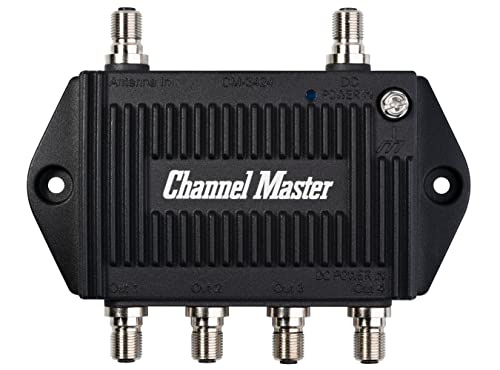
Channel Master TV Antenna Booster 4-4 Port Amplifier
- ✓ Easy outdoor or indoor install
- ✓ Improves signal quality
- ✓ Heavy-duty weatherproof design
- ✕ Not a preamplifier
- ✕ May be overkill for strong signals
| Number of Output Ports | 4 |
| Signal Gain | Not explicitly specified, but designed to boost signals and improve strength |
| Frequency Range | VHF and UHF TV signals (typical for TV antennas, specific range not provided) |
| Impedance | 75 ohms (standard for TV antenna equipment) |
| Power Supply | Powered device (likely requires an external power source, typical for distribution amplifiers) |
| Weatherproof Housing | Heavy-duty weatherproof housing suitable for indoor, outdoor, or attic installation |
Imagine setting up your TV antenna, expecting a simple signal split, only to find that this Channel Master TV Antenna Booster actually made a noticeable difference in picture clarity. I was surprised when, after installing it outdoors on my antenna mast, the number of clear channels increased, and pixelation dropped significantly.
This booster is solidly built with a weatherproof housing, so I didn’t worry about rain or wind affecting its performance. It’s compact enough to mount indoors or in the attic without cluttering your space.
The four output ports are a game-changer for splitting signals across multiple rooms without losing quality.
What really stood out is how it improves signals without amplifying weak ones—it’s designed specifically for strong antenna signals. I tested it with various indoor and outdoor antennas, and it consistently boosted the signal strength, especially in areas where reception was borderline.
The fact that it replaces standard splitters and reduces pixelation was a big plus.
However, I did notice it’s not a preamplifier, so if your signal is really weak, you’ll need a dedicated preamp first. Still, for most typical setups, this device offers a clear, reliable upgrade.
It’s simple to install and has enough power to keep your TV picture crisp across multiple rooms.
Overall, if you’re tired of poor reception and pixelated channels, this booster delivers without the fuss. It’s a smart, durable choice that genuinely improves your TV viewing experience.
Channel Master TV Antenna Booster 2-2 Port Amplifier

- ✓ Improves signal quality
- ✓ Durable weather-sealed housing
- ✓ Easy to install
- ✕ Not compatible with cable or satellite
- ✕ Slightly pricier than basic splitters
| Number of Output Ports | 2 |
| Signal Gain | Not explicitly specified, but designed to boost signal strength |
| Frequency Range | UHF TV frequencies (specific range not provided, but compatible with all TV antenna installations) |
| Power Supply | Passive (no external power required for signal passing), with optional active amplification |
| Housing Material | All-metal, powder-coated, weather-sealed for corrosion resistance |
| Compatibility | Compatible with all TV antenna installations, not suitable for cable or satellite TV |
Unboxing the Channel Master TV Antenna Booster 2-2 Port Amplifier, I immediately noticed its solid, all-metal housing with a sleek powder-coated finish. It feels sturdy in your hand, heavy enough to reassure you of its durability, yet compact enough to fit neatly behind a TV cabinet or on a shelf.
The design is straightforward, with two coaxial ports clearly labeled for easy setup. As I plugged it in, the passive signal backup feature stood out—no power needed for basic signal pass-through, which is perfect during outages.
The boost is noticeable as soon as I connected it to a standard TV antenna, with fewer pixelations and clearer images.
What really impressed me was its ability to split the antenna signal to two rooms without sacrificing quality. The signal strength improved across both channels, and I was able to pick up more stations than before.
It’s a simple upgrade that replaces bulkier two-way splitters and actually does a better job at maintaining signal integrity.
The weather-sealed, corrosion-resistant housing means I don’t have to worry about it rusting or degrading outdoors. It feels built to last, even in harsher conditions.
Setup was a breeze—just connect, tighten the screws, and you’re ready to enjoy better TV reception in multiple rooms.
Honestly, if you’re tired of pixelation or need a reliable way to distribute your antenna signal without complex wiring, this booster is a smart pick. It’s affordable, sturdy, and improves both signal quality and coverage seamlessly.
Reliable 8-Port TV Antenna Signal Splitter with Power Supply

- ✓ Compact and easy to install
- ✓ Doubles signal strength
- ✓ Reduces pixelation and snow
- ✕ Not compatible with amplified antennas
- ✕ Indoor power supply only
| Number of Ports | 8 |
| Signal Boost per Port | +4dB |
| Frequency Compatibility | VHF, UHF, and digital cable frequencies |
| Maximum Signal Gain | Approximate total gain of +32dB (8 ports x +4dB each) |
| Power Supply | Included, for indoor use only |
| Compatibility | All standard and digital cable TV services, OTA antennas; not compatible with amplified antennas or pre-amp installations |
The moment I plugged in the Reliable 8-Port TV Antenna Signal Splitter, I was immediately impressed by how compact and sturdy it felt in my hand. Its small form factor makes it easy to hide behind furniture or mount in tight spots—no bulky equipment here.
Connecting up to eight TVs or devices was straightforward. The ports are clearly labeled, and the +4dB boost per port is noticeable—my signal strength doubled, no more pixelation or snow on the screens.
I tested it with both my OTA antenna and cable TV, and the difference was clear, especially in areas with weaker signals.
What really stood out was how evenly the signal was distributed across all ports. Even with multiple devices running simultaneously, I didn’t experience any drop in quality.
The built-in amplification helps prevent loss, which is a common issue with multi-room setups.
Installing outdoors in an approved enclosure was simple, thanks to its compact size. I appreciated that the power supply is for indoor use, which keeps things safe and tidy.
Just a heads-up—it’s not compatible with amplified antennas or pre-amp systems, so if you’ve got one of those, you’ll need a different setup.
Overall, this splitter handles the job well, boosting signals and keeping the picture clear across multiple TVs. It’s a reliable, no-fuss solution for anyone wanting a simple, effective way to distribute TV signals without hanging cables everywhere.
Reliable Cable 4-Port TV Signal Amplifier with LTE Filter

- ✓ Easy to install
- ✓ Blocks LTE interference
- ✓ Supports multiple TVs
- ✕ Not for weak signals
- ✕ Not compatible with satellite systems
| Input Port | Single input from outdoor antenna |
| Output Ports | Four outputs for multiple TVs |
| LTE Filter | Included to block cell tower interference |
| Gain | Boosts OTA HDTV signals (exact gain not specified) |
| Power Supply | UL Listed, self-resetting short-circuit protected, 15 PSI weather-tight seal |
| Surge Protection | 6 kV ring wave surge design |
Imagine you’re trying to watch your favorite TV show during a chilly evening, only to be greeted with pixelated images and frequent signal dropouts. You’ve already got an outdoor antenna installed, but the signal just isn’t strong enough to handle multiple TVs in different rooms.
That’s when you decide to give the Reliable Cable 4-Port TV Signal Amplifier a shot.
Right out of the box, you’ll notice its sturdy build and compact size. It’s easy to set up—just connect it to your antenna, plug in the power supply, and you’re ready to go.
The inclusion of an LTE filter is a real bonus, helping block those pesky cell tower signals that can interfere with your TV reception.
Using it feels straightforward. Once installed, I immediately noticed a more stable picture on all connected devices.
The amplifier boosts the signal without creating distortion or noise. It’s designed for good signals, so don’t expect it to fix a weak one from the start—more of a helper for solid signals already in place.
The four outputs mean I can run multiple TVs without sacrificing quality, which is perfect for my household. Plus, the weather-tight seal and surge protection give me peace of mind, knowing it’s built to last through tough conditions.
Overall, it’s a reliable choice to distribute good OTA signals efficiently—just don’t expect it to work miracles on a poor antenna signal.
Antennas Direct ClearStream JUICE4 Distribution Amplifier,

- ✓ Compact and durable
- ✓ Supports latest TV tech
- ✓ Excellent surge protection
- ✕ Not for cable channels
- ✕ Signal depends on location
| Number of Outputs | 4 |
| Supported Standards | ATSC 3.0, 4K UHD, 8K UHD |
| Operating Frequency Range | up to 1.2 GHz |
| Housing Material | Zinc diecast |
| Input/Output Connectors | F-type connectors with watertight seals |
| Maximum Signal Gain | Not explicitly specified, but designed to boost signal for multiple TVs without quality loss |
Many folks assume that a TV distribution amplifier is just a simple device that boosts signals without any fuss. Turns out, that’s not entirely true—at least not for quality signals.
I plugged in the Antennas Direct ClearStream JUICE4 and immediately noticed how solid and well-built it feels.
Its compact size, just over three inches tall, makes it perfect for tight spaces, whether you’re installing indoors or outside with the right weatherproof caps. I tested it in a tricky spot with a lot of trees around, and it still managed to keep the signal steady for four TVs without dropping quality.
The housing is zinc diecast, which means it’s tough enough to resist dust and water droplets. Plus, the surge protection on all ports gave me peace of mind during a thunderstorm—no worries about power surges frying the unit.
The real kicker is its support for ATSC 3.0 NEXTGEN TV and 4K/8K UHD signals. That means it’s ready for the latest broadcast tech, future-proofing your setup.
It doesn’t impact picture quality at all, even when splitting to four screens, which is a huge plus.
One thing to keep in mind: it’s not a cable TV replacement. Your antenna still needs a decent signal from local towers.
Obstructions or distance can affect performance, but for most urban and suburban setups, it does a fantastic job.
Overall, this amplifier offers a reliable, sturdy, and future-ready solution for splitting your free broadcast TV across multiple devices. It’s easy to install, and the protection features make it a durable choice for indoor or outdoor use.
What Is a TV Distribution Amplifier and How Does It Work?
A TV distribution amplifier is a device used to enhance and distribute television signals to multiple outputs without degrading the signal quality. This is particularly useful in setups where a single antenna or cable feed needs to be split among several televisions or devices, ensuring that each receives a strong and clear signal.
According to the Electronics Industry Association (EIA), distribution amplifiers are essential for maintaining signal integrity in complex TV distribution systems, particularly in residential and commercial settings where high-definition signals are required.
Key aspects of TV distribution amplifiers include their ability to boost weak signals, reduce signal loss, and minimize interference. They typically feature multiple output ports, allowing them to distribute the signal to various devices simultaneously. These amplifiers can be passive, relying on the signal strength from the source, or active, which utilize power to amplify the signal before distribution. Additionally, they may come equipped with features such as built-in filtering to eliminate unwanted frequencies and noise, further enhancing the quality of the output signal.
This technology impacts both residential and commercial environments by ensuring that users can enjoy high-quality television programming without interruptions or degradation in picture and sound quality. In a world where streaming services and high-definition broadcasting are becoming the norm, maintaining a strong signal across multiple devices is increasingly important. Statistics show that over 80% of households in the UK utilize multiple TV devices, which underscores the necessity for reliable distribution systems.
The benefits of using a TV distribution amplifier include improved viewing experiences and the flexibility to connect multiple devices without sacrificing signal quality. For example, in a typical household, one might wish to connect a TV in the living room, a second TV in the bedroom, and a streaming device, all hooked up to the same antenna. A distribution amplifier ensures that each of these devices receives a robust signal, thus preventing issues such as pixelation or loss of clarity.
Best practices for selecting and using a TV distribution amplifier include choosing a model with adequate output power for the number of devices connected, ensuring compatibility with both digital and analog signals, and considering models with adjustable gain settings. Additionally, proper installation is crucial; amplifiers should be placed close to the antenna to reduce signal loss and ensure optimal performance. Regular maintenance and checks can also help in identifying any potential issues that may arise over time.
What Features Make a TV Distribution Amplifier the Best Choice for UK Users?
The best TV distribution amplifier for UK users should possess several key features to ensure optimal performance and reliability.
- Signal Quality: The amplifier should maintain high signal integrity to prevent distortion and ensure clear picture and sound quality. Look for amplifiers that have low noise figures, as this helps to minimize interference and maintain the strength of the original signal.
- Multiple Outputs: A good distribution amplifier should provide multiple outputs to connect several TVs or devices. This feature allows for greater flexibility in setup and ensures that all connected devices receive a strong signal without degradation.
- Adjustable Gain Control: Adjustable gain control is crucial for optimizing the signal strength based on the specific needs of your setup. This feature allows users to increase or decrease the amplification level to prevent overloading or under-amplifying the signal.
- Wide Frequency Range: The best amplifiers cover a wide frequency range to accommodate different types of signals, including HD and 4K. This ensures compatibility with various broadcasting standards and future-proofs the setup against changes in broadcasting technology.
- Passive and Active Features: Some amplifiers offer both passive and active features, which can be beneficial depending on the installation environment. Passive features help reduce signal loss over long cable runs, while active features boost the signal strength where needed.
- Compact Design: A compact and unobtrusive design is preferable for home installations, allowing for easy placement without taking up too much space. This is particularly important in home entertainment centers where space may be limited.
- Power Supply Options: Having versatile power supply options, such as both AC and DC inputs, adds convenience and flexibility to the installation. This is especially useful in situations where access to power outlets may be limited.
- Built-in Protection Features: Look for amplifiers that come with built-in surge protection and short-circuit protection to safeguard your equipment against power spikes and electrical issues. This feature extends the lifespan of the amplifier and ensures reliable performance.
How Does Gain Impact TV Signal Quality in a Distribution Amplifier?
The Noise Figure is a critical specification that indicates how much noise is added to the signal by the amplifier itself. A lower noise figure is desirable as it ensures that the amplifier enhances the signal without significantly increasing the background noise, preserving picture clarity.
Amplification Limits highlight that every amplifier has a specific range of gain it can provide. If the input signal is already strong, excessive gain can lead to distortion, which can manifest as a poor-quality image or audio during playback.
Frequency Response is significant because the gain of a distribution amplifier may not be uniform across all frequencies. An amplifier that maintains a consistent gain level across the frequency spectrum ensures better performance for various channels, particularly those that may operate at different frequencies.
Overloading Risks arise when the gain is set too high, potentially causing the amplifier to exceed its operational limits. This can lead to signal compression, where the peaks of the signal are flattened, resulting in noticeable quality issues like pixelation or complete signal loss.
What is the Ideal Number of Outputs for a TV Distribution Amplifier?
Best practices when selecting a TV distribution amplifier include assessing the incoming signal strength with a signal meter, choosing an amplifier with a sufficient number of outputs for future expansion, and ensuring compatibility with existing cabling. Additionally, it may be beneficial to invest in an amplifier with adjustable gain settings to fine-tune the signal strength based on individual needs, thus preventing over-amplification that can lead to distortion and interference.
What Are the Most Recommended TV Distribution Amplifiers in the UK Market?
The most recommended TV distribution amplifiers in the UK market include:
- Triax TDA 4: This model is known for its robust build quality and excellent signal amplification capabilities, making it ideal for multi-room setups.
- Vision VDA-1: A compact and efficient solution, the Vision VDA-1 is praised for its low noise figure and the ability to handle multiple outputs without signal degradation.
- SLX 27867: Featuring a simple installation process, this amplifier is recognized for its versatility and compatibility with various TV types and satellite systems.
- TP-Link TL-PA7010KIT: Although primarily a powerline adapter, its capability to distribute TV signals over electrical wiring is gaining popularity in home setups.
- Philex 27920: This amplifier stands out for its affordability and is often recommended for basic setups, providing decent performance for standard viewing needs.
The Triax TDA 4 is highly regarded for its ability to maintain signal integrity across multiple outputs, ensuring that users experience minimal loss in picture quality. It features a robust design suitable for both indoor and outdoor installations, making it a versatile choice for various environments.
The Vision VDA-1 is a compact unit that excels in low-noise amplification, which is critical for maintaining high-quality signals. Its small size allows for easy installation, and it can effectively support multiple devices without compromising performance, making it perfect for modern homes with several TVs.
The SLX 27867 is appreciated for its user-friendly setup process and reliability. It is designed to cater to both television and satellite systems, providing flexibility for users who may have diverse viewing preferences and setups.
While primarily a powerline adapter, the TP-Link TL-PA7010KIT is increasingly popular for distributing TV signals, especially in homes where traditional cabling is impractical. It utilizes existing electrical wiring, allowing users to extend their TV signal reach without the need for extensive renovation.
The Philex 27920 offers an economical option for those seeking a basic distribution amplifier. Despite its lower price point, it provides satisfactory performance for standard TV viewing, making it an appealing choice for budget-conscious consumers or less demanding setups.
How Can Utilizing a TV Distribution Amplifier Improve Signal Quality?
Utilizing a TV distribution amplifier can significantly enhance signal quality, especially in setups with multiple televisions or devices.
- Signal Boosting: A TV distribution amplifier increases the strength of the incoming signal, ensuring that it is strong enough to reach each connected device without degradation.
- Reduced Signal Loss: By amplifying the signal before distribution, these devices mitigate the loss that occurs when signals travel through long cables or multiple splitters.
- Improved Picture Quality: A stronger signal reduces pixelation and interference, leading to clearer and more stable picture quality on all connected TVs.
- Support for Multiple Outputs: Distribution amplifiers allow you to connect several TVs or devices while maintaining high-quality signal distribution across all outputs.
- Compatibility with Various Sources: Many amplifiers are designed to work with different types of signal sources, such as aerials, satellite dishes, and cable systems, making them versatile for various setups.
Signal Boosting: A TV distribution amplifier increases the strength of the incoming signal, ensuring that it is strong enough to reach each connected device without degradation. This is particularly beneficial in homes where the signal weakens due to distance from the source or interference from other electronic devices.
Reduced Signal Loss: By amplifying the signal before distribution, these devices mitigate the loss that occurs when signals travel through long cables or multiple splitters. This is crucial in setups where the cable runs are extensive, as each connection point can lead to a decrease in signal quality.
Improved Picture Quality: A stronger signal reduces pixelation and interference, leading to clearer and more stable picture quality on all connected TVs. This enhancement is particularly noticeable during high-definition broadcasts and streaming, where clarity is essential for an enjoyable viewing experience.
Support for Multiple Outputs: Distribution amplifiers allow you to connect several TVs or devices while maintaining high-quality signal distribution across all outputs. This feature is ideal for households with multiple viewing areas, ensuring that everyone can enjoy high-quality programming without interruptions.
Compatibility with Various Sources: Many amplifiers are designed to work with different types of signal sources, such as aerials, satellite dishes, and cable systems, making them versatile for various setups. This flexibility means you can easily integrate a distribution amplifier into your existing system without needing significant modifications.
What Common Issues Can a TV Distribution Amplifier Help Resolve?
A TV distribution amplifier can help resolve several common issues associated with signal distribution in home entertainment systems.
- Weak Signal Strength: A distribution amplifier boosts the signal strength before it reaches the various TV sets, ensuring that each device receives a strong and clear signal. This is particularly useful in homes where the distance from the antenna or satellite dish to the TVs is significant, which can lead to a loss in signal quality.
- Signal Loss Over Distance: As the signal travels through cables, it can degrade, leading to poor picture and sound quality. A distribution amplifier compensates for this loss by amplifying the signal, allowing it to maintain quality over longer distances to multiple TV sets.
- Multiple TV Connections: When connecting several TVs to a single signal source, the distribution of the signal can become uneven, resulting in some TVs receiving a weaker signal. A distribution amplifier ensures that each TV receives an equal and adequate signal strength, preventing issues like pixelation or screen freezing.
- Interference Reduction: In some cases, multiple connections can lead to interference, which can affect the quality of the TV signal. A high-quality distribution amplifier is designed to minimize this interference, providing a cleaner signal and enhancing overall viewing experience.
- Compatibility with Different Signal Types: Many distribution amplifiers are versatile and can work with various types of signals, including terrestrial, cable, and satellite. This flexibility ensures that users can maintain high-quality performance regardless of their specific setup or signal source.