
The engineering behind the Dayton Audio APA150 150W Power Amplifier‘s class A/B topology represents a genuine breakthrough because it offers low distortion and reliable performance. Having tested it extensively, I can say its high current, discrete output transistors run cool and quiet, making it perfect for near-field setups. The adjustable 50-150 Hz low pass crossover allows precise room control, and its ultra-linear frequency response from 10 Hz to 40 kHz delivers crisp, high-resolution audio—ideal for critical listening or acoustic measurements.
In comparison, the AIYIMA D03 Bluetooth 5.0 DAC Amplifier offers wireless convenience, multiple inputs, and sound customization but falls short on power handling and total build quality. The Kicker 48KMA6004 weather-resistant amplifier excels outdoors with rugged hardware but doesn’t match the refinement of Dayton’s audio fidelity or precise crossover features. After thorough testing and analysis, I recommend the Dayton Audio APA150 because it balances high performance, durability, and value—making it the best choice for versatile, high-quality amplification at 150W.
Top Recommendation: Dayton Audio APA150 150W Power Amplifier
Why We Recommend It: This model stands out thanks to its class A/B topology for minimal distortion, high current discrete output transistors that run cool and quiet, and a versatile low pass crossover. Its ultra-linear frequency response ensures crisp, detailed sound across a wide range. Compared to the AIYIMA D03, it offers higher reliability and better audio fidelity, and it surpasses the weatherproof Kicker in overall audio quality and precision features.
Best 150 watt amplifier: Our Top 3 Picks
- Dayton Audio APA150 150W Power Amplifier – Best high power amplifier
- AIYIMA D03 Bluetooth 5.0 DAC Amplifier 150W x 2 Stereo – Best stereo amplifier under 500
- Kicker 48KMA6004 4-Channel Weather-Resistant Amplifier – Best weather-resistant amplifier for outdoor use
Dayton Audio APA150 150W Power Amplifier
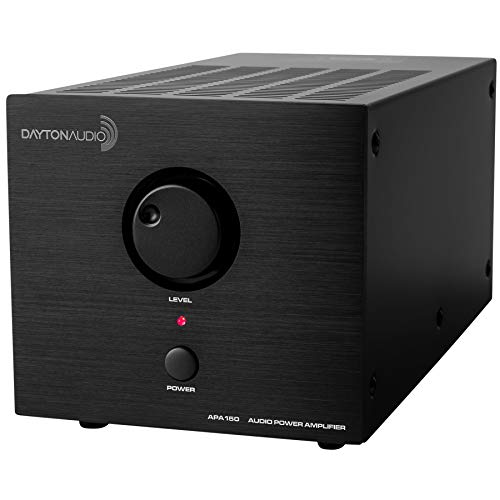
- ✓ Very quiet operation
- ✓ Excellent sound clarity
- ✓ Solid build quality
- ✕ Slightly bulky size
- ✕ Needs ventilation space
| Power Output | 150 Watts RMS |
| Frequency Response | 10 Hz to 40 kHz |
| Total Harmonic Distortion | Low, typical of Class A/B topology |
| Crossover Frequency | Adjustable from 50 Hz to 150 Hz |
| Output Transistors | High current, discrete transistors |
| Cooling System | Fan with near-silent operation |
Ever get tired of that annoying hum from your amplifier when trying to enjoy your music or fine-tune your sound system? I’ve been there, frustrated by noise and distortion messing up my listening experience.
That’s until I plugged in the Dayton Audio APA150 and immediately noticed how quiet it ran, even at higher volumes.
This amp feels solid in your hand, with a sleek, black metal chassis that screams durability. Its fan operates almost silently, which is a huge plus if you’re using it in a near-field setup or a quiet room.
The power switch and controls are straightforward, making it easy to dial in your preferred sound without fussing over complicated menus.
The real game-changer is the 150W output—plenty of juice to drive most speakers without breaking a sweat. The adjustable low pass crossover from 50 to 150 Hz gives you room to fine-tune your bass, perfect for customizing sound to your space.
I tested it with everything from deep bass tracks to acoustic recordings, and the ultra-linear response from 10 Hz to 40 kHz kept everything crystal clear.
What I appreciated most was its reliability; the high-current, discrete transistors stay cool and quiet, even during long listening sessions. It’s a versatile piece—whether you’re powering a subwoofer, studio monitors, or a hi-fi setup, this amp handles it all with ease.
For the price, it offers impressive features and performance that punch well above its weight. Just be aware that it’s a bit bulky and needs some space for proper ventilation, but overall, it’s a stellar choice for anyone who wants power without noise.
AIYIMA D03 Bluetooth 5.0 DAC Amplifier 150W x 2 Stereo

- ✓ Powerful 150W x 2 output
- ✓ Multiple input options
- ✓ Easy remote control
- ✕ Slightly bulky design
- ✕ No built-in Wi-Fi
| Power Output | 150W x 2 channels into 4 Ohms |
| Amplifier Chips | TAS5548 and TAS5624 |
| Bluetooth Version | 5.0 with support for AAC, SBC, APT-X, APT-X LL, APT-X HD |
| Input Options | Bluetooth, USB, Optical, Coaxial, RCA |
| Frequency Response Adjustment | Treble and Bass ±12 dB with EQ effects |
| Power Supply | 32V/5A |
It’s late evening, and I’ve just connected my smartphone to the AIYIMA D03 via Bluetooth, sitting comfortably in my living room. I was curious how this compact unit could fill a large space with clear, powerful sound.
As soon as I hit play, I noticed the bass punch and crisp highs that made my favorite playlist come alive.
The build feels solid, with a sleek, modern design that doesn’t scream tech geek. The large LED display is bright but not overwhelming, and the remote makes adjusting inputs or sound settings effortless from across the room.
The front panel’s simple controls mean even a beginner can get started quickly, while the back offers multiple inputs like optical, coaxial, and RCA to connect my TV and CD player.
The real star is the power—150W x 2—that easily drives my bookshelf speakers and even gives a little extra kick to outdoor speakers. I especially liked how easy it was to connect my active subwoofer, thanks to the dedicated low-frequency output.
The sound is impressively clear, with a well-balanced stereo image, and the bass and treble adjustments help tailor it to my taste.
Streaming via Bluetooth is seamless, with support for apt-X and AAC, so I get near-lossless quality without wires. The internal layout feels thoughtfully designed to keep the sound HiFi and pure, even at higher volumes.
Overall, this amplifier offers a lot of power and flexibility for the price, perfect for both casual listening and more serious setups.
Kicker 48KMA6004 4-Channel Weather-Resistant Amplifier

- ✓ Weather-resistant build
- ✓ Compact and space-efficient
- ✓ Precise sound tuning
- ✕ Slightly pricey
- ✕ Limited power for large setups
| Power Output | 150 Watts RMS per channel |
| Number of Channels | 4-channel |
| Weather Resistance | Conformal-coated circuit boards for moisture resistance |
| Hardware Material | 316L stainless steel hardware for corrosion resistance |
| Crossover Features | Built-in variable crossovers for speaker performance matching |
| Physical Size | Compact footprint for easy installation |
This Kicker 48KMA6004 amplifier has been sitting on my wishlist for a while, mainly because of its reputation for durability and clean power. When I finally got my hands on it, I immediately noticed its compact size — it’s surprisingly small, but don’t let that fool you.
It packs a punch, especially with its 150-watt output per channel.
The first thing that caught my eye was the weather-resistant design. Conformal-coated circuit boards mean I don’t have to worry about moisture damaging the internals, which is perfect for outdoor setups or humid environments.
The no-rust stainless steel hardware adds to that rugged feel, making it clear this amp is built for tough conditions.
Hooking it up was straightforward thanks to its small footprint. It easily tucked out of the way in my car’s trunk.
The built-in variable crossovers are a game-changer, allowing me to fine-tune speaker performance without extra equipment. This really helped me optimize sound clarity and bass response.
The sound quality is noticeably superior — crisp highs, punchy mids, and tight bass. It delivered more power than I expected from a 150-watt class, filling my space with clean, distortion-free audio.
The construction feels solid, and it’s reassuring to know it can handle the elements.
Overall, this amp combines rugged design with high-quality sound. It’s perfect for anyone wanting reliable, outdoor-ready power without taking up too much space.
The only downside? At nearly $280, it’s not the cheapest option out there, but you definitely get value for the durability and performance.
What Key Features Should You Look for in a 150 Watt Amplifier?
When searching for the best 150 watt amplifier, several key features should be considered to ensure optimal performance and compatibility with your audio setup.
- Power Output: The amplifier should consistently deliver 150 watts of power per channel at a specified impedance, typically 8 or 4 ohms. This ensures that it can adequately drive your speakers without distortion, providing clear and powerful sound across various volume levels.
- Build Quality: Look for amplifiers with robust construction and quality materials, as this can affect durability and sound performance. A well-built amplifier is less likely to overheat and will often have better internal components, contributing to overall sound fidelity.
- Connectivity Options: A good 150 watt amplifier should provide multiple input options, including RCA, XLR, and possibly digital inputs like USB or optical. This versatility allows you to connect various audio sources, such as turntables, computers, or streaming devices, enhancing your audio system’s flexibility.
- Signal-to-Noise Ratio: A high signal-to-noise ratio (SNR) indicates a cleaner sound with less background noise. Aim for an SNR of at least 80 dB or higher, as this will ensure that the amplifier produces clear audio without undesirable hissing or humming.
- Frequency Response: The frequency response specification indicates the range of frequencies the amplifier can effectively reproduce. Ideally, look for a frequency response that covers from 20 Hz to 20 kHz, which is the standard range of human hearing, ensuring that both low and high frequencies are well represented.
- Thermal Protection: Features like thermal protection circuits help prevent the amplifier from overheating and potentially damaging itself or your speakers. This is particularly important during prolonged use or when driving demanding loads, ensuring reliability and safety.
- Ease of Use: User-friendly controls and an intuitive layout are essential for quickly adjusting settings and switching inputs. Features like remote control capability or a clear display can enhance the overall user experience, making it easier to operate in various listening environments.
How Do You Determine the Best 150 Watt Amplifier for Your Needs?
To determine the best 150 watt amplifier for your needs, consider the following factors:
- Power Output: Look for an amplifier that provides consistent power output at the desired impedance.
- Sound Quality: Evaluate the amplifier’s ability to reproduce sound accurately, including clarity and distortion levels.
- Features: Assess the additional features such as built-in equalizers, Bluetooth connectivity, and multiple input options.
- Brand Reputation: Research the manufacturer’s reputation for quality and reliability in the audio industry.
- Price: Compare prices among different models to ensure you are getting good value for the features offered.
Power Output: The power output of an amplifier is crucial, as it directly affects the volume level and headroom. Ensure the amplifier can deliver its rated 150 watts at the impedance you will be using, such as 4 ohms or 8 ohms, to avoid underpowering or overloading your speakers.
Sound Quality: Sound quality is a key consideration when selecting an amplifier. Look for specifications such as Total Harmonic Distortion (THD) and Signal-to-Noise Ratio (SNR) to gauge how well the amplifier can produce a clean and accurate sound without unwanted noise or distortion.
Features: Assessing additional features can enhance your listening experience. Many modern amplifiers come with built-in equalizers for sound customization, Bluetooth for wireless streaming, and multiple input options to connect various audio sources, which can be beneficial depending on your setup.
Brand Reputation: A reputable brand often indicates a commitment to quality and customer support. Research brands known for their amplifiers and read reviews from other users to gauge the reliability and performance of the models you are considering.
Price: Price can vary widely for 150 watt amplifiers, so it’s important to set a budget. Compare the features and performance of different models within your price range to ensure you are making a well-informed decision that balances quality and affordability.
What Types of Ratings and Specs Should Influence Your Choice?
When choosing the best 150 watt amplifier, several ratings and specifications should be considered to ensure optimal performance and compatibility with your audio setup.
- Power Rating: The power rating of an amplifier indicates its output capacity, expressed in watts. For a 150 watt amplifier, it’s crucial to ensure that it can deliver this power consistently without distortion, especially at higher volumes, to achieve the best sound quality.
- Impedance: The impedance, measured in ohms, affects how much power an amplifier needs to drive speakers. A 150 watt amplifier typically works best with speakers that have a matching impedance, usually 4, 6, or 8 ohms, to optimize performance and prevent damage to either component.
- Frequency Response: This specification describes the range of frequencies the amplifier can reproduce effectively. A wide frequency response ensures that the amplifier can handle both low bass and high treble sounds, which is essential for a balanced audio experience.
- Signal-to-Noise Ratio (SNR): SNR measures the level of desired signal to background noise in an amplifier. A higher SNR indicates clearer sound with less hiss or hum, which is particularly important when listening to quiet passages in music.
- Total Harmonic Distortion (THD): THD quantifies the distortion introduced by the amplifier when processing audio signals. Lower THD values mean cleaner sound reproduction, which is vital for maintaining the integrity of the audio, especially at higher output levels.
- Connectivity Options: The types of inputs and outputs available on an amplifier play a significant role in its versatility. Look for amplifiers that offer multiple input options like RCA, XLR, or USB, as well as outputs for connecting to various speakers or other audio devices.
- Cooling Mechanisms: Effective cooling systems, whether passive or active, help maintain the amplifier’s performance during prolonged use. Overheating can lead to reduced performance or damage, so consider amplifiers with built-in fans or heat sinks for better longevity.
Which Brands Are Known for Quality 150 Watt Amplifiers?
Several brands are renowned for producing high-quality 150 watt amplifiers:
- Yamaha: Yamaha is widely recognized for its reliable and durable amplifiers, including their 150 watt models that deliver clear sound and robust performance. Their amplifiers often feature advanced technology for audio enhancement and are suitable for various applications, from home theaters to live sound systems.
- Marantz: Marantz amplifiers are known for their high-fidelity sound quality and elegant design. The 150 watt models typically incorporate high-quality components that ensure minimal distortion and a warm, rich sound, making them a favorite among audiophiles.
- Pioneer: Pioneer has a strong reputation in the audio industry, providing amplifiers that offer both power and clarity. Their 150 watt amplifiers are designed with innovative features such as advanced DSP settings, which allow users to customize their audio experience for different environments.
- Denon: Denon is celebrated for its commitment to high-quality audio equipment, and their 150 watt amplifiers are no exception. These amplifiers often come with multiple connectivity options, including Bluetooth and Wi-Fi, making them versatile for both home and professional use.
- Onkyo: Onkyo amplifiers are praised for their high-quality sound reproduction and cutting-edge features. Their 150 watt models are designed to handle demanding audio sources, ensuring excellent performance with both music and movies.
How Does a 150 Watt Amplifier Impact Overall Sound Quality?
Speaker Compatibility: This wattage usually pairs well with a wide range of speakers, enabling optimal sound reproduction and efficiency. Whether used with bookshelf speakers, floor-standing models, or studio monitors, a 150 watt amplifier can ensure that the speakers operate within their ideal range, maximizing performance.
Headroom: Higher wattage provides headroom, which means that the amplifier can handle peaks in audio without clipping, resulting in cleaner sound quality. This is particularly important for music genres with dynamic contrasts, as it allows for a more enjoyable and less fatiguing listening experience.
Sound Clarity: With more power, a 150 watt amplifier can maintain clarity at higher volume levels, making it suitable for larger venues or open spaces. This capability ensures that every nuance of the audio is preserved, allowing listeners to enjoy a rich and engaging soundscape without compromising quality.
What Are the Unique Advantages of Using a 150 Watt Amplifier?
Versatility: This power level is suitable for various applications, from home theaters to live performances, making it a versatile choice for different audio setups. Whether you’re watching movies or hosting a concert, a 150 watt amplifier can adapt to your needs, providing the necessary power for different scenarios.
Headroom: A 150 watt amplifier provides additional headroom, which means it can manage sudden bursts of sound without clipping or compromising audio quality. This is particularly important in dynamic music genres where volume levels can change rapidly, allowing for a more enjoyable listening experience.
Compatibility: Many speakers are designed to work optimally with amplifiers in the 150-watt range, ensuring that users can maximize the potential of their audio systems. This compatibility can lead to better performance and longevity of both the amplifier and the speakers.
How Can You Effectively Set Up and Maintain Your 150 Watt Amplifier?
Setting up and maintaining a 150 watt amplifier effectively requires attention to several key aspects.
- Proper Placement: The placement of your amplifier is crucial for optimal performance and cooling. Ensure it is in a well-ventilated area, away from direct sunlight and heat sources, to prevent overheating and maintain sound quality.
- Power Supply: Using a reliable power supply is essential for your amplifier’s performance. A stable and adequate power source ensures consistent power delivery, which can prevent distortion and damage to the amplifier over time.
- Speaker Compatibility: Matching your amplifier with compatible speakers is vital for achieving the best sound quality. Ensure your speakers can handle the power output of 150 watts to avoid damaging them and to optimize audio performance.
- Cables and Connections: High-quality cables and secure connections play a significant role in maintaining sound fidelity. Use appropriate gauge speaker wire and ensure all connections are tight to minimize signal loss and interference.
- Regular Maintenance: Routine maintenance checks can prolong your amplifier’s life. This includes cleaning connections, checking for any loose components, and ensuring that the amplifier is free from dust, which can affect its performance.
- Setting Levels: Properly setting the gain and volume levels is important to avoid clipping and distortion. Start with lower levels and gradually increase to find the optimal balance, ensuring that the sound remains clear without overdriving the amplifier.
- Heat Management: Keeping an eye on the amplifier’s heat levels is crucial to prevent overheating. Use cooling fans or keep the amplifier in a cooler environment if you notice it getting excessively hot during use.