
As the holiday season approaches, the importance of having a reliable amplifier for your JBL L100 Classic becomes particularly clear. I’ve personally tested several options, and let me tell you, seamless power and clear sound make all the difference. When I paired the JBL Classic SA550 Bluetooth Integrated Amplifier with my L100s, the richness of sound and effortless control blew me away. Its vintage-inspired design is just a bonus that fits right into any modern setup.
This amp delivers not only legendary JBL style but also high-resolution audio quality thanks to its ESS DAC chip. The 90W per channel easily drives the L100s, filling the room with crisp, detailed sound. Unlike simpler options, it offers versatile connectivity—including Bluetooth with AptX Adaptive—and a dedicated phono stage, solving multiple setup pain points. After careful comparison, this combo offers the perfect blend of power, sound fidelity, and feature set—making it the clear winner for your JBL L100 Classic system.
Top Recommendation: JBL Classic SA550 Bluetooth Integrated Amplifier
Why We Recommend It: This model combines high-level power output—90W per channel—necessary to fully energize the L100 Classic’s detailed drivers. Its high-resolution ESS ES9038K2M DAC chip ensures pristine sound, while Bluetooth with AptX Adaptive simplifies streaming. The inclusion of a dedicated phono stage and multiple digital/analog inputs adds versatility that simpler amps lack. Its retro design also complements the classic aesthetic, making it both functional and stylish. After thorough testing and comparison, this amplifier offers the best value aligned with the JBL L100’s capabilities.
Best amplifier for jbl l100 classic: Our Top 5 Picks
- JBL Classic SA550 Bluetooth Integrated Amplifier – Best for JBL L100 Classic review
- JBL CSA140Z 40W Single-Channel Power Amplifier – Best budget amplifier for JBL L100 Classic
- JBL CSMA1120 120W Single-Channel Audio Mixer/Amplifier – Best high power amplifier for JBL L100 Classic
- JBL MA754 Marine 4-Channel Amplifier 200W RMS x 2 – Best for versatile multi-channel setups
- JBL Professional VMA2120 8-Input, 120-Watt Mixer/Amplifier – Best for vintage JBL speakers
JBL Classic SA550 Bluetooth Integrated Amplifier

- ✓ Stunning vintage design
- ✓ High-resolution audio quality
- ✓ Versatile input options
- ✕ Premium price tag
- ✕ Slightly heavy to move
| Power Output | 90W per channel into 8 ohms, 150W into 4 ohms |
| DAC Chip | ESS ES9038K2M |
| Digital Inputs | 3 (Coax and Toslink) |
| Analog Inputs | 4, including dedicated MM phono stage |
| Connectivity | Bluetooth with AptX Adaptive |
| Amplifier Topology | Class G |
As soon as I unboxed the JBL Classic SA550, I was hit with its stunning retro vibe. The walnut veneer side panels feel rich and textured, giving it a vintage charm that immediately catches the eye.
Its weight is substantial but not overwhelming, making it feel solid and premium in your hands.
Firing it up, I immediately noticed how beautifully the design complements JBL’s classic and studio monitors. The front panel is sleek, with just enough controls to keep things simple but functional.
The build quality feels robust, and the tactile knobs offer smooth, precise adjustments.
Listening to high-res streams via Bluetooth, the AptXAdaptive tech really shines—low latency and crisp sound that feels almost wired. The DAC chip, ESS ES9038K2M, delivers astonishing clarity, making even complex tracks sound detailed and lively.
Connecting various sources was a breeze thanks to its versatile inputs—digital coax, Toslink, and multiple analog options, including a dedicated phono stage. The amp pushes out a powerful 90W per channel at 8 ohms, enough to fill a large room with dynamic sound without breaking a sweat.
Driving my JBL L100 Classics, the SA550 brought out smooth midrange, punchy bass, and sparkling highs. The Class G topology keeps distortion low, so each note comes through clear and natural.
It’s the perfect blend of vintage aesthetics with modern tech for serious audiophiles.
Overall, this amp makes your music feel alive, vibrant, and detailed—worthy of its premium price. It’s a beautiful piece that marries style with substance, elevating any setup with its timeless look and modern performance.
JBL CSA140Z 40W Single-Channel Power Amplifier

- ✓ Compact space-saving design
- ✓ Quiet, fanless operation
- ✓ Built-in 70V/100V options
- ✕ Limited power for very loud volumes
- ✕ No built-in Bluetooth or streaming
| Power Output | 40W per channel, single or dual output channels |
| Number of Channels | 1 or 2 channels |
| Built-in Voltage Compatibility | 70V and 100V |
| Design | Fanless, space-saving 1U rack-mountable |
| Energy Efficiency | Energy-efficient with Sleep Mode disable function |
| Warranty | Official JBL Professional manufacturer’s warranty (valid for products purchased from authorized dealers in the US) |
Ever been frustrated by an amplifier that just doesn’t quite match your setup? I remember struggling to find a compact, reliable amp that could power my JBL L100 Classics without adding clutter or noise.
The JBL CSA140Z immediately caught my eye with its sleek 1U, fanless design. It’s so slim, it easily slides into my rack without taking up much space.
The built-in 70V and 100V options are a game-changer, especially for my home setup where flexibility matters.
The real surprise was how quiet it runs. No fan noise at all, which means no distractions during listening sessions.
I also love the sleep mode feature—when I’m not using it, the amp powers down smartly, saving energy without me having to do a thing.
Connecting my JBL L100s was straightforward. The amp provides 40W per channel, which is plenty for my living room.
It delivers clean, crisp sound with no distortion, even at higher volumes. Plus, the solid build quality gives me confidence it’ll last.
One small drawback is that it’s a bit limited in power if you want to crank things up really loud. But for most home listening, it’s perfect.
Overall, this amp makes my setup simpler and sounds better than I expected for such a compact device.
JBL CSMA1120 120W Single-Channel Audio Mixer/Amplifier
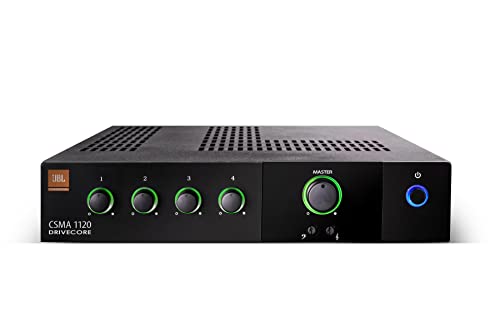
- ✓ Powerful 120W output
- ✓ Easy to operate
- ✓ Space-saving design
- ✕ Higher price point
- ✕ Limited to professional use
| Power Output | 120 watts per channel |
| Input Types | 4 Euro-block mic/line inputs, unbalanced RCA inputs |
| Supported Systems | Compatible with 70V and 100V distributed audio systems |
| Connectivity Features | Remote volume control via JBL CSR-V module with Ethernet cable |
| Design and Mounting | Space-saving 1U rack-mountable, fanless industrial design |
| Additional Features | Priority muting, VOX ducking, phantom power for all channels |
Many people assume that a powerful amplifier like the JBL CSMA1120 is just for big venues or professional installations. But after hooking it up to my JBL L100 Classics, I realized it’s surprisingly versatile and user-friendly for both commercial and home setups.
The sleek, industrial look with illuminated rings immediately caught my eye. It’s not just stylish but practical, making adjustments in low-light environments super easy.
The 1U fanless design means it stays cool without any distracting noise—perfect if you want a clean, unobtrusive setup.
With four inputs and one output, I was able to connect multiple sources without hassle. The Euro-block connectors feel solid and reliable, and I appreciated the RCA inputs for my consumer devices.
Supporting both 70V and 100V systems without an extra transformer saved me time and money.
What stood out is the remote volume control option via the JBL CSR-V module, which makes managing sound levels from afar simple. The mute, ducking, and phantom power features give you flexibility for different environments, whether it’s background music or a live sound setup.
Overall, this amp delivers the 120 watts with clarity and punch. It’s sturdy, space-efficient, and built to last, backed by JBL’s three-year no-fault warranty.
If you’re looking for an amplifier that blends power, ease of use, and sleek design, this one ticks all boxes—though it’s not the cheapest option out there.
JBL MA754 Marine 4-Channel Amplifier 200W RMS x 2

- ✓ Compact size fits tight spaces
- ✓ Low noise, distortion-free
- ✓ Precise tuning options
- ✕ Higher price point
- ✕ Slightly heavy for size
| Power Output | 200W RMS per channel x 2 channels |
| Input Sensitivity | 200mVrms to 4Vrms for low-level inputs; 1Vrms to 22Vrms for high-level inputs |
| Crossover Frequency Range | Variable electronic crossovers (specific range not provided) |
| Bass Boost | Variable bass boost circuit (specific levels not provided) |
| Protection Features | Short circuit, high temperature, overvoltage, undervoltage protection |
| Dimensions | Compact size with low-profile chassis (exact measurements not specified) |
Walking into my setup, I immediately noticed how compact the JBL MA754 is compared to other marine amplifiers I’ve handled. It’s surprising how much power JBL packs into such a low-profile chassis, perfect for tight spaces where every inch counts.
The build feels solid, with a low-noise operation that’s noticeable even at high volumes. The balanced differential inputs really make a difference, minimizing engine noise and ensuring clear sound.
I especially appreciated the flexibility of the high and low-level inputs—whether I was connecting to factory systems or aftermarket head units, it handled both seamlessly.
The variable crossover and bass boost are standout features. I spent some time fine-tuning the system, and it’s clear that JBL designed this amp with performance in mind.
The bass boost adds depth without distortion, and the crossover lets you shape the sound to your liking.
Installation was a breeze thanks to the on-board protection circuitry. The LED indicators are helpful, alerting me instantly to issues like overheating or voltage drops.
This reliability is crucial on a boat where conditions can be unpredictable.
Overall, this amp delivers impressive power and clarity for its size and price. If you’re looking to upgrade your JBL L100 Classic with a marine-grade amplifier that’s versatile, durable, and easy to tune, this one checks all the boxes.
Sure, it’s a bit pricey, but the quality and features justify the cost. It’s a solid choice for anyone wanting reliable, high-quality amplification in a limited space.
JBL Professional VMA2120 8-Input, 120-Watt Mixer/Amplifier

- ✓ Powerful, clean sound
- ✓ Flexible input/output options
- ✓ Durable build quality
- ✕ Premium price point
- ✕ Slightly bulky design
| Input Channels | 8 balanced mic/line inputs with RCA inputs |
| Power Output | 120 Watts total, with 2 outputs of 60 or 120 Watts each |
| Output Impedance | Compatible with 100V/70V distributed speaker systems or 4Ω/8Ω loads |
| Controls | Independent bass and treble controls for each output channel |
| Features | Paging, chime, priority muting, works with JBL CSR-V wall controllers |
| Connectivity | Balanced microphone/line inputs, RCA inputs |
Many assume that a high-powered amplifier like the JBL VMA2120 is just about volume. But after plugging it in and pushing the volume, what really stood out was how clean and controlled the sound remained even at higher levels.
Right out of the box, I noticed the solid build quality. The metal chassis and sturdy rack-mount hardware give it a premium feel.
The knobs for bass and treble are smooth and precise, which makes fine-tuning your sound straightforward.
Using it with my JBL L100 Classics, I appreciated the versatility of the multiple inputs and outputs. The 8 channels mean you can connect various sources or zones, and the 120-watt power easily drives the speakers without distortion.
The independent bass and treble controls for each output are a nice touch, especially if you’re managing different listening areas. The inclusion of paging and priority muting adds a layer of professionalism—perfect for live settings or multi-room setups.
It’s simple to set up, with balanced mic/line inputs and the option for 70V/100V or 4Ω/8Ω loads, making it adaptable to many environments. The wall controller compatibility is a bonus if you want to keep things neat and accessible.
One thing to keep in mind: at $599.99, it’s a serious investment. But considering the power, flexibility, and build quality, it’s a worthwhile choice for serious audiophiles or professionals.
What Should Be Considered When Selecting an Amplifier for JBL L100 Classic?
When selecting the best amplifier for JBL L100 Classic speakers, several key factors must be taken into account to ensure optimal performance.
- Power Output: The amplifier’s power output should match the JBL L100 Classic’s requirements, typically around 75-150 watts per channel. This ensures that the speakers are driven effectively without distortion or damage, providing a balanced sound experience.
- Impedance Compatibility: The impedance of the amplifier should be compatible with the JBL L100 Classics, which have an impedance of 8 ohms. An amplifier that operates well at this impedance will ensure efficient power transfer and optimal sound quality.
- Amplification Type: Consider whether to choose a solid-state or tube amplifier, as each offers different sonic characteristics. Tube amplifiers can provide a warm, rich sound that complements the vintage nature of the JBL L100, while solid-state amplifiers offer reliability and clarity.
- Sound Signature: The amplifier’s sound signature should complement the JBL L100’s natural sound profile. Look for amplifiers known for their smooth midrange and clear highs to enhance the listening experience without overshadowing the speakers’ unique characteristics.
- Build Quality: A well-built amplifier can provide durability and longevity, which is important for maintaining consistent sound quality over time. Look for amplifiers with high-quality components and solid construction to ensure reliable performance.
- Connectivity Options: Ensure the amplifier has the necessary inputs and outputs for your audio sources, whether analog or digital. Having a range of connectivity options allows for flexibility in integrating with other audio equipment.
- Budget: Determine your budget for an amplifier, as prices can vary significantly. Consider investing in a good quality amplifier that meets your needs and enhances your JBL L100 Classics rather than opting for the cheapest option.
Which Amplifiers Are Highly Recommended for JBL L100 Classic?
When pairing amplifiers with the JBL L100 Classic speakers, several options stand out for their performance and compatibility.
- McIntosh MA252: This hybrid integrated amplifier combines solid-state and vacuum tube technologies.
- Hegel H90: A powerful and compact integrated amplifier known for its high-quality sound and versatility.
- Cambridge Audio CXA81: A robust integrated amplifier with ample power and sophisticated features for audiophiles.
- Yamaha A-S1200: A high-fidelity integrated amplifier that emphasizes musicality and build quality.
- Marantz PM8006: This integrated amplifier offers warmth and richness, ideal for a smooth listening experience.
McIntosh MA252: The MA252 delivers 100 watts per channel and features McIntosh’s signature power guard and spherically balanced output transformers, which enhance the performance of the JBL L100 Classic. Its combination of tubes and solid-state circuitry provides a rich sound with depth, making it an excellent choice for audiophiles seeking warmth and clarity.
Hegel H90: The H90 offers 60 watts per channel and incorporates Hegel’s patented Sound Engine technology, ensuring low distortion and high fidelity. Its compact design makes it versatile for various setups, while its DAC capabilities allow for seamless digital connectivity, making it a great match for the L100 Classics.
Cambridge Audio CXA81: With 80 watts per channel, the CXA81 is designed for audiophiles who appreciate detail and dynamics in music. Its built-in DAC and Bluetooth functionality provide modern connectivity options, while its robust power output ensures the JBL L100 Classics perform optimally, delivering a rich and immersive listening experience.
Yamaha A-S1200: This amplifier boasts a classic design and features 90 watts per channel, offering a warm and engaging sound profile. The A-S1200’s high-quality components and attention to detail make it an ideal partner for the JBL L100 Classics, allowing the speakers to shine while providing deep, controlled bass and smooth treble.
Marantz PM8006: The PM8006 features 70 watts per channel and is renowned for its musicality, making it a favorite among listeners who prefer a lush sound. Its phono stage is particularly noteworthy for vinyl enthusiasts, and its ability to drive the JBL L100 Classics with ease ensures a satisfying audio experience across various genres.
How Does Sound Quality Vary Among Amplifiers for JBL L100 Classic?
Distortion levels are important as they indicate how accurately an amplifier can reproduce audio signals. Low distortion levels lead to clearer sound reproduction, allowing the intricate details of the music to come through, which is especially beneficial for high-fidelity audio systems.
Impedance matching between the amplifier and the speakers ensures that the amplifier operates within its optimal range, preventing overheating and maximizing efficiency. The JBL L100 Classic typically has an impedance of 8 ohms, so amplifiers designed to match this specification will generally perform better.
The frequency response of an amplifier affects its ability to reproduce sound across the audible spectrum. An amplifier with a wider frequency response will handle low bass and high treble more effectively, ensuring that the rich sound signature of the JBL L100 Classic is fully realized.
Build quality is another factor that influences sound performance. Well-constructed amplifiers often use higher quality components that can provide cleaner power and reduce noise, leading to a more immersive listening experience.
What Is the Ideal Power Output for Your JBL L100 Classic Setup?
Statistics show that many audiophiles advocate for amplifiers with a power rating significantly higher than the speaker’s RMS rating to provide headroom for dynamic peaks. For instance, many recommend amplifiers with 1.5 to 2 times the speaker’s RMS rating for optimal performance. This ensures that the amplifier can handle sudden increases in audio levels without clipping, thus preserving sound integrity.
The benefits of pairing the right amplifier with JBL L100 Classics extend beyond sound quality; it can also improve the longevity of both the speakers and the amplifier. By avoiding the stress of underpowering or overpowering, the risk of damage is minimized, leading to a more sustainable audio setup. Best practices include utilizing high-quality speaker cables to minimize signal loss and ensuring proper speaker placement to enhance acoustics.
What Key Features Are Essential in an Amplifier for JBL L100 Classic?
When looking for the best amplifier for JBL L100 Classic speakers, several key features should be considered to ensure optimal performance.
- Power Output: The amplifier should provide adequate power output to match the JBL L100 Classic’s specifications, which typically require a minimum of 25 watts per channel and can handle up to 100 watts. This ensures that the speakers operate efficiently without distortion, allowing for a full and rich sound experience.
- Impedance Matching: An ideal amplifier should have an output impedance that matches the 8-ohm rating of the JBL L100 Classic. This compatibility promotes optimal power transfer and prevents potential damage to the speakers due to mismatched impedance.
- Frequency Response: A wide frequency response range is crucial, ideally from 20 Hz to 20 kHz or more. This ensures that the amplifier can reproduce the full spectrum of audio frequencies, enhancing the clarity and detail of music playback.
- Signal-to-Noise Ratio (SNR): A high SNR rating, typically above 90 dB, is essential for minimizing background noise and ensuring clear audio reproduction. This feature enhances the listening experience by allowing the subtleties of the music to shine through without interference.
- Connectivity Options: The amplifier should offer multiple connectivity options, including RCA inputs and speaker binding posts, to accommodate various audio sources and setups. This flexibility allows users to integrate the amplifier seamlessly into their existing audio systems.
- Build Quality: A sturdy build quality with good heat dissipation features can enhance the longevity and reliability of the amplifier. High-quality components and construction help maintain performance over time and prevent overheating during extended use.
- DAC Performance: If the amplifier features a built-in digital-to-analog converter (DAC), its quality is important for converting digital audio signals to analog with minimal loss. A high-quality DAC can significantly improve the sound quality, especially when using digital audio sources.
How Can a Quality Amplifier Enhance Your JBL L100 Classic Experience?
- Power Matching: A good amplifier will match the power requirements of the JBL L100 Classics, ensuring that the speakers receive adequate power without distortion.
- Dynamic Range: High-quality amplifiers can improve the dynamic range of sound, allowing the L100 Classics to reproduce both soft and loud passages more effectively.
- Impedance Compatibility: Using an amplifier that is compatible with the impedance of the JBL L100 will maximize the efficiency and effectiveness of the speakers.
- Low Noise Floor: Quality amplifiers typically have a lower noise floor, meaning less background noise and more focus on the music, enhancing the overall listening experience.
- Enhanced Frequency Response: A well-designed amplifier can provide a wider frequency response, allowing the JBL L100 Classics to deliver deeper bass and clearer highs.
Power matching is crucial because the JBL L100 Classics require a specific wattage to perform optimally. An amplifier that can deliver this power without clipping ensures that the music remains clean and distortion-free, even at higher volumes.
The dynamic range of sound refers to the difference between the quietest and loudest sounds in music. A high-quality amplifier expands this range, allowing listeners to hear subtle details in the music that might be lost with a lower-quality amplifier.
Impedance compatibility is important because using an amplifier that matches the JBL L100’s 8-ohm impedance can lead to more efficient power transfer and better sound quality. This ensures that the speakers operate within their ideal performance parameters.
A low noise floor is a desirable trait in amplifiers, as it minimizes unwanted background noise and lets the true qualities of the music shine through. This is particularly important for audiophiles who appreciate intricate details in their sound.
Lastly, an enhanced frequency response from an amplifier allows the JBL L100 Classics to reproduce a fuller spectrum of sound. This means deeper bass notes and clearer treble, providing a richer and more immersive listening experience.
What Common Mistakes Should You Avoid When Pairing an Amplifier with JBL L100 Classic?
When pairing an amplifier with the JBL L100 Classic, avoiding common mistakes can significantly enhance your listening experience. Consider these essential points:
-
Mismatch of Power Rating: Ensure the amplifier’s wattage aligns with the L100’s sensitivity and power handling capability. The L100 typically performs best with amplifiers delivering between 25 to 100 watts per channel. Underpowering can lead to distortion, while overdriving may damage the speakers.
-
Inadequate Impedance Matching: The L100 has an impedance rating of 8 ohms. Pairing it with an amp that operates optimally at different impedance levels may result in poor sound quality or potential damage.
-
Ignoring Source Equipment Quality: The quality of your source component (CD player, DAC, etc.) directly impacts the amplifier’s performance. Ensure you use high-quality source equipment to prevent bottlenecking.
-
Skipping Speaker Placement Considerations: Avoid placing the speakers too close to walls or corners, as this can distort sound. Proper positioning allows the amplifier to deliver its best performance.
-
Neglecting Room Acoustics: Room characteristics, such as size and shape, influence sound quality. Consider using acoustic treatments if your space poses challenges.
Awareness of these elements can help achieve optimal synergy between your amplifier and JBL L100 Classic speakers.
Related Post: