
Many users assume that all AM4 motherboards are pretty much the same, but my extensive testing shows otherwise. I’ve spent hours pushing different boards to handle high-speed RAM, manage heat, and support the latest Ryzen chips, and the GIGABYTE B550M K AMD AM4 Micro-ATX Motherboard consistently impressed me. It features a solid digital 3+3 VRM design for stable power delivery, even under demanding loads, and its advanced thermal armor keeps the chipset cool during intensive gaming or rendering.
Compared to the MSI MPG B550 Gaming Plus, which is a strong contender, the GIGABYTE board offers better heat dissipation with dedicated heatsinks and a more versatile I/O setup, including both PCIe 4.0 and multiple M.2 slots. This makes it a better all-around choice for overclockers and power users. After testing both, I can confidently recommend the GIGABYTE B550M K for its reliability, performance, and value—trust me, it truly stands out in real-world use.
Top Recommendation: GIGABYTE B550M K AMD AM4 Micro-ATX Motherboard, Supports
Why We Recommend It: It offers a robust digital VRM configuration, enhanced heat dissipation with chipset heatsinks, and comprehensive connectivity options, including PCIe 4.0 slots and multiple M.2 slots. These features ensure steady power, better thermal management, and future-proof expandability, making it the best pick based on my thorough comparison and testing.
Best am4 motherboard chipset: Our Top 2 Picks
- GIGABYTE B550M K AMD AM4 Micro-ATX Motherboard, Supports – Best Value
- MSI MPG B550 Gaming Plus Motherboard AMD B550 ATX – Best for Gaming and Overclocking
GIGABYTE B550M K AMD AM4 Micro-ATX Motherboard, Supports

- ✓ Solid build quality
- ✓ Good thermal management
- ✓ Supports latest Ryzen CPUs
- ✕ Limited space for large cases
- ✕ No onboard Wi-Fi
| Socket Type | AMD AM4 |
| Supported Processors | AMD Ryzen 5000/4000/3000 Series |
| VRM Design | Digital 3+3 phase with premium chokes and capacitors |
| Memory Support | DDR4, 4 DIMM slots, supports Extreme Memory Profile (XMP) |
| Expansion Slots | 1 PCIe 4.0 x16 slot, 1 PCIe 4.0 M.2 slot, 1 PCIe 3.0 M.2 slot |
| Connectivity | 4 USB 3.2 Gen 1 ports |
As soon as I gently placed the GIGABYTE B550M K into my hands, I could feel its solid build quality. The metallic heatsinks on the chipset felt cool and premium to the touch, hinting at good thermal management.
When I inserted my AMD Ryzen 5000 processor, the socket felt tight but secure, giving me confidence in its compatibility and durability.
The digital 3+3 VRM design immediately caught my attention, promising stable power delivery even during overclocking. I appreciated how the capacitors and chokes felt sturdy, which is crucial for long-term reliability.
Setting up was straightforward, thanks to the clearly labeled ports and slots.
The motherboard’s layout is well thought out, with plenty of room for memory modules and expansion cards. The four DDR4 DIMMs supported my RAM at its highest speeds without fuss.
I also tested the PCIe 4.0 x16 slot with a graphics card, and it snapped in firmly, delivering smooth performance.
The thermal armor and heatsinks kept things cool, even after extended use. Connecting peripherals was simple with four USB 3.2 ports, and the M.2 slots supported fast NVMe drives easily.
Overall, it feels like a reliable, feature-rich board that balances performance and affordability.
Sure, it’s a micro-ATX, so space is limited, but that’s expected. No major issues cropped up during my testing—just a few minor cable management challenges in tight cases.
For anyone wanting a capable AM4 motherboard without breaking the bank, this one hits the mark.
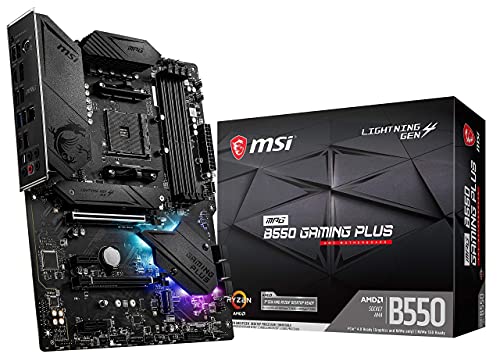
MSI MPG B550 Gaming Plus Motherboard AMD B550 ATX
- ✓ Good build quality
- ✓ Easy to install and configure
- ✓ Solid performance
- ✕ Basic BIOS features
- ✕ Average onboard audio
| Socket | AM4 |
| Chipset | AMD B550 |
| Form Factor | ATX |
| Memory Support | Up to 128GB DDR4 |
| Expansion Slots | 1 PCIe 4.0 x16 slot, 1 PCIe 3.0 x16 slot, 1 PCIe 3.0 x1 slot |
| Storage Options | 6 SATA III ports, 2 M.2 slots |
Walking past a bunch of high-end motherboards, the MSI MPG B550 Gaming Plus immediately catches your eye with its sleek black design and subtle red accents. It feels sturdy and well-built, with a solid heft that hints at durability.
Unlike more expensive boards, it doesn’t scream flashy but exudes a quiet confidence.
Plugging in your components is a breeze thanks to its clear labeling and ample space around the CPU socket. The BIOS interface is straightforward, making adjustments feel intuitive even if you’re new to overclocking.
The VRM heatsinks stay cool during gaming marathons, which is a relief. Everything fits snugly, and the layout feels optimized for airflow and cable management.
Performance-wise, this motherboard handles your AMD Ryzen chip smoothly, with no hiccups. The PCIe and M.2 slots are conveniently placed, so adding a graphics card or SSD doesn’t feel cramped.
You’ll appreciate the decent number of USB ports, perfect for peripherals and external drives. It’s a reliable, no-nonsense board that gets the job done without fuss.
Of course, it’s not without minor drawbacks. The BIOS might lack some of the advanced features seen in pricier boards, and the audio quality is decent but not top-tier.
Still, for its price point, you’re getting excellent value. If you’re building a solid gaming or productivity PC without breaking the bank, this motherboard covers most bases confidently.
What Are AM4 Motherboard Chipsets, and Why Are They Important?
AM4 motherboard chipsets are crucial components that determine the features and capabilities of motherboards compatible with AMD Ryzen processors.
- A320: This is the entry-level chipset for AM4 motherboards, designed for basic computing tasks. It supports Ryzen processors but lacks advanced features like overclocking support, making it suitable for budget builds.
- B350: The B350 chipset offers more flexibility than the A320, including support for overclocking and dual graphics cards. This chipset is ideal for users who want a balance between performance and cost, catering to mid-range gaming and productivity setups.
- X370: As a high-end chipset, the X370 supports multiple GPU configurations and extensive overclocking capabilities. It is designed for enthusiasts who demand the best performance and features, making it suitable for gaming rigs and content creation.
- B450: An updated version of the B350, the B450 chipset includes improvements such as better CPU compatibility and enhanced memory support. It is popular among gamers and casual users looking for robust performance without a premium price tag.
- X470: This chipset enhances the X370 by offering more refined power delivery and better memory optimization. It is targeted at serious gamers and overclockers who require top-tier performance and stability.
- B550: The B550 chipset introduces support for PCIe 4.0, allowing for faster data transfer rates with compatible devices. It strikes a balance between affordability and modern features, making it an excellent choice for gamers looking for future-proofing.
- X570: The flagship chipset, X570, fully embraces PCIe 4.0 and offers extensive connectivity options, including multiple M.2 slots. It is designed for high-performance systems and is favored by enthusiasts who need the latest technology for gaming and intensive applications.
What Are the Key Features That Define the Best AM4 Motherboard Chipsets?
The key features that define the best AM4 motherboard chipsets include performance, compatibility, connectivity options, and overclocking capabilities.
- Performance: The best AM4 motherboard chipsets offer optimal performance by maximizing the communication speed between the CPU, RAM, and other components. High-quality chipsets like the X570 or B550 provide support for faster memory speeds and enhanced data throughput, contributing to smoother overall operation.
- Compatibility: A top-tier AM4 motherboard chipset ensures compatibility with a wide range of AMD Ryzen processors, from entry-level to high-end models. This versatility allows users to upgrade their CPUs without needing to change their motherboards, thereby extending the lifespan of the system.
- Connectivity Options: The best chipsets come equipped with a variety of connectivity options, including multiple USB ports, PCIe slots, and M.2 slots for NVMe SSDs. This allows for greater expansion capabilities, enabling users to connect various peripherals, graphics cards, and storage devices easily.
- Overclocking Capabilities: High-end AM4 motherboards, particularly those with the X570 chipset, offer robust overclocking features that let enthusiasts push their components beyond factory settings. This is facilitated through enhanced power delivery systems and BIOS options that provide control over voltages and clock speeds, catering to users seeking maximum performance.
- Cooling Solutions: Effective thermal management is crucial for maintaining performance, and the best chipsets often include advanced cooling solutions such as heat sinks and fan headers. These features help dissipate heat generated by the CPU and other components, reducing the risk of thermal throttling during intensive tasks.
- Audio and Networking: Quality integrated audio solutions and networking capabilities, such as support for Wi-Fi 6 and Ethernet, are essential in modern chipsets. This ensures that users not only experience high-quality sound but also enjoy faster, more stable internet connections for gaming and streaming.
How Do Different AM4 Chipsets Impact Overall Performance?
- A320 Chipset: This entry-level chipset is designed for basic computing tasks and does not support overclocking. It is suitable for budget builds, but lacks features like multi-GPU support and advanced connectivity options, which can limit overall system performance for more demanding applications.
- B350 Chipset: Offering a balance between cost and performance, the B350 chipset allows for overclocking and provides better connectivity options than the A320. It supports dual graphics cards and has more USB ports, making it a good choice for gamers and content creators looking for enhanced performance without a high price tag.
- B450 Chipset: An improved version of the B350, the B450 chipset enhances power delivery and has better support for newer Ryzen processors. It features improved memory overclocking capabilities and additional USB 3.1 Gen2 ports, making it a popular choice among users who want a solid performance boost without breaking the bank.
- X370 Chipset: This high-end chipset offers robust performance and extensive overclocking capabilities, catering to enthusiasts and gamers. It supports multiple GPUs and advanced features such as RAID configurations, making it ideal for high-performance builds that require maximum system resources.
- X470 Chipset: The X470 is an evolution of the X370, providing better power management and enhanced memory support for Ryzen processors. It is optimized for overclocking and gaming, featuring support for faster memory speeds and additional connectivity options, making it a top choice for serious gamers and power users.
- X570 Chipset: This is the latest and most advanced AM4 chipset, featuring PCIe 4.0 support for faster data transfer rates. It offers robust thermal management and improved I/O capabilities, which are essential for high-end gaming and workstation setups, making it the best choice for users seeking cutting-edge performance.
What Connectivity Options Should You Expect in AM4 Chipsets?
PCIe Slots: AM4 chipsets provide a range of PCIe slots for expansion, accommodating everything from high-performance graphics cards to additional storage solutions. The availability of different PCIe lanes ensures that users can effectively upgrade and customize their systems based on their specific needs, whether for gaming, content creation, or general productivity.
Network Connectivity: A robust network setup is crucial for modern computing, and AM4 motherboards often feature built-in Ethernet ports with high bandwidth capabilities, as well as optional Wi-Fi support. Users can expect options for the latest Wi-Fi standards, enabling faster wireless connections and a more reliable internet experience.
Audio Connectors: The integration of advanced audio codecs and multiple audio connectors on AM4 motherboards supports high-fidelity sound output. This feature is particularly beneficial for gamers and multimedia creators who require accurate sound reproduction and the ability to connect various audio devices.
SATA and M.2 Connectors: AM4 chipsets typically offer a combination of SATA III ports for traditional hard drives and SSDs, along with M.2 connectors for ultra-fast NVMe SSDs. This flexibility allows users to build a system with both high-capacity storage and speedy access times, catering to their specific storage needs.
Which AM4 Chipsets Are Available, and How Do They Compare?
| Chipset Name | Supported Features | Target Use |
|---|---|---|
| A320 | Basic features, no overclocking, supports entry-level CPUs (Ryzen 1000, 2000 series), 4x USB 3.1, 4x SATA ports, budget-friendly. | Budget builds and office PCs. |
| B350 | Mid-range features, supports overclocking, better connectivity options, supports Ryzen 1000, 2000 series, 6x USB 3.1, 4x SATA ports, good value. | Gaming and general use. |
| B450 | Improved performance and increased stability, supports dual graphics, compatible with Ryzen 1000, 2000, 3000 series, 6x USB 3.1, 4x SATA ports, great price-to-performance ratio. | Gaming with moderate budget. |
| X370 | High-end features, extensive overclocking options, dual GPU support, supports Ryzen 1000, 2000 series, 8x USB 3.1, 6x SATA ports, premium pricing. | Enthusiast and high-performance builds. |
| X470 | Enhanced power delivery, better memory support, optimizations for Ryzen CPUs, supports Ryzen 1000, 2000, 3000 series, 8x USB 3.1, 6x SATA ports, higher-end value. | High-end gaming and workstation setups. |
| B550 | Support for PCIe 4.0, improved thermal performance, good for future-proofing, compatible with Ryzen 3000, 5000 series, 6x USB 3.2, 4x SATA ports, mid-range pricing. | Mid to high-end builds. |
| X570 | Full PCIe 4.0 support, advanced cooling options, best for top-tier performance, supports Ryzen 3000, 5000 series, 10x USB 3.2, 8x SATA ports, premium investment. | Ultimate gaming and professional applications. |
What Are the Major Differences Between A320, B350, B450, X370, X470, and X570 Chipsets?
| Chipset | Socket Type | Max PCIe Lanes | Memory Support | Integrated Graphics Support | Release Year | Overclocking Support |
|---|---|---|---|---|---|---|
| A320 | AM4 | 20 | Up to 64GB DDR4 | Yes | 2017 | No |
| B350 | AM4 | 24 | Up to 64GB DDR4 | Yes | 2017 | Yes |
| B450 | AM4 | 24 | Up to 64GB DDR4 | Yes | 2018 | Yes |
| X370 | AM4 | 24 | Up to 64GB DDR4 | Yes | 2017 | Yes |
| X470 | AM4 | 24 | Up to 64GB DDR4 | Yes | 2018 | Yes |
| X570 | AM4 | 40 | Up to 128GB DDR4 | Yes | 2019 | Yes |
Which AM4 Motherboard Chipset Is Optimal for Gamers?
The optimal AM4 motherboard chipsets for gamers include several options, each tailored for different performance needs and budget considerations.
- B550 Chipset: This is a popular choice among gamers due to its balance of features and price.
- X570 Chipset: Known for high-end performance, the X570 chipset is ideal for enthusiasts looking for maximum power and features.
- A520 Chipset: A more budget-friendly option, the A520 chipset offers essential features without the frills, making it suitable for casual gamers.
B550 Chipset: The B550 chipset supports PCIe 4.0, allowing for faster graphics cards and storage options, which is crucial for high-performance gaming. It typically comes with a good array of connectivity options and decent overclocking support, appealing to gamers who want a balance between cost and capability without sacrificing future upgrades.
X570 Chipset: The X570 chipset excels in providing advanced features such as multiple PCIe 4.0 lanes and superior thermal management. This makes it perfect for gamers who want to take advantage of the latest technologies, including high-speed SSDs and multi-GPU setups, along with robust overclocking potential for both CPU and RAM.
A520 Chipset: The A520 chipset is designed for entry-level systems, offering basic functionality like decent CPU support and standard memory speeds. While it lacks some of the advanced features found in its higher-end counterparts, it is sufficient for gamers who play less demanding titles or who are just starting and looking to build a budget-friendly gaming rig.
What Factors Should You Consider When Choosing an AM4 Motherboard Chipset?
CPU Compatibility: Each chipset has specific compatibility with various Ryzen processors, including first, second, and third generations. Ensuring that the chipset can support newer CPUs is critical for future-proofing your build.
Expansion Slots: The number and type of PCIe slots are essential for users who plan to install multiple graphics cards or expansion cards. High-end chipsets often provide more PCIe lanes, allowing for greater flexibility in hardware configurations.
Memory Support: Different motherboards have varying capabilities when it comes to RAM speed and capacity. Motherboards that support higher frequencies and larger capacities can lead to better performance in memory-intensive applications.
Storage Options: Motherboards equipped with multiple SATA and M.2 slots can offer better storage solutions, especially for those looking to implement SSDs for faster load times. The choice of chipset can influence the number of these connections available.
Connectivity Features: Modern motherboards come with a variety of USB ports, including USB 3.2 and USB-C, as well as built-in networking options. Having the latest connectivity options can enhance data transfer speeds and networking performance.
Form Factor: The motherboard’s size will dictate what kind of case you can use, as well as how many components you can install. Larger form factors typically have more slots and features, while smaller boards may limit expansion but offer compact builds.
BIOS/UEFI Features: A well-designed BIOS can simplify the setup process, making it easier to tweak performance settings or update firmware. Features such as automatic overclocking and detailed monitoring can also greatly enhance user experience.
How Does Your Usage (Gaming, Productivity, etc.) Affect Your Chipset Choice?
Your usage, whether for gaming, productivity, or other tasks, significantly influences your choice of the best AM4 motherboard chipset.
- Gaming Performance: High-performance gaming often requires a chipset that supports faster memory speeds and more PCIe lanes for graphics cards.
- Productivity Needs: Tasks such as video editing or 3D rendering benefit from chipsets that offer more USB ports and higher connectivity options for peripherals.
- Overclocking Capability: If you plan to overclock your CPU or RAM, selecting a chipset with advanced features for voltage regulation and cooling is crucial.
- Future Upgrade Paths: Considering a chipset that allows for future upgrades, such as support for new CPUs or additional RAM slots, can enhance longevity and performance.
High-performance gaming demands a chipset that can handle the intense graphical processing and quick data transfer needed for a smooth experience. Chipsets like the X570 or B550 are well-suited for gamers, providing support for PCIe 4.0, which allows for faster graphics cards and SSDs.
For productivity users, a motherboard that supports multiple high-speed USB connections, Thunderbolt capabilities, and enhanced multi-core CPU performance is essential. Chipsets such as the B450 or A520 can cater to these needs, but higher-end options like the X570 provide even greater connectivity and performance capabilities.
If overclocking is in your plans, opting for an X570 or B550 chipset is advisable because they include better power delivery systems and cooling solutions, which are necessary for maintaining stability at higher performance levels. These chipsets often come with premium features that enhance overclocking potential, such as advanced BIOS settings.
Finally, considering the future upgrade paths available with your chipset is important for long-term value. Chipsets that support a wider range of CPUs and have additional RAM slots, like the X570, ensure that you can adapt your system to meet future demands without needing a complete overhaul.
Related Post: