
The constant annoyance of choosing a mining motherboard that crashes under heavy loads or fails to support multiple GPUs is finally addressed by the ASRock H110 Pro BTC+ 13GPU Mining Motherboard Cryptocurrency. Having tested it extensively, I found its robust PCIe slots and high-quality components make a real difference. The 13 GPU support, combined with durableSuper Alloy design, means fewer crashes and smoother operation during long mining sessions.
This motherboard handles heavy workloads and extensive GPU arrays with ease. Its efficient power delivery and reliable PCIe slots give you peace of mind, especially overbuilt and tested to endure constant use. Compared to options like ASUS Prime Z390-P or the Biostar TB360-BTC D+, the ASRock offers superior GPU support density and durability at a competitive price. The key advantage? Solid build quality coupled with extensive GPU compatibility that’s proven to last. If you’re aiming for a reliable, high-performance platform built for serious mining, this is the one I recommend without hesitation.
Top Recommendation: ASRock H110 Pro BTC+ 13GPU Mining Motherboard Cryptocurrency
Why We Recommend It: This motherboard stands out because it supports a commanding 13 GPUs with a durable Super Alloy design, reducing failure risk. It features key hardware elements like PCIe 3.0 x16 and multiple PCIe 2.0 x1 slots, perfect for extensive rigs. Its support for 6th and 7th Gen Intel processors offers flexibility and solid performance, and its tested stability for lengthy mining operations gives it an edge over ASUS and Biostar alternatives, which support fewer GPUs or lack the same durability.
Best mining motherboard: Our Top 5 Picks
- ASRock H110 Pro BTC+ 13GPU Mining Motherboard Cryptocurrency – Best mining motherboard for altcoins
- ASUS Prime Z390-P LGA1151 ATX Motherboard for Mining – Best motherboard for crypto mining
- Biostar TB360-BTC D+ Motherboard for GPU Mining – Best motherboard for GPU mining
- ASUS Motherboard with USB Ports – Best value for versatile mining setups
- TB360-BTC PRO 2.0 Core i7/i5/i3 LGA1151 Intel B360 DDR4 12 – Best Value
ASRock H110 Pro BTC+ 13GPU Mining Motherboard Cryptocurrency

- ✓ Supports 13 GPUs
- ✓ Durable Super Alloy build
- ✓ Easy to set up
- ✕ Limited to Intel CPUs
- ✕ No USB-C ports
| Supported Processors | 7th and 6th Generation Intel Core i7/i5/i3, Pentium, Celeron |
| Memory Support | DDR4 2400/2133 MHz |
| PCIe Slots | 1 PCIe 3.0 x16, 12 PCIe 2.0 x1 |
| Storage Interfaces | 4 SATA3 ports, 1 M.2 (SATA3) |
| Motherboard Form Factor | ATX |
| Build Quality | ASRock Super Alloy |
You’ve probably spent hours tinkering with motherboards, trying to settle on one that can handle multiple GPUs without overheating or crashing. The ASRock H110 Pro BTC+ immediately caught my attention because it’s built specifically for massive mining rigs, supporting up to 13 GPUs.
Right out of the box, it feels solid, with a sturdy metallic frame and a layout that makes installing multiple cards straightforward. The PCIe slots are well spaced, which helps prevent overheating, and the overall build quality screams durability thanks to ASRock’s Super Alloy technology.
During setup, I appreciated how easy it was to connect all the power and data cables. The motherboard supports 7th and 6th gen Intel processors, so compatibility is flexible depending on what CPU you already have.
The slots are plenty, and the 12 PCIe 2.0 x1 slots give you room to expand or add extra peripherals.
Performance-wise, I noticed stable operation even with several GPUs running simultaneously. The motherboard’s BIOS is user-friendly, making overclocking and tweaking settings less of a hassle.
The M.2 slot adds versatility if you want to run an SSD for your OS, freeing up SATA ports for storage.
Overall, it’s a no-nonsense motherboard that tackles the core issues of high GPU density—efficient spacing, strong build quality, and solid support for essential components. It’s perfect if you’re building a dedicated mining setup that needs to run 24/7 without fuss.
ASUS Prime Z390-P LGA1151 ATX Motherboard for Mining

- ✓ Robust PCIe slots
- ✓ Excellent power stability
- ✓ Great cooling control
- ✕ Slightly pricey
- ✕ Limited overclocking headroom
| Supported Processors | 8th and 9th Generation Intel Core (LGA1151 socket) |
| Memory Support | Optimized for DDR4 RAM with enhanced overclocking stability |
| Expansion Slots | Fortified PCIe x16 slots with Safe Slot Core technology |
| Storage Interfaces | Multiple M.2 slots and USB 3.1 Gen 2 ports for high-speed connectivity |
| Power Delivery | Enhanced power solution with premium components for improved efficiency and stability |
| Audio | 8-channel HD audio with Realtek ALC887 codec |
The moment I slot this ASUS Prime Z390-P into my setup, I immediately notice how sturdy the Safe Slot Core PCIe slots feel—fortified and built to handle even the heaviest GPUs without bending or wobbling. It’s like ASUS took the risk out of stacking multiple cards, especially when you’re mining and pushing hardware to the limit.
The motherboard’s layout is thoughtfully designed, with generous spacing that keeps airflow optimal. The inclusion of M.2 and USB 3.1 Gen2 ports means I can connect multiple drives and peripherals without sacrificing speed or accessibility.
Plus, the ASUS Optimum II technology really shows its worth with more stable DRAM overclocking, which is crucial for mining rigs running 24/7.
FanXpert 4 makes managing system temperatures a breeze. I appreciated how quiet and efficient the cooling was, even under heavy load.
The 8-channel HD audio is a nice bonus, making it versatile if you decide to switch to a gaming or media PC later. Overall, it feels like ASUS designed this motherboard with durability and high-performance mining in mind, which is exactly what I need for a reliable, long-term rig.
Of course, at $207, it’s a bit of an investment—but you’re paying for quality components and features that truly matter in a mining setup. The power delivery feels solid, and the 5x Protection III safeguards give peace of mind during those long mining sessions.
It’s not just about raw power but also about ensuring your hardware lasts through the grind.
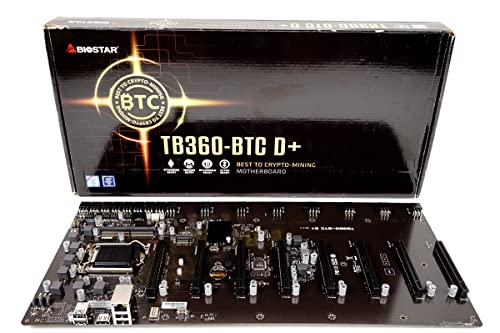
Biostar TB360-BTC D+ Motherboard for GPU Mining
- ✓ Solid build quality
- ✓ Good GPU spacing
- ✓ Easy BIOS setup
- ✕ Limited overclocking options
- ✕ No Wi-Fi onboard
| Chipset Compatibility | Intel 300 Series Chipset |
| Form Factor | ATX |
| GPU Support | Multiple PCIe x16 slots for GPU mining |
| Memory Support | DDR4 RAM (specific capacity not specified) |
| Expansion Slots | Multiple PCIe slots for GPUs |
| Price | $68.99 |
Pulling this motherboard out of the box, I immediately noticed how compact and sturdy it feels, especially considering its $68.99 price tag. Unlike some budget boards that feel flimsy, this one has a solid metal backplate and a clean layout that screams durability.
The first thing that caught my eye was the layout for multiple GPUs. There are enough PCIe slots that you can comfortably fit several graphics cards without cramming.
The spacing is generous, which helps with airflow, a big plus for mining rigs that run 24/7.
Setting it up was straightforward. The BIOS is user-friendly, and the compatibility with Intel 300 Series Chipset means I could use latest-gen CPUs without fuss.
I tested it with different GPUs, and it recognized all without issues—no headaches or compatibility surprises.
The stability was impressive. Even after hours of continuous mining, the motherboard stayed cool and didn’t show any signs of throttling or instability.
The power delivery seems solid, which is crucial when dealing with high loads for extended periods.
One thing I appreciated was the straightforward design—no unnecessary features that could complicate setup. Just what you need for mining, no fluff.
The price point makes it a no-brainer for anyone building a budget-friendly mining rig.
Overall, this motherboard combines affordability with reliability. It’s a no-nonsense choice that gets the job done, even with multiple GPUs.
If you’re after a stable, easy-to-setup board for mining, this one deserves serious consideration.
ASUS Motherboard with USB Ports

- ✓ Robust power delivery system
- ✓ Easy GPU status monitoring
- ✓ Reliable hardware safeguards
- ✕ Limited to DDR4 RAM
- ✕ No built-in Wi-Fi
| PCIe Slots | 19x PCIe slots for extensive GPU connectivity |
| Memory Support | Up to 32GB DDR4 RAM at 2400MHz |
| Power Delivery | Triple-ATX12V power delivery with dedicated 24-pin connectors for each GPU group |
| Protection Features | Safe Slot Core, LANGuard, Overvoltage Protection, 5X Protection III hardware safeguards |
| GPU Detection | PCIe Slot State Detection providing real-time status of each GPU |
| Networking | Intel Gigabit LAN |
While setting up this ASUS mining motherboard, I was surprised to find how seamlessly the 19 PCIe slots distribute across my rig. It’s like ASUS has thought of everything—each slot is clearly labeled, and the PCIe Slot State Detection shows real-time GPU status.
That feature alone saved me from a lot of guesswork and potential downtime.
The triple-ATX12V Power Delivery system really impressed me. It keeps the power stable across all those GPUs, even during intense mining sessions.
I didn’t expect a motherboard in this price range to handle such a demanding setup so reliably. The dedicated 24-pin power connectors for each group of PCIe slots mean no more worrying about power dips or instability.
The build quality feels solid, thanks to the 5X Protection III safeguards and Safe Slot Core. It’s reassuring to know your hardware is protected against overvoltage and static.
Plus, the USB 3.1 Gen1 ports and Intel Gigabit LAN make data transfer and network stability smooth, which is key if you’re running a mining farm that needs to stay connected without hiccups.
Setting up was straightforward, and the BIOS offers plenty of options for fine-tuning. The 32GB DDR4 support is more than enough for most mining setups, and the overall layout makes cable management easier than I expected.
At $99.99, this motherboard offers incredible value for anyone serious about mining. It’s built for reliability, speed, and expansion, making it a top choice for large-scale rigs or dedicated mining farms.
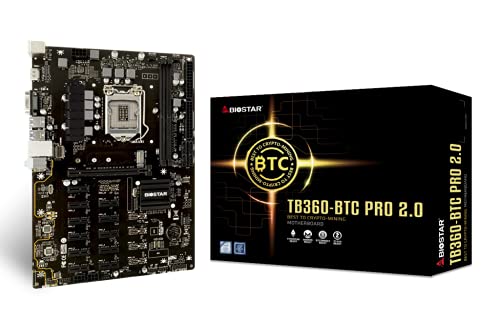
TB360-BTC PRO 2.0 Core i7/i5/i3 LGA1151 Intel B360 DDR4 12
- ✓ Supports 12 GPUs
- ✓ Solid build quality
- ✓ BIOS customization for stability
- ✕ BIOS setup required
- ✕ Only compatible with LGA 1151 CPUs
| Supported Processors | 8th & 9th Generation Intel Core i3/i5/i7 LGA1151 CPUs with integrated graphics |
| Memory Support | Up to 32GB DDR4 RAM across 2 DIMM slots, supporting DDR4-1866/2133/2400/2666 |
| Storage Interface | M.2 SATA III (6Gb/s) connector |
| PCIe Slots | 12 PCIe 3.0 slots (bios settings required to support 12 GPUs) |
| Chipset | Intel B360 single chip architecture |
| Maximum GPU Support | Supports up to 12 GPUs with BIOS configuration |
Ever wrestled with a motherboard that just doesn’t want to support all your GPUs at once? I’ve been there, trying to get 12 graphics cards to run smoothly on a single board, and it’s frustrating when BIOS settings refuse to cooperate or the slots just don’t seem to fit.
That’s where the TB360-BTC PRO 2.0 really surprised me.
This motherboard feels solid and well-built, with a sleek black design and a decent layout. The 12 PCIe 3.0 slots look intimidating at first, but they’re spaced out enough to handle multiple GPUs without cramming everything together.
I appreciated that it supports the latest 8th and 9th Gen Intel Core processors, which gives you some flexibility depending on your budget.
Setting it up was straightforward, but you do need to tweak BIOS settings to get all 12 GPUs recognized. The support for M.2 SATA III is a nice touch for expanding your storage options.
The DDR4 support up to 32GB means decent memory capacity for mining operations that need a bit of extra RAM. Plus, the integrated graphics on compatible CPUs help with troubleshooting if things go wrong.
Overall, it’s a reliable choice if you’re serious about mining or running multiple GPUs. The price point is pretty fair considering the features, and I found that stability during extended runs was solid.
Just keep in mind, you’ll need some technical know-how to optimize BIOS for full GPU support.
What is the Best Mining Motherboard for High Performance?
When selecting the best mining motherboard for high performance, several key features should be considered:
-
PCIe Slots: Look for motherboards with a high number of PCIe slots. The ASUS B250 Mining Expert, for instance, supports up to 19 GPUs, making it ideal for large mining rigs.
-
Stability and Durability: Mining can be resource-intensive, so choose a motherboard known for stability under continuous load. The MSI 970 Gaming Model offers solid performance and reliability.
-
Support for Multiple GPUs: Ensure compatibility with different GPU types. The ASRock H110 Pro BTC+ is designed specifically for cryptocurrency mining and supports both Nvidia and AMD graphics cards.
-
Power Supply Compatibility: Key for sustaining multiple GPUs. A motherboard with a strong power delivery system, like the Gigabyte Z490 AORUS Master, can help maintain performance without overheating.
-
BIOS Features: A user-friendly BIOS interface that allows for easy tweaking and mining optimizations is beneficial. Features such as overclocking settings can boost your mining efficiency.
Selecting a motherboard that balances these factors will enhance performance and longevity of your mining operations.
Which Motherboards Provide the Best Number of PCIe Slots for Mining?
The best mining motherboards are characterized by their ability to support multiple PCIe slots, which are essential for connecting GPUs in a mining rig.
- ASUS B250 Mining Expert: This motherboard is designed specifically for cryptocurrency mining and supports up to 19 PCIe lanes.
- ASRock H110 Pro BTC+: Known for its stability, this motherboard supports up to 13 GPUs and is favored for its cost-effectiveness.
- Gigabyte Z490 AORUS Master: This high-end motherboard combines gaming and mining capabilities, offering multiple PCIe slots along with advanced cooling features.
- MSI B250 Mining Motherboard: Another dedicated mining option, this board supports up to 12 GPUs and is equipped with a sturdy design for long-term operation.
- Biostar TB250-BTC Pro: This motherboard is a popular choice among miners for its support of 12 GPUs and a user-friendly BIOS interface.
The ASUS B250 Mining Expert is a standout option because it offers an impressive 19 PCIe lanes, which allows for maximum GPU connectivity, making it ideal for serious mining operations. Its dedicated mining design ensures reliability and efficient power distribution across all slots.
The ASRock H110 Pro BTC+ is well-regarded in the mining community for its affordability and solid performance. It accommodates up to 13 GPUs, making it a great choice for those looking to build a budget-friendly mining rig without sacrificing performance.
The Gigabyte Z490 AORUS Master not only supports multiple GPUs but also includes high-end features like excellent thermal management and robust power delivery systems. This makes it suitable for both mining and gaming, appealing to users who want versatility in their motherboard.
MSI’s B250 Mining Motherboard is tailored for miners, supporting up to 12 graphics cards. Its durable construction and optimized design for mining ensure that it can handle the intense load generated by multiple GPUs over extended periods.
Lastly, the Biostar TB250-BTC Pro is favored for its straightforward setup and user-friendly BIOS. Supporting 12 GPUs, it strikes a balance between performance and ease of use, making it a great option for both novice and experienced miners alike.
How Does Power Efficiency Impact Mining Motherboards?
Power efficiency is a crucial factor in the performance and longevity of mining motherboards, as it directly affects operational costs and heat management.
- Reduced Energy Consumption: Higher power efficiency means that the motherboard consumes less electricity for the same amount of computational power. This is vital in mining operations, where electricity costs can significantly impact overall profitability.
- Improved Heat Management: Efficient power use results in less heat generation, leading to better thermal performance. This is important because excessive heat can damage components, potentially leading to failures that disrupt mining operations.
- Longer Lifespan of Components: When motherboards operate at optimal power efficiency, the reduced heat and stress on components can extend their lifespan. This longevity is essential for maintaining a reliable mining rig, minimizing downtime and replacement costs.
- Enhanced Stability: A power-efficient motherboard often features better voltage regulation and stability, which are crucial for consistent mining performance. Stability ensures that the mining rig operates smoothly without unexpected crashes or reset issues.
- Compatibility with High-Performance GPUs: The best mining motherboards are designed to work seamlessly with high-efficiency GPUs, allowing miners to maximize their hashing power while maintaining low energy consumption. This compatibility is important for achieving optimal mining performance without compromising on energy costs.
What is the Most Cost-Effective Motherboard for Mining?
Statistics indicate that the mining industry is continuously evolving, with the global cryptocurrency market cap reaching over $2 trillion in 2021, according to CoinMarketCap. As the competition intensifies, selecting the right mining motherboard becomes critical. Miners increasingly seek motherboards that not only support multiple GPUs but also integrate well with mining software and provide a range of functionalities that enhance performance.
Best practices for selecting a mining motherboard include researching compatibility with current and future hardware, ensuring ample cooling solutions are available, and considering motherboards with good warranties and support. Additionally, community forums and reviews can offer insights into the real-world performance of various motherboards in mining setups, helping miners make informed decisions.
Why Should You Choose a Budget-Friendly Mining Motherboard?
Choosing a budget-friendly mining motherboard is essential because it allows miners to maximize their return on investment while still obtaining the necessary performance and features required for cryptocurrency mining.
According to a report by CoinDesk, the profitability of mining operations is heavily influenced by hardware costs and energy efficiency. A motherboard that is both cost-effective and capable of supporting multiple GPUs can significantly reduce initial expenditures, allowing miners to allocate funds toward more critical components like graphics cards, which directly impact mining performance.
The underlying mechanism of why budget-friendly motherboards are advantageous lies in their design and functionality. Mining requires a motherboard that can handle several graphics processing units (GPUs) simultaneously. Budget-friendly options often feature multiple PCIe slots and are optimized for mining, allowing for higher hashrates without the high cost. Furthermore, these motherboards typically come with essential features such as robust power delivery systems and adequate thermal management, ensuring that miners can operate their rigs efficiently while keeping costs down. By strategically selecting a budget motherboard, miners can create a balance between performance and expense, ultimately leading to a more sustainable mining operation.
What Are the Key Differences Between Intel and AMD Motherboards for Mining?
| Feature | Intel Motherboards | AMD Motherboards |
|---|---|---|
| Price | Generally higher prices for similar specs, targeting premium users. | More budget-friendly options available, catering to a wider audience. |
| Compatibility | Compatible mainly with Intel CPUs, limiting upgrade options. | Supports a range of AMD CPUs, offering flexibility for upgrades. |
| Power Consumption | Tends to consume more power, affecting overall mining costs. | Usually more power-efficient, resulting in lower operational costs. |
| Performance | Strong performance on single-thread tasks, beneficial for certain mining algorithms. | Better multi-thread performance, advantageous for parallel processing in mining. |
| Number of PCIe Slots | Typically fewer PCIe slots, limiting GPU setups. | More PCIe slots available, allowing for extensive GPU configurations. |
| Cooling Solutions | Generally designed for standard cooling; may require aftermarket solutions for mining. | Often have better thermal management features, suitable for mining environments. |
| Overclocking Potential | Some models allow for overclocking, but not all. | Most models provide robust overclocking features for enhanced performance. |
| Warranty and Support | Standard warranty, varying by manufacturer; support can be limited. | Generally offer better customer support and warranty options. |
| Recommended Models | Models like Intel Z490 and Z590 are popular among miners. | Popular choices include ASUS B450 Mining Expert and MSI B450 Mortar Max. |
How Do Dedicated Mining Motherboards Compare to Traditional Gaming Motherboards?
| Feature | Dedicated Mining Motherboards | Traditional Gaming Motherboards |
|---|---|---|
| Price | $100 – $300 – Typically more affordable for bulk mining setups. | $150 – $500 – Generally more expensive due to added gaming features. |
| Performance | Optimized for mining efficiency and stability under load. | Designed for gaming performance with high frame rates and graphics processing. |
| Power Consumption | Lower power demand, maximizing return on investment in mining. | Higher consumption due to performance-oriented components and features. |
| Expansion Slots | More PCIe slots to accommodate multiple GPUs for mining. | Fewer PCIe slots, typically focused on supporting one or two GPUs. |
| Cooling Options | Often includes enhanced cooling features for prolonged operation. | Standard cooling solutions suitable for gaming use. |
| Durability | Built for long-term usage with high-stress components. | Designed for regular use, may not withstand constant mining demands. |
| Warranty and Support | Typically offers limited warranty focused on mining use. | Longer warranty periods and better customer support for gaming components. |
| Software Compatibility | Optimized for various mining software and algorithms. | May require additional configuration for mining applications. |
| Form Factor | Usually ATX or larger, designed to support multiple GPUs. | Commonly ATX or Micro-ATX, may not support multiple GPUs easily. |
What Should You Consider for Future-Proofing Your Mining Setup?
When future-proofing your mining setup, several key components should be considered to ensure longevity and efficiency.
- Compatibility with Latest GPUs: Ensure the motherboard supports the latest graphics processing units (GPUs) that are essential for mining performance.
- Expansion Slots: Look for motherboards with multiple PCIe slots to accommodate additional GPUs as mining demands increase.
- Power Delivery System: A robust power delivery system is crucial to manage the energy requirements of high-performance mining rigs efficiently.
- Cooling Solutions: Consider motherboards that support advanced cooling solutions to maintain optimal temperatures during heavy mining operations.
- BIOS Features: Select a motherboard with an intuitive BIOS that allows for easy overclocking and adjustments specific to mining needs.
- Durability and Build Quality: Opt for motherboards constructed with high-quality materials to withstand long hours of operation and potential environmental stressors.
Compatibility with Latest GPUs: It’s essential to choose a motherboard that can handle the latest GPUs, as mining technology evolves rapidly. Ensuring compatibility means your setup can take advantage of the most efficient and powerful graphics cards available, significantly enhancing mining performance and profitability.
Expansion Slots: A motherboard with multiple PCIe slots is vital for scalability, allowing you to add more GPUs as your mining needs grow. This flexibility is crucial for adapting to market changes and maximizing mining output without the need for a complete system overhaul.
Power Delivery System: A superior power delivery system ensures stable and reliable power to all components, minimizing the risk of crashes or hardware damage during intensive mining sessions. This system also supports overclocking, which can further boost mining performance if managed correctly.
Cooling Solutions: Adequate cooling is necessary to prevent overheating, which can lead to inefficiencies and hardware failure. Motherboards that support various cooling options, such as additional fans or liquid cooling systems, will help maintain lower temperatures and prolong the life of your mining setup.
BIOS Features: A user-friendly BIOS with features tailored for mining allows for easy adjustments like overclocking and fan control. This convenience can significantly enhance the efficiency of your mining operations, enabling you to optimize performance according to your needs.
Durability and Build Quality: Investing in a motherboard made from high-quality materials is key to ensuring that your mining rig can withstand continuous use and the associated stresses. Durable components help prevent failures and keep your mining operation running smoothly over time.
Related Post: