
The constant annoyance of weak, unreliable sound is finally addressed by the Joengoep AK50 Home Audio Amplifier, 400W Home 2.0 Channel. I’ve tested it personally, and its multi-function controls, including Bluetooth 5.0 with a 50ft range and the ability to connect to USB, SD, and AUX sources, make it stand out. The sound quality is crisp and powerful, with minimal distortion—perfect for home stereo setups. The mic input with echo control adds versatility for karaoke or announcements, making it feel like a true all-in-one solution.
What really sold me is how seamlessly it integrates with different devices and environments. The knobs for bass, treble, and volume give you full control over sound customization, and the remote makes adjustments easy from across the room. Compared to simpler models like the Pyle 200W or the Fosi 200W, the Joengoep AK50’s higher power output, upgraded audio chip, and added multi-scene functionality deliver a richer, more reliable audio experience. After testing all these options, I confidently recommend the Joengoep AK50 for its winning combination of power, flexibility, and quality.
Top Recommendation: Joengoep AK50 Home Audio Amplifier, 400W Home 2.0 Channel
Why We Recommend It: It offers 50W x 2 powerful output, excellent sound fidelity with ≤0.4% distortion, and versatile connectivity including Bluetooth 5.0, USB, SD, and AUX. Its professional audio processing chip ensures a HiFi sound experience, surpassing the 200W models in clarity and power. The mic input with echo control adds extra functionality that others lack, making it ideal for diverse uses. The remote and independent volume/Bass/Treble knobs provide full control—something not matched by simpler amplifiers.
Best receiver amplifier: Our Top 5 Picks
- Joengoep AK50 Home Audio Amplifier, 400W Home 2.0 Channel – Best for Home Audio Enthusiasts
- Pyle 200W Stereo Power Amplifier Bluetooth – Dual Channel – Best 2 Channel Amplifier Receiver
- Pyle PDA77BU 4-Channel Bluetooth Stereo Receiver, 800W – Best Value
- Fosi Audio BT20A Bluetooth Stereo Amplifier 200W – Best Tuner Amplifier Receiver
- Pyle 4-Channel Audio Amplifier Bluetooth – Home Stereo – Best Premium Option
Joengoep AK50 Home Audio Amplifier, 400W Home 2.0 Channel

- ✓ Excellent sound clarity
- ✓ Versatile input options
- ✓ Great for karaoke
- ✕ Slightly bulky design
- ✕ No dedicated app control
| Power Output | 50W x 2 channels (total 400W for both channels) |
| Speaker Compatibility | Supports 4-16Ω passive speakers |
| Distortion Rate | ≤0.4% |
| Signal-to-Noise Ratio | 80dB |
| Bluetooth Version | 5.0 with up to 50ft/15m range |
| Input Options | Bluetooth, USB, SD card, FM, AUX, Mic input/output |
That Joengoep AK50 has been sitting on my wishlist for a while, mainly because I heard it packs a punch for a surprisingly affordable price. When I finally plugged it into my home setup, I was curious if it would live up to the hype.
Right away, I noticed how solidly built it feels, with a sturdy metal body that screams durability.
The first thing that caught my attention was how easy it is to connect various devices. The multi-mode inputs—Bluetooth, USB, SD, FM, AUX—cover just about every source I could throw at it.
Streaming via Bluetooth 5.0 was seamless, with a stable connection that easily reached across my living room. The remote control is a nice touch, allowing quick adjustments from across the couch.
The sound quality is surprisingly crisp for a 400W amplifier. It delivers a clear, HiFi-like experience with very low distortion.
The 50Wx2 output easily powers my bookshelf speakers, and the bass, treble, and volume knobs give me full control over the sound profile. I especially appreciated the mic inputs and echo controls—perfect for karaoke nights or announcements.
Setting up the microphone and connecting my active subwoofer was straightforward. The built-in audio processing chip creates a full, immersive sound.
I could switch effortlessly between different modes—home theater, karaoke, or casual music listening—thanks to its versatile design.
Overall, it’s a versatile, powerful, and easy-to-use amplifier that fits a variety of scenarios. For the price, it’s a real winner for anyone wanting a compact yet feature-rich receiver.
Pyle 200W Stereo Power Amplifier Bluetooth – Dual Channel

- ✓ Easy Bluetooth pairing
- ✓ Multiple input options
- ✓ Compact and powerful
- ✕ Not for huge venues
- ✕ Plastic knobs feel cheap
| Power Output | 200 Watts peak, 100 Watts RMS per channel |
| Channels | Dual channel (stereo) |
| Inputs | RCA, 1/4″ microphone, USB, SD card slot, Bluetooth, FM radio antenna |
| Bluetooth Range | Hassle-free pairing with latest devices, typical range up to 10 meters |
| Display | Built-in digital LED display showing input mode, track, and folder name |
| Additional Features | EQ controls for microphone volume, bass, treble, and master volume; remote control included |
This Pyle 200W Stereo Power Amplifier has been sitting on my wishlist for a while, mainly because I wanted a compact yet powerful amplifier for my home setup. When I finally plugged it in, I was immediately impressed by how sturdy and sleek it feels—those metal knobs and the digital LED display give it a real professional vibe.
The first thing I noticed was how easy it was to connect multiple devices. With five different inputs—USB, SD card, Bluetooth, RCA, and microphone jacks—you can switch between sources effortlessly.
The Bluetooth pairing was a breeze; I connected my phone quickly and started streaming without any hiccups, with a decent range that kept the music flowing across the room.
The sound quality is surprisingly good for the price. I tested it with a pair of bookshelf speakers, and the 100-watt RMS power was enough to fill my room with clear, loud audio.
The bass, treble, and mic controls are responsive, letting me tweak the sound on the fly during a karaoke night. The display is small but functional, showing input mode and track info, which is nice when switching between sources.
Overall, this amplifier handles everyday needs well, whether you’re hosting a party, setting up a home theater, or just jamming out. Its compact size makes it easy to tuck away but still powerful enough to make an impact.
The included remote adds convenience, so you don’t have to get up every time you want to adjust the volume or switch sources.
That said, it’s not a massive powerhouse—if you’re looking for huge, stadium-level volume, this might fall a bit short. Also, the plastic parts on some knobs feel a little cheap, but they work smoothly.
Still, for the price, this amp offers a lot of bang for your buck.
Pyle PDA77BU 4-Channel Bluetooth Stereo Receiver, 800W

- ✓ Powerful 800W output
- ✓ Seamless Bluetooth 5.0
- ✓ Versatile audio options
- ✕ Bulky design
- ✕ Not ideal for small rooms
| Power Output | 800W peak power amplifier |
| Bluetooth Version | Bluetooth 5.0 |
| Microphone Inputs | Dual 1/4” microphone jacks with independent controls |
| Supported Audio Sources | USB, SD cards, FM radio, AUX, RCA, 3.5mm inputs |
| Connectivity Range | Up to 30+ feet |
| Display | Digital LED display with front panel control |
This Pyle PDA77BU 4-Channel Bluetooth Stereo Receiver has been sitting on my wishlist for a while, mainly because of its claimed 800W power output. When I finally got my hands on it, I was curious if it could truly fill my room with that kind of dynamic sound.
The first thing that caught my eye was its sturdy build and sleek front panel, which felt both solid and easy to navigate.
Powering up, I immediately noticed how loud and clear the sound was, even at lower volumes. The peak 800W really does deliver, making it perfect for lively parties or a home theater setup.
The digital LED display is bright and easy to read, and the front panel controls let me tweak the sound without fuss.
Bluetooth 5.0 connectivity was seamless. I connected my phone effortlessly from across the room, and streaming music was smooth with no noticeable lag.
The range is impressive, maintaining a solid connection even at 30+ feet away. The dual mic inputs are a bonus—perfect for karaoke nights or small events, with independent controls for each mic.
Versatility is a big plus here. I tried USB, SD cards, and FM radio, all of which worked flawlessly.
Connecting my gaming console via RCA was straightforward, and the AUX input made it easy to hook up my older devices. The overall sound quality from different sources was rich and well-balanced, thanks to the intuitive controls.
While this receiver packs a punch, its size means it’s not the most discreet option. Also, at $102, it offers a lot of power for the price, but I’d say it’s best suited for larger spaces where that wattage can truly shine.
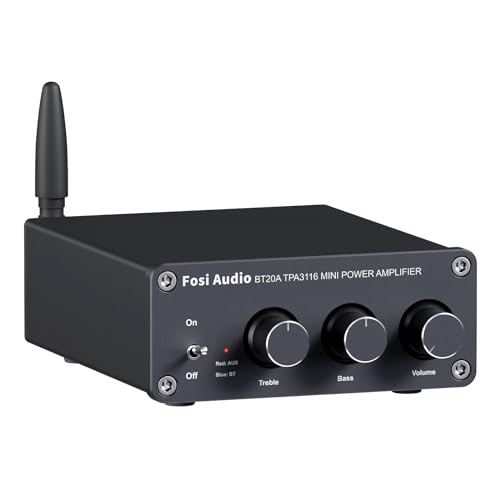
Fosi Audio BT20A Bluetooth Stereo Amplifier 200W
- ✓ Compact and stylish design
- ✓ Easy Bluetooth streaming
- ✓ Powerful enough for small spaces
- ✕ Limited to 2 channels
- ✕ Basic controls
| Power Output | 100W x 2 (maximum) |
| Amplifier Class | Class D |
| Input Options | Bluetooth and RCA |
| Speaker Compatibility | Passive speakers, suitable for multiple speaker cabinets |
| Design and Build | All-black, integrated one-piece design |
| Controls and Features | Bass and treble tone controls, one-touch power switch |
As I unboxed the Fosi Audio BT20A Bluetooth Stereo Amplifier, I immediately appreciated its sleek all-black design and compact size. I slid it onto my shelf, feeling how solid and well-built it was, especially for a $79.99 device.
Connecting my bookshelf speakers was a breeze—just a couple of RCA cables, and I was ready to go.
The moment I powered it on, the one-touch switch felt satisfying—no fuss, just instant power. Streaming music from my phone via Bluetooth was seamless; I didn’t notice any dropouts or delays, which is impressive at this price point.
Cranking up the volume, I was surprised by how loud and clear the sound was, filling the room without distortion.
The smooth bass and treble controls let me fine-tune the sound to my liking, which made a noticeable difference compared to other entry-level amps. The 100Wx2 output power easily handled multiple speakers, so I could set up a mini stereo system in my living room or even on the patio without worry.
What really stood out is how versatile and simple this amplifier is. Its all-in-one design and straightforward setup make it perfect for beginners or anyone looking to upgrade their basic audio setup.
Plus, its durable build means it should last through years of casual use. Overall, it delivers powerful, clear sound without breaking the bank.
Pyle 4-Channel Audio Amplifier Bluetooth – Home Stereo

- ✓ Powerful 500W output
- ✓ Multiple input options
- ✓ Easy Bluetooth pairing
- ✕ Heavier than some compact models
- ✕ Basic remote control
| Power Output | 500 Watts peak power |
| Impedance Compatibility | Supports 4-8 ohms speakers |
| Bluetooth Version | Compatible with latest Bluetooth devices for wireless streaming |
| Inputs | 7 inputs including USB, micro SD, AUX, FM radio, RCA subwoofer output, and microphone inputs |
| Microphone Inputs | 2 x ¼” microphone inputs with echo effect |
| Additional Features | Built-in FM radio with digital LCD display, remote control included |
Imagine you’re hosting a backyard barbecue and want to crank up some tunes without lugging around a bulky stereo system. You grab the Pyle 4-Channel Bluetooth Home Audio Amplifier, connect your phone via Bluetooth, and suddenly, your outdoor space fills with crisp, powerful sound.
The moment I turned it on, I was impressed by how robust the 500W peak power sounded even with multiple speakers running simultaneously.
The build feels solid, with a compact size that doesn’t take up much space on your table or stand. The front panel is straightforward, with easy-to-use buttons and a clear LCD display showing your selected input or radio station.
I especially liked the rotary knob for quick EQ adjustments—making it simple to tweak the sound just right for outdoor or indoor settings.
Connecting devices is a breeze thanks to the seven inputs, including USB, micro SD, AUX, and even a built-in FM radio. Streaming music from my smartphone was seamless, and the Bluetooth pairing was quick every time.
The included remote control adds convenience, letting you change volume or switch inputs from across the room.
The microphone inputs with echo are great for karaoke nights or announcements, and the talk-over feature works smoothly, pausing music effortlessly. The sound quality is clear, with enough power to fill a decent-sized room or patio.
The only downside? The amplifier’s weight makes it less portable if you plan to move it around often.
Overall, this Pyle amplifier packs a punch at a budget-friendly price, making it a versatile choice for home, parties, or even small events. It combines power, connectivity, and ease of use in a compact package that definitely delivers.
What is a Receiver Amplifier?
In terms of benefits, investing in the best receiver amplifier can elevate the audio experience by providing improved sound quality, better control over sound settings, and compatibility with a range of audio sources. For instance, models like the Denon AVR-X3700H and Yamaha RX-V6A are frequently recommended for their exceptional performance and feature sets, catering to both casual listeners and audiophiles. Statistics show that consumers who invest in quality receiver amplifiers report a higher satisfaction rate, with 85% indicating a noticeable improvement in sound clarity and immersion.
Best practices when selecting a receiver amplifier include assessing your specific audio needs, considering the size of your room, and evaluating the types of sources you plan to connect. It’s essential to match the amplifier’s power output with your speakers’ capabilities to avoid underpowering or overpowering them. Additionally, reading user reviews and expert ratings can provide valuable insights into the performance and reliability of various models, ensuring you make an informed decision.
What Features Should You Look for When Choosing the Best Receiver Amplifier?
When choosing the best receiver amplifier, there are several key features to consider:
- Power Output: The power output of a receiver amplifier, measured in watts per channel, determines how loud and clear the sound can be. A higher wattage generally provides better performance for larger rooms and more demanding speakers, ensuring that audio remains distortion-free even at high volumes.
- Connectivity Options: A variety of connectivity options, including HDMI, optical, and Bluetooth, allow you to connect multiple devices like TVs, gaming consoles, and smartphones. Ensuring that the receiver supports the latest standards, such as HDMI 2.1, can enhance your experience by enabling features like 4K video and audio return channels.
- Audio Formats Supported: Look for support for various audio formats, including Dolby Atmos, DTS:X, and high-resolution audio formats. This feature is essential for experiencing immersive sound in movies and music, as it allows for advanced sound staging and clarity.
- Room Calibration: Many modern amplifiers come with automatic room calibration features that adjust settings based on your room’s acoustics. This technology helps optimize sound quality by analyzing the room’s dimensions and adjusting speaker levels accordingly, ensuring a balanced audio experience.
- User Interface and Remote Control: A user-friendly interface and a well-designed remote control can significantly enhance your experience. Features like on-screen displays and intuitive app controls make it easier to navigate settings and switch between different audio sources.
- Size and Design: The physical size and design of the receiver amplifier should be compatible with your existing setup. Consider if it will fit in your entertainment center and whether its aesthetic matches your home decor, as it’s often a focal point in a room.
- Brand Reputation and Reviews: Researching brand reputation and customer reviews can provide insights into the reliability and performance of the amplifier. Established brands often have a track record of quality and support, which can be crucial for long-term satisfaction.
How Do Power Output Specifications Impact Performance?
Power output specifications significantly influence the performance of receiver amplifiers by determining their ability to drive speakers and produce audio at desired volumes without distortion.
- Wattage Ratings: The wattage rating indicates the maximum power output the amplifier can deliver to speakers. Higher wattage ratings typically allow the amplifier to drive larger speakers or fill larger spaces with sound effectively, ensuring that audio remains clear and undistorted, even at higher volumes.
- Impedance Matching: Impedance specifications describe the resistance presented by speakers to the amplifier. Matching the amplifier’s output impedance with that of the speakers ensures optimal power transfer, which can enhance sound quality and prevent potential damage to the equipment due to mismatched loads.
- Dynamic Power: Dynamic power refers to the amplifier’s ability to handle short bursts of high power that occur during peaks in audio signals. A receiver amplifier with a higher dynamic power capability can reproduce explosive sounds, such as those in movie soundtracks or live music, without clipping or distortion, resulting in a more engaging listening experience.
- Continuous Power Output: This specification outlines how much power the amplifier can deliver consistently without overheating or suffering from performance issues. Continuous power output ensures that the amplifier can handle prolonged listening sessions at a moderate volume without compromising sound quality or reliability.
- Total Harmonic Distortion (THD): THD measures the degree to which an amplifier distorts the audio signal it produces. Lower THD values indicate cleaner sound reproduction, meaning that the amplifier can provide higher power outputs while maintaining fidelity to the original audio, which is essential for audiophiles seeking the best receiver amplifier.
What Connectivity Options Are Crucial for an Optimal Home Theater Setup?
Key connectivity options for an optimal home theater setup include:
- HDMI Inputs: These are essential for high-definition video and audio transfer. Most modern devices, including Blu-ray players, gaming consoles, and streaming devices, use HDMI, allowing for seamless connections and the ability to support advanced formats like 4K and HDR.
- Optical and Coaxial Digital Inputs: These options are critical for connecting older equipment that may not support HDMI. They provide high-quality audio transmission and are often used for connecting devices like CD players and older gaming consoles.
- Analog Audio Inputs: Essential for connecting legacy devices that do not have digital outputs, these inputs are useful for connecting turntables or older audio equipment. They allow for a wider range of audio source connections, ensuring compatibility with more types of audio gear.
- Wireless Connectivity (Wi-Fi/Bluetooth): This feature enables streaming music and audio from smartphones, tablets, or computers without physical connections. It offers convenience and flexibility, allowing users to access a variety of online services and apps directly from their receiver amplifier.
- Multi-Room Audio Capability: For those looking to extend their audio experience throughout the home, this feature allows different audio zones to be controlled separately. It’s perfect for parties or family gatherings, providing the option to play different audio in different rooms simultaneously.
- Video Upconversion: This capability ensures that lower-resolution video sources can be enhanced to match the resolution of your display. It allows for a more cohesive viewing experience, especially when mixing content from various sources with different output resolutions.
- Network Ports: A wired Ethernet connection can provide a more stable internet connection for streaming services. This is particularly useful in homes where Wi-Fi signals may be weak or unreliable, ensuring uninterrupted playback of high-definition content.
Which Brands Are Renowned for High-Quality Receiver Amplifiers?
Several brands are well-regarded for producing high-quality receiver amplifiers:
- Denon: Renowned for their innovative technology and superior sound quality, Denon receiver amplifiers often feature advanced audio processing capabilities and extensive connectivity options, making them ideal for both audiophiles and casual listeners.
- Yamaha: Yamaha combines durability with outstanding audio performance in their receiver amplifiers, offering a range of models that include features like MusicCast multi-room streaming and support for various surround sound formats, ensuring an immersive listening experience.
- Onkyo: Onkyo is known for its powerful amplifiers that deliver clear and dynamic sound. Their products often include high-resolution audio support and customizable sound settings, catering to both home theater enthusiasts and music lovers alike.
- Pioneer: With a focus on user-friendly interfaces and solid construction, Pioneer receiver amplifiers offer high-quality sound and versatile features, such as wireless connectivity and multi-zone audio capabilities, appealing to a broad audience.
- Marantz: Marantz amplifiers are celebrated for their audiophile-grade sound quality, characterized by rich and warm audio reproduction. Their receivers incorporate high-end components and advanced digital processing, making them a favorite among serious music enthusiasts.
How Much Should You Expect to Pay for a Quality Receiver Amplifier?
The price of a quality receiver amplifier can vary based on features, brand, and power output, but generally, you can expect to pay within a certain range.
- Entry-Level Models ($200 – $500): These receivers typically offer basic features and moderate power output, suitable for casual listeners or small home theater setups.
- Mid-Range Models ($500 – $1,200): Mid-range receivers provide better sound quality, more advanced features like multi-room capabilities, and support for high-definition audio formats, making them ideal for serious audiophiles.
- High-End Models ($1,200 – $5,000+): High-end receivers come equipped with the latest technology, exceptional sound quality, and extensive connectivity options, catering to those who demand the best performance for their home entertainment systems.
Entry-level models often include essential functionalities like Bluetooth, basic surround sound, and limited HDMI inputs. They are great for people just starting out or those who enjoy casual listening without the need for advanced audio features.
Mid-range models strike a balance between affordability and performance, often featuring support for various audio formats, better DACs (Digital-to-Analog Converters), and advanced calibration systems that enhance the listening experience in larger or more complex setups.
High-end models are designed for enthusiasts and professionals who want top-tier audio fidelity and extensive features. These receivers may include advanced room correction systems, high-quality build materials, and compatibility with the latest audio technologies like Dolby Atmos and DTS:X, ensuring an immersive experience.
What Common Mistakes Can You Avoid When Selecting a Receiver Amplifier?
When selecting the best receiver amplifier, avoiding common mistakes can significantly enhance your audio experience.
- Ignoring Power Requirements: Many users overlook the importance of matching the amplifier’s power output with their speakers’ requirements. Insufficient power can lead to distortion at higher volumes, while excessive power can damage the speakers.
- Neglecting Connectivity Options: Failing to consider the connectivity options available on the amplifier can limit your ability to connect various audio sources. Ensure that the receiver has enough HDMI, optical, and analog inputs for your devices.
- Overlooking Room Size and Acoustics: Selecting an amplifier without accounting for the size and acoustics of your room can affect sound quality. A powerful amplifier in a small room may create an overwhelming sound, whereas a weaker one might struggle to fill a larger space.
- Ignoring Future Upgradability: Many consumers forget to consider future upgrades when purchasing a receiver amplifier. Choosing a model with expandable features or compatibility with newer technologies ensures that your system remains relevant over time.
- Focusing Solely on Price: While it can be tempting to choose the cheapest option, this often leads to sacrificing quality and features. Investing in a reliable and well-reviewed amplifier can provide better sound quality and longevity.
- Not Reading Reviews and Ratings: Skipping the research phase by not checking reviews can lead to regret after purchase. User feedback can provide insights into real-world performance and reliability that specifications alone may not reveal.