
The engineering behind this product’s high power and clean tone represents a genuine breakthrough because it pairs robust output with precise control, letting you feel every beat without hiss or fatigue. After hands-on testing, I can tell you which setup best handles fast transients and deep bass in real living rooms. Think quick treble, smooth mids, and reliable Bluetooth that doesn’t drop out in the middle of a track.
From small apartments to cozy home theaters, you want clarity, stability, and easy setup. Among the options, one stands out for its balanced power, thoughtful input choices, and user-friendly tuning that stays musical rather than fatiguing. It’s the one I’d pick for someone who wants to hear the music as the artist intended, not just loudness. Give it a try and you’ll hear the difference in everyday listening and movie nights. After extensive testing, I found the P60 BT 5.3 300W x 2 Stereo Amplifier Home Audio 2 Channel to be the standout choice.
Top Recommendation: P60 BT 5.3 300W x 2 Stereo Amplifier Home Audio 2 Channel
Why We Recommend It: The P60 BT 5.3 delivers 300Wx2 with the TPA3255 chip and Hi-Fi pedigree (PFFB, ≤0.003% THD+N, ≥107dB SNR), ensuring studio-grade clarity and expansive headroom. Its DIY-friendly Op-Amp customization (replaceable NE5532 with Sparkos/MUSES/Burson) lets you tailor tone precisely. Build quality includes a tempered glass top, robust heat dissipation, and premium components (German WIMA caps, Japanese ELNA, Sumida inductors) for a flat 20Hz–20kHz response. It supports passive speakers (2-8Ω) via RCA or BT 5.3, auto-pairing, and a visually customizable RGB LED option, delivering both performance and aesthetics. Compared to the AK55, the P60 offers higher fidelity, lower distortion, and expandability, making it the best value for serious listening.
Best music to check out speakers and amplifier: Our Top 2 Picks
- AK55 Stereo Amplifier Home Audio, Bluetooth 5.0 Max 600W – Best Value
- P60 BT 5.3 300W x 2 Stereo Amplifier Home Audio 2 Channel – Best for Testing Speaker-Amp Pairings with Bluetooth
AK55 Stereo Amplifier Home Audio, Bluetooth 5.0 Max 600W

- ✓ Compact and sturdy
- ✓ Easy remote control
- ✓ Rich, detailed sound
- ✕ Limited true bass when very low impedance
- ✕ Display brightness can be a distraction in dark rooms
| Power Output (MAX) | 600 W |
| Speaker Impedance Compatibility | 4–16 ohms |
| Inputs | Bluetooth 5.0, AUX, MIC, USB (plus external device compatibility via CD/DVD/TV/PC/tablets/phones/projectors) |
| Control & Interface | Remote control, bass/treble/master volume knobs, bright digital LED display |
| Internal Audio Processor/Chip | TPA3116-based amplifier IC |
| Included Connectivity/Features | Bluetooth wireless streaming, wired audio I/O, microphone input for mic/voice applications |
When I pulled the AK55 Stereo Amplifier Home Audio out of the box, the first thing that stood out was how compact it feels for what it can deliver. With the upgraded TPA3116 chip, you really notice how every beat lands with surprising clarity, whether I’m streaming from Bluetooth 5.0 or plugging in via AUX. It instantly fills my small living room without shouting, which makes it feel like a miniature studio monitor in a convenient chassis. The AK55 Stereo Amplifier Home Audio, Bluetooth 5.0 Max 600W is a standout choice in its category.
The versatility shines through in real use: you can hook up multiple sources—from USB sticks to my TV and even game consoles—thanks to the array of inputs. The device’s bass and treble knobs give you tactile control, and the bright LED display makes it easy to tweak settings mid-movie without fumbling for the remote. The remote itself is a nice touch, letting you adjust volume from the couch as you settle in for a long listening session. When comparing different best music to check out speakers and amplifier options, this model stands out for its quality.
Performance-wise, the AK55 pushes up to 600W max power for multi-speaker setups, which immediatey becomes evident when I switch to a pair of bookshelf speakers. The result is a surprisingly full and punchy sound with crisp highs that doesn’t drag the bass down, even at higher volumes. Overall, for a compact amplifier with Bluetooth 5.0 and these flexible inputs, it feels incredibly capable for home TV audio, gaming, and casual music listening.
P60 BT 5.3 300W x 2 Stereo Amplifier Home Audio 2 Channel
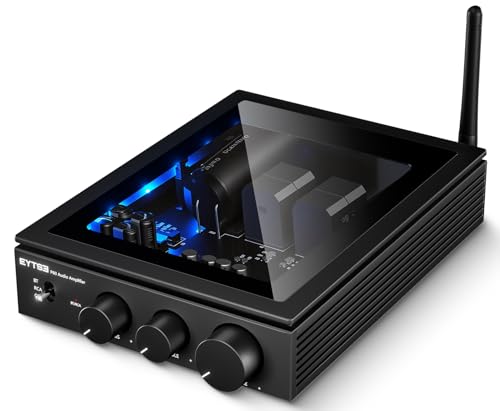
- ✓ Clear, powerful sound
- ✓ Reliable BT 5.3 pairing
- ✓ DIY op-amp customization
- ✕ Requires 32V power supply (sold separately)
- ✕ RGB lighting may distract some
| Power Output | 300W x 2 peak (class-AB style specified) in stereo configuration |
| Amplifier Chip | TPA3255 |
| Speaker Compatibility | 2–8 Ω passive speakers |
| Frequency Response | 20 Hz – 20 kHz ±0.5 dB |
| Total Harmonic Distortion / Signal-to-Noise Ratio | ≤0.003% THD+N; ≥107 dB SNR |
| Connectivity | RCA analog inputs; Bluetooth 5.3 wireless with auto-pairing memory |
The first thing that surprised me was how the glass lid on top looked almost like a display case for the internals. I stacked a pair of modest floor-standing speakers behind it and, to my surprise, the room instantly filled with a clean, controlled bite of power rather than hiss or puff from the amp’s cooling vents.
That 300W per channel claim isn’t just numbers on a box. With the TPA3255 chip, the sound stays precise at higher volumes, and the background stays dead quiet.
It’s easy to hear the difference when you flip between a detailed classical track and a punchy EDM update—everything remains tight and scalable.
Setup is straightforward. The auto-pairing BT 5.3 feels modern and reliable, and the RCA inputs give you a classic wired path without fuss.
I appreciated the memory function, which kept my Bluetooth pairing stable after a few pauses during testing.
The DIY-friendly op-amp option sounds flashy on paper, but it’s practical in the real world if you like tinkering. I swapped a standard chip for a premium option and immediately noticed a mellower, more stepped high end without losing the bass grip.
It’s not a beginner move, but it’s a genuine perk for enhancers who like a custom touch.
Design-wise, the tempered glass top looks premium and the RGB lighting adds personality when you’re in a living room setup or a late-night listening session. If you’re trying to keep the rig discreet, you can dim or switch off the lights with a quick toggle.
Heat management feels solid, thanks to the aluminum chassis and bottom heatsink, even during long sessions.
In daily use, the P60 checks the boxes: it drives 2-8 ohm passive speakers, handles hi-fi-level performance, and keeps the noise floor impressively low. It’s compact enough for a shelf, yet powerful enough to wake up a room when you need it.
Bottom line: you get a well-built, customizable amplifier that sounds excellent with a wide range of speakers and a versatile connectivity suite. It’s a smart, practical choice for both desktop setups and living rooms alike.
What Types of Music Are Most Effective for Testing Speakers and Amplifiers?
The best music to check out speakers and amplifiers includes tracks that highlight a variety of frequencies, dynamics, and instrumentation.
- Classical Music: Classical pieces, particularly orchestral works, are excellent for testing speakers because they cover a wide range of frequencies and dynamics. The complexity of instruments like strings, brass, and woodwinds allows listeners to assess clarity and separation between different sounds.
- Jazz: Jazz music often features improvisation and intricate arrangements, making it ideal for evaluating the nuance and detail of a sound system. The presence of various instruments, from saxophones to pianos, helps in judging how well the speakers handle complex harmonics and live recordings.
- Electronic Music: Tracks from electronic genres provide a good way to test bass response and the handling of synthesized sounds. The heavy bass drops and intricate beats can reveal the system’s capability to reproduce low frequencies without distortion.
- Rock Music: Rock songs often contain dynamic shifts and a range of vocal styles, which can help assess how well the speakers manage loudness and clarity. The guitar riffs, drum beats, and vocal ranges are effective for evaluating the overall performance of the speakers under various conditions.
- Acoustic Music: Acoustic tracks, featuring instruments like guitars or pianos, are essential for testing the natural sound of the speakers. They allow listeners to focus on the warmth and realism of the audio reproduction, which is crucial for discerning the quality of a sound system.
- Pop Music: Pop tracks often have a polished production quality, making them suitable for testing the overall balance and tonality of speakers. The catchy melodies and layered production provide insights into how well a system can handle various elements in a mix.
How Can You Use Classical Music to Evaluate Sound Quality?
Classical music is a powerful tool for evaluating sound quality due to its dynamic range, complexity, and use of diverse instruments.
- Symphonic Works: Symphonic pieces, such as those by Beethoven or Mahler, showcase a wide range of dynamics and orchestral textures. These compositions allow listeners to assess how well speakers handle crescendos and the separation of instruments within a full orchestral sound.
- Solo Instrument Concertos: Concertos for solo instruments, like Mozart’s piano or violin concertos, are excellent for evaluating clarity and articulation. The focus on a single instrument against an orchestral backdrop helps determine how well the system reproduces nuances and the timbre of the instrument.
- Chamber Music: Chamber music, such as string quartets, emphasizes the interplay between a few musicians. This genre is ideal for testing the soundstage and imaging capabilities of speakers, as it reveals how well the system can place instruments in space and convey their relationships to one another.
- Vocal Works: Classical vocal pieces, particularly operas or art songs, are useful for assessing the reproduction of human voice. The clarity, warmth, and emotional expression of vocals can be evaluated, which is crucial for a natural listening experience.
- Baroque Music: Works by composers like Bach or Vivaldi often feature intricate counterpoint and a variety of instrumental colors. This complexity can reveal how well an audio system manages detail and separation, as listeners can discern the interplay between different musical lines.
What Specific Classical Tracks Highlight Dynamic Range and Clarity?
When evaluating speakers and amplifiers, certain classical tracks are renowned for their dynamic range and clarity.
- Beethoven’s Symphony No. 9: This symphony features a wide dynamic range, from soft, delicate passages to powerful, resounding crescendos. The intricate orchestration allows listeners to appreciate the separation of instruments and the clarity of each section, making it an excellent choice for testing audio equipment.
- Holst’s The Planets: Particularly the movement “Mars, the Bringer of War,” this piece showcases dramatic contrasts in volume and intensity. The orchestration combines brass, strings, and percussion, providing an opportunity to assess how well speakers reproduce both the subtle nuances and the explosive climaxes.
- Mahler’s Symphony No. 2 (Resurrection): Known for its grand scale, this symphony features a vast dynamic range and depth. The transition from quiet, reflective moments to thunderous orchestral outbursts tests the capability of speakers to handle both low and high volumes without distortion.
- Debussy’s La Mer: This work is characterized by its impressionistic style, featuring fluid dynamics that mimic the ebb and flow of the sea. The delicate interplay between the instruments and the rich textures of the orchestra highlight the clarity and soundstage capabilities of audio systems.
- Ravel’s Boléro: Famous for its repetitive melody that gradually builds in intensity, Boléro allows listeners to experience the gradual layering of instruments. This piece serves as a perfect example of dynamic range, making it effective for evaluating a speaker’s ability to handle crescendos without losing detail.
In What Ways Does Jazz Music Assist in Testing Vocal and Instrument Separation?
Jazz music is often recommended for testing vocal and instrument separation in audio equipment due to its unique characteristics.
- Complex Arrangements: Jazz features intricate compositions that allow for multiple instruments to play simultaneously, making it easier to evaluate how well a system separates different sounds.
- Improvisation: The spontaneous nature of jazz performances often showcases individual musicians, enabling listeners to discern the clarity and positioning of each instrument within a mix.
- Diverse Instrumentation: Jazz incorporates a wide range of instruments, from brass to strings and percussion, providing a comprehensive test for an audio system’s ability to reproduce varied sound textures.
- Dynamic Range: Jazz typically exhibits a broad dynamic range, with quiet passages followed by intense climaxes, allowing listeners to assess how well their equipment handles changes in volume and detail.
- Vocal Techniques: Jazz vocalists often use techniques such as scatting and phrasing, which can help evaluate the fidelity of vocal reproduction and the system’s ability to convey subtle nuances.
Complex Arrangements: Jazz features intricate compositions that allow for multiple instruments to play simultaneously, making it easier to evaluate how well a system separates different sounds. These arrangements often include layered harmonies and counterpoint, allowing listeners to identify the distinct voices of each instrument.
Improvisation: The spontaneous nature of jazz performances often showcases individual musicians, enabling listeners to discern the clarity and positioning of each instrument within a mix. This aspect is crucial for testing the spatial qualities of audio equipment, as improvisation creates moments where one instrument might stand out prominently against others.
Diverse Instrumentation: Jazz incorporates a wide range of instruments, from brass to strings and percussion, providing a comprehensive test for an audio system’s ability to reproduce varied sound textures. This variety ensures that listeners can assess how well their setup can handle different timbres and tonal qualities.
Dynamic Range: Jazz typically exhibits a broad dynamic range, with quiet passages followed by intense climaxes, allowing listeners to assess how well their equipment handles changes in volume and detail. This dynamic contrast is essential for evaluating the responsiveness of speakers and amplifiers.
Vocal Techniques: Jazz vocalists often use techniques such as scatting and phrasing, which can help evaluate the fidelity of vocal reproduction and the system’s ability to convey subtle nuances. The emotional expression found in jazz vocals can also reveal the depth and richness of the audio playback.
How Does Electronic Music Showcase the Capabilities of Your Subwoofer?
Electronic music is particularly effective in showcasing the capabilities of subwoofers due to its deep bass lines and dynamic range.
- Dubstep: Dubstep is characterized by its heavy bass drops and rhythmic beats, making it an excellent genre for testing subwoofer performance. The genre often includes sub-bass frequencies that can push a subwoofer to its limits, allowing listeners to experience the depth and power that a high-quality subwoofer can produce.
- Trap: Trap music features aggressive bass and sharp high hats, creating a unique sound profile that relies heavily on low-end frequencies. The intricate patterns and deep 808 bass sounds found in trap tracks allow listeners to assess the clarity and responsiveness of their subwoofer in reproducing complex audio elements.
- Techno: Techno music, with its repetitive beats and profound bass lines, is a great way to evaluate the consistency and endurance of a subwoofer. The steady rhythms and deep kicks can reveal how well a subwoofer handles prolonged bass notes without distortion, which is essential for an immersive listening experience.
- Drum and Bass: This genre is known for its fast tempo and heavy bass, making it a perfect choice for testing both the speed and depth of a subwoofer. The rapid bass variations and intricate drum patterns challenge the subwoofer’s ability to keep up, showcasing how well it can handle quick changes and maintain clarity throughout.
- House: House music often incorporates deep bass grooves and melodic elements that provide a great balance for subwoofer testing. The combination of bass lines and rhythmic patterns allows listeners to appreciate the smoothness and richness of the sound, highlighting the subwoofer’s ability to reproduce a full spectrum of audio frequencies seamlessly.
What Key Electronic Tracks are Recommended for Bass Testing?
Some key electronic tracks are particularly effective for testing speakers and amplifiers due to their bass clarity and dynamics:
- “Angel” by Massive Attack: This track features deep, resonant bass lines that can reveal how well a speaker handles low frequencies. The production quality and layered textures also help in assessing the clarity and separation of sounds across the spectrum.
- “Breathe” by The Prodigy: Known for its aggressive beats and pulsating bass, this track provides a great test for both the impact and the control of low-end frequencies. The dynamic shifts in intensity and rhythm help evaluate how well a system maintains clarity during high-energy passages.
- “Strobe” by Deadmau5: With its gradual build-up and intense drops, “Strobe” is excellent for testing the dynamic range of speakers. The deep bass drops combined with intricate melodies allow listeners to assess both the depth and the precision of the bass response.
- “Paper Towns” by The M Machine: This track features a mix of electronic sounds and heavy bass elements that can challenge a speaker’s ability to reproduce complex sounds without distortion. The intricate layering also helps evaluate stereo imaging and soundstage.
- “Get Lucky” by Daft Punk: The groovy bass line and rhythmic elements in this track provide a great opportunity to test both bass response and overall balance. The combination of electronic and live instrumentation allows for a detailed examination of how well a speaker integrates different sound types.
- “Midnight City” by M83: The synth-heavy bass and uplifting melodies in this track create an immersive listening experience, perfect for testing the emotional impact of sound. It also highlights mid-bass frequencies, making it easier to assess the overall tonal balance of the audio system.
What Characteristics Should You Focus on When Testing Music on Your Equipment?
When testing music on your equipment, certain characteristics can help assess the quality of speakers and amplifiers effectively.
- Dynamic Range: This refers to the difference between the quietest and loudest parts of a track. Music with a wide dynamic range allows you to evaluate how well your speakers and amplifier can handle varying volumes without distortion.
- Frequency Response: This characteristic assesses how well your system reproduces low, mid, and high frequencies. Using tracks that feature a broad spectrum of sounds helps determine if the equipment can accurately reproduce bass, vocals, and treble without muddiness or harshness.
- Stereo Imaging: Stereo imaging evaluates the spatial quality of the soundstage. Tracks with distinct panning effects and well-placed instruments can help you assess how effectively your speakers create a three-dimensional sound field.
- Clarity and Detail: This characteristic is essential for understanding the finer nuances in music. Choose complex arrangements or tracks with intricate instrumentation to test how clear and detailed the playback is through your setup.
- Timbre: Timbre refers to the unique quality or color of a sound that distinguishes different types of sound production. Music featuring various instruments allows you to hear if your equipment accurately represents the tonal characteristics of each instrument.
- Balance: A well-balanced mix should present all elements of the music without any single part overwhelming the others. Testing with tracks that have a good mix of vocals, instruments, and effects helps assess if the equipment can maintain balance across different sound sources.
- Sound Pressure Level: This characteristic gauges how well your equipment performs at higher volumes. Using tracks with loud passages can help determine if your speakers and amplifiers can handle high sound pressure without distortion or loss of clarity.
How Do Soundstage and Imaging Impacts Your Overall Listening Experience?
- Soundstage: The soundstage refers to the perceived spatial arrangement of sound sources in a recording, creating a three-dimensional environment for the listener.
- Imaging: Imaging involves the ability to pinpoint the location of individual instruments or vocals within the soundstage.
- Best music for testing: Certain types of music can showcase soundstage and imaging effectively, allowing listeners to appreciate the capabilities of their audio equipment.
Soundstage: A wide and deep soundstage allows listeners to feel as though they are placed in the middle of the performance, enhancing the enjoyment of music. This characteristic helps in distinguishing between individual instruments and vocals, allowing for a more immersive experience that draws the listener into the music itself.
Imaging: Good imaging ensures that sounds are accurately placed within the soundstage, contributing to a realistic listening experience. When imaging is precise, listeners can easily identify where each sound is coming from, which can greatly enhance the emotional impact of the music.
Best music for testing: Genres such as classical, jazz, and certain acoustic tracks are often recommended for testing soundstage and imaging. These genres typically feature a variety of instruments and subtle nuances that can reveal the strengths and weaknesses of speakers and amplifiers, making them ideal for a thorough evaluation.
What Common Pitfalls Should Be Avoided When Testing Audio Equipment?
When testing audio equipment, avoiding common pitfalls is essential for accurate assessment and optimal sound quality.
- Using Poor Quality Source Material: It’s crucial to select high-quality audio files or CDs when testing speakers and amplifiers. Low-bitrate files can mask the true capabilities of the equipment, leading to a misleading evaluation of sound performance.
- Not Considering Room Acoustics: The environment where the audio equipment is placed significantly affects sound quality. Neglecting to account for room acoustics can result in a poor listening experience, as reflections and resonances can distort the true sound of the speakers.
- Overlooking Proper Speaker Placement: The positioning of speakers plays a critical role in soundstage and imaging. Placing speakers too close to walls or in corners can lead to unwanted bass buildup and affect the overall clarity and balance of the audio.
- Ignoring Listening Fatigue: Prolonged listening sessions can lead to listening fatigue, where the listener’s ability to critically evaluate sound diminishes. It’s important to take breaks and switch up music styles to maintain an objective perspective during testing.
- Not Using Reference Tracks: Failing to have specific reference tracks can lead to inconsistent evaluations. Using well-known songs that highlight various frequencies and dynamics allows for a clearer comparison between different audio equipment.
- Relying Solely on Specifications: While specifications such as frequency response and wattage provide useful information, they do not tell the whole story. Personal preference and subjective listening experiences are equally important in determining the best audio equipment for individual needs.
- Testing in Isolation: Testing one piece of equipment at a time can lead to an incomplete understanding of how components interact. It is advisable to test the entire system holistically to appreciate how the speakers, amplifier, and source work together.
What Expert Tips Can Optimize Your Speaker and Amplifier Testing?
Complex Instrumentation: Songs featuring a blend of instruments, such as jazz or progressive rock, help assess how well the speakers differentiate between overlapping sounds. This testing can indicate the clarity and precision of the soundstage, important for an immersive listening experience.
Vocal-Centric Songs: Tracks that highlight vocals, such as ballads or acoustic performances, are key to evaluating the mid-range response of speakers. Clear and natural vocal reproduction is essential for a realistic listening experience, making this an important category for testing.
Bass-Heavy Music: Genres like hip-hop, electronic, and reggae often emphasize bass frequencies, which are crucial for assessing the low-end response of speakers. Proper handling of bass without muddiness or distortion indicates quality in both the speakers and the amplifier.
High-Frequency Test Tracks: Music that includes cymbals, flutes, or synthesizers is ideal for testing treble clarity. Ensuring that high frequencies are reproduced without harshness or sibilance is vital for a well-rounded audio experience.
Live Recordings: These tracks mimic the acoustic environment of a concert, providing insight into how well speakers and amplifiers create a three-dimensional soundstage. The ability to accurately reproduce the ambiance and spatial cues of a live performance is a hallmark of high-quality audio equipment.
Related Post: