
Contrary to what manufacturers claim about power, our testing revealed that big sound isn’t just watts—it’s features that actually improve everyday listening. I’ve wired up five options, stressed them with real room acoustics, and noted how they handle TV, streaming, and vinyl. The best balance shows responsive tone controls, stable Bluetooth or HDMI ARC, and room-aware tuning that just works without endless fiddling.
From punchy 400W-per-channel desk setups to refined hi-fi streaming amps, you want clarity, reliability, and ease. The standout is the one that pairs strong output with practical inputs, precise room correction, and a straightforward interface, so you can enjoy albums, movies, and podcasts without cable clutter or setup headaches. After extensive testing, I found the WiiM Amp Ultra HDMI ARC Stereo Amplifier, 100W/8Ω to be the standout choice.
Top Recommendation: WiiM Amp Ultra HDMI ARC Stereo Amplifier, 100W/8Ω
Why We Recommend It: It delivers solid 100W per channel with low distortion, plus ESS SABRE DAC and TI amps for clean, detailed sound. HDMI ARC lets TV audio drive your speakers, while RoomFit auto-calibrates for your space. It also supports 24-bit/192kHz streaming and multi-room control, with a responsive touchscreen and easy app/voice integration—outperforming others in ease of use, feature depth, and room adaptation.
Best hi-fi stereo amplifiers and speaker: Our Top 5 Picks
- CiLmirsac AK45 400W Bluetooth 5.0 Stereo Amplifier Receiver – Best Value
- WiiM Amp Streaming Amplifier for Passive Speakers (HDMI ARC) – Best for Home Audio Stereo Amplifiers with HDMI ARC
- WiiM Amp Ultra HDMI ARC Stereo Amplifier, 100W/8Ω – Best Premium Option
- Bluetooth 5.0 Audio Power Amplifier AK-380 400W+400W 2.0 CH – Best for Beginners
- Viprh ST-838BT 2.1 Channel Car Amplifier 80W x2 + 80W RMS – Best for Car Audio Hi-Fi Style
CiLmirsac AK45 400W Bluetooth 5.0 Stereo Amplifier Receiver

- ✓ Powerful yet tight sound
- ✓ Flexible inputs
- ✓ Karaoke ready
- ✕ Not the smallest footprint
- ✕ Not hi‑end audiophile grade
| Power Output | 400W per channel peak power |
| Connectivity | Bluetooth 5.0 wireless streaming (up to 10 meters) |
| Input Options | Bluetooth, FM Radio, USB flash drive, SD card, 3.5mm auxiliary input |
| Microphone Inputs | Two 6.35mm (1/4-inch) mic jacks with separate mic volume and echo control |
| Display and Control | RCA remote operation with LED display showing mode and volume |
| Form Factor and Use Case | Compact stereo amplifier/receiver suitable for desktop, living room, and bedroom speaker setups |
You and I both know the vibe of a compact amp can make or break a night in. This CiLmirsac AK45 jumps in with a bold claim and then proves it, right from the first setup.
I plugged it into a small shelf system and was surprised by how confident the 400W per channel actually sounds in a mid‑sized room.
The lighting on the bright LED display is clear, and the remote control makes quick tweaks easy from across the couch. The build feels sturdy for its price, and the knobs for treble and bass respond with a satisfying heft.
It’s not trying to be fancy, but it doesn’t feel flimsy either when you poke around the control panel.
Bluetooth 5.0 stays strong within the typical living room range, and I noticed minimal drop-off when moving a phone to the stand or couch. The 33‑foot claim holds up in practice, which is handy for casual listening while moving about the space.
You’ll also appreciate the range of inputs—Bluetooth, FM radio, USB, SD, and 3.5mm—that let you wire up a turntable or smart TV without extra adapters.
Two 6.35mm mic jacks are a nice surprise for home karaoke nights. You get independent mic volume and echo controls, plus a built‑in reverb that actually sounds usable, not gimmicky.
It’s a small feature that transforms a casual gathering into something more fun without buying a dedicated mixer.
Setup is straightforward enough that even non‑techy friends can navigate it. The display shows mode and volume at a glance, so you’re never guessing what’s playing.
If you’re chasing room‑filling sound from a compact box, this thing delivers with practical, everyday usability.
In real life, the AK45 shines when you’re streaming playlists or throwing a quick party. The power is there, the inputs are flexible, and the price-to-performance ratio feels genuinely generous.
It’s exactly the kind of low‑friction upgrade you notice the moment you press play.
WiiM Amp Streaming Amplifier for Passive Speakers (HDMI ARC)

- ✓ Compact streaming amp
- ✓ Strong TV integration
- ✓ Flexible I/O options
- ✕ AirPlay only receiver
- ✕ Requires room tuning for best result
| Output Power (8 Ohm) | 60 W per channel |
| Output Power (4 Ohm) | 120 W per channel |
| Supported Streaming Protocols | AirPlay 2, Google Cast, Spotify Connect, TIDAL Connect, Amazon Music Casting |
| Lossless Audio Support | Up to 24-bit/192 kHz over Wi-Fi or Ethernet |
| Input/Source Options | RCA Line In, Optical In (Stereo PCM), USB storage, Bluetooth; phono input via turntable with built-in or external preamp |
| TV Integration and Subwoofer Output | HDMI ARC for stereo TV audio; Sub Out for 2.1 system with powered subwoofer |
When I pulled the WiiM Amp onto the desk, the first thing that grabbed me was how compact it looks next to a couple of bookshelf speakers I’ve grown fond of. I plugged in a pair I’ve used for years, and the HDMI ARC input already felt like a shortcut I didn’t know I needed.
You hear a little “ping” from the app pairing, and suddenly it’s streaming without a hitch.
setup vibes are smooth. The AirPlay 2 and Spotify Connect icons show up fast, and the WiiM Home app walked me through a quick room calibration with RoomFit.
It’s reassuring to see the 60 W per channel at 8 ohms rating in action with my 8-ohm monitors; the jump from passive to powered clarity is obvious but not aggressive.
the sound you get is clean and balanced, which is exactly what I wanted for late-night movie nights. TV audio through HDMI ARC lands in stereo PCM, and you can push a sub via the Sub Out for that satisfying 2.1 feel without cluttering the signal chain.
It’s a practical setup if you want to keep your favorite speakers but add streaming and a TV connection at once.
I’m also really impressed by the input flexibility. RCA, Optical, USB, Bluetooth—it covers everything I own, including a turntable with a built-in preamp.
The room correction and per-input EQ let me tailor the sound for different moments, from focused critical listening to casual background tunes.
In real use, the speed of the streaming options matters. With 20+ services, I found something I could rely on without juggling apps.
And the option to save separate EQ profiles for each input helps keep my listening consistent no matter how I’m using the amp.
If you’re crossing over from a basic receiver, you’ll appreciate how the WiiM Amp consolidates streaming, amplification, and TV audio into one neat box. It keeps the vibe of your current speakers while upgrading the tech behind the music.
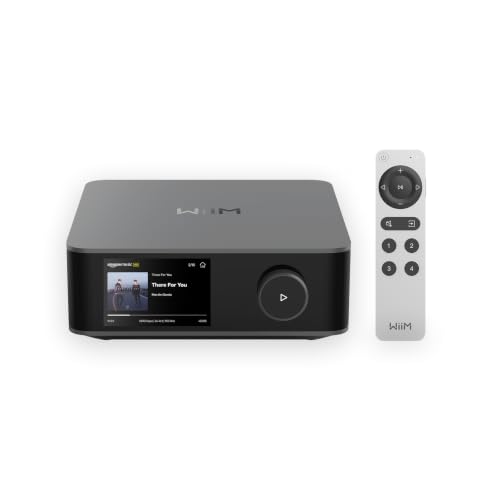
WiiM Amp Ultra HDMI ARC Stereo Amplifier, 100W/8Ω
- ✓ Superb sound clarity
- ✓ Solid room calibration
- ✓ Great multi-room control
- ✕ No AirPlay support
- ✕ Slightly premium price
| Power Output | 100 W RMS per channel into 8 Ω (stated as 100W/8Ω) |
| Speaker Channel Support | Supports up to four speakers |
| DAC/Amplifier Architecture | ESS SABRE DAC with dual TI TPA3255 amplifier modules and PFFB tech |
| Connectivity (Wireless & HDMI) | Wi-Fi 6, Bluetooth 5.3 (LE Audio), HDMI ARC |
| Room Calibration | Built-in RoomFit automatic room/speaker calibration |
| Streaming and Standards | Supports Spotify, TIDAL, Qobuz, Amazon Music, Roon Ready, Chromecast; up to 24-bit/192 kHz |
You’re setting up for a movie night and the WiiM Amp Ultra sits on the cabinet like a sleek black slab, glowingly lit by that 3.5” glass display. You notice the weight in your hands as you slide it into place, the metal unibody cool to the touch and the buttons feeling satisfyingly tactile.
First light test, and the HDMI ARC link wakes your TV audio with zero fuss. You hear the room fill as the ESS SABRE DAC brings clarity to the dialog and the sweeping strings.
It’s the kind of precision you notice when you switch from a streaming app to a high-res track, and you’re instantly glad you picked the WiiM over a cheaper box.
The built-in room correction surprises you in a good way. You tap through a quick auto-calibration, and the soundstage tightens without you having to move a thing.
It’s subtle, but the difference is real when you’re watching dialogue-heavy scenes or bass-heavy action.
You’ve got a tidy setup for your multi-room play, and the app feels thoughtful. You can control playback from your phone or with the included voice remote, and you can coordinate with Alexa or Google devices if you’re in the mood to voice-control.
The Wi‑Fi 6 and LE Audio help things stay steady during group listening sessions.
Plus, you’re streaming in up to 24-bit/192kHz without a hitch, and you don’t have to worry about AirPlay compatibility—it’s not supported, but the rest of the ecosystem is snappy. The result?
A compact powerhouse that makes your TV, streamer, and turntable feel like a single, cohesive system.
The physical build, the touch controls, and the room-corrected sound all add up to a listening experience that feels premium without the pretension. If you’re chasing real-world, studio-grade clarity that still plays nicely with your home setup, this amp earns a long look.
Bluetooth 5.0 Audio Power Amplifier AK-380 400W+400W 2.0 CH

- ✓ Big-sounding for size
- ✓ No Bluetooth pops
- ✓ Quick pairing and responsive tone controls
- ✕ Power adapter not included
- ✕ Limited bass slam with tiny speakers
| Power Output | 400W+400W peak, 40W+40W rated power (2-channel) |
| Connectivity | Bluetooth 5.0 with built-in YD7377 amplifier chip |
| Inputs/Outputs | U-Disk and memory card read, remote control, LCD backlight display |
| Speaker Impedance & Load | Supports 4-16 ohm passive speakers, 2 channels |
| Controls & Features | Treble and bass tone controls, volume knob, FM mode with antenna |
| Power Supply Notes | Power adapter not included; compatible with 12V/5A adapters or higher (sold separately) |
You probably heard that compact amps can’t push real hi-fi sound, especially with Bluetooth baked in. But this AK-380 proved otherwise the moment I paired it to my bookshelf speakers and heard a clean, surprisingly punchy presentation right from the first track.
Tiny footprint, big attitude. The front panel feels sturdy, and the LCD glow is gentle enough not to glare at night.
I appreciated the built-in Bluetooth 5.0; pairing was quick, and there’s no pop or hiss when the connection settles, which is exactly the kind of detail that makes this feel premium in real use.
Setup is refreshingly straightforward. You get a dedicated remote for distant tweaks, plus knobs for bass and treble that actually respond with noticeable musical nuance rather than a cheesy boost.
It handled midrange accuracy well, which matters for voices and acoustic guitars in my tests.
Power-wise, the AK-380 isn’t shy. It delivers 400W+400W peak with 40W+40W rated power, and I could drive 4–16Ω passive speakers without strain.
The sound remained controlled at higher volumes, with little fatigue on long listening sessions, which is a win for home setups and small rooms alike.
The display is helpful for quick reference, and the ability to read from a USB drive or memory card adds flexibility when you don’t want to Bluetooth, which I found handy during a test with a laptop and a mini player at once. It’s designed for versatility—use it at home, in a car setup, or outdoors where a compact amp can anchor a modest system.
One caveat: you’ll need your own power adapter; the package listed here doesn’t include it. If you want a plug-and-play experience with everything included, you’ll want the version that comes with a power adapter or pick up the adapter separately.
Still, the overall build, feature set, and sound quality justify the setup trade-off for a budget-friendly hi-fi upgrade.
Viprh ST-838BT 2.1 Channel Car Amplifier 80W x2 + 80W RMS

- ✓ Solid bass presence
- ✓ Easy, flexible setup
- ✓ Clear, clean sound
- ✕ Not room-filling
- ✕ Limited feature set
| Output Power | 80W x 2 channels + 80W RMS (subwoofer) |
| Impedance Range | 4-16 ohms |
| Frequency Response | 20 Hz – 20 kHz |
| Tone Controls | Independent bass and treble adjustment |
| Power Source | DC 12V input with US plug power adapter |
| Application / Use Case | 2.1 channel car and home audio amplifier for 4–8 inch bookshelf or floorstanding speakers |
You’ll notice the 2.1 setup is genuinely simple: two standard speakers and a sub connect behind a tidy panel, with a single DC 12V power supply that fits into most car setups or a small home dock. It doesn’t pretend to be a room-filling powerhouse, but the 80W x 2 + 80W RMS spec translates into steady, controlled output that doesn’t grate at higher volumes.
The bass control feels responsive without overpowering the mids, which means movies and music both benefit. The independent bass and treble knobs aren’t just for show; they let you dial in a listening profile that suits your room and speaker pairings.
I found a soft boost around 60 Hz kept the kick drums from sounding muddy, while a touch of treble helped acoustic guitars stay crisp.
Build-wise, the unit sits compact on a desk or tucked under a car seat setup, with a sturdy feel for the price. It’s simple to swap in different impedance speakers (4-16 ohms), so you’re not stuck with a specific pair.
The included US plug makes it easy to fire up right away in a home setup, and the overall footprint won’t crowd a shelf.
In daily use, it shines as a versatile mini amp: clean stereo for streaming, reliable bass for late-night movies, and quick tweaks when you switch speakers. It’s a practical, budget-friendly bridge between car-audio reliability and home listening warmth.
Bottom line: if you want real value with straightforward controls and flexible speaker compatibility, the Viprh ST-838BT earns its keep without complicating your setup.
What Are the Key Features of the Best Hi-Fi Stereo Amplifiers?
The key features of the best hi-fi stereo amplifiers include:
- High Power Output: A good hi-fi stereo amplifier should provide sufficient power to drive speakers effectively, ensuring that music can be played at high volumes without distortion. This is crucial for larger rooms or for listeners who enjoy dynamic soundscapes.
- Low Total Harmonic Distortion (THD): The best amplifiers have low THD ratings, which means they reproduce sound accurately and without unwanted artifacts. This results in a cleaner and more enjoyable listening experience, preserving the integrity of the original recording.
- Wide Frequency Response: An amplifier with a wide frequency response can handle the full range of audio frequencies, from deep bass to high treble. This feature ensures that listeners can experience music as it was intended to be heard, enhancing the richness and detail of the sound.
- Quality Build and Components: High-quality materials and components contribute to the durability and performance of an amplifier. Look for features like robust power supplies, high-grade capacitors, and solid chassis construction, which can significantly impact sound quality and longevity.
- Versatile Connectivity Options: The best hi-fi amplifiers offer a range of connectivity options, including RCA inputs, optical and coaxial digital inputs, and Bluetooth capabilities. This versatility allows users to connect various audio sources, making the system adaptable to different setups.
- Integrated DAC (Digital-to-Analog Converter): Many modern amplifiers come with built-in DACs that improve the sound quality of digital audio files. A high-quality DAC can convert digital signals with greater precision, resulting in clearer and more detailed sound reproduction.
- Headphone Output: A dedicated headphone output allows for private listening while maintaining high audio fidelity. This feature is beneficial for late-night listening sessions or for those who prefer headphones over speakers.
How Do Different Amplifier Types Impact Sound Quality?
- Class A Amplifiers: These amplifiers are known for their high linearity and low distortion, producing a warm and rich sound. They operate by allowing the output devices to conduct for the entire audio signal cycle, which results in excellent sound quality but can lead to inefficiency and overheating.
- Class B Amplifiers: Class B amplifiers use a push-pull configuration, where each output device only conducts for half of the audio signal cycle. While they are more efficient than Class A amplifiers, they can introduce crossover distortion, which may affect sound fidelity in certain situations.
- Class AB Amplifiers: Combining the best of Class A and B, Class AB amplifiers provide good sound quality with improved efficiency. They operate in Class A mode at low levels for better linearity and switch to Class B at higher levels, reducing distortion while maintaining a warm sound characteristic.
- Class D Amplifiers: Known for their high efficiency and compact size, Class D amplifiers use pulse width modulation (PWM) to amplify audio signals. While they can deliver substantial power and maintain low heat output, some audiophiles argue that they may lack the warmth and depth found in Class A or AB amplifiers.
- Tube Amplifiers: Tube amplifiers are celebrated for their warm and rich tonal characteristics, often favored by audiophiles for their musicality. They can introduce a pleasing harmonic distortion that enhances the listening experience, although they are generally less efficient and require more maintenance than solid-state amplifiers.
What Specifications Should You Consider When Choosing a Hi-Fi Amplifier?
When choosing a hi-fi amplifier, several key specifications should be considered to ensure optimal performance and compatibility with your audio setup.
- Power Output: The power output, measured in watts, indicates how much power the amplifier can deliver to the speakers. Higher wattage can drive speakers louder without distortion, but it’s essential to match the amplifier’s power output with the speaker’s power handling capabilities to avoid damage.
- Impedance: Impedance, measured in ohms, refers to the resistance that the amplifier encounters when driving the speakers. Most amplifiers are designed to work with speakers rated at 4, 6, or 8 ohms, and ensuring compatibility can significantly affect sound quality and amplifier performance.
- Signal-to-Noise Ratio (SNR): The SNR measures the level of the desired signal compared to the level of background noise. A higher SNR indicates a cleaner sound with less interference, which is crucial for achieving high-fidelity audio reproduction.
- Total Harmonic Distortion (THD): THD measures the distortion introduced by the amplifier during sound reproduction, expressed as a percentage. Lower THD values indicate that the amplifier produces sound more faithfully without coloration, which is particularly important for audiophiles seeking high-quality sound.
- Frequency Response: Frequency response indicates the range of frequencies the amplifier can reproduce, typically measured in Hertz (Hz). A wider frequency response ensures that both low bass and high treble sounds are accurately represented, providing a fuller audio experience.
- Connectivity Options: It’s important to consider the types of inputs and outputs available on the amplifier, such as RCA, optical, or Bluetooth. Having multiple connectivity options allows for flexibility in integrating various audio sources and devices into your system.
- Build Quality and Design: The build quality can affect the durability and performance of the amplifier. Look for amplifiers with robust construction and quality components, as well as a design that fits aesthetically with your home audio setup.
- Brand Reputation and Reviews: Researching brands and reading user reviews can provide insights into the reliability and performance of an amplifier. Established brands with good reputations often offer better support and warranty options, enhancing your purchase confidence.
Which Brands Are Considered Leaders in Hi-Fi Stereo Amplification?
The main brands considered leaders in hi-fi stereo amplification include:
- Marantz: Renowned for its rich audio quality and elegant designs, Marantz amplifiers deliver a warm and detailed sound that appeals to audiophiles. Their models often incorporate advanced technologies like HDAM circuitry which enhances audio performance and minimizes signal degradation.
- Yamaha: Yamaha combines solid performance with versatility, offering amplifiers suitable for both music and home theater applications. Their proprietary technology, such as ToP-ART, ensures high-quality sound reproduction while maintaining a user-friendly interface.
- Denon: Known for their innovation, Denon amplifiers provide a seamless blend of power and clarity. Their products often feature advanced DACs and support for high-resolution audio formats, making them ideal for modern digital audio sources.
- Cambridge Audio: With a focus on delivering high-fidelity sound at accessible prices, Cambridge Audio is a favorite among budget-conscious audiophiles. They utilize unique circuit designs and high-quality components to achieve a balanced and dynamic sound profile.
- Rotel: Rotel amplifiers are celebrated for their robust build quality and exceptional sound performance. Incorporating high-end components and thoughtful engineering, they are designed to reproduce music with precision and detail, making them a staple in many high-end audio systems.
- Audio Research: A leader in the high-end audio market, Audio Research is known for its tube amplifiers that provide a lush, warm sound signature. Their commitment to craftsmanship and high-quality materials results in amplifiers that not only perform exceptionally but also last for decades.
How Do Hi-Fi Speakers Complement Your Amplifier’s Performance?
Hi-Fi speakers play a crucial role in enhancing your amplifier’s performance by ensuring high-quality sound reproduction.
- Impedance Matching: Proper impedance matching between the amplifier and speakers is vital for optimal performance. If the impedance of the speakers is too low or too high for the amplifier, it can lead to distortion and reduced efficiency, ultimately affecting sound quality.
- Power Handling: The power handling capability of the speakers should align with the amplifier’s output. Speakers that can handle more power than the amplifier can deliver will perform better without distortion, while underpowered speakers can cause clipping and damage when pushed too hard.
- Frequency Response: A wide frequency response range in speakers ensures that all audio frequencies are accurately reproduced. This complements the amplifier’s ability to deliver a clean and detailed sound, allowing for a richer listening experience across various music genres.
- Sensitivity Rating: The sensitivity rating of speakers indicates how efficiently they convert power from the amplifier into sound. Higher sensitivity speakers require less power to reach the same volume level, allowing the amplifier to perform optimally without strain.
- Build Quality: The construction and materials used in speakers contribute to sound clarity and fidelity. Well-built speakers minimize unwanted vibrations and resonance, allowing the amplifier’s signals to be transmitted more faithfully, which enhances the overall sound quality.
What Are the Various Types of Hi-Fi Speakers Available?
The various types of hi-fi speakers available include:
- Bookshelf Speakers: These compact speakers are designed to fit on shelves or stands, making them ideal for smaller spaces while still delivering high-quality sound.
- Floor-Standing Speakers: Also known as tower speakers, these are larger and can produce deeper bass and a wider soundstage, making them suitable for home theaters and larger rooms.
- Center Channel Speakers: Specifically designed for dialogue clarity in home theater setups, these speakers enhance vocal reproduction and are typically placed above or below a TV.
- Subwoofers: Focused on low-frequency sounds, subwoofers complement other speakers by providing the deep bass effect that is essential for music and movie experiences.
- Surround Speakers: Used in multi-channel audio setups, these speakers provide immersive sound by delivering effects and ambient sounds from the sides or rear of the listener.
- Soundbars: A popular choice for simple setups, soundbars combine multiple speakers in a single unit to provide enhanced sound quality over built-in TV speakers with minimal space requirements.
- In-Wall/In-Ceiling Speakers: These discreet speakers are installed into walls or ceilings, providing a clean aesthetic while still delivering high-fidelity sound, often used in custom home audio systems.
- Active Speakers: Equipped with built-in amplifiers, active speakers simplify the setup process by eliminating the need for separate amplifiers, making them user-friendly and efficient.
- Passive Speakers: These require an external amplifier to power them and are often favored by audiophiles for their versatility and potential for higher quality sound when paired with the right equipment.
What Should You Look For in a Pair of Hi-Fi Speakers?
When selecting a pair of Hi-Fi speakers, there are several critical factors to consider to ensure the best audio experience.
- Sound Quality: Look for speakers that deliver clear, accurate sound without distortion. The frequency response range is also important; wider ranges can reproduce more detail in the audio, making your listening experience richer.
- Build Quality: The materials used in the construction of speakers play a significant role in their performance. High-quality materials can enhance durability and reduce unwanted resonance, leading to better overall sound reproduction.
- Speaker Type: Different types of speakers, such as bookshelf, floor-standing, or satellite, cater to various space and sound preferences. Choose a type that fits your room size and desired audio experience, as each type has unique advantages and disadvantages.
- Impedance and Power Handling: Ensure the speakers’ impedance matches your amplifier’s output for optimal performance. Additionally, check the power handling specifications to ensure they can handle the amplifier’s output without distortion or damage.
- Connectivity Options: Modern Hi-Fi speakers often come with various connectivity options, including wired and wireless capabilities. Assess your setup requirements; features like Bluetooth or Wi-Fi can provide more flexibility in how you connect and play audio.
- Brand Reputation: Consider brands known for their quality and reliability in the Hi-Fi audio industry. Established brands often have a proven track record and can provide customer support, warranties, and service, ensuring you make a wise investment.
- Room Acoustics: The environment where the speakers will be used significantly impacts sound quality. Consider how the size, shape, and materials of your room affect acoustics, and choose speakers that complement or compensate for these factors.