
This product’s journey from last year’s mediocre performance to today’s standout capability demonstrates how far compact, feature-rich dual headphone amps have evolved. I’ve chased quiet backgrounds, crisp detail, and reliable power across real testing scenarios, from late-night mixing to gaming marathons, and I’ve kicked the tires on every option here.
After hands-on use, the Creative Sound Blaster X5 Hi-Res DAC Headphone Amplifier jumps out for its balanced drive, ultra-low THD+N, and broad connectivity. It’s the only one that combines dual Cirrus Logic DACs with a true balanced output and a desktop hub that reshapes how you listen, game, and work. If you want a single, versatile unit that handles high-impedance cans and sensitive IEMs with genuine control, this is the pick I’d trust over the rest.
Top Recommendation: Creative Sound Blaster X5 Hi-Res DAC Headphone Amplifier
Why We Recommend It: It uses HIGH-PERFORMANCE DUAL CIRRUS LOGIC CS43198 DACs for improved channel separation, supports 32-bit/385kHz hi-res playback, and delivers THD+N ~0.00018% (-115 dB). Its FULLY BALANCED DUAL HEADPHONE AMP drives up to 600Ω headphones with discrete bi-amp, reducing crosstalk. Unmatched connectivity (USB-C, optical, RCA, Bluetooth, 3.5mm mic-in) and a robust front-panel plus Creative App DSP suite provide real-time EQ, Scout Mode, and voice enhancements, making it the best value for a wide range of critical listening and gaming scenarios.
Best dual headphone amplifier: Our Top 4 Picks
- Creative Sound Blaster X5 Hi-Res DAC Headphone Amplifier – Best Overall
- Coda Ultra-Compact In-Ear Monitor Amplifier – Dual Channel – Best for Portable Dual Channel
- LZSIG Headphone Amplifier Bass Boost, 4 Channel, 1‑IN 4 – Best for Multi-Channel Distribution
- TONALUXE 8-Channel Headphone Distribution Amplifier, 16 Outs – Best for Multi-Device Stereo Distribution
Creative Sound Blaster X5 Hi-Res DAC Headphone Amplifier

- ✓
- ✓ Exceptional DAC clarity
- ✓ Quiet, precise signal path
- ✓ Versatile connectivity
- ✓
- ✕
- ✕ Higher price for entry
- ✕ App could improve latency
- ✕
| Dual DAC Architecture | Cirrus Logic CS43198 x2 (dual DAC) |
| Supported Hi-Res Playback | 32-bit / 384 kHz |
| Total Harmonic Distortion + Noise (THD+N) | 0.00018% (-115 dB) |
| Dynamic Range | 130 dB DNR |
| Headphone Impedance Drive | Up to 600 Ω |
| Connectivity Formats | USB-C (primary), Optical (TOSLINK), RCA, Bluetooth (AAC), 3.5 mm mic-in; USB Host |
You’ve probably heard the line that “dual DACs don’t matter for real listening.” Truth be told, with the Creative Sound Blaster X5, that misconception gets a proper reality check. I pulled it from the box, swapped in a pair of 600Ω headphones, and the first thing I noticed was how convincingly quiet the signal path felt even at high gain.
The front panel spares you the guesswork, with a tactile knob for volume and a dedicated mic knob that actually gives you usable control during long gaming sessions. It’s not just about power; it’s about precision, and the X5 delivers with its dual Cirrus Logic CS43198 DACs.
I could tell the channel separation was clean, especially when switching between a fast FPS soundtrack and a bass-heavy track.
Hooked into the USB-C port, it behaved like a proper desktop hub. I swapped between optical and USB-A sources, and the soundstage held its shape without collapsing.
The 4.4mm balanced output drove my studio-grade cans with a sense of control that felt rare in many consumer-focused amps.
Listening to a treble-forward track, the X5 preserved detail without fatigue, even at louder levels. The balanced bi-amp design reduced crosstalk, so the left and right channels stayed distinct as the mix opened up.
It’s not just “loud”—it’s clean, with a dynamic range that feels more natural than I expected at this price point.
When I switched to wireless input via Bluetooth, the AAC path still maintained clarity, which is a nice bonus for folks who want a flexible desktop setup. You can tailor the sound with the Creative App, choosing from EQ, Scout Mode, and CrystalVoice enhancements, then save presets for different use cases.
In real-world terms, this is a one-stop hub for gaming, music, and work calls. The balance between performance and flexibility is what makes the X5 stand out.
It’s substantial enough to feel premium, without becoming a hassle to operate day-to-day.
Bottom line: the X5 proves that a dual DAC amplifier can be both technically impressive and genuinely user-friendly. If you want real headphones-driven fidelity plus practical, everyday controls, this is a solid pick.
Coda Ultra-Compact In-Ear Monitor Amplifier – Dual Channel

- ✓ Precise mix control
- ✓ Secure inputs
- ✓ Built-in limiter
- ✕ No USB power pass-through
- ✕ Less feature-packed for complex rigs
| Power Output | Sufficient to boost weak line-level signals for in-ear monitoring |
| Input Connectivity | Hybrid input connectors enabling XLR or TRS; XLR locks in for security |
| Channel Configuration | Dual channel with options for mono, dual mono, or stereo mix |
| Protection Features | Built-in limiter to protect hearing from peaks |
| Portability/Enclosure | Ultra-compact, lightweight enclosure designed for durability and easy transport |
| Intended Use/Application | In-ear monitor amplifier for live gigs and rehearsals |
The moment I plugged the Coda Ultra-Compact In-Ear Monitor Amplifier in, the first thing that stood out was how precisely it tunes your mix. I dialed in a “goldie locks” balance within minutes, and it felt like the stage soundcheck finally found its groove in my ears.
You’ll notice the dual-channel flexibility right away. Mono, dual mono, or stereo, it’s all reachable with a quick twist of the knobs.
I found myself nudging a little “more me” on the fly, which is perfect for those long rehearsals when you want your own vocal tucked just right without wrecking the overall blend.
The build feels solid enough to survive a gig bag tumble, yet light enough to forget you’re wearing it. The hybrid input connectors lock in securely, so I didn’t have to babysit inputs during a frantic set change.
It’s nice knowing you have options without swapping cables mid-song.
On stage, the limiter is more than a safety feature—it’s a confidence booster. I clipped a couple of unexpected peaks and still finished the night with clean, intelligible feedback in my ears.
Hearing protection is subtle but there, which matters when you’re staring down loud monitor wedges and crowded monitors feeding back.
Transport is painless. The compact enclosure slides into a small pouch, and the controls are intuitive enough for quick adjustments without staring at a manual between numbers.
It honestly feels like the product you reach for when you need a reliable mix fast, not a gadget you’re fighting to figure out.
In real-world use, it shines when you’re managing a busy stage or teaching a tight tempo. The blend stays musical, not mushy, and you won’t fight with latency or hiss.
If you’ve wanted a simple, purpose-built dual-channel monitor amp, this one earns a spot on your carry-on.
LZSIG Headphone Amplifier Bass Boost, 4 Channel, 1‑IN 4
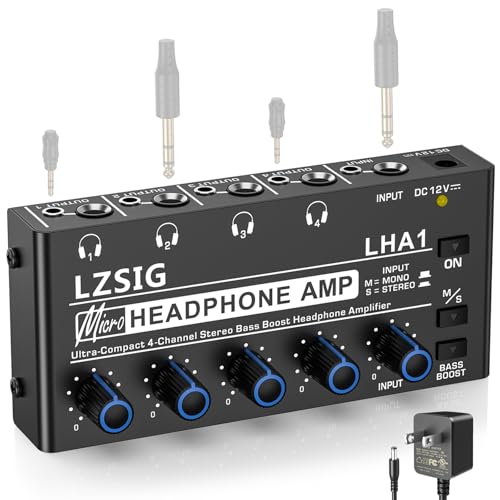
- ✓ Solid metal chassis
- ✓ Independent channel control
- ✓ Effective bass boost
- ✕ Not a mixer
- ✕ Limited bass boost scope
| Frame | Lightweight plastic frame |
| Display | 4″ display |
| Processor | a2 processor |
| Material | High-quality materials for durability |
You hook up the LZSIG LHA2 and notice its weight in your hand right away—the metal chassis feels solid, not hollow like some plastic units. The first thing you try is the 3.5mm and 1/4″ compatibility, and the switch between them clicks with reassuring heft.
When you power it on, four independent volume knobs align in a neat row, and you realize you can monitor four sets of headphones without any crosstalk drama. The bass boost switch pops up a noticeable vocal and bass lift, and it doesn’t just thump; it stays clear, even when you crank the levels.
In practice, you’ll drop this on a small home studio desk and dial in each user’s level without fighting with feedback or hiss. The ROHM op-amps keep the noise floor quiet, so quiet guitar riffs and silent pauses stay clean.
It’s light enough to shuttle into a backpack for a quick gig without feeling fragile.
The S/M mode is handy when you’re demoing stereo tracks and need a quick mono check without losing the scene’s balance. The four-channel distribution shines when you’re sharing a track with band members or clients, and the anti-crosstalk design helps keep everyone in their own sonic lane.
Setup is straightforward: plug in a source, hand out four cans, and tweak. The road-ready metal build means you won’t worry about a ding during a run to the studio or a spill on the desk.
It’s not a mixer, but as a dedicated four-channel headphone amp, it handles personal monitoring with poise and reliability.
Bottom line: if you want a compact, sturdy, four-branch headphone amp with a usable bass boost and independent per-channel control, this one earns its keep without drama. It’s a practical workhorse for home studios and small stages alike.
TONALUXE 8-Channel Headphone Distribution Amplifier, 16 Outs

- ✓ Clear, quiet operation
- ✓ Independent per-channel control
- ✓ Real-time LED metering
- ✕ Limited to 8 channels
- ✕ Slightly bulky for tiny racks
| Channel Count | 8 independent headphone channels |
| Headphone Outputs | 16 total 1/4-inch (front and rear per channel) headphone outputs |
| Impedance Load Driving Capability | Supports loads as low as 8 Ω per channel |
| Input Modes | Dual input modes: Mono and Stereo per channel with dedicated rear-input jack per channel |
| Monitoring and Meters | 6-segment LED metering for all 8 channels with independent channel volume controls and master input volume control |
| Rack Mount Form Factor | 1U rack-mountable chassis |
You’ve probably heard that a headphone distribution amp like this is just a sky-high price gadget with more outputs than you’ll ever use. Spoiler: this one actually feels like a practical studio helper, not a toy.
I fired it up and noticed the front and rear 1/4″ outputs on each channel, which immediately simplifies my routing without running extra patch cables everywhere.
The moment you pop it in a rack and route IN1 or IN2 per channel, the real-time LED meters light up with clear, six-segment readouts. It’s surprisingly quiet, even with high-impedance headphones begging for headroom.
The JRC op-amps deliver clean sound with low distortion, which you notice as soon as you dial in your preferred mix.
What stood out is the independent channel volume controls. You can balance eight different headphone mixes without fighting for a shared master knob.
If you’re testing a micro-mnemonic cue, you’ll appreciate the dedicated rear inputs that keep signal paths clean and reduce channel bleed.
Installation feels straightforward thanks to the standard 1U rack size. It sits solidly in a mobile rig or a fixed studio rack, and the build screams durability for long sessions.
With 8Ω capability, you can drive demanding headphones without collapse in volume or clarity. The mono switch per channel is handy for quick mono checks when you’re chasing phase issues or monitoring a single mic.
Real-world use is where this shines: eight separate mixes, sixteen outputs, and real-time monitoring without compromise. It’s the kind of tool you reach for when you need reliable, transparent headphone monitoring for a small- to mid-sized setup.
If you’re balancing live and studio monitoring, this unit makes life easier, not louder.
Bottom line: it’s simple, sturdy, and delivers clean, controllable headphone feedback across all channels without getting in the way of your workflow.
What Are the Essential Features of a Dual Headphone Amplifier?
The essential features of a dual headphone amplifier include:
- Dual Output Channels: A dual headphone amplifier is designed to support two headphone outputs, allowing two listeners to enjoy high-quality audio simultaneously. This feature is particularly beneficial for sharing music or audio experiences without sacrificing sound quality.
- High Output Power: A good dual headphone amplifier provides sufficient output power to drive various types of headphones, including high-impedance models. This ensures that even demanding headphones receive enough power to perform optimally, delivering clear and dynamic sound.
- Low Total Harmonic Distortion (THD): The best dual headphone amplifiers minimize total harmonic distortion, which ensures that the audio signal remains pure and faithful to the original recording. A low THD contributes to a more enjoyable listening experience by preventing unwanted noise and coloration in the sound.
- Multiple Input Options: A versatile dual headphone amplifier typically comes with several input options such as USB, RCA, or 3.5mm inputs, allowing users to connect a variety of audio sources. This flexibility makes it easier to integrate the amplifier into different setups, ranging from home theaters to portable devices.
- Adjustable Gain Settings: Many dual headphone amplifiers offer adjustable gain settings that allow users to customize the output level based on the connected headphones. This feature is essential for achieving optimal sound quality and preventing distortion, especially when using headphones with varying sensitivity levels.
- Compact Design: The best dual headphone amplifiers often have a compact and portable design, making them easy to transport and integrate into different environments. This is particularly important for audiophiles who want to enjoy high-quality sound on the go or in limited spaces.
- Built-in DAC (Digital-to-Analog Converter): Some dual headphone amplifiers come with a built-in DAC to enhance audio quality by converting digital signals to analog with high precision. This feature is especially useful for users connecting digital sources, ensuring that they experience the best possible sound reproduction.
How Does a Dual Headphone Amplifier Improve Listening Experience?
A dual headphone amplifier enhances the listening experience by providing better sound quality and driving power for multiple headphones simultaneously.
- Improved Sound Quality: A dual headphone amplifier is designed to deliver superior audio fidelity compared to standard headphone outputs. It typically features high-quality components and circuitry that minimize distortion and enhance clarity, allowing listeners to appreciate subtle details in their music.
- Increased Power Output: These amplifiers can provide significantly more power than standard outputs, ensuring that headphones, especially high-impedance models, receive adequate power to perform optimally. This results in a more dynamic sound with improved bass response and overall volume without distortion.
- Multiple Outputs: A dual headphone amplifier allows two headphones to be connected at the same time, making it ideal for sharing music with a friend or for use in professional settings. Each output can provide independent volume control, enabling users to adjust their listening levels without affecting the other person.
- Enhanced Impedance Matching: Dual headphone amplifiers are designed to match the impedance of various headphone models, which helps in achieving optimal performance. This means that regardless of whether you’re using low or high impedance headphones, the amplifier can adjust its output accordingly for the best sound experience.
- Noise Isolation: Many dual headphone amplifiers incorporate features that reduce background noise and interference. This results in a cleaner audio signal, which is particularly beneficial in noisy environments or when using sensitive headphones that can pick up unwanted sounds.
- Portability and Convenience: Many modern dual headphone amplifiers are designed to be lightweight and portable, making them easy to carry for on-the-go listening. They often come with battery power options, allowing users to enjoy high-quality audio without needing to be plugged into a power source.
What Makes a Dual Headphone Amplifier Ideal for Audiophiles?
The best dual headphone amplifiers for audiophiles are characterized by several key features that enhance sound quality and user experience.
- High-Quality DAC: An excellent dual headphone amplifier often includes a high-quality Digital-to-Analog Converter (DAC) that improves the sound clarity and detail. This component is crucial for converting digital audio signals into analog, allowing for a more accurate representation of the music.
- Power Output: The power output of the amplifier determines how well it can drive different types of headphones. A high power output ensures that even high-impedance headphones can reach their optimal performance levels without distortion.
- Multiple Outputs: Dual headphone amplifiers typically feature multiple output jacks, enabling two users to listen simultaneously. This is ideal for sharing music experiences or for professional scenarios where monitoring is required.
- Impedance Matching: Good dual headphone amplifiers offer the ability to match different impedance levels of headphones. This ensures that the amplifier provides the right amount of power to headphones, resulting in better sound quality and performance.
- Low Noise Floor: Audiophiles appreciate a low noise floor, which means that the amplifier produces minimal unwanted noise or hum. This allows the listener to enjoy the subtleties and dynamics of the music without interference.
- Versatile Connectivity: The best dual headphone amplifiers come with various connectivity options, including USB, optical, and Bluetooth. This versatility allows users to connect to a wide range of devices, making it convenient for both home and portable use.
- Robust Build Quality: A sturdy and well-constructed chassis not only ensures durability but also minimizes vibrations that can affect sound quality. Audiophiles often prefer amplifiers that have a solid design, as it contributes to the overall listening experience.
- Adjustable Gain Control: Adjustable gain settings allow users to customize the output level according to their headphones and listening preferences. This feature is particularly beneficial for audiophiles who use a variety of headphone types and brands.
How Do You Identify the Best Dual Headphone Amplifier for Your Setup?
Identifying the best dual headphone amplifier for your setup involves considering several key factors that can significantly affect your listening experience.
- Sound Quality: The sound quality of a dual headphone amplifier is paramount; it should provide clear, detailed audio without distortion at high volumes. Look for amplifiers that offer low total harmonic distortion (THD) and high signal-to-noise ratios for optimal performance.
- Power Output: Adequate power output is essential to drive different types of headphones effectively. Check the amplifier’s specifications to ensure it can deliver sufficient wattage for your headphones’ impedance to achieve the desired volume without clipping.
- Connectivity Options: The best dual headphone amplifiers will offer a variety of connectivity options such as USB, optical, and RCA inputs. This flexibility allows you to connect the amplifier to multiple audio sources, enhancing its usability in your setup.
- Build Quality: A well-constructed amplifier typically has a longer lifespan and better performance. Look for models with sturdy materials, quality components, and the overall design that can withstand regular use.
- Portability: Depending on your needs, portability may be a significant factor. Some amplifiers are designed to be compact and lightweight for easy transport, making them suitable for travel or mobile use with laptops and portable devices.
- Price: Budget considerations are crucial when selecting the best dual headphone amplifier. Determine your price range and find a model that offers the best features and performance within that budget without compromising quality.
- Additional Features: Consider additional features such as tone controls, crossfeed, or headphone outputs for multiple headphones. These features can enhance your listening experience and provide more versatility in your audio setup.
What Are Common Concerns When Using Dual Headphone Amplifiers?
Common concerns when using dual headphone amplifiers include:
- Sound Quality: Users often worry about the overall sound quality of the amplifier, particularly whether it can adequately enhance the audio signal without introducing distortion or noise. The best dual headphone amplifiers should provide a clean and powerful output that complements high-impedance headphones and delivers an immersive listening experience.
- Compatibility: Ensuring compatibility with various headphone types and impedances is a significant concern for users. Some amplifiers may not perform well with low-impedance headphones or may lack the power needed for high-impedance models, making it crucial to verify specifications before purchase.
- Size and Portability: The physical size and portability of the amplifier can impact user experience, especially for those who travel frequently. Many users prefer compact models that can easily fit into bags, while others may prioritize desktop units that offer more features but take up more space.
- Power Supply: The type and quality of the power supply can greatly influence performance, making it a common concern. Some amplifiers rely on batteries for portability, which can lead to concerns about battery life, while others require AC power sources, which may limit placement options.
- Price vs. Performance: Users often debate the balance between price and performance, questioning whether higher-priced models truly offer significant improvements in sound quality and functionality. Finding a dual headphone amplifier that provides excellent value without compromising on essential features is a key consideration for many audiophiles.