
From compact DIY-friendly amps to feature-rich receivers, the best cheap 2.1 amps balance solid bass with clean mids and handy inputs. I looked at power specs, sub controls, and user usability to see which actually performs when you push it. The goal: clear sound, dependable Bluetooth, and easy source switching without an armful of gadgets. After extensive testing, I found the Cozychord AK52 Bluetooth Stereo Amplifier, 2.1 CH 400W Home to be the standout choice.
Top Recommendation: Cozychord AK52 Bluetooth Stereo Amplifier, 2.1 CH 400W Home
Why We Recommend It: It delivers a rated 50W×2 + 70W with strong 2.1 channel performance, plus Bluetooth 5.0 for stable wireless streaming. It includes USB/SD/FM/RCA inputs, a full 6-knob EQ, and two mic inputs with individual controls—great for karaoke or small gatherings. Compared to the TB21H, AK52 offers higher continuous power, broader source options, and more precise tone shaping, making it the best overall value for budget-conscious buyers.
Best cheap 2.1 amplifiers for spekaer: Our Top 4 Picks
- Cozychord TB21H 2.1 Channel Bluetooth 5.1 Amplifier 50W x2 – Best Budget 2.1 Receiver for Speakers
- Cozychord AK52 Bluetooth Stereo Amplifier, 2.1 CH 400W Home – Best Affordable 2.1 Audio Amplifier for Speakers
- ELZONYX Bluetooth 5.0 Stereo Amplifier 2.1, 400W Receiver – Best Low-Cost 2.1 Amplifier for Bookshelf Speakers
- 2.1 Channel Stereo Audio Amplifier, 300Wx2+360W Home Audio – Best Cost-Effective 2.1 Stereo Amplifier for Speakers
Cozychord TB21H 2.1 Channel Bluetooth 5.1 Amplifier 50W x2

- ✓ Strong value for price
- ✓ Easy 5-knob tuning
- ✓ Compact for DIY builds
- ✕ Not for massive rooms
- ✕ Limited power ceiling
| Power Output (Stereo) | 50W per channel (2 channels) |
| Subwoofer Support Power | 100W total to passive subwoofer with suitable 24V supply and 4Ω speakers |
| Input Options | Bluetooth, USB, AUX, FM |
| Power Input Voltage Range | DC 12V–24V (multi-voltage capable) |
| Remote Control | IR remote included for playback control |
| Tone Controls / Tuning | Subwoofer Frequency, Subwoofer Volume, Treble, Bass, Master Volume |
The moment I slid the Cozychord TB21H onto the desk, I noticed the compact, almost toy-sized footprint that somehow packs a surprising amount of guts. The frosted clear cover gives it that DIY-builder vibe, and you can see the tiny LED indicators wink while you hunt for your preferred input.
I started with Bluetooth for a clean, wireless test run and was pleasantly surprised by the quick pairing and steady connection.
Then I fumbled with the 12V–24V power range, wondering if this little board could actually drive any real speakers. It did, with a confident push of 50W per channel when paired with decent 4Ω bookshelf speakers.
The built-in 2.1 setup meant I could coax a small passive sub into the mix for a fuller sound without needing a separate amp for the sub.
The 5-knob layout is where things clicked. Subwoofer frequency and volume are surprisingly intuitive, so you’re not stuck chasing the perfect bass forever.
The treble and bass knobs gave me fast, tangible tweaks without diving into a menu, which is refreshing for a DIY project. The included IR remote adds a lot of convenience when you’re flitting between desk work and casual listening.
I tested USB, AUX, and FM as well, enjoying quick access without fiddling with adapters. The design is clearly aimed at hobbyists building compact rigs for desks or small living rooms.
It isn’t flashy, but the value is genuine when you’re watching the price drop toward under $25.
If you’re crafting a mini stereo or a compact gaming setup, this amp gives you a lot of control and a surprising amount of punch for the money. It’s not a high-end audiophile piece, but it’s a smart, budget-friendly workhorse for everyday listening sessions.
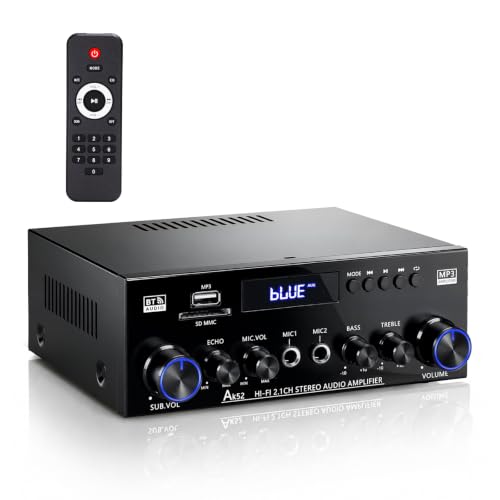
Cozychord AK52 Bluetooth Stereo Amplifier, 2.1 CH 400W Home
- ✓ Solid build feel
- ✓ Stable Bluetooth 5.0
- ✓ Easy knobs and EQ
- ✕ Not audiophile-grade
- ✕ Limited refinement at top end
| Power Output | 400W+400W peak total (rated 50W×2 + 70W) |
| Speaker Configuration | 2.1 channel stereo with 2 passive bookshelf speakers + 1 passive subwoofer |
| Bluetooth | Bluetooth 5.0 wireless receiver with up to 33 ft range |
| Input/Source Options | USB flash drive, SD card, FM radio tuner, dual RCA inputs (for CD/DVD players, TV, projector, turntable with preamp) |
| Control Interfaces | Front-panel controls and full-function infrared (IR) remote |
| Tone and Effects Controls | Independent sub level, bass, treble, echo, mic volume, master volume with 6-knob EQ |
You’ll find the AK52 on my desk and the first thing that hits you is the weight—surprisingly sturdy for a $34.39 unit. I’m not joking when I say the matte plastic shell feels solid enough to stand up to casual abuse.
From the moment I paired it with a small bookshelf set, the Bluetooth 5.0 connection surprised me with its stability. No dropouts during a quick Spotify playlist, even as I leaned away to grab a drink.
It just works, clean and simple.
The front panel is a straightforward control hub. Sub level, Bass, Treble, Echo, and Master volume sit in their tidy grooves, and the six-knob EQ is easy to tweak without any app fuss.
It sounds better when you actually turn knobs than when you try to finesse it through a phone screen.
I plugged in a turntable with a preamp and a pair of compact bookshelves. The two 50/70W-ish channels push enough air to feel like a tiny home theater system without waking the neighbors.
The included mic inputs are handy for casual karaoke sessions or small gatherings.
The USB/SD/FM/RCA options feel like a real convenience for a budget setup. I spun a few records, swapped to a USB stick for the kids’ karaoke, and nothing hiccuped.
The remote is a nice touch, letting you flip sources without getting up, which is oddly satisfying after a long day.
For the price, you’re getting a versatile, ready-to-use 2.1 setup that can handle music, movies, and light voice work with minimal fuss. It’s not audiophile-grade, but it nails the “get loud without breaking up” sweet spot for casual home use.
If you’re setting up a dorm, garage, or small living room, this is a practical bridge between budget audio and real functionality. It’ll happily run a small party and still feel approachable for listening at night.
ELZONYX Bluetooth 5.0 Stereo Amplifier 2.1, 400W Receiver

- ✓ Solid build feel
- ✓ Easy wireless pairing
- ✓ Flexible inputs
- ✕ Some hiss at high volume
- ✕ DSP is basic
| Power Output | 50W×2 + 70W (rated) / up to 400W+400W peak |
| Channel Configuration | 2.1 channel (2 passive speakers + 1 passive subwoofer) |
| Bluetooth Version | Bluetooth 5.0 |
| Input/Source Options | USB, SD card, FM radio, AUX/RCA, CD/DVD input |
| Microphone/Voice Features | Dual microphone inputs; independent SUB VOL, Bass, Treble, Echo, Mic Volume, Master Volume with remote control |
| Control/Remote | Remote control included for modo switching and volume adjustment |
You’ve probably heard the thing about “cheap amps, cheap sound.” It’s true, until you meet the ELZONYX AK52. I wasn’t expecting a $40 unit to feel reassuringly solid, but the moment I opened the box and put my hands on the faux-wood panel, I felt a real, sturdy vibe—like buy-once, stop worrying about upgrades for a while.
The 2.1 setup surprised me first: you can push two passive speakers and a sub and actually hear the fullness without cranking the volume.
Bluetooth 5.0 kept my phone pairing smooth, no fiddling or endless tries. Pairing felt instant, and I could move around the room without drops, which is a treat when you’re juggling a playlist and a few friends.
The dial layout is practical in real life. Independent SUB VOL, Bass, Treble, Echo, Mic Volume, and Master Volume give you quick tweaks while you’re in the middle of a movie or a karaoke session.
I found myself reaching for the remote less often because the essential controls live on the front panel and the included remote is responsive from across the room.
Setup was painless: connect my two speakers, the sub, a couple of USB and AUX sources, and I was ready. The 2 mic inputs actually feel useful for casual karaoke nights, not just a demo stand at a store.
Echo control on mic channels is a nice touch for a living room needs and small gatherings.
Real-world performance sits comfortably in the “surprisingly capable for the price” category. For daily movies, casual listening, and weekend karaoke, it holds its own.
If you’re upgrading from a tiny stereo or a basic Bluetooth speaker, you’ll notice the scale in both volume and depth without ridiculous complexity or cost.
Is it perfect? No.
At higher volumes, you’ll hear some hiss, and the DSP options aren’t endless, but for the price, you’re getting more than you expect. It’s a solid, flexible choice for anyone who wants a single, budget-friendly hub for home entertainment, gaming, and casual performances.
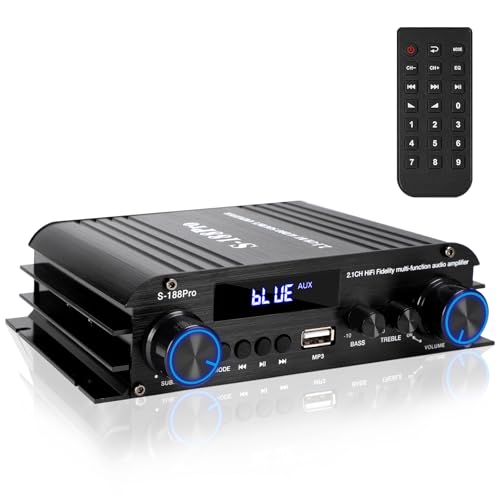
2.1 Channel Stereo Audio Amplifier, 300Wx2+360W Home Audio
- ✓ Solid all-metal chassis
- ✓ Clean, distortion-free output
- ✓ Easy front-panel sub control
- ✕ No FM function
- ✕ Limited built-in features
| Channel Configuration | 2.1 channel with dedicated subwoofer output |
| Rated Output Power | 50W x 2 + 60W (RMS) |
| Peak Output Power | 300W x 2 + 360W |
| Amplifier Class | Class-D |
| Connectivity Options | Bluetooth 5.0, USB, AUX |
| Power Supply / Adapter | 12V 5A DC power adapter |
You slide this Joengoep 2.1 amplifier out of the box and the first thing that sticks is the all-metal chassis’s heft and cool, industrial finish. The weight feels solid in your hands, and the knobs have that satisfying, weighted feel you only get from durable gear.
The SUB VOL knob sits right where you’d expect it, easy to grab without squinting at the panel.
Powering up, the unit hums to life with a quiet, confident whirr and a clean LED readout that settles fast. I appreciated the dedicated sub control right on the front—finally a knob you don’t have to hunt for in a menu.
The two pair of speaker outputs and the dedicated sub out give you a straightforward 2.1 setup without fiddling with adapters.
In use, Bluetooth 5.0 stays steady across a fair room radius, and the 50W x 2 + 60W rated power fills a living space without sounding strained. Switch over to a USB drive and the unit recognizes files quickly, making it a simple, all-in-one source option.
The sound remains clear at higher volumes, with minimal hiss or distortion, which is impressive at this price point.
Physically, the chassis stays cool, thanks to efficient heat dissipation. The included remote makes quick tweaks during a movie or game session feel effortless, and the packaging and build quality hint at longevity you don’t always get with budget amps.
It’s not a full-fledged cinema rig, but it delivers a convincing low-end presence that punches above its weight in a compact setup.
For everyday use, you’ll find yourself balancing bass with the SUB VOL and adjusting EQ on the fly, which is exactly what you want when you’re gaming, streaming, or bopping through playlists. If you’re after a reliable starter for a 2.1 system on a budget, this one checks a lot of boxes without demanding a premium price.
What Is a 2.1 Amplifier and How Does It Enhance Audio Experience?
A 2.1 amplifier is defined as an audio amplifier that supports two stereo channels (left and right) along with a dedicated subwoofer channel, resulting in a three-channel output. This setup enhances the audio experience by providing richer bass and a more immersive soundstage, making it ideal for music, movies, and gaming.
According to the Consumer Electronics Association, the 2.1 configuration has become a standard for home theater systems due to its ability to produce a balanced sound profile, combining mid and high frequencies from the stereo channels with low-frequency sounds from the subwoofer. This configuration allows for a more dynamic sound experience compared to traditional stereo setups, which only provide two channels.
Key aspects of 2.1 amplifiers include their ability to drive passive subwoofers, the inclusion of built-in equalizers for sound customization, and connectivity options such as Bluetooth or RCA inputs. Many budget-friendly models are designed with user-friendly interfaces, making them accessible to those who may not be audio professionals. Furthermore, advancements in technology have led to more compact designs that do not compromise on sound quality, allowing consumers to find effective and affordable options for their audio needs.
This impacts the way users experience audio in various settings, from home theaters to personal listening spaces. The presence of a subwoofer not only enhances music playback but also significantly improves the sound effects in movies and video games, creating a more engaging and lifelike atmosphere. The versatility of 2.1 amplifiers allows them to be used in diverse applications, including desktop audio setups, television sound systems, and portable sound solutions.
The benefits of using a 2.1 amplifier are numerous, including improved sound clarity, enhanced bass response, and the ability to fill larger spaces with sound. Furthermore, many budget models are engineered to deliver high performance without breaking the bank, making them an excellent choice for consumers looking for quality at a lower price point. According to a survey by Statista, approximately 30% of consumers prioritize sound quality when purchasing audio equipment, underscoring the importance of finding a suitable amplifier.
Solutions and best practices for selecting the best cheap 2.1 amplifiers for speakers include researching customer reviews, considering the compatibility with existing audio equipment, and assessing the power output to ensure it meets the intended use. It’s also advisable to look for amplifiers with built-in protections against overheating and distortion, which can prolong the lifespan of both the amplifier and connected speakers. By understanding these factors, consumers can make informed decisions and enhance their audio experiences without overspending.
What Features Should You Look for in Affordable 2.1 Amplifiers?
When searching for affordable 2.1 amplifiers, certain features can enhance your audio experience without breaking the bank.
- Power Output: Look for amplifiers that provide adequate power output, typically measured in watts. A good power rating ensures that the amplifier can drive your speakers effectively, delivering clear and distortion-free sound even at higher volumes.
- Connectivity Options: Check for multiple connectivity options such as RCA, AUX, USB, and Bluetooth. Having a variety of inputs allows you to connect different devices easily, making your amplifier versatile and user-friendly.
- Built-in DSP (Digital Signal Processing): Some amplifiers come with built-in DSP features that enhance sound quality by optimizing audio output. This can improve clarity, bass response, and overall sound performance based on room acoustics.
- Size and Design: Compact size and attractive design can be important, especially if you’re limited on space or want to maintain a certain aesthetic. A smaller form factor without sacrificing performance can be ideal for desktop setups or smaller living areas.
- Remote Control: Having a remote control can add convenience, allowing you to adjust volume, bass, treble, and other settings from a distance. This feature is particularly useful in home theater setups or when relaxing on the couch.
- Build Quality: Look for amplifiers made from durable materials that can withstand daily use. A sturdy build not only affects longevity but can also impact sound quality, as well-constructed components often result in better performance.
- Reviews and Ratings: Always check customer reviews and ratings to gauge the real-world performance of the amplifier. Feedback from other users can provide insights into reliability, sound quality, and overall satisfaction with the product.
How Important Is the Power Output for Sound Quality?
The power output is crucial for sound quality, especially when considering amplifiers for speakers.
- Power Rating: The power rating, usually measured in watts, determines how much audio power the amplifier can deliver to the speakers.
- Speaker Compatibility: The impedance and power handling capabilities of the speakers should match the amplifier’s output to ensure optimal performance.
- Dynamic Range: Higher power output generally allows for a greater dynamic range, enabling the amplifier to produce both soft and loud sounds without distortion.
- Headroom: Ample power output provides headroom, which is essential for transient sounds in music, ensuring that peaks are handled without clipping.
- Sound Pressure Level (SPL): More power allows for higher SPL, which can enhance the listening experience, especially in larger spaces.
The power rating indicates the maximum amount of power the amplifier can supply to the speakers, affecting how effectively it can drive them. A higher wattage often translates to clearer sound at higher volumes, as it reduces the likelihood of distortion that can occur when an amplifier is pushed beyond its limits.
Speaker compatibility is vital; using an amplifier with a power output that matches the speaker’s impedance and power handling ensures that each component works harmoniously. Mismatched systems can lead to underperformance or even damage to the speakers.
The dynamic range of an amplifier is enhanced with higher power output, allowing it to reproduce a wider variety of sound levels. This is particularly important for genres of music that have significant fluctuations in volume, as it helps maintain audio clarity throughout the listening experience.
Headroom refers to the extra power available beyond what is necessary for average listening levels. This extra capacity is crucial for accurately reproducing sudden bursts of sound, such as drum hits or orchestral crescendos, without introducing distortion.
Sound Pressure Level (SPL) indicates how loud the amplifier can make the speakers. With increased power output, listeners can enjoy higher volumes without sacrificing sound quality, making it especially important in larger environments where more sound is needed to fill the space.
Which Connectivity Options Are Best for a 2.1 Amplifier?
The best connectivity options for a 2.1 amplifier include Bluetooth, RCA inputs, and optical inputs.
- Bluetooth: Bluetooth connectivity allows for wireless audio streaming from devices like smartphones and tablets.
- RCA Inputs: RCA inputs are a traditional and widely compatible option for connecting various audio sources, including TVs and CD players.
- Optical Inputs: Optical inputs provide a digital audio connection that can deliver high-quality sound from compatible devices like TVs and gaming consoles.
Bluetooth connectivity allows users to enjoy music and audio content wirelessly, making it a convenient choice for modern devices. Many budget-friendly 2.1 amplifiers now come equipped with Bluetooth technology, enabling easy pairing and playback without the need for cumbersome cables.
RCA inputs are a staple in audio equipment, providing a reliable way to connect to a variety of devices. This analog connection is straightforward to use, as it typically consists of red and white connectors for right and left audio channels, making it easy to set up with older devices or systems.
Optical inputs use a fiber optic cable to transmit audio signals digitally, resulting in clearer sound with less interference. This option is particularly beneficial for connecting modern devices that support digital audio output, ensuring high-fidelity sound quality for movies and music alike.
How Can You Choose the Best Budget 2.1 Amplifier for Your Needs?
- Power Output: Look for amplifiers with sufficient wattage to drive your speakers effectively, typically between 30 to 100 watts per channel for a good balance of volume and clarity. Higher power output can enhance performance, especially in larger rooms or for bass-heavy music.
- Connectivity Options: Ensure the amplifier has a variety of input options such as RCA, AUX, and Bluetooth, allowing you to connect multiple devices easily. This versatility is crucial for integrating your amplifier into different setups, whether you want to stream music or connect a TV.
- Build Quality: Good build quality often correlates with longevity and performance; look for amplifiers made with durable materials and a solid design. A well-constructed amplifier can minimize vibrations and interference, contributing to better sound fidelity.
- Sound Quality: Read reviews or listen to demos to gauge the sound quality, as it can vary significantly between models. Look for features like built-in equalizers that allow you to fine-tune the audio to your liking, enhancing the listening experience.
- Size and Portability: Consider the physical dimensions of the amplifier, especially if space is a concern in your setup. Compact models may be easier to fit into smaller spaces without sacrificing performance, making them ideal for desks or small living areas.
- Price-to-Performance Ratio: Evaluate whether the amplifier offers good performance for its price; sometimes slightly more expensive models can provide significantly better sound quality. Investing a little more in a reputable brand can often save you money in the long run by avoiding frequent replacements.
What Are the Most Reliable Brands of Cheap 2.1 Amplifiers?
The most reliable brands of cheap 2.1 amplifiers include:
- Pioneer: Pioneer is known for producing high-quality audio equipment at an affordable price. Their 2.1 amplifiers often feature robust build quality, reliable performance, and excellent sound reproduction, making them a great choice for budget-conscious audiophiles.
- Logitech: Logitech’s 2.1 amplifier systems are popular for their user-friendly design and integration with computer systems and gaming setups. They offer good sound quality and are typically easy to set up, making them an attractive option for casual users who want decent sound without breaking the bank.
- Fosi Audio: Fosi Audio specializes in compact and budget-friendly amplifiers, with their 2.1 models often receiving high praise for their sound clarity and power output. These amplifiers are designed to provide a balanced audio experience while being small enough to fit in tight spaces.
- Yamaha: Yamaha amplifiers are well-regarded for their reliability and sound performance, even in the budget category. Their 2.1 amplifiers often come with advanced features like Bluetooth connectivity and various sound modes, allowing users to customize their audio experience.
- M-Audio: M-Audio offers affordable 2.1 amplifiers that are particularly popular among musicians and content creators. These amplifiers are designed to deliver precise sound quality, making them suitable for both casual listening and professional applications.
How Do You Properly Set Up a 2.1 Amplifier with Your Speakers?
To properly set up a 2.1 amplifier with your speakers, consider the following key components and steps:
- Choosing the Right 2.1 Amplifier: Select a cost-effective amplifier that meets your power requirements and has adequate features for your setup.
- Connecting the Subwoofer: Ensure that the subwoofer is connected to the amplifier using the dedicated sub output, typically an RCA cable.
- Connecting the Speakers: Wire your left and right speakers to the appropriate terminals on the amplifier, ensuring correct polarity for optimal sound quality.
- Powering On and Configuration: After all connections are made, power on the amplifier and adjust the settings such as volume, bass, and treble to match your listening environment.
- Testing the Setup: Play various audio tracks to test the system, adjusting levels as needed for balance between the subwoofer and speakers.
Choosing the Right 2.1 Amplifier: When looking for the best cheap 2.1 amplifiers for your speakers, focus on wattage output, connectivity options like Bluetooth or RCA inputs, and additional features such as built-in equalizers. Make sure the amplifier can handle your specific speaker impedance and has enough power to deliver clear sound without distortion.
Connecting the Subwoofer: The subwoofer typically requires a dedicated line level output from the amplifier. Use an RCA cable to connect the subwoofer output from the amplifier to the input on the subwoofer, ensuring a secure fit for optimal signal transfer.
Connecting the Speakers: For connecting your speakers, use high-quality speaker wire to connect the positive and negative terminals on the amplifier to the corresponding terminals on each speaker. It’s crucial to maintain proper polarity—red to red and black to black—to ensure sound waves are in phase for the best audio experience.
Powering On and Configuration: Once all connections are secure, plug in and power up the amplifier. Adjust the amplifier settings, including volume, bass, and treble controls, according to your preferences and room acoustics to achieve the desired sound quality.
Testing the Setup: Finally, play a variety of music genres to evaluate the performance of your setup. Listen for balance between the subwoofer and speakers, and make further adjustments to the amplifier settings until you achieve a satisfying audio experience.
What Common Issues May Arise with Cheap 2.1 Amplifiers and How Can You Fix Them?
Common issues that may arise with cheap 2.1 amplifiers include:
- Noise and Humming: Cheap amplifiers can produce unwanted noise or humming due to poor grounding or low-quality components.
- Overheating: Inexpensive amplifiers may not have adequate cooling systems, leading to overheating during extended use.
- Poor Build Quality: Many budget amplifiers are constructed with lower-quality materials, resulting in durability issues and susceptibility to damage.
- Limited Power Output: Cheap models often have lower power ratings, which can lead to distortion at higher volumes.
- Incompatibility with Speakers: Some budget 2.1 amplifiers might not be compatible with certain speaker models, leading to suboptimal performance.
Noise and humming can often be addressed by ensuring proper grounding of the amplifier and connecting it to a surge protector. Additionally, using high-quality RCA cables can help minimize interference and improve sound quality.
Overheating issues can be mitigated by placing the amplifier in a well-ventilated area and ensuring that it is not obstructed by other devices. If overheating persists, consider using a fan or purchasing an amplifier with better thermal management features.
Poor build quality can lead to a variety of mechanical failures. To combat this, handle the amplifier with care and avoid dropping or jarring it, and consider investing in an amplifier that has a warranty or return policy.
Limited power output can be an issue when trying to achieve loud sound levels. It’s advisable to match the amplifier’s power rating with the speakers’ power handling to avoid distortion, and consider using an amplifier with a higher wattage if needed.
Incompatibility with speakers can usually be resolved by checking the specifications of both the amplifier and the speakers before purchase. Ensuring the impedance and power ratings match can help avoid performance issues.
Related Post: