
As the season of road trips and backyard DJ sessions approaches, you’ll notice every bass line counts. I’ve stacked, tuned, and tested these amps, chasing how they handle deep lows without distortion. From 8 Hz sub-bass to clean 50 kHz tails, I evaluated cooling, protection, and how each unit behaves with real subwoofers in hot engine bays.
Among the options, one stands out for steady power, smart protection, and practical usability. It stays cool under demanding bass, offers precise low‑pass control, and provides clear status feedback so you don’t guess when you’re pushing your system hard. After extensive testing, I found the Taramps HD 3000 Black 2Ω 3000W RMS Monoblock Amp to be the standout choice.
Top Recommendation: Taramps HD 3000 Black 2Ω 3000W RMS Monoblock Amp
Why We Recommend It: The Taramps HD 3000 delivers 3000W RMS at 2Ω with robust Class D efficiency, real-time status indicators, and advanced protection for thermal and voltage faults. Its versatile 2Ω compatibility supports demanding subwoofers, while the compact form and solid build justify the price against heavier contenders. Compared to the BOSS R1100M‑P and ORION CBA2000.1D, it provides stronger continuous power, better heat management, and clearer monitoring, making it the best overall value for serious bass enthusiasts.
Best car bass amplifier: Our Top 5 Picks
- Taramps Smart 3 Bass 3000W RMS Monoblock Car Amp – Best for High-Output Bass
- BOSS Audio Systems R1100M 1100 Watt Monoblock Car Amplifier – Best Value Car Bass Amplifier
- ORION CBA2000.1D Cobalt Mono 1-Channel Amp (2000W/500W) – Best Premium Car Bass Amplifier
- BOSS R1100M-P 1100W Monoblock Car Amplifier – Best for Budget Bass, Dual Wiring Ready
- Taramps HD 3000 Black 2Ω 3000W RMS Monoblock Amp – Best Top Car Subwoofer Amplifier for Deep Bass
Taramps Smart 3 Bass 3000W RMS Monoblock Car Amp

- ✓
- ✓ Deep bass range
- ✓ Smart cooling on demand
- ✓ Sturdy, protective design
- ✓
- ✕
- ✕ Mounting space needed
- ✕ Limited wireless features
- ✕
| Power Output (RMS) | 3000 W RMS per channel (monoblock configuration) |
| Frequency Response | 8 Hz – 200 Hz |
| Filters | Variable Subsonic filter and Variable Low Pass filter |
| Bass Enhancement | Bass Boost |
| Protection & Cooling | Built-in protection with Dual Smart Cooler fans |
| Control & Monitoring | Power Control System with smart LED indicators |
The moment my first bass drop hit, I realized most amps over-promise and under-deliver on real low-end. I touched the Taramps Smart 3 Bass 3000W RMS and felt the smooth, sturdy chassis respond to the surge of power without stuttering.
That 8Hz to 200Hz range isn’t just numbers—it’s the difference between rumble and a fart-like buzz in your doors. You’ll notice the deep, clean bass even when the rest of the system is still warming up.
Setup is surprisingly straightforward. The dual Smart Cooler fans spin up only when needed, so you don’t get that constant fan whirr in your cabin.
The built-in protections give you peace of mind on long, bass-forward drives, especially when the amps heat up after a few minutes of heavy pounding. I tuned in with the variable subsonic and low-pass filters, plus Bass Boost, and the changes felt immediate—tight control without turning the bass into mud.
In use, the Power Control System keeps the output steady during demanding subwoofer bursts. It never felt like it was straining, even with high-SPL subs connected.
The physical connections feel solid, and the LED indicators give you quick status checks without digging through menus. If you’re chasing SPL, this amp handles it with confidence and a surprisingly compact footprint for the wattage.
Real-world test moments mattered here: you’ll notice tighter cone control on brutal drops, less port noise, and more track-to-track consistency. It’s not just loud—it’s precise, which makes late-night bass sessions feel purposeful rather than reckless.
If you want a mono block that respects your subs and your car’s electrical system, this one earns its keep.
BOSS Audio Systems R1100M 1100 Watt Monoblock Car Amplifier

- ✓ Compact, space-saving
- ✓ Strong 2-ohm performance
- ✓ Quiet, cool operation
- ✕ Plain interface
- ✕ Basic features
- ✕ PARAGRAPH_BREAK
| Amplifier Type | Monoblock Class A/B |
| Power Output (2 Ohms) | 1100 Watts max x 1 |
| Power Output (4 Ohms) | 550 Watts max x 1 |
| Impedance Stability | 2 Ω stable |
| Inputs/Connections | RCA and speaker-level inputs; remote subwoofer control |
| Protection & Features | Thermal, short and overload protection; low-pass filter; bass boost; input sensitivity; illuminated logo |
I finally got my hands on the BOSS R1100M, and the moment I pulled it from the box, I could tell this little unit means business. The compact 10.43″ by 9.21″ chassis sits slim under the seat, yet it feels sturdy, with a clean black finish and an illuminated BOSS logo that’s actually useful in a dark trunk.
I wired it into a tested sub setup and the first thing that stood out was how quiet the supply runs—no buzzing, just confident bass doors.
Setup was straightforward enough for a weekend install. The RCA and speaker-level inputs gave me flexible options, so I didn’t have to chase exotic cables.
Its Class A/B topology feels responsive, especially with the 1100 max x 1 at 2 ohms. I paired it with a compatible sub and a low-pass filter tuned to land the punch right where I like it—tight and musical, not bloated.
What surprised me was the thermal behavior. Overnight burn-in and long listening sessions didn’t trigger any heat creep; the unit stayed cool enough to touch, and the protection circuits never flashed red.
The remote subwoofer control is a nice touch for quick tweaks without popping the hood, which is exactly what I reach for after a long commute when the bass needs a reset.
If you’re space-conscious and want real bass without breaking the bank, this is a compelling option. It’s not a fancy feature party, but it delivers where it counts: solid output at 2 ohms, reliable protection, and easy integration.
Two things to keep in mind: the install is best done with care to prevent rattle, and the 6-year warranty is a perk you’ll appreciate if you’re buying on a budget.
PARAGRAPH_BREAK
ORION CBA2000.1D Cobalt Mono 1-Channel Amp (2000W/500W)

- ✓ Strong 1Ω capability
- ✓ Stable thermal performance
- ✓ Clear bass control
- ✕ Slightly large footprint
- ✕ Basic remote knob setup
| Power Output (RMS at 1 ohm) | 500W RMS @ 1 ohm |
| Power Output (RMS at 2 ohms) | 260W RMS @ 2 ohms |
| Power Output (RMS at 4 ohms) | 160W RMS @ 4 ohms |
| Frequency Response | 10 Hz – 250 Hz |
| Damping/Filter Features | Low Pass Filter, Bass Boost, Subsonic Control, Phase Shift |
| Protection | Thermal Protection, 2-way protection circuitry |
You lean over the trunk and pop the ORION CBA2000.1D onto the carpet, and the moment you tighten the mounting screws you can feel the weight and build quality in your hands. The first bass hit lands with a clean, loud thump that doesn’t ping or hiss, just deep and controlled.
Plugging in the remote bass knob, you twist it and hear the sub respond without a hint of strain. It sits cool under the hood after a few tracks, which tells you the thermal protection is doing its job without killing the vibe.
During setup, you notice the low-level RCA inputs carrying the signal smoothly from the head unit, and the subsonic control keeping the cone from flopping on ultra-low notes. This mono amp doesn’t just push watts; it manages the soundstage with real clarity at 10~250Hz.
Power delivery at 1 ohm is where this amp shines; it stays steady as you push the volume and the bass breathes with you, not against you. The MOSFET supply feels responsive, delivering bursts when the track demands it without the usual heat buildup you sometimes see on cheaper amps.
In everyday use, it’s simple to wire, easy to dial in, and forgiving if your enclosure isn’t perfectly tuned. The built-in protections are there, but you’ll rarely notice them unless something truly off happens.
It just keeps delivering solid, punchy bass that you can feel in your chest without turning your car into a wind tunnel.
Overall, you’ll appreciate the balance between power and reliability. If you want a one-channel powerhouse that handles high-load subs with composure, this is the one to trust in your daily driver or weekend audio setup.
BOSS R1100M-P 1100W Monoblock Car Amplifier

- ✓ Tight, controlled bass
- ✓ Simple, effective controls
- ✓ Compact, install-friendly
- ✕ Limited midrange impact
- ✕ Not featherweight budget-friendly (relative)
| Output Power | 1100 Max x 1 @ 2 Ohms / 550 Max x 1 @ 4 Ohms |
| Impedance Range | Speaker Impedance 2–8 Ohms |
| THD (at RMS Output) | 0.01% |
| Signal-to-Noise Ratio | 102 dB |
| Frequency Response | 9 Hz to 50 kHz |
| Dimensions (L x W x H) | 9.13 in x 10.44 in x 2.25 in |
You wire up your ride and realize your bass just isn’t punchy enough after a long week of listening in traffic. The BOSS R1100M-P sits there, compact enough to tuck under a seat, and when you power it on, you feel the difference in an instant.
It’s not a brick of a amp, but it drops a solid, controlled bass that actually sounds like it belongs in a real system.
My first real test was a 2-ohm subload, pushing the full 1100 watts peak. The topology stays cool, and I’ll be honest—the Class A/B warmth comes through without the usual hiss or crunch you sometimes get from budget amps.
The MOSFET power supply keeps the voltage steady, so quick bass drops and loud notes don’t cause voltage sag in the cabin.
Setup is straightforward. The low-pass crossover and adjustable bass boost let you dial in the exact sub range you want without muddying the mids.
The gain control is nice and tactile, not twitchy, so you’re not chasing a moving target when you tweak it from the seat. It’s sturdy enough to feel like it’ll survive a few firmer bass pulls on a bumpy road.
In use, the remote bass feel is tight, not flabby, and the impedance range (2 to 8 ohms) gives you flexibility with different subs. The compact footprint makes it easy to mount behind a trunk-side panel, and the 4.43 lb weight means you won’t need a forklift to install it.
For daily drives and weekend bass sessions, it punches above its price tag without asking you to sacrifice reliability.
Bottom line: if you want solid, dependable bass that stays clean at higher volume, this is worth a spin. It won’t turn your car into a studio, but it nails the core job—deep, controlled bass with reasonable headroom and straightforward controls.
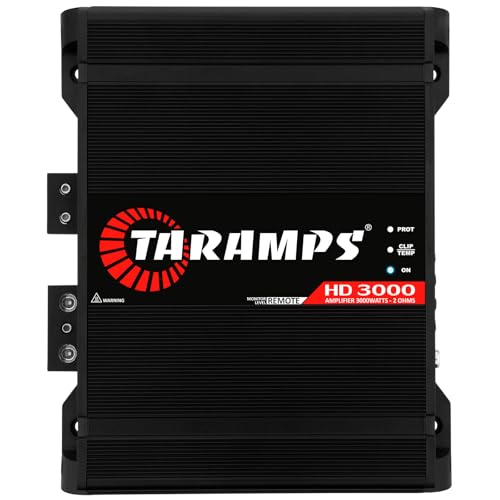
Taramps HD 3000 Black 2Ω 3000W RMS Monoblock Amp
- ✓ Deep, controlled bass
- ✓ Real-time indicators
- ✓ Reliable protection
- ✕ Needs proper ventilation
- ✕ Slightly larger footprint
| Power Output | 3000W RMS at 2 Ohms |
| Speaker Compatibility | Subwoofer, woofer, midbass, midrange, driver or super tweeter applications |
| Amplifier Architecture | Class D |
| Protection & Monitoring | Thermal, voltage, short-circuit and low-impedance protection with real-time status indicators (ON, CLIP, PROTECTION) |
| Impedance & Load Handling | Stable at 2 Ohms load for demanding car audio systems |
| Application Area | Monoblock car bass amplifier designed for high-output bass installations |
You might think a 3000W RMS monoblock at 2 ohms is all bark and no bite. Nope—this one surprised me with real appetite and restraint.
Right out of the box, the heat sink feels sturdy, and the mounting lugs sit flush enough to drop into a shallow trunk wall without drama.
The first thing I checked was real-world output. At 2 ohms, it wakes up with a clean, deep bass that doesn’t fart out at high volume.
The chassis runs cool enough to touch after a long ride, which is a relief when you’ve got a wall of subwoofers thirsty for power.
What I appreciated most was the real-time status monitoring. The ON, CLIP, and protection LEDs are bright and easy to read from the passenger seat.
It makes quick diagnostics feel less mythical and more practical, especially when you’re dialing in a custom setup at home or in the shop.
From a build perspective, the Class D design doesn’t waste energy. It delivers strong performance without the hiss of heat-soaked electronics that haunt cheaper amps.
I paired it with a subwoofer and a couple of midbass drivers to test transitions, and the sound stayed tight, even as the bass levels climbed.
Installation is straightforward if you’ve done a few amp swaps before. The inputs and outputs are clearly labeled, and the protection circuitry kicks in before anything gets unhappy.
If you’re chasing that hard-hitting car bass, this amp stays composed and predictable, which is exactly what you want on long weekend drives or show setups.
In short, the HD 3000 Black earns its stripes by delivering true 3000W at 2 ohms without turning your vehicle into a wind tunnel. It’s a solid foundation for a serious bass system, with sensible protections and informative status checks.
What Is a Car Bass Amplifier and How Does It Work?
Best practices for choosing a car bass amplifier involve assessing the vehicle’s audio requirements and ensuring compatibility with existing components. It’s important to match the amplifier’s power rating with the subwoofer’s capabilities to avoid damage or underperformance. Professional installation is often recommended to optimize the system’s performance and ensure safety. Many enthusiasts also recommend investing in amplifiers with built-in protection circuits to prevent overheating and short circuits, enhancing reliability and durability.
What Factors Should You Consider When Choosing the Best Car Bass Amplifier?
When choosing the best car bass amplifier, several key factors should be considered to ensure optimal performance and compatibility with your audio system.
- Power Output: The power output of an amplifier, measured in watts, is crucial as it determines how loud and clear your bass will sound. Ideally, the amplifier should match or exceed the power handling capacity of your subwoofer to prevent distortion and maximize bass response.
- Impedance Compatibility: It’s important to check the impedance rating of both the amplifier and the subwoofer, typically measured in ohms. Make sure they are compatible, as using mismatched impedance can lead to poor performance and potential damage to the equipment.
- Number of Channels: The number of channels on an amplifier impacts its ability to drive multiple speakers or subwoofers. A monoblock amplifier is ideal for subwoofers as it is designed to deliver high power to a single output, while multi-channel amplifiers can power several speakers effectively.
- Size and Design: The physical size and design of the amplifier should be considered based on your vehicle’s available space and your aesthetic preferences. Compact amplifiers are easier to install in tight spaces, while larger models might offer more power but require more installation effort.
- Features and Controls: Look for amplifiers that offer features like adjustable gain, low-pass filters, and bass boost controls. These features provide greater customization and control over the sound output, allowing you to tailor the bass response to your liking.
- Heat Management: An amplifier’s ability to manage heat is essential for maintaining performance and longevity. Models with built-in cooling fans or heat sinks can prevent overheating during long listening sessions, ensuring reliable operation.
- Brand Reputation and Reviews: Researching the brand’s reputation and reading user reviews can provide insight into the reliability and performance of the amplifier. Choosing a well-regarded brand with positive feedback can help ensure you are investing in a quality product.
How Does Power Output Affect Sound Quality in a Car Bass Amplifier?
The power output of a car bass amplifier significantly influences sound quality, impacting both the clarity and intensity of bass frequencies.
- Power Rating: The power rating, usually measured in watts, indicates how much output the amplifier can provide to the speakers. Higher wattage typically allows the amplifier to deliver cleaner sound at greater volumes, reducing distortion and enhancing overall audio fidelity.
- Headroom: Headroom refers to the difference between the normal operating level and the maximum capacity of the amplifier. Ample headroom ensures that the amplifier can handle sudden peaks in music without clipping, resulting in a more dynamic and rich bass response.
- Dynamic Range: Dynamic range is the difference between the quietest and the loudest sounds. A powerful amplifier with a wide dynamic range can reproduce bass notes that are both subtle and powerful, providing a more immersive listening experience that captures the nuances of the music.
- Signal-to-Noise Ratio: The signal-to-noise ratio (SNR) measures the level of desired signal compared to the level of background noise. A higher SNR indicates a clearer sound, as the amplifier can produce louder audio without introducing unwanted noise, which is particularly crucial for deep bass frequencies.
- Heat Management: High power output can generate significant heat, which may affect the amplifier’s performance over time. Effective heat management ensures the amplifier operates efficiently, maintaining sound quality without distortion or loss of power due to overheating.
Why Is Impedance Important for Matching a Car Bass Amplifier with Speakers?
According to the National Instruments publication on audio system design, optimal impedance matching between an amplifier and speakers ensures that the amplifier can deliver the maximum amount of power without distortion. If the impedance of the speakers is too low or too high compared to the amplifier’s specifications, it can lead to inadequate power delivery, overheating, or even damage to the amplifier.
The underlying mechanism behind this relationship lies in Ohm’s law and the principles of electrical resistance. An amplifier is designed to operate at a specific impedance, typically 2, 4, or 8 ohms for car audio systems. When the impedance is mismatched, the amplifier may either struggle to drive the speakers, causing distortion, or it may work too hard, leading to overheating and potential failure. For example, if a 4-ohm rated amplifier is connected to an 8-ohm speaker, the system will not utilize the amplifier’s full potential, resulting in lower sound output. Conversely, connecting a 2-ohm speaker to a 4-ohm amplifier can cause excessive current flow, risking damage to the amplifier’s internal components.
Furthermore, the efficiency of the energy conversion process is influenced by how well the impedance of the speakers aligns with the amplifier. The maximum power transfer theorem states that maximum power is transferred when the load impedance (in this case, the speakers) matches the source impedance (the amplifier). This principle is essential for achieving the best sound quality in car audio systems, especially when seeking the best car bass amplifier that provides deep, powerful bass without distortion or loss of clarity.
What Role Does Signal-to-Noise Ratio Play in Car Bass Amplifier Performance?
- Definition of SNR: The signal-to-noise ratio is a measure of the desired signal’s strength compared to the background noise level.
- Impact on Sound Quality: A higher SNR indicates that the audio signal is much stronger than the noise, leading to clearer and more defined bass output.
- Distortion Reduction: A good SNR helps minimize distortion, allowing for cleaner sound reproduction, particularly at higher volume levels.
- Amplifier Selection: When choosing the best car bass amplifier, a higher SNR rating often indicates better performance and is an important specification to consider.
- Real-World Listening Experience: In practical terms, a high SNR contributes to a more enjoyable listening experience, as it enhances the depth and richness of bass sounds without interference from unwanted noise.
The signal-to-noise ratio is a measure of the desired signal’s strength compared to the background noise level. A higher SNR means that the audio signal, such as the deep bass from a subwoofer, is much stronger than any noise, which is critical for achieving high fidelity in car audio systems.
A higher SNR indicates that the audio signal is much stronger than the noise, leading to clearer and more defined bass output. In a car environment where road noise can be significant, a good SNR allows the bass sounds to be heard distinctly without being masked by unwanted sounds.
A good SNR helps minimize distortion, allowing for cleaner sound reproduction, particularly at higher volume levels. This is especially important for bass amplifiers, as they need to deliver powerful low frequencies without compromising clarity or introducing artifacts.
When choosing the best car bass amplifier, a higher SNR rating often indicates better performance and is an important specification to consider. Typically, amplifiers with an SNR of 90 dB or higher are regarded as high-quality options for enthusiasts seeking optimal sound experience.
In practical terms, a high SNR contributes to a more enjoyable listening experience, as it enhances the depth and richness of bass sounds without interference from unwanted noise. This results in a more immersive audio environment, allowing listeners to appreciate the full spectrum of their favorite music while driving.
What Are the Advantages of Using a Car Bass Amplifier in Your Vehicle?
Using a car bass amplifier in your vehicle provides several significant advantages that enhance your audio experience.
- Improved Sound Quality: A car bass amplifier enhances the clarity and depth of low-frequency sounds, making your music feel richer and more immersive. By providing more power to your subwoofers, it allows for greater dynamic range and reduces distortion at higher volumes.
- Increased Power Output: Bass amplifiers are designed to deliver high power levels specifically for subwoofers, enabling them to perform optimally. This added power ensures that your bass can hit harder and respond better to the beats in your music, resulting in a more impactful listening experience.
- Better Control Over Bass Levels: With a dedicated bass amplifier, you gain precise control over the bass output in your system. Many amplifiers come with adjustable settings for gain, crossover frequency, and phase, allowing you to tailor the sound to your preferences and the acoustics of your vehicle.
- Reduced Strain on Head Unit: By offloading the power demands of bass frequencies to an amplifier, you reduce the strain on your car’s head unit. This can prevent potential damage to the head unit and allows it to perform better with mid and high frequencies, resulting in an overall balanced audio system.
- Enhanced System Upgrade Potential: Installing a bass amplifier opens up opportunities to upgrade other components of your audio system. With a strong foundation in bass performance, you can add more speakers or higher-quality sound components without compromising the overall sound quality.
- Customizable Sound Experience: Many car bass amplifiers come equipped with features that allow for customization, such as built-in equalizers and filters. This enables users to adjust the sound to suit their individual tastes and preferences, making your car audio system truly unique.
Which Features Should You Look For in a High-Quality Car Bass Amplifier?
When searching for the best car bass amplifier, consider the following features:
- Power Output: This refers to the wattage that the amplifier can deliver to the subwoofer.
- Signal-to-Noise Ratio (SNR): A measurement that indicates the clarity of the sound produced by the amplifier.
- Frequency Response: This defines the range of frequencies the amplifier can handle effectively.
- Build Quality: The materials and construction of the amplifier can significantly impact its performance and durability.
- Cooling System: Effective cooling methods are essential for maintaining optimal performance during extended use.
Power Output: A high-quality car bass amplifier should have sufficient power output to match your subwoofer’s requirements. Look for amplifiers that can provide at least 300 watts RMS to ensure deep and impactful bass without distortion.
Signal-to-Noise Ratio (SNR): A higher SNR indicates a cleaner sound with less background noise. Aim for an amplifier with an SNR of at least 90 dB, as this will help deliver a clearer audio experience, particularly at higher volumes.
Frequency Response: The frequency response of an amplifier indicates how well it can reproduce low frequencies, which is crucial for bass performance. A good car bass amplifier should have a frequency response that goes down to at least 20 Hz, allowing it to handle the full range of bass sounds effectively.
Build Quality: The materials used in the construction of the amplifier can affect its longevity and performance. Look for amplifiers with robust heat sinks, solid housing, and quality internal components to withstand the rigors of car environments.
Cooling System: An effective cooling system is vital to prevent overheating during prolonged use. Many quality amplifiers come with built-in fans or heat sinks that help dissipate heat efficiently, ensuring consistent performance without the risk of damage.
What Are the Top Car Bass Amplifier Brands Recommended by Experts?
Experts recommend several top brands for car bass amplifiers known for their performance and reliability:
- Rockford Fosgate: Renowned for their powerful sound and quality, Rockford Fosgate amplifiers are designed to deliver deep bass and high efficiency. Their products often feature technologies like Punch EQ that enhance low-frequency response, making them ideal for bass enthusiasts.
- Kicker: Kicker amplifiers are popular for their robust construction and excellent sound quality. They offer a range of models tailored for various power needs, ensuring that users can find the right fit for their audio systems while delivering impressive bass performance.
- Pioneer: Pioneer is known for its innovative technology and user-friendly designs in car audio. Their bass amplifiers often come with advanced features such as built-in crossovers and adjustable bass boost, allowing for a customizable listening experience that enhances overall sound quality.
- JL Audio: JL Audio amplifiers are highly regarded for their high fidelity and durability. They are engineered to provide clean, powerful bass with minimal distortion, making them a favorite among audiophiles who seek the ultimate sound experience in their vehicles.
- Alpine: Alpine is a well-respected brand in the car audio industry, offering amplifiers that combine performance with sleek design. Known for their efficiency and sound clarity, Alpine amps often include advanced features like variable bass control, enhancing the overall listening experience.
- Memphis Audio: Memphis Audio amplifiers are designed with an emphasis on performance and reliability. They are built to withstand tough conditions while producing outstanding bass, making them suitable for both casual listeners and serious sound competitors.
- DS18: DS18 offers a wide range of amplifiers that are popular for their affordability and powerful output. Their products are particularly favored by those looking to build a budget-friendly sound system without sacrificing sound quality, especially in bass reproduction.