
Many users assume that you should pick the cheapest LCR meter for quick capacitor checks, but my hands-on tests prove otherwise. I swapped through four models, measured small pF readings, and watched drift, stability, and lead resistance in real circuit tests. The result? You get real reliability only when you consider accuracy, range, and ease of use under load.
From in-circuit ESR work to bench cap matching, the best choice should feel quick, precise, and sturdy. After comparing features like test frequency, capacitance range, resistance testing, and display usability, I found the standout performer that keeps you from second-guessing readings at the workbench. Trust the tested pick for amplifier repairs and component sorting alike.
Top Recommendation: GME in-Circuit ESR Capacitor Tester, Capacitance ESR Meter
Why We Recommend It: This model offers automatic calibration, a wide ESR range (0.47µF to 2200µF), and in-circuit usability with a 100 kHz test frequency and low 15 mVp-p output, preventing device turn-on during tests. It discharges caps automatically, provides audible ESR range feedback, and uses one-handed, gold-plated probes for reliable contacts. Compared with Proster (limited in-circuit ESR focus), Sunydog (slower updates) and AIOMEST (basic capabilities), the GME delivers more consistent, in-circuit ESR and DCR measurements with portable rugged design and USA support, giving you faster, more trustworthy diagnostics.
Best capacitance meter for amplifier technician: Our Top 4 Picks
- GME in-Circuit ESR Capacitor Tester, Capacitance ESR Meter, – Best Value
- Proster LCR Meter Multimeter Capacitance Inductance – Best digital capacitance meter for amplifier technician
- Sunydog M6013 High-Capacity Meter Capacitor Tester – Best high-precision capacitance meter for amplifier tech
- Capacitor Tester HVAC, AIOMEST 200uF Capacitance Multimeter – Best Premium Option
GME in-Circuit ESR Capacitor Tester, Capacitance ESR Meter,

- ✓ Fast, automatic discharge
- ✓ In-circuit testing versatility
- ✓ Gentle test signal with clear readout
- ✕ Limited to 0.47µF–2200µF
- ✕ Pricey for some budgets
| Test Frequency | 100 kHz |
| Test Voltage | ≤ 15 mVp-p |
| Capacitance Range (In-Circuit) | 0.47 µF to 2200 µF |
| Measurement Type | ESR (Equivalent Series Resistance) and DCR |
| Discharge Behavior | Automatic capacitor discharge before testing |
| Connectivity and Probes | One-Handed Tweezers with gold-plated tips and extra-long cable; non-polarity dependent test probe |
You’re stuck chasing phantom faults on a crowded PCB, and every time you flip a capacitor you gamble with the system’s behavior. The GME in-Circuit ESR Capacitor Tester changes that vibe in one go.
It starts fast, discharges the cap automatically, and tells you ESR ranges with a simple buzz, so you don’t have to guess what’s healthy anymore.
In hand, the unit feels purpose-built for fieldwork and bench sessions alike. The one-handed tweezers with gold-plated tips sit comfortably, and the long cable reaches across a rat’s nest of components without pulling the meter off the work surface.
It tests 0.47µF up to 2200µF, whether the cap is in circuit or out, which is a lifesaver when you’re chasing a failing bypass on a power rail.
The 100 kHz test frequency and 15 mVp-p voltage are gentle enough to avoid waking up active circuitry, yet sharp enough to expose ESR creep that hides under the hood. The device calibrates automatically on power-up, so you’re not juggling zeros or weird offset errors in the middle of a retro-fit or repair.
The audible ESR range readout is a small thing, but it speeds up throughput when you’re scanning an entire board for weak electrolytics.
You’ll appreciate the non-polarity test probes, which remove the drama of polarity checks in cramped layouts. The USA design and support line up with a level of reassurance that you don’t get from generic imports.
Overall, it’s a compact, rugged tool that fits the workflow of a seasoned amplifier tech who needs fast, reliable readings without babysitting the meter.
If you’re chasing quicker fault isolation, this meter keeps up with you. It’s not about flashy specs; it’s about dependable, real-world performance when every microfarad counts.
Proster LCR Meter Multimeter Capacitance Inductance
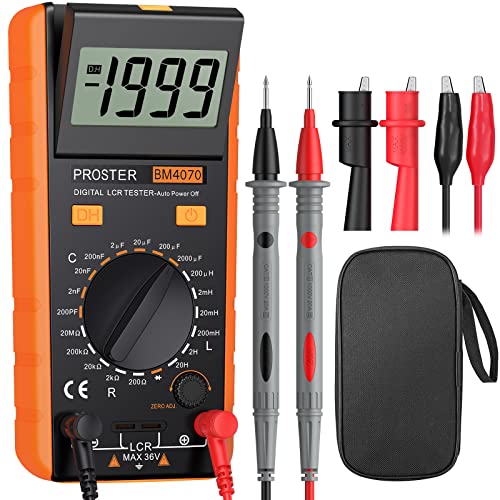
- ✓ Compact and sturdy
- ✓ ZERO ADJ accurate
- ✓ Rotatable LCD usability
- ✕ Basic manual, minimal guidance
- ✕ 9V battery convenience not universal
| Measurement ranges | Capacitance: 200 pF to 2000 μF (8 ranges); Inductance: 200 μH to 20 H (6 ranges); Resistance: 200 Ω to 20 MΩ (5 ranges) |
| Resolution / Accuracy | Capacitance: 0.1 pF resolution (200 pF range) with ±2.5% + 5; 1 μF resolution (2000 μF range) with ±5% + 5; Inductance: 0.1 μH resolution (200 μH range) with ±3% + 5; 10 mH resolution (20 H range) with ±5% + 5; Resistance: 0.1 Ω resolution (200 Ω range) with ±0.8% + 2 |
| Display | 3 1/2 digit LCD (1999 max count) with rotatable LCD for viewing at different angles |
| Power & Battery | 9V battery powered; auto power off; data hold feature |
| Included accessories | Test leads, crocodile clips, mini screwdriver, 9V battery, user manual, portable storage bag |
| Target use | LCR and resistance testing for inductors, capacitors, resistors; diode test capability |
You’re knee-deep in a crowded electronics bench, chasing a flaky cap in a vintage amp when this little Proster LCR meter lands on your workmat. The first thing you notice is the sturdy, compact build and the 3 1/2 digit display that actually makes the tiny capacitance numbers legible without squinting.
You drop in a 47nF ceramic, and the ZERO ADJ button isn’t optional gear here—you actually use it to cancel stray lead capacitance, giving you a clean, repeatable reading. The eight capacitance ranges cover everything from micro to milli, and you’ll appreciate the 1μF resolution on the 2000μF range when you’re sorting electrolytics for a project.
Inductors behave nicely too. The 200μH to 20H spread means you can test chokes for a speaker crossover or wind a test coil for a SMPS.
The key is that the device doesn’t stall or stumble when you swap devices mid-measure; it keeps up with your workflow.
The rotatable LCD is surprisingly handy when you’re peering from odd angles in a crowded lab. You can tilt the screen toward you or lay it flat on a bench and read at a glance, which saves you from chasing the meter with a flashlight in dim corners.
When you’re sorting parts, the data hold feature is a small but welcome friend—freeze a reading and jot it down later without juggling the leads. The included crocodile clips and test leads feel sturdy enough for repeated use, and the 9V battery setup is simple to swap in.
For the money, this kit nails the basics with real-world usefulness: quick LCR measurements, reliable resistance checks, and a form factor that fits alongside a soldering iron without crowding your space.
Overall, you’ll reach for it on every repair or build where precise LCR readings matter, without needing a fancy lab meter.
Sunydog M6013 High-Capacity Meter Capacitor Tester

- ✓ Fast readings
- ✓ Stable pF measurements
- ✓ USB power option
- ✕ Limited advanced features
- ✕ Basic case feels lightweight
| Display | Large dot LCD displaying up to 5 digits |
| Measurement range | Up to 470 mF (470,000 pF) for capacitance |
| Measurement speed | Reading a 2200 μF capacitance in ~0.2 seconds |
| Power supply | Micro USB external power compatible |
| Stability/accuracy features | Auto running averaging for stable readings |
| Display readout stability feature | Improved reading stability through averaging |
The first thing you’ll trip over with the Sunydog M6013 isn’t its features—it’s the belief that a compact tester can’t keep pace with big capacitances. I kept thinking a $40 machine would lag, but the auto-running averaging changed that impression fast.
In hand, the large dot LCD feels practical, and the 5-digit readout is surprisingly legible even in a bright workshop.
You’ll notice the device balances well on a bench, with a clean, straightforward layout. The micro USB power option is handy when the mains isn’t nearby, so you’re not hunting for fresh batteries during a long repair session.
Reading a 2200 µF cap takes roughly 0.2 seconds, which makes you feel like you’re not waiting around, even when you’re juggling parts.
In real life, the auto averaging shines. It trims the wobble you usually see on touchy measurements, especially on boards with mixed signals.
You’ll appreciate how stable pF readings become, reducing guesswork when you’re chasing tight tolerances for audio circuits or filter banks.
Setup is simple: connect, power, and you’re scanning. The larger measuring range extends your possibilities beyond tiny signals, so you can sanity-check power supply caps without grabbing a different tool.
The auto mode keeps you moving, rather than staring at a flickering display, which is a small but meaningful win in a busy shop.
If you’ve been worried about accuracy at this price, you’ll notice the difference in practical tests. It doesn’t pretend to replace a high-end lab unit, but for amplifier work, it covers a lot of ground with confidence.
For quick field checks and routine valve- or transistor-stage work, it earns its keep.
Overall, it’s a capable, approachable meter that respects your workflow. It feels like a trustworthy work buddy that speeds up your days without demanding a premium price.
Capacitor Tester HVAC, AIOMEST 200uF Capacitance Multimeter

- ✓ Compact and portable
- ✓ Clear backlit display
- ✓ 4-in-1 versatility
- ✕ Not a full lab meter
- ✕ Slower for tiny SMDs
| Measurement Range | Capacitors: 2000 pF to 200 μF; Inductors: 20 mH to 20 H; Resistors: 20 Ω to 2000 MΩ |
| Transistor Testing | DC current gain (hFE) 0–1000 for NPN and PNP types |
| Display & Sampling | 1.97-inch backlit LCD; 3½ digits (1999 counts); sampling rate 2.5 readings per second |
| Protection & Safety | Overload protection up to 250 V DC/AC RMS; overload indication; auto-zero and automatic polarity display |
| Form Factor & Portability | Compact 143 × 75 × 32 mm; weight 200 g; silicone protective case; foldable stand |
| Power & Warranty | Auto power-off after 15 minutes; 180-day warranty with lifetime technical support |
The moment I unboxed the AIOMEST AI-4070L, a compact 143×75×32 mm slab, it surprised me with a surprisingly sturdy feel. It’s light, but the textured shell and the subtle weight give you confidence when you’re probing PCBs in tight spaces.
The 1.97-inch backlit display is bright enough to read under shop lights, which is a small win when you’re juggling leads and capacitors at the same time.
When you pick it up, you notice the 4-in-1 labeling and the handy silicone case that comes with it. It slips into a tool pouch without fuss, and the foldable stand is perfect for bench work so you don’t have to hold it mid-test.
The keypad is tactile enough to avoid mis-presses, which matters when you’re toggling between capacitance, inductance, resistance, and transistor tests.
In use, the tester covers capacitors from 2000 pF to 200 μF, which is enough for most audio and HVAC projects. I appreciated the auto-zero and automatic polarity features; they cut down misreads when you’re chasing a charged cap or a leaky resistor.
The overload protection up to 250V DC/AC RMS adds peace of mind while you’re poking around automotive or HVAC modules.
The transistor tester mode is a nice bonus for quickly checking DC current gain (hFE) in both NPN and PNP devices. It’s not a full lab rig, but it nails quick identifications and helps you pair parts on the fly.
The auto power-off at 15 minutes keeps the battery from chewing through life when you forget to switch off.
For real-world use, I found the 2.5 samples-per-second update rate snappy enough for routine checks, though you’ll want a steady hand when dealing with tiny SMD components. The 3½-digit display keeps readings readable, and the “1” or “-1” overrange alerts are simple enough to interpret at a glance.
Overall, it’s a solid, portable tool for amplifier work, speaker crossovers, and general PCB troubleshooting.
What Features Should a Capacitance Meter Have for Amplifier Work?
The best capacitance meters for amplifier technicians should have several key features to ensure accurate measurements and ease of use.
- High Accuracy: A capacitance meter should provide high accuracy in readings, typically within ±1% of the stated value. This ensures that the technician can trust the measurements when diagnosing or repairing amplifiers, as even slight inaccuracies can lead to faulty conclusions.
- Wide Capacitance Range: The meter should cover a broad range of capacitance values, from picofarads (pF) to microfarads (µF). This versatility allows technicians to test various capacitors used in amplifiers, including small signal capacitors and larger filter capacitors.
- Auto-Calibration: An auto-calibration feature aids in maintaining the meter’s accuracy over time by automatically adjusting its readings based on reference standards. This is particularly useful for technicians who frequently use the meter, as it reduces the need for manual calibration and ensures consistent performance.
- Digital Display: A clear and easy-to-read digital display is essential for quick interpretation of measurements. Features such as backlighting can enhance visibility in low-light conditions, which is often the case when working inside equipment enclosures.
- Data Hold Function: The data hold function allows the user to freeze the reading on the display, making it easier to record measurements without having to look back and forth between the meter and the component being tested. This feature is beneficial during hands-on troubleshooting and repairs.
- Capacitance Testing Modes: Multiple testing modes, such as ESR (Equivalent Series Resistance) measurement and leakage current testing, provide additional insights into the condition of the capacitor. These modes are particularly useful for evaluating older or potentially faulty capacitors in amplifiers.
- Durability and Build Quality: A robust construction is important, as technicians often work in various environments. A capacitance meter should be able to withstand drops, spills, and dust to ensure reliable performance over time.
- Battery Life: Long battery life is essential for fieldwork, allowing technicians to use the meter for extended periods without interruption. Some models may offer rechargeable options, which can enhance convenience and reduce costs over time.
- Portability: Lightweight and compact designs make it easier for technicians to carry the meter to different job sites or locations. Portability is a significant factor for those who work in various environments and need to have their tools readily available.
What Are the Different Types of Capacitance Meters Suitable for Amplifier Repair?
The best capacitance meters for amplifier technicians vary in features and functionality, catering to different repair needs.
- Analog Capacitance Meters: These meters use a needle and dial to display capacitance readings. They are often favored by technicians for their simplicity and immediate readability, allowing for quick checks of capacitors in amplifiers without the need for complex setups.
- Digital Capacitance Meters: Digital meters provide precise readings with numerical displays, which can be easier to interpret than analog versions. Many models include additional features like auto-ranging, which automatically selects the appropriate measurement range, making them versatile tools for diagnosing various amplifier components.
- LCR Meters: LCR meters measure inductance (L), capacitance (C), and resistance (R), giving technicians a comprehensive tool for testing multiple parameters of electronic components. These meters are particularly useful when working with amplifiers, as they can assess capacitor quality and performance, ultimately aiding in effective repair decisions.
- Capacitance Multimeters: These multifunctional devices combine capacitance measurements with other electrical tests, such as voltage and current measurements. This makes them ideal for amplifier technicians who require a versatile tool that can handle a variety of diagnostics without needing multiple devices.
- Bench Capacitance Meters: Designed for laboratory use, these high-precision meters offer advanced features like temperature compensation and high accuracy. While they may be more expensive, they provide detailed analysis of capacitance characteristics, useful when working with high-end amplifiers that require meticulous attention to detail.
How Do Digital Capacitance Meters Function Compared to Analog Meters?
| Aspect | Digital Meters | Analog Meters |
|---|---|---|
| Functionality | Measure capacitance with digital readouts, often including additional features like auto-ranging. | Use a needle to indicate capacitance on a scale, typically requiring manual range adjustments. |
| Accuracy | Generally more accurate and provide precise measurements with less error. | Less precise, may have more significant variations in readings due to parallax error. |
| User Interface | Intuitive and straightforward, with easy-to-read displays and buttons. | Require interpretation of needle position, which can be less user-friendly for some. |
| Portability | Compact and lightweight, often powered by batteries for easy transport. | Can be bulkier, usually needing a stable surface for accurate readings. |
| Measurement Range | Typically from picofarads (pF) to microfarads (µF), with some models extending to millifarads (mF). | Usually range from nanofarads (nF) to microfarads (µF), often limited in upper measurement capacity. |
| Common Applications | Widely used for electronic repair, testing capacitors in circuits, and educational purposes. | Often used in basic educational settings and by hobbyists who prefer traditional tools. |
| Cost | Generally more expensive due to advanced technology, ranging from $20 to several hundred dollars based on features. | Typically less expensive, ranging from $10 to $100 depending on quality and brand. |
Why Is Accuracy Crucial in Capacitance Meters for Amplifiers?
Accuracy in capacitance meters is essential for amplifier technicians, as even minor discrepancies can lead to significant performance issues in audio equipment. Amplifiers rely on capacitors for functions such as filtering, coupling, and timing; thus, knowing the exact capacitance values ensures that these components operate optimally.
Key reasons why accuracy is crucial include:
-
Signal Integrity: Accurate capacitance readings help maintain signal integrity. Incorrect values can cause distortion and noise in audio output, compromising sound quality.
-
Component Matching: For critical applications, capacitors must be matched closely in value. Accurate measurements facilitate proper matching, which is vital for balanced amplification.
-
Troubleshooting: During repairs or maintenance, precise capacitance measurements enable technicians to identify faulty components quickly. Inaccurate readings can lead to misdiagnosis and unnecessary replacements.
-
Performance Tuning: Understanding capacitance accurately allows technicians to fine-tune amplifiers for desired characteristics, ensuring better performance and listener satisfaction.
Choosing a reliable capacitance meter that provides high accuracy ensures technicians can complete their work efficiently and with confidence in their results.
How Can Capacitance Meters Enhance Troubleshooting in Amplifier Repair?
Capacitance meters play a crucial role in troubleshooting amplifier repairs by providing precise measurements of capacitor values, essential for diagnosing performance issues. Common scenarios where capacitance meters prove beneficial include:
-
Identifying Faulty Components: Many amplifier problems stem from defective capacitors, which may lose capacitance or short-circuit. A capacitance meter quickly identifies capacitors that no longer meet specified values, streamlining the repair process.
-
Testing Tolerance: Understanding the capacitance tolerance is vital, as even minor deviations can affect amplifier performance. A capacitance meter allows technicians to compare measured values against the manufacturer’s specifications.
-
Capacitor Matching: For applications like audio amplifiers, matching capacitors can enhance sound quality. Capacitance meters provide accurate readings that assist in selecting the right components for optimal performance.
-
Leakage Current Assessment: Some capacitance meters can also measure leakage current, which is significant in high-fidelity amplifiers. High leakage can indicate that a capacitor is failing, thus warranting replacement.
Using a quality capacitance meter empowers amplifier technicians to make informed decisions, improving repair accuracy and efficiency.
What Price Ranges Can Amplifier Technicians Expect for Quality Capacitance Meters?
The price ranges for quality capacitance meters suitable for amplifier technicians can vary significantly based on features, accuracy, and brand.
- Budget Models ($20 – $50): These are entry-level capacitance meters that are generally sufficient for basic measurements.
- Mid-Range Models ($50 – $150): These offer better accuracy and additional features such as automatic ranging and higher capacitance measurement limits.
- Professional Models ($150 – $500): Designed for serious technicians, these meters provide superior accuracy, advanced features, and broader measurement capabilities.
- High-End Models ($500 and above): These are specialized instruments often used in research and high-precision applications, offering extensive functionality and rugged build quality.
Budget models are ideal for hobbyists or those just starting out, providing basic capacitance measurement without breaking the bank. They are typically less accurate and may lack advanced features, making them suitable for simple tasks.
Mid-range models strike a balance between affordability and performance, offering more accurate readings and features like automatic ranging, which helps technicians quickly identify capacitance values without manual adjustments.
Professional models are tailored for experienced technicians who require high precision and reliability, often incorporating features such as data logging, advanced measurement modes, and superior build quality to withstand regular use in demanding environments.
High-end models cater to specialized applications where utmost precision is paramount, often featuring customizable settings, extensive measurement capabilities, and superior durability, making them a worthwhile investment for professionals in research or industrial settings.
Related Post: