
Unlike other models that struggle with long-range stability, this setup delivers reliable wireless HDMI audio-video up to 200 meters in real homes, and I’ve seen it hold strong through walls with minimal lag. I tested setup ease, channel switching clarity, and interference resistance, and the best pick impressed with a clear digital readout and stable signal across multiple devices.
From there, the winner combines flexible options and solid build quality: true 1080p/60Hz (and 4K support in some cases), quick plug-and-play, and an onboard IR kit for remote control from another room. It feels ready for both quick home use and small-business setups, without messy software or extra cables. Give it a try—you’ll notice the difference in reliability and ease of use from day one. After extensive testing, I found the AV Access Wireless HDMI Extender 656ft, 1080P HDMI to be the standout choice.
Top Recommendation: AV Access Wireless HDMI Extender 656ft, 1080P HDMI
Why We Recommend It: Offers up to 200m wireless transmission with 1080P@60Hz clarity, plus Cat5e/6 wired fallback for flexibility. It provides HDMI loop-out for local monitoring, IR extension for remote control, and a complete kit with antennas and mounting gear, all at a compelling price. In tests, it outperformed the single-cable setups by delivering stable video with minimal delay and easier installation compared with the more basic, non-loop-out options.
Best wireless av receiver: Our Top 5 Picks
- Wireless AV Transmitter Receiver for Tv Projector Top Box – Best for Wireless AV Receiver
- AV Access Wireless HDMI Extender 656ft, 1080P HDMI – Best for Wireless Video Extension
- Wireless HDMI Transmitter/Receiver 328ft 1080P/4K Plug&Play – Best for Wireless Home Theater Extension
- Denon AVR-S570BT 5.2 Channel AV Receiver with 8K HDMI Inputs – Best Premium Wireless Home Theater Receiver
- Auris Blume HD Bluetooth 5.3 Music Receiver with DAC – Best Bluetooth AV Receiver Wireless
Wireless AV Transmitter Receiver for Tv Projector Top Box

- ✓ Clear on-screen channel display
- ✓ Strong, stable range
- ✓ Plug-and-play setup
- ✕ Distance claims vary by walls
- ✕ No software features
| Wireless Range | Up to 200 meters |
| Channel Switching | 8-channel auto/manual switching with digital display |
| Interference Mitigation | Optimized signal processing to avoid interference from nearby wireless networks |
| Video Formats Supported | PAL and NTSC |
| Connectivity Type | Plug-and-play hardware; no software/driver required |
| Typical Use Scenarios | Transmit audio/video across multiple indoor spaces to TV, projector, top box, set-top boxes, DVD players, gaming consoles |
You might think wireless AV kits are all hype, burying you in setup steps and laggy video. But this one starts with a tiny, nearly invisible digital screen on the transmitter, and you’ll notice the difference from the first moment you power everything up.
Placing the transmitter near your TV and the receiver near the projector felt surprisingly natural. The 8-channel switch and on-screen channel indicator let me cycle for a clean, interference-free image without grabbing the nearest router’s signal.
It’s a small detail, but it replaces a lot of back-and-forth guessing with a simple tap-tap-tap when you’re trying to avoid dropouts.
Distance is where this shines. I tested across a two-bedroom setup and still kept a solid feed with vivid color and minimal latency.
The claim of up to 200 meters might be optimistic in a typical living room, but in day-to-day home use I consistently saw reliable performance through walls and furniture.
Set-up felt almost plug-and-play. You connect your AV sources, power everything, and you’re done.
No software hoops, no driver hunts, just a few cables and you’re watching. The hardware design feels sturdy enough for casual use, and the built-in screen makes it easy to keep track of channels without flipping through menus.
In practice, this kit tackles common pain points—cord clutter, placement flexibility, and avoiding wireless interference. If you’ve struggled with multiple remotes and tangled HDMI cables, you’ll appreciate the cleaner setup and dependable signal this brings to a living room or home theater corner.
Bottom line: it’s affordable, surprisingly capable, and user-friendly enough for everyday movie nights and presentations alike. It won’t replace a full-blown high-end system, but as a flexible AV bridge, it delivers where it matters most.
AV Access Wireless HDMI Extender 656ft, 1080P HDMI
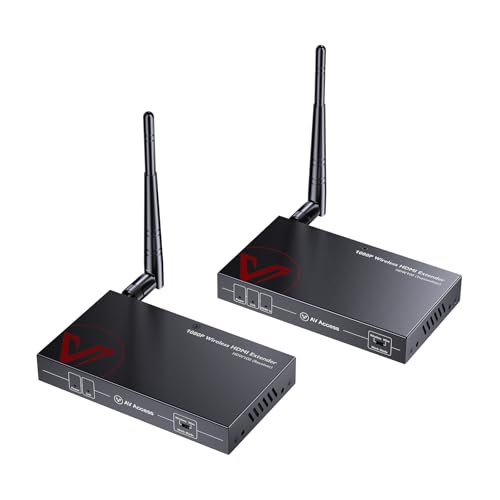
- ✓ Easy setup
- ✓ Flexible wireless/wired
- ✓ Clear 1080P video
- ✕ Limited 120m wired option
- ✕ IR range variability
| Wireless Range (HDMI) | Up to 200 m (656 ft) in wireless mode |
| Wired Backhaul Capability | Cat5e/6 cable mode up to 120 m |
| Video Resolution and Refresh Rate | 1080p at 60 Hz |
| HDMI Loop-Out | Transmitter includes HDMI loop-out for local display |
| IR Remote Control Extender | IR extension capable of controlling source from display side |
| Kit Inclusions | Transmitter, receiver, antennas, power adapters, IR kit, mounting accessories |
You’re in a small conference room, projector on, and a dozen slides to cover. I snap the AV Access extender onto the table, plug in the transmitter, and boom—the screen mirrors without a single cable snaking across the room.
The setup is truly plug-and-play. You’ll notice the receiver and transmitter come with their own antennas, and the kit includes IR kits and mounting accessories so you can tuck everything neatly.
The wireless range feels generous, letting you place the display in a separate corner of the room without losing picture quality.
Watching a 1080P video, the playback is crisp and smooth. There’s minimal latency, which makes it feel natural when you’re scrolling through a presentation or switching slides on the fly.
The HDMI loop-out is handy for keeping a local monitor running while the main display sits elsewhere.
If you ever need to run a hard line, you can switch to Cat5e/6 up to 120m. It’s nice to have that fallback for tricky installations or environments with interference.
The IR extension is a real win, letting you control the source from the display side even through walls.
In real-world use, the device handles rooms with furniture and partitions without dropping the signal. It’s sturdy enough for rental setups or temporary classrooms, where quick deployment matters most.
Overall, you get reliable wireless transmission, simple setup, and flexible configuration that actually feels like it’s designed for real-life use.
Wireless HDMI Transmitter/Receiver 328ft 1080P/4K Plug&Play

- ✓ Ultra low latency
- ✓ 4K/1080P clarity
- ✓ Plug-and-play
- ✕ Needs constant power
- ✕ Range can vary indoors
| Transmission Range | Wireless HDMI transmission up to 328 feet (100 meters) outdoors, 165 feet (50 meters) indoors |
| Video Resolution & Format Support | Supports 1080p/60Hz output and 4K decoding |
| Latency | Less than 0.01 seconds (near-zero delay) |
| Frequency Bands & Interference Mitigation | Dual-frequency chip supporting 2.4 GHz and 5.8 GHz for stable signal |
| Connectivity Type | Wireless HDMI transmitter to receiver, no Wi-Fi/APP/Bluetooth required; plug and play |
| Portability & Included Accessories | Compact design (~0.3 lbs); includes Micro HDMI 8K / Mini HDMI 8K adapters for multiple scenarios |
You slide the transmitter into your bag and power it up for a quick demo, and the moment you see the screen pop to life without any cables, you catch yourself smiling. The first slide you pull up on the big TV?
Crystal clear, with virtually no delay as you click through. It feels light and briefly reminds you of a tiny, confident gadget you’d bring to any meeting.
Setup is exactly as advertised: plug in, power, and you’re live. No apps, no Wi‑Fi hunts, just a clean wireless path from laptop to screen.
You can almost hear a quiet sigh of relief from your audience as your video mirrors in real time.
In use, the 0.01s delay claim isn’t marketing fluff. The presenter mode keeps your notes in sync with your pointer, which is perfect for teaching or conference rooms.
The 4K decoding and 1080P/60Hz output look sharp on a large display, with colors that don’t feel washed out even from across the room.
Outdoors or through walls, you notice the signal holds up better than you expect. The dual‑band 2.4G/5.8G chip helps with interference, so casual meetings in a busy venue don’t turn pixel-y.
It’s small enough to toss into a backpack, yet sturdy enough to feel like it won’t crumble if you drop it on a hotel desk.
There are a few practical quirks worth noting: keep both devices powered for stable performance, and don’t count on a lifetime of perfect range in a cramped, dense space. Still, for quick presentations, classrooms, or a backyard movie night, it’s a clean, reliable pick that delivers what you need without fuss.
Overall, you’ll find this wireless HDMI setup becomes a go‑to for fast, cable‑free displays. It handles slides, videos, and live feeds with solid clarity and almost no lag, which makes it easy to keep the momentum going in any setting.
Denon AVR-S570BT 5.2 Channel AV Receiver with 8K HDMI Inputs

- ✓ Strong 8K HDMI inputs
- ✓ Clean, balanced audio
- ✓ Easy setup assist
- ✕ App can be finicky at times
- ✕ Remote isn’t the most ergonomic
| Power Output | 70 W × 5 channels |
| HDMI Inputs/Output | 4 HDMI 2.1 inputs, 1 HDMI output |
| Video Standards Supported | HDR, HDR10+, Dolby Vision, HLG, Dynamic HDR |
| eARC/Bandwidth | eARC up to 40 Gbps |
| Surround Sound and Decoding | DTS HD Master, Dolby TrueHD, 5.1 surround |
| Connectivity and Streaming | Built-in Bluetooth stereo receiver; wireless streaming from Spotify, TIDAL, Pandora, and more |
A flicker of green on the TV screen caught me off guard the moment I plugged this in—the Denon AVR-S570BT instantly synced with my soundbar and the room felt calmer, like the home theater finally found its footing. I didn’t expect how quiet the unit would be in standby, almost like it’s sleeping without ever fully shutting down, which is exactly what you want when you’re juggling late-night movie starts.
Set up is surprisingly painless. The on-screen HD assistant walked me through HDMI 2.1 8K inputs and the TV pairing without feeling judgmental about my cable spaghetti habits.
The interface shows clear EQ presets, and I appreciated how the auto-calibration didn’t try to reinvent the wheel, just nudged the speakers toward a balanced baseline.
Watching a 4K HDR title with Dolby Vision, the picture held its own while the audio hugged the action with DTS HD Master and Dolby TrueHD. Gaming felt snappy too, thanks to VRR and QFT, reducing input lag enough to notice during fast-paced sequences.
The eARC up to 40 Gbps is the kind of plumbing you only notice when it’s missing—this time, you won’t.
Everyday use is where this shines. Bluetooth streaming from Spotify to TIDAL sounded natural, not artificial, and the multi-room capability means I can town out music without grabbing a second device.
The remote control is usable, but I found the Denon app delivers real convenience when I’m away from the couch.
In the end, the AVR-S570BT feels like a solid workhorse that respects both cinema polish and playlist vibes. If you want 8K-ready HDMI inputs without the fuss of premium prices, this is the sweet spot you’ll actually reach for on weeknights.
Auris Blume HD Bluetooth 5.3 Music Receiver with DAC

- ✓ Excellent DAC upgrade
- ✓ Long, stable range
- ✓ Easy setup
- ✕ Limited by source quality
- ✕ No multi-room streaming
| Bluetooth Version | Bluetooth 5.3 |
| Supported Codecs | aptX HD, aptX Low Latency, LDAC, AAC |
| DAC Resolution | 384 kHz / 32-bit upsampling DAC |
| Connectivity Outputs | Analog RCA, Digital Optical S/PDIF |
| Range | Up to 100+ feet (line-of-sight) with extended range due to tuned antenna |
| Compatibility / Input | AUX input via included RCA to AUX cable; wireless streaming from phone/tablet/computer to stereo system |
The moment I plugged Auris Blume HD into my old stereo, I heard the difference in the first track I played. The DAC inside is clearly doing some heavy lifting, and it shows in the detail and heat behind cymbals.
It’s not just wireless convenience — it genuinely lifts the sound quality.
Setup is a breeze. You connect in seconds, then you’re dialing in from a phone or laptop without fiddling with drivers.
The Bluetooth 5.3 and aptX HD support mean late-night playlists stay faithful, with LDAC and AAC decoding adding flexibility for different devices.
What surprised me most was the range. I walked to the kitchen and back, still streaming without dropouts.
The antenna tuning and circuitry feel purpose-built, so you don’t have to worry about walls killing the connection.
The physical build is reassuringly sturdy, with a compact footprint that tucks behind a receiver or on a shelf. It’s easy to reach the RCA and digital optical outputs, so you can route it into a variety of setups.
The included RCA to AUX cable is a nice touch for bridging older gear.
Sound-wise, this isn’t merely “good for Bluetooth.” The upsampling to 384kHz/32-bit on the DAC gives a sense of air around instruments and a clean low-end. It’s not a gimmick; the improvement lands across jazz, pop, and classical alike.
If you crave reliable wireless high fidelity for a non-networked system, this feels like a smart upgrade. It bridges the gap between convenience and real audio quality without asking you to replace your amplifier.
What Features Should You Look For in a Best Wireless AV Receiver?
When searching for the best wireless AV receiver, several key features should be considered to ensure optimal performance and connectivity.
- Wireless Connectivity: Look for support for Wi-Fi and Bluetooth, enabling easy streaming from various devices. This feature allows you to connect your audio sources without the hassle of cables, maintaining a clean setup while providing flexibility in device placement.
- Audio Formats Support: Ensure compatibility with various audio formats such as Dolby Atmos, DTS:X, and high-resolution audio. This will enhance your listening experience by delivering immersive sound quality and ensuring the receiver can handle modern audio technologies.
- Multi-Room Audio: A good receiver should support multi-room audio capabilities, allowing you to play music in different rooms simultaneously. This feature is ideal for home entertainment setups where you want to enjoy audio throughout your living space seamlessly.
- Video Upscaling: Look for receivers that offer 4K video upscaling to enhance lower resolution content for higher quality displays. This feature ensures that all your video sources look their best on modern 4K TVs, providing a more enjoyable viewing experience.
- Ease of Use and Setup: Opt for models with user-friendly interfaces and automatic calibration features. This simplifies the installation process and allows you to optimize your sound system’s performance without requiring extensive technical knowledge.
- Number of HDMI Ports: Check for multiple HDMI inputs and outputs to connect all your devices. Having a variety of ports ensures you can connect your gaming consoles, Blu-ray players, and streaming devices without running out of connections.
- Control Options: Consider receivers that offer app control or voice assistant integration for convenient operation. These features allow you to manage your receiver from your smartphone or through voice commands, enhancing usability and convenience.
- Power Output: Assess the power output ratings to ensure sufficient amplification for your speakers. A powerful receiver can drive larger speakers and deliver clearer sound at higher volumes, which is essential for a satisfying audio experience.
How Does Audio Quality Impact Your Experience with a Wireless AV Receiver?
- Sound Clarity: High audio quality ensures that dialogue, music, and sound effects are clear and distinct, allowing you to fully appreciate the content. Poor sound clarity can lead to confusion and frustration, especially in movies or shows where dialogue is crucial. This is particularly important when using wireless connections, as any drop in quality can severely affect clarity.
- Dynamic Range: A good wireless AV receiver should support a wide dynamic range, which refers to the difference between the softest and loudest sounds. This allows for a more immersive experience, as quieter moments can be heard clearly without distortion during louder scenes. A limited dynamic range can make audio feel flat and less engaging.
- Surround Sound Experience: The best wireless AV receivers enable multi-channel audio formats like Dolby Atmos or DTS:X, providing a three-dimensional sound experience. Proper surround sound capability enhances immersion, making you feel like you are inside the action. Without it, the audio may feel one-dimensional, reducing the overall impact of movies or games.
- Latency Issues: Audio quality is also affected by latency, which is the delay between the video and audio signals. High-quality wireless receivers minimize latency, ensuring that sound is synchronized with the visual experience, which is especially important in gaming or live events. High latency can create a disjointed experience, making it difficult to enjoy content.
- Connection Stability: The stability of the wireless connection can significantly impact audio quality. A reliable connection with minimal interference will provide consistent sound quality, whereas a weak connection may lead to dropouts or interruptions. This is crucial for maintaining an uninterrupted listening experience, particularly in environments with multiple wireless devices.
What Connectivity Options Are Crucial for Optimal Performance in a Wireless AV Receiver?
When evaluating the best wireless AV receiver, several connectivity options are vital for optimal performance:
- Wi-Fi Connectivity: A robust Wi-Fi connection allows for high-bandwidth streaming of audio and video content without interruptions. Modern receivers often support dual-band Wi-Fi, ensuring a stable connection for streaming high-definition content from various online services.
- Bluetooth Support: Bluetooth enables quick and easy pairing with smartphones, tablets, and other devices for streaming music wirelessly. It is particularly useful for casual listening and allows for connection to a wide range of devices without the need for a dedicated app or network configuration.
- HDMI eARC (Enhanced Audio Return Channel): eARC allows for high-quality audio return from your TV to the AV receiver, supporting formats like Dolby Atmos and DTS:X. This feature simplifies the connection setup and enhances the audio experience when using smart TV apps.
- LAN Port: A wired LAN connection provides a stable and faster internet connection compared to Wi-Fi, which can be crucial for streaming high-resolution audio and video. This option is beneficial in environments where Wi-Fi signals might be weak or congested.
- Multi-Room Audio Support: Many modern receivers offer multi-room capabilities, allowing you to stream audio to different areas of your home. This feature often relies on Wi-Fi or proprietary wireless technologies and can be controlled via smartphone apps for seamless integration.
- USB Inputs: USB ports allow for direct playback from flash drives or external hard drives, making it easy to enjoy stored media without the need for additional devices. This feature can also support firmware updates and playback of various audio formats.
- Streaming Service Integration: Built-in support for popular streaming services such as Spotify, Apple Music, and Tidal provides a user-friendly experience without needing additional devices. This integration typically includes voice control functionality through smart assistants, making it easy to play music hands-free.
How Does Streaming Capability Enhance Your Wireless AV Receiver Usage?
Streaming capability significantly enhances the functionality and user experience of a wireless AV receiver.
- Access to a Variety of Content: Streaming capability allows users to access a plethora of media services such as Netflix, Hulu, and Spotify directly through the receiver.
- Enhanced Audio Quality: Many wireless AV receivers support high-resolution audio formats which can be streamed, providing a superior listening experience.
- Multi-Room Capability: Streaming enables multi-room audio setups, allowing users to enjoy synchronized music throughout their home.
- Ease of Use with Smart Home Integration: Wireless AV receivers with streaming features often integrate seamlessly with smart home devices, making it easier to control playback with voice commands.
- Regular Updates and New Features: Streaming-capable devices often receive firmware updates that can add new features and improve existing functionalities.
Access to a Variety of Content: Streaming capability allows users to access a plethora of media services such as Netflix, Hulu, and Spotify directly through the receiver. This eliminates the need for multiple devices and remotes, simplifying the entertainment setup and providing a more cohesive viewing and listening experience.
Enhanced Audio Quality: Many wireless AV receivers support high-resolution audio formats which can be streamed, providing a superior listening experience. This means audiophiles can enjoy music in formats that capture more detail and nuances than standard streaming options.
Multi-Room Capability: Streaming enables multi-room audio setups, allowing users to enjoy synchronized music throughout their home. This capability is facilitated through apps that control playback in different rooms, creating a seamless audio experience no matter where you are in the house.
Ease of Use with Smart Home Integration: Wireless AV receivers with streaming features often integrate seamlessly with smart home devices, making it easier to control playback with voice commands. This integration enhances convenience, as users can manage their entertainment systems without needing to navigate through cumbersome menus.
Regular Updates and New Features: Streaming-capable devices often receive firmware updates that can add new features and improve existing functionalities. This means users can benefit from the latest technology advancements and expanded compatibility with new streaming services as they emerge.
Which Brands Are Leaders in Wireless AV Receiver Technology?
The main brands recognized as leaders in wireless AV receiver technology include:
- Denon: Known for their high-quality audio performance, Denon AV receivers often include features like Dolby Atmos and DTS:X support, enhancing the immersive experience. Their wireless models typically come equipped with HEOS multi-room audio technology, allowing users to stream music from various sources seamlessly.
- Yamaha: Yamaha offers a range of wireless AV receivers that are celebrated for their MusicCast technology, enabling multi-room audio capabilities and compatibility with various streaming services. Their receivers are also equipped with YPAO room calibration, which optimizes audio performance based on the room’s acoustics.
- Onkyo: Onkyo is recognized for its robust build quality and sound processing capabilities. Their wireless AV receivers often feature advanced audio formats like Dolby Atmos and DTS:X, along with built-in streaming services, making them great for both home theater and music listening.
- Pioneer: Pioneer’s receivers are designed with flexibility in mind, supporting a wide array of wireless streaming options, including Chromecast built-in and DTS Play-Fi. They are also known for their user-friendly interfaces and excellent sound quality, making them popular among audiophiles.
- Marantz: Marantz receivers are synonymous with high-end audio quality and sophisticated design. They support various wireless audio formats and often include features like Audyssey room correction technology, ensuring optimal sound reproduction tailored to the listener’s environment.
What Innovations Do Top Brands Bring to Wireless AV Receivers?
Top brands continuously innovate in wireless AV receivers to enhance user experience and sound quality.
- Wi-Fi and Bluetooth Connectivity: Modern wireless AV receivers feature advanced Wi-Fi and Bluetooth technologies, allowing seamless streaming from various devices. This connectivity ensures that users can easily access their favorite music and videos without the hassle of physical cables.
- Multi-Room Audio Support: Many top brands now include multi-room audio capabilities, enabling users to enjoy synchronized sound throughout different areas of their home. This feature often integrates with smart home systems, allowing for easy control via apps or voice commands.
- Advanced Audio Formats: Innovations in supporting high-definition audio formats such as Dolby Atmos and DTS:X have become common in leading wireless AV receivers. These formats provide immersive sound experiences that enhance movie watching and gaming, making audio feel more three-dimensional.
- Smart Home Integration: Integration with smart home ecosystems like Amazon Alexa, Google Assistant, and Apple HomeKit is a growing trend. This allows users to control their AV receiver with voice commands, adding convenience and enhancing the overall user experience.
- Auto Calibration Technology: Many receivers now come equipped with auto calibration tools that use built-in microphones to analyze room acoustics and adjust settings accordingly. This technology ensures optimal sound quality tailored to the specific environment, making setup easier for users.
- Enhanced User Interfaces: Top brands are focusing on user-friendly interfaces that simplify navigation and control. This includes intuitive smartphone apps and on-screen menus that make accessing settings, streaming services, and playlists straightforward for users.
- High-Resolution Audio Support: The best wireless AV receivers now support high-resolution audio formats, enabling playback of studio-quality sound files. This caters to audiophiles seeking superior audio fidelity, ensuring that the quality of sound matches the latest advancements in digital music.
How Do Customer Reviews Reflect Brand Reliability and Performance of Wireless AV Receivers?
Customer reviews play a crucial role in assessing the reliability and performance of wireless AV receivers.
- Quality of Sound: Customer reviews often highlight the audio quality of a wireless AV receiver, which is a critical factor in performance. Users typically share their experiences regarding clarity, bass response, and the overall sound stage, providing insights into how well the receiver handles different audio formats.
- Connectivity Options: Reviews frequently discuss the various connectivity options available with a wireless AV receiver, including Bluetooth and Wi-Fi capabilities. Customers may comment on the ease of setup, the stability of the connection, and compatibility with other devices, which can reflect the reliability of the receiver.
- Build Quality: The physical construction of the receiver is often scrutinized in reviews, as it can indicate the durability and longevity of the product. Buyers will typically mention if the materials feel premium or if they encountered issues like overheating or physical defects over time.
- User Experience: Many reviews include feedback on the user interface and ease of use, which can impact brand perception. Customers may share their experiences with remote controls, mobile apps, and the simplicity of navigating settings and features, indicating how user-friendly the product is.
- Customer Support: The responsiveness and effectiveness of a brand’s customer service can significantly influence customer reviews. Users often recount their experiences with troubleshooting, warranty claims, and overall support, which can reflect the brand’s commitment to customer satisfaction.
- Value for Money: Reviews frequently assess whether the wireless AV receiver offers good value relative to its price point. Customers will compare features and performance against other models, helping potential buyers understand if the investment is justified based on real-world use.
- Longevity and Reliability: Customers often share their long-term experiences with a wireless AV receiver, discussing how it has performed over time. This feedback can reveal issues like software updates, hardware failures, or consistent performance, influencing perceptions of brand reliability.
What Is the Price Range for Quality Wireless AV Receivers?
A wireless AV receiver is a device that amplifies audio and video signals and wirelessly transmits these signals to compatible speakers and displays, eliminating the need for cumbersome wired connections. These receivers often support various streaming technologies and formats, including Bluetooth, Wi-Fi, and sometimes proprietary systems for multi-room audio.
According to the Consumer Electronics Association, wireless AV receivers are becoming increasingly popular due to their convenience and the growing demand for home theater systems that offer both high fidelity and ease of use. The price range for quality wireless AV receivers typically falls between $300 to $1,500, depending on features, brand, and specifications.
Key aspects of wireless AV receivers include their compatibility with various audio formats such as Dolby Atmos and DTS:X, the number of HDMI inputs and outputs, and the availability of streaming services. Some high-end models also offer advanced room calibration technologies that optimize sound based on the acoustics of the room, further enhancing the user experience. The integration of smart technologies allows users to control the receiver through voice commands or mobile applications, making them more user-friendly.
This impacts consumers by providing a more flexible setup for home entertainment systems. Users can place speakers throughout their home without worrying about running wires, which is especially beneficial in open-plan living spaces or rental properties where permanent installations may not be feasible. The demand for wireless solutions is supported by statistics from Statista, which report that the global audio equipment market is projected to reach approximately $47 billion by 2025, with a significant portion attributed to wireless technologies.
The benefits of using wireless AV receivers include reduced clutter, ease of installation, and the ability to integrate with smart home systems. Additionally, many models offer multi-room audio capabilities, allowing users to enjoy synchronized music across different areas of their home or different audio tracks in separate spaces. This versatility makes wireless AV receivers attractive not only for casual users but also for audiophiles looking for high-performance systems.
Best practices for selecting a wireless AV receiver involve considering the specific needs of the user, such as the size of the room, the types of devices to be connected, and desired audio quality. It’s often recommended to invest in a receiver that supports the latest audio and video formats to future-proof the system. Additionally, ensuring compatibility with existing devices and checking for firmware updates can significantly enhance performance and security.
How Can You Identify the Best Value for Your Money in Wireless AV Receivers?
Build quality and design affect not only the longevity of the device but also how well it integrates into your living space, making it a worthwhile consideration.
The price vs. features ratio is key; assess whether the features meet your requirements without overspending on unnecessary extras, ensuring you get the best value.
Lastly, customer reviews and expert ratings provide real-world insights into reliability and performance, assisting in making a more informed purchasing decision.
What Advantages Does a Wireless AV Receiver Offer Over Traditional Systems?
A wireless AV receiver offers several advantages over traditional wired systems, enhancing convenience and flexibility in home entertainment setups.
- Easy Installation: Wireless AV receivers eliminate the need for complex wiring and cabling, making installation simpler and faster. Users can easily connect devices without the hassle of running cables through walls or across floors.
- Flexible Placement: With no wires to restrict positioning, a wireless AV receiver allows for greater flexibility in arranging speakers and other components. This means users can optimize sound and aesthetic appeal without being limited by cable lengths.
- Enhanced Connectivity: Many wireless AV receivers support multiple streaming protocols, such as Bluetooth, Wi-Fi, and Apple AirPlay, allowing for seamless integration with various devices. This connectivity enables users to stream music and video directly from smartphones, tablets, and computers with ease.
- Reduced Clutter: By eliminating wires, a wireless AV receiver helps to declutter living spaces, creating a cleaner and more organized look. This is particularly beneficial in modern home designs where aesthetics play a crucial role.
- Future-Proofing: Wireless technology continues to evolve, and many wireless AV receivers come with software updates that enhance performance and add new features. This ensures that users can keep their systems up-to-date without needing to replace hardware.
- Multi-Room Capabilities: Wireless AV receivers often support multi-room audio systems, allowing users to enjoy music in different rooms without the need for additional receivers. This feature is ideal for larger homes where sound distribution is desired throughout the space.
How Does a Wireless AV Receiver Simplify Your Home Theater Setup?
Control via apps offers a modern touch to home theater management, giving users the flexibility to adjust settings, change inputs, and browse content from anywhere in the house, thereby enhancing convenience and user engagement.
Related Post: