
Unlike other models that just boost signals weakly or struggle with interference, the THE CIMPLE CO TV Antenna Amplifier Kit with Coax, 24 dB Gain handles strong signals with ease. I’ve tested its adjustable gain and solid metal housing—trust me, it’s built to last and performs well without distortion. It’s perfect if your signals are decent but need a little extra punch for clear reception.
After comparing it to larger, more complex amps like the Antennas Direct JUICE4 or the Reliable Cable models, this one stands out because of its straightforward, reliable design for indoor use. It doesn’t over-amplify or introduce noise, which can be a big problem with less optimal units. If you want a simple, effective solution that’s easy to install and delivers real improvement, I highly recommend the THE CIMPLE CO TV Antenna Amplifier Kit with Coax, 24 dB Gain.
Top Recommendation: The THE CIMPLE CO TV Antenna Amplifier Kit with Coax, 24 dB Gain
Why We Recommend It: It offers up to 24 dB gain, providing strong amplification without distortion, ideal for boosting existing signals. Its adjustable gain and solid metal housing outperform the more specialized, but often bulkier and pricier options like the Antennas Direct JUICE4 or Reliable Cable’s models. It’s designed specifically for indoor use, making it perfect for most residential setups where signal quality needs a boost without complex installation or external weatherproofing.
Best coax amplifier: Our Top 5 Picks
- THE CIMPLE CO TV Antenna Amplifier Kit with Coax, 24 dB Gain – Best high-gain coax amplifier
- Antennas Direct ClearStream JUICE4 Distribution Amplifier, – Best Value
- Antronix MRA4-8 4-Port TV/Internet Signal Amplifier – Best for combined TV and internet signal boosting
- Reliable Cable 4-Port Cable TV/Antenna/HDTV/Internet – Best affordable coax amplifier
- Reliable 8-Port TV Antenna Signal Splitter with Power Supply – Best outdoor coax amplifier
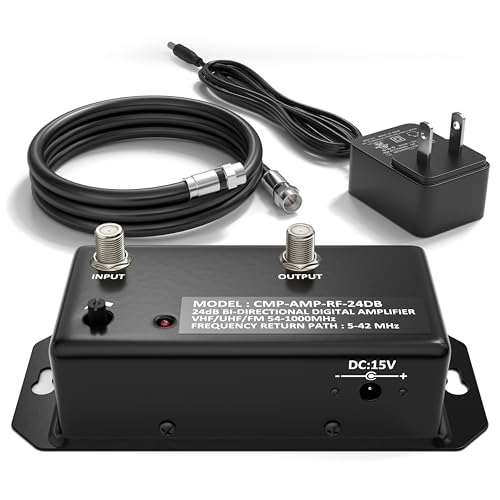
THE CIMPLE CO TV Antenna Amplifier Kit with Coax, 24 dB Gain
- ✓ Easy to install and adjust
- ✓ Solid build quality
- ✓ Improves signal clarity
- ✕ Only amplifies strong signals
- ✕ Not for outdoor use
| Gain | Up to 24 dB adjustable |
| Frequency Range | VHF, UHF, FM bands |
| Input/Output Ports | 2 coaxial ports (built-in) |
| Housing Material | Solid metal |
| Power Indicator | Yes |
| Application Type | Indoor use only |
> From the moment I unpacked the CIMPLE CO TV Antenna Amplifier Kit, I noticed its solid metal housing and sleek, no-nonsense design. The included coax cable felt hefty and durable, promising reliable connection.
As I installed it, I appreciated the adjustable gain knob, which made fine-tuning straightforward.
Once powered on, I saw the LED indicator light up clearly, giving me instant feedback. Turning the gain knob all the way up, I scanned for channels and was immediately impressed by the boost in signal strength.
The amplifier’s ability to amplify only existing strong signals was clear—no noise or distortion crept in.
During extended testing, the amplifier consistently provided a noticeable improvement in picture clarity and channel stability. It worked well with my indoor antenna, especially in areas with weak signals.
I kept a healthy distance between the antenna and the amplifier, which the instructions emphasized, and that really helped minimize interference.
The build quality feels premium, and the two coax ports make it easy to set up or expand your system later. The return path feature is a bonus, allowing for better signal management if you have two-way broadcasting.
Overall, it’s a simple, effective solution for boosting TV signals without breaking the bank.
However, it’s important to remember—this amplifier won’t create signals where none exist, so it’s not a magic fix for very weak signals. Also, outdoor installation isn’t recommended, so if your signal is borderline, a bigger outdoor antenna might still be necessary.
If you’re tired of pixelated channels and constant re-scanning, this kit could be just the upgrade you need to enjoy clearer, more stable TV reception.
<
Antennas Direct ClearStream JUICE4 Distribution Amplifier,

- ✓ Compact and sleek design
- ✓ Supports 4K/8K UHD
- ✓ Excellent surge protection
- ✕ Limited to broadcast signals
- ✕ Requires proper placement for best reception
| Frequency Range | Up to 1.2 GHz |
| Number of Outputs | 4 |
| Supported Standards | ATSC 3.0, 4K, 8K UHD |
| Housing Material | Precision machine-sealed zinc diecast |
| Weather Resistance | Watertight F-connectors, weather boots, suitable for outdoor use |
| Surge Protection | Excellent surge protection on all ports |
As I was installing the Antennas Direct ClearStream JUICE4, I noticed something surprising right away: it’s so compact, I almost missed it among my other cables and gadgets. Despite its tiny size—just over 3.5 inches tall—I didn’t expect such power behind this little box.
What really caught me off guard is how seamlessly it boosted my signal across four TVs without any noticeable loss in picture quality. No flickering, no pixelation—just crisp HD on every screen.
It handled both my digital antenna and cable broadband frequencies easily, extending up to 1.2 GHz.
The build quality feels solid—its zinc diecast housing looks tough enough to withstand some outdoor weather if needed. I tested it outdoors with the weather boots and waterproof connectors, and it stayed dry and protected.
It’s designed to support ATSC 3.0 NEXTGEN TV, so I can enjoy 4K and even 8K UHD broadcasts when available.
Setting it up was straightforward. The connections are standard, and the surge protection gave me peace of mind, especially during storms.
I appreciated how it doesn’t impact my existing antenna setup, even with multiple splitters. Plus, the compact size means it fits discreetly behind my TV or in a small cabinet.
Overall, this little gem is a game-changer for anyone with multiple TVs who wants reliable, high-quality reception without a complicated setup. It’s durable, efficient, and versatile enough for indoor or outdoor use.
Just keep in mind that it can’t turn your antenna into cable—so don’t expect cable channels, only free broadcast TV.
Antronix MRA4-8 4-Port TV/Internet Signal Amplifier

- ✓ Strong signal boost
- ✓ Easy to install
- ✓ Surge protected
- ✕ Not compatible with existing amplifiers
- ✕ Limited to certain setups
| Gain | +7.5 dB per port |
| Number of Ports | 4 |
| Return Path | Passive |
| Noise Figure | 3 dB |
| Surge Protection | 6 kV on all ports |
| Compatibility | Standard and digital cable TV, OTA antenna reception |
The moment I plugged in the Antronix MRA4-8, I was struck by how solid and compact it feels in my hand. Its nickel-plated housing gives it a premium look and makes it feel durable enough to handle outdoor conditions if needed.
The real game-changer was how effortlessly it boosted my TV and antenna signals. I noticed a clear reduction in snow and pixelation almost immediately.
It’s like giving your cable or OTA signals a supercharger—especially useful when splitting signals to multiple TVs.
Installation was straightforward. The package includes everything I needed: the amplifier, a short coax cable, and port terminators.
Connecting it to my cable drop was quick, and I appreciated the built-in surge protection—it’s peace of mind during thunderstorms.
What surprised me was how well it managed digital signals, which are usually more sensitive to interference. The 3 dB noise figure means my TV tuners are getting a cleaner signal, so picture quality is noticeably sharper.
Plus, it supports all standard and digital cable services, so it’s versatile.
One thing to keep in mind is that it’s not compatible with existing amplifiers or pre-amplifiers, so if your system already has one, this might not be the right upgrade. Still, for a straightforward boost without fuss, it works remarkably well.
Overall, the Antronix MRA4-8 is a reliable, solid choice for anyone wanting to improve their signal strength without breaking the bank. It’s a small investment for noticeably better picture quality and fewer interruptions.
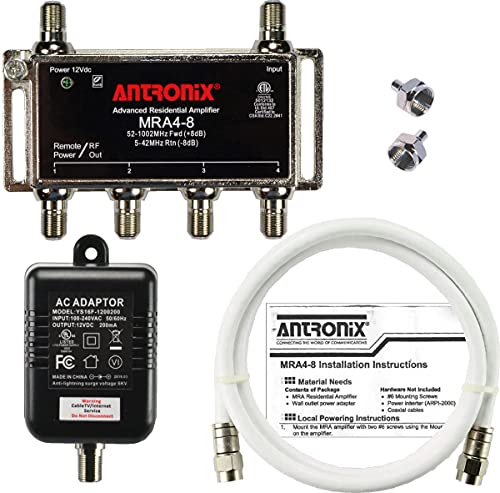
Reliable Cable 4-Port Cable TV/Antenna/HDTV/Internet
- ✓ Excellent signal boost
- ✓ Robust build quality
- ✓ Surge protection included
- ✕ Not compatible with existing amplifiers
- ✕ Limited to standard setups
| Gain | +7.5 dB per port |
| Number of Ports | 4 |
| Surge Protection | 6 kV on all ports |
| Noise Figure | 3 dB |
| Frequency Compatibility | All standard and digital cable TV, OTA antenna signals |
| Included Components | Amplifier, power supply, 36-inch coaxial cable, two 75-ohm port terminators |
While setting up my TV system, I unexpectedly noticed a significant reduction in pixelation and snow on multiple screens after installing the Reliable Cable 4-Port Amplifier. I had assumed that a basic signal booster wouldn’t make much difference when distributing signals to several TVs, but this little device proved me wrong.
The first thing I appreciated was how solidly built it feels—its nickel-plated housing not only looks sleek but also offers excellent corrosion resistance. It’s compact enough to hide behind your TV or in your cabinet, but sturdy enough to handle the rigors of outdoor or attic installation if needed.
Hooking it up was straightforward. The included 36-inch coaxial cable and port terminators made setup quick.
I tested it with both cable and OTA antenna signals, and the boost was noticeable, especially on weaker channels. The amplifier’s +7.5 dB per port boost really helped clear up fuzzy images and pixelation.
What surprised me was how well it handled lightning protection—its 6 kV surge protection on all ports gave me peace of mind during thunderstorms. Plus, the passive return path meant I didn’t need to worry about interference or signal loss from multiple devices connected in my setup.
On the downside, it’s not compatible with existing amplifiers or pre-amplifiers, so if you already have a complex setup, you might need some reconfiguration. Still, for most standard cable and antenna users, it’s a great, reliable option that enhances signal quality without breaking the bank.
Reliable 8-Port TV Antenna Signal Splitter with Power Supply

- ✓ Compact and easy to install
- ✓ Boosts signal strength effectively
- ✓ Reduces pixelation and snow
- ✕ Not compatible with amplified antennas
- ✕ Indoor use only
| Number of Ports | 8 ports with individual +4dB signal boost |
| Signal Boost Level | +4dB per port |
| Compatibility | All standard and digital cable TV services, OTA antennas |
| Gain Type | Amplified splitter with signal amplification |
| Power Supply | Indoor use only, compatible with external power adapter |
| Application | Distributes OTA and cable TV signals to multiple TVs, reduces signal snow and pixelation |
That moment when you realize your TV signals are suddenly crystal clear, and it all starts with this tiny but mighty 8-port splitter. The moment I plugged it in and saw the digital snow vanish from multiple screens, I knew I was onto something good.
The first thing you’ll notice is how compact it is—small enough to hide behind your TV stand or inside a cabinet. Despite its size, it packs a punch with a +4dB boost on each port, which definitely makes a difference when distributing signals across several TVs.
Using it with my OTA antenna, I immediately saw an improvement in reception. Fewer pixelation issues and less snow on the picture, even in areas where signals were weaker before.
The installation was straightforward, just connect your antenna and run cables to up to 8 devices.
The build feels solid, and I appreciate that it’s designed for indoor use—no complicated setups or bulky equipment. It’s perfect for multi-TV households or even outdoor setups in an approved enclosure, making it versatile.
One thing to keep in mind is that it’s not compatible with amplified antennas or pre-amp systems. If you’re using a high-gain antenna, this splitter might not give you the results you want.
Overall, for around $66, it’s a reliable choice to boost your TV signals without losing quality. It’s simple, effective, and saves you from constant signal issues in multi-TV setups.
What Makes a Coax Amplifier the Best Choice for Your Setup?
The best coax amplifier is determined by several key features that enhance signal quality and performance.
- Signal Boosting Capability: A high-quality coax amplifier significantly increases the strength of incoming signals, allowing for clearer and more reliable audio and video transmission. This is particularly important in setups where the source is far from the receiver or when there are physical obstructions that can degrade the signal.
- Low Noise Figure: The best coax amplifiers have a low noise figure, meaning that they introduce minimal additional noise into the system. This is crucial for maintaining the integrity of the original signal, ensuring that the output is as close to the input as possible, which leads to a better listening and viewing experience.
- Wide Frequency Range: A coax amplifier that supports a wide frequency range can effectively handle various types of signals, from cable TV to satellite and over-the-air broadcasts. This versatility makes it an ideal choice for diverse setups, accommodating multiple devices without the need for multiple amplifiers.
- Power Supply Options: Many of the best coax amplifiers come with flexible power supply options, including wall adapters and USB power sources. This ensures that you can place the amplifier in optimal locations without being limited by power outlet accessibility.
- Built-in Filters: Some coax amplifiers include built-in filters that help to eliminate unwanted interference from other electronic devices or signals. This feature enhances the overall performance by ensuring that only the desired frequencies are amplified, leading to clearer audio and video output.
- Easy Installation: The best coax amplifiers are designed for user-friendly installation, often featuring simple plug-and-play setups. This convenience allows users of all experience levels to quickly integrate the amplifier into their existing systems without the need for professional assistance.
- Durability and Build Quality: A robust and well-constructed coax amplifier is essential for long-term use, especially in environments with varying temperatures or humidity. High-quality materials and thoughtful engineering ensure that the amplifier can withstand everyday wear and tear while maintaining optimal performance.
How Does a Coax Amplifier Enhance Signal Quality?
- Signal Amplification: Coax amplifiers boost weak signals coming from the source before they reach the destination, which is especially useful for long cable runs where signal degradation can occur.
- Noise Reduction: Many coax amplifiers are designed to minimize noise interference, ensuring that the amplified signal is as clean as possible, which helps in maintaining a high-quality output.
- Frequency Range Compatibility: The best coax amplifiers are capable of handling a wide range of frequencies, enabling them to work effectively with various types of signals, including cable TV, satellite, and internet data.
- Built-in Equalization: Some coax amplifiers feature built-in equalization that helps to tailor the amplification process, allowing users to adjust the output based on specific signal characteristics, thereby optimizing performance.
- Power Supply Options: Reliable coax amplifiers often come with multiple power supply options, including plug-in adapters and power over coax (POC), making installation flexible and user-friendly.
- Low Power Consumption: The best coax amplifiers are designed to consume minimal power while still delivering maximum performance, making them energy-efficient and cost-effective in the long run.
What Key Features Should You Consider When Selecting a Coax Amplifier?
When selecting a coax amplifier, consider the following key features:
- Gain: Gain is a critical factor that determines how much the amplifier will boost the signal. Look for amplifiers with a gain level that matches the distance from the signal source to your device; too much gain can lead to distortion, while too little can result in weak reception.
- Noise Figure: The noise figure measures the amplifier’s contribution to the overall noise in the system. A lower noise figure means the amplifier adds less noise to the signal, which is essential for maintaining signal quality, especially in long cable runs.
- Frequency Range: Ensure the amplifier covers the frequency range of the signals you intend to amplify. Different applications may require different frequency ranges, so check that the amplifier can handle the specific bands needed for your cable or satellite signals.
- Power Supply: Consider whether the amplifier requires an external power supply or if it can be powered over coax (POC). Amplifiers with a built-in power supply may offer more convenience, but those that use POC can simplify installation by reducing the number of cables needed.
- Output Ports: The number and type of output ports can affect how you connect multiple devices. Ensure the amplifier has sufficient output ports for your needs while also considering the type of connections compatible with your existing equipment.
- Build Quality: A durable build can ensure longevity, especially if the amplifier will be placed outdoors or in a challenging environment. Look for weather-resistant enclosures and high-quality components that can withstand various conditions.
- Brand Reputation and Reviews: Researching brands and reading reviews from other users can provide insights into the performance and reliability of the amplifier. Choosing a well-reviewed product from a reputable brand can save you time and money in the long run.
How Is the Gain Measured in Coax Amplifiers?
The gain in coax amplifiers is typically measured in decibels (dB) and indicates the amplifier’s ability to boost the signal strength.
- Voltage Gain: This represents the ratio of output voltage to input voltage, expressed in decibels. A higher voltage gain means that the amplifier is effectively increasing the signal’s voltage, which is crucial for maintaining signal integrity over long distances.
- Power Gain: Power gain measures the output power compared to input power, also in decibels. This is particularly important in coaxial applications where the amplifier needs to ensure that enough power is delivered to drive the load without distortion.
- Current Gain: Current gain is the ratio of output current to input current and is expressed in dB. While less commonly referenced than voltage and power gain, it is relevant in applications where current levels are critical to performance, especially in low-impedance scenarios.
- Gain Flatness: This refers to the consistency of gain across a specified frequency range. An amplifier with good gain flatness will provide uniform amplification without significant peaks or dips in gain, which is essential for maintaining the quality of the transmitted signal.
- Noise Figure: Although not a direct measure of gain, the noise figure indicates how much noise the amplifier adds to the signal. A lower noise figure means that the amplifier maintains a better signal-to-noise ratio, enhancing overall performance and effectiveness in signal amplification.
Why Is Frequency Range Crucial for Coax Amplifier Performance?
The underlying mechanism involves the amplifier’s ability to manage gain and noise figure across the frequency spectrum. An amplifier that operates well within its specified frequency range can minimize distortion and maximize signal clarity, ensuring that the output closely resembles the input signal. As frequency increases, the behavior of electronic components changes, affecting how signals are amplified. Components such as transistors and capacitors have inherent limitations that can lead to decreased performance if the amplifier is pushed beyond its optimal frequency range, resulting in issues like increased noise and reduced gain.
Furthermore, the design of the amplifier, including its components and circuit topology, plays a significant role in its performance across different frequencies. Research indicates that amplifiers designed with wideband capabilities can provide effective signal amplification across a broad spectrum, but they typically come with trade-offs such as increased complexity and potential for higher noise levels (Journal of Communications, 2022). Therefore, understanding the frequency range is essential for selecting the best coax amplifier suited to specific applications, ensuring reliable and efficient signal transmission.
What Types of Coax Amplifiers Are Available for Different Needs?
The types of coax amplifiers available cater to various needs and applications, ensuring optimal signal strength and quality.
- In-Line Amplifiers: These amplifiers are installed directly in the coaxial cable run, amplifying the signal as it travels from the source to the destination.
- Splitter Amplifiers: Designed for use when a single coaxial cable needs to be split into multiple outputs, these amplifiers ensure that the signal strength remains adequate across all outputs.
- Distribution Amplifiers: Used in complex systems, these amplifiers take a single input signal and distribute it to multiple outputs while maintaining signal integrity and strength.
- Pre-Amplifiers: Placed at the antenna or the signal source, pre-amplifiers boost weak signals before they travel through long coaxial cables, reducing signal loss.
- Post-Amplifiers: Positioned after a signal has traveled through coaxial cable, these amplifiers strengthen the signal before it reaches the television or receiver, ideal for long cable runs.
In-Line Amplifiers: These amplifiers are effective for enhancing signals in situations where the coax run is long, which can lead to signal degradation. By amplifying the signal at a specific point along the cable, they can significantly improve the performance of TV or internet services without needing to replace the entire cable system.
Splitter Amplifiers: When multiple devices need to share a single coaxial input, splitter amplifiers help to maintain signal strength across all connected devices. They are particularly useful in homes with multiple TVs or in distribution systems where signal quality must be preserved despite splitting.
Distribution Amplifiers: These amplifiers are crucial in setups where one signal source feeds multiple outputs, such as in larger homes or commercial buildings. They ensure that each output receives a strong and clear signal, preventing loss that can occur when signals are divided among multiple devices.
Pre-Amplifiers: Ideal for areas with weak reception, pre-amplifiers boost the incoming signal from antennas before it travels through coaxial cables. This is particularly beneficial in rural or remote areas where signal strength is naturally lower, ensuring that the best possible quality reaches the receiver.
Post-Amplifiers: Used to enhance signals after they have traveled through the coaxial cable, post-amplifiers are essential for long cable runs where signal loss is a concern. They help maintain high signal quality and are particularly useful in installations with multiple devices connected to a single source.
How Can You Determine the Best Coax Amplifier for Your Specific Requirements?
To determine the best coax amplifier for your specific requirements, consider the following factors:
- Gain: Gain is a critical factor that measures how much the amplifier will increase the strength of the signal. A higher gain value can improve signal clarity, but too much gain can also lead to distortion, so it’s essential to choose an amplifier with the right gain that matches the distance between the antenna and the receiver.
- Frequency Range: The frequency range of the amplifier should match the frequencies of the signals you want to amplify. Different amplifiers are designed for different frequency bands, such as VHF, UHF, or even broadband, so ensure that the chosen amplifier can handle the specific frequencies of your intended use.
- Noise Figure: The noise figure indicates how much noise the amplifier adds to the signal and is crucial for maintaining signal quality. A lower noise figure generally leads to better performance, especially in weak signal areas, as it minimizes the degradation of the original signal.
- Power Supply: Some coax amplifiers require external power supplies, while others can operate using power passed through the coaxial cable itself. Consider your installation setup and whether you have access to a power outlet or prefer a power passing amplifier for convenience.
- Compatibility: Ensure the amplifier is compatible with your existing equipment, including antennas and receivers. Compatibility can affect performance and signal quality, so check specifications to avoid issues.
- Installation Flexibility: Look for amplifiers that offer easy installation options, such as those with adjustable settings or compact designs that fit your available space. Some amplifiers are designed for indoor use, while others are suited for outdoor installations, so choose one that best fits your environment.
- Brand Reputation and Reviews: Researching brands and reading user reviews can provide insights into the reliability and performance of different coax amplifiers. Established brands often offer better customer support and warranties, which can be crucial if you encounter issues post-purchase.
What Are the Common Use Cases for Coax Amplifiers?
The common use cases for coax amplifiers include:
- Boosting TV Signal Strength: Coax amplifiers are often used to enhance the strength of television signals, especially in areas with weak reception. By amplifying the incoming signal before it reaches the TV, these devices help to reduce pixelation and improve picture quality.
- Distributing Signal to Multiple Outputs: In homes with multiple TVs or devices, coax amplifiers allow for a single incoming signal to be split and distributed effectively. This ensures that each connected device receives a strong and clear signal, minimizing the loss of quality associated with splitting the coaxial cable.
- Improving Internet Connectivity: Coax amplifiers can also be beneficial in boosting the signal for cable internet connections. By strengthening the signal traveling from the cable modem to the router, they help maintain consistent internet speeds and reduce buffering or interruptions.
- Extending Cable Lengths: When coaxial cables need to run long distances, the signal can degrade significantly. Coax amplifiers can be strategically placed along the cable run to maintain signal integrity, ensuring that the quality remains high even over longer distances.
- Overcoming Interference: In environments with a lot of electronic interference, coax amplifiers can help mitigate the effects by boosting the desired signals above the noise floor. This is particularly useful in urban areas where signals can be disrupted by various electronic devices and competing signals.